
12-Inch 2000 CFM Solar Attic Fan
4.5Editor score
Up to 2000 CFM airflow
Heavy-duty copper motor
Hail-resistant metal housing
Controller-free solar operation
A solar vent fan for shed can remove trapped heat, humidity, dust, and stale odors without requiring a nearby electrical outlet. The right model depends on shed size, available sunlight, fan diameter, nighttime needs, and whether you want automatic or manual controls.
This comparison evaluates ten solar-powered ventilation kits by airflow, solar-panel output, motor and housing construction, weather resistance, noise, power options, installation requirements, and animal-safety features. It covers compact fans for pet houses and chicken coops as well as higher-output systems for garages, workshops, barns, and larger sheds.
Each pick reveals a different balance of capacity, convenience, and resilience, from direct-sunlight models to battery-backed and thermostat-controlled systems. Product ratings and availability can change over time, so readers should verify the latest listing details, included accessories, and current price before purchasing.
4.5Editor score

4.8Editor score

3.9Editor score
As an Amazon Associate we earn from qualifying purchases.
The comparison below highlights the major differences among ten solar ventilation kits, including fan size, airflow, power configuration, weather rating, controls, and intended applications.

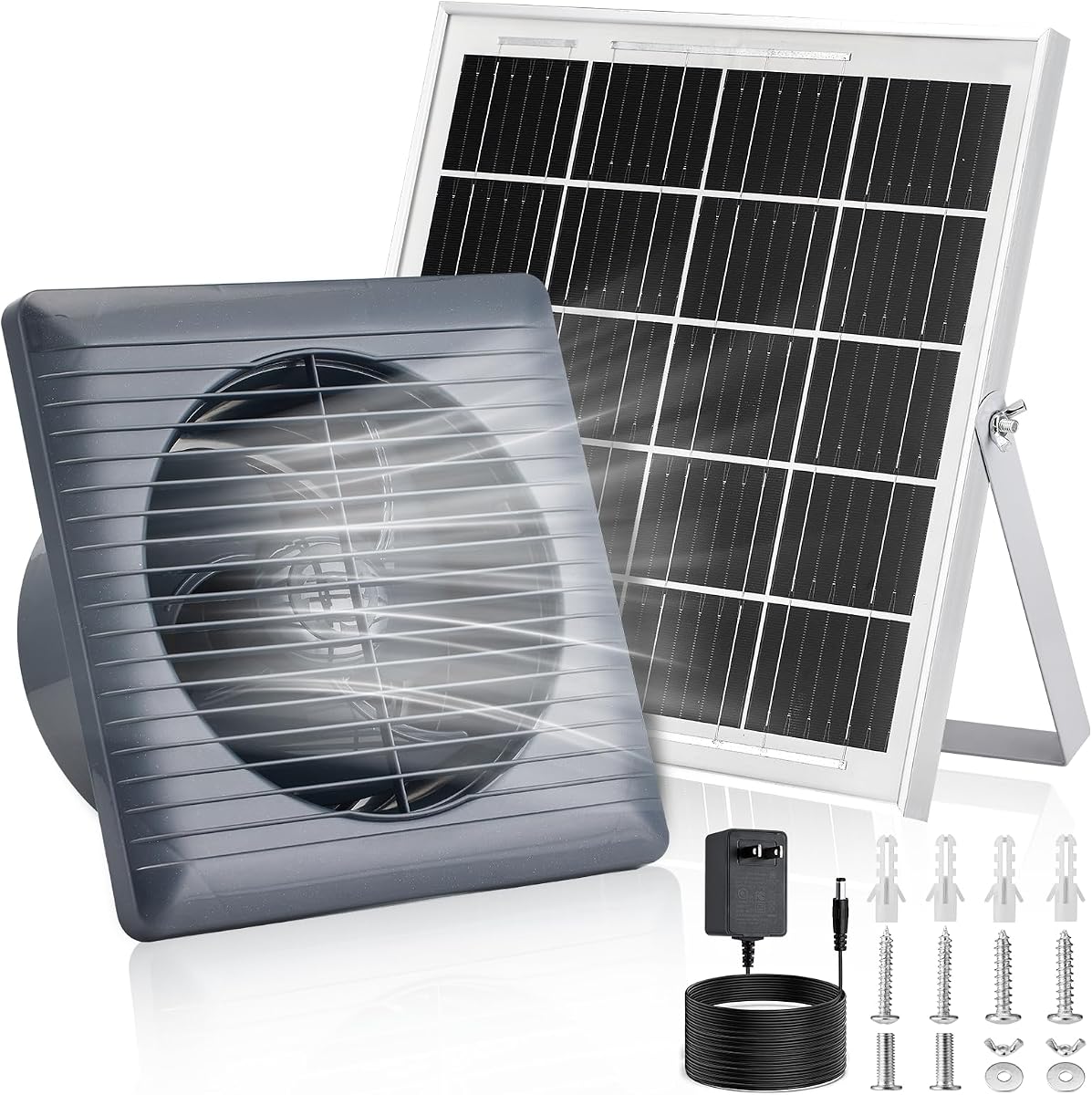




The HG Power 12-inch Solar Powered Exhaust Fan combines the strongest feature set in this guide with a 4.8 rating. It is designed for buyers who want more than simple daylight operation, offering a temperature-controlled 12-inch shutter fan, a 40W bifacial solar panel, and backup operation through an included AC adapter.
We may earn a commission when you buy through this link, at no additional cost to you.
Its standout strength is automatic control. Energy Saving mode varies fan speed with available sunlight, while Performance mode provides four speed settings when the adapter supplies power. A selectable target temperature from 68 to 113 degrees Fahrenheit automatically starts and stops the fan, and a ten-minute delay after the target is reached helps avoid rapid on-and-off cycling.
The 12-inch fan delivers 764 CFM, making it a meaningful upgrade from the compact units intended for small coops, pet houses, and garden sheds. The installation kit includes the smart controller and temperature probe, AC/DC adapter, panel, shutter fan, mounting bracket, screws, cables, and manual. It is also more complex than direct-solar models because of the probe, controller, wiring, and thermostat setup.
This is the strongest all-around recommendation for a medium or large shed, workshop, garage, basement, sunroom, or greenhouse where temperature management matters. Choose it when automatic control, nighttime backup, and serious airflow justify a more involved installation. For a tiny enclosure or a simple exhaust opening, one of the smaller kits will be easier to place.
The thermostat lets the fan react to the selected temperature rather than relying on a fixed schedule. The ten-minute shutdown delay also reduces unnecessary cycling, making the controller particularly useful in spaces that heat up unevenly.
The 40W bifacial panel can collect sunlight from both sides, while the included adapter keeps the system operating when sunlight is weak or absent. This arrangement offers more consistency than a fan that stops entirely after sunset.
We may earn a commission when you buy through this link, at no additional cost to you.
This 8-inch Solar Exhaust Fan earns a 4.1 rating and offers a balanced combination of airflow, quiet operation, and installation flexibility. Its 25W monocrystalline solar panel, 430 CFM airflow, and 2,300 RPM motor make it a practical choice for small sheds, chicken coops, greenhouses, pet houses, and similar enclosed structures.
We may earn a commission when you buy through this link, at no additional cost to you.
The package supports both daylight operation and continuous household-powered ventilation. A 16.4-foot solar cable provides placement flexibility, while the included power adapter allows the fan to continue operating at night or during poor weather. An anti-backflow valve with an internal iron block remains closed when the fan stops, helping keep insects and outside animals from entering.
The fan is designed to move excess heat, moisture, dust, and odors, improving circulation without requiring a conventional electrical connection. Installation involves drilling a seven-inch hole, securing the fan with the included bracket, connecting the panel, and selecting the desired mode with a separate on/off switch. This is straightforward compared with thermostat-based systems, although drilling and weatherproofing the opening still require care.
This model suits buyers who want substantial airflow without the complexity of a digital controller. It is especially attractive for a shed where daytime ventilation is usually enough but power is available when continuous operation is needed. It may feel oversized for a tiny pet house, while larger or poorly ventilated buildings may need a more powerful fan.
Because the same fan can use either the solar panel or the included adapter, owners can reduce daytime energy use without abandoning ventilation after dark. It does not store solar energy, but it can be switched to household power whenever continuous airflow is needed.
The anti-backflow valve is a meaningful detail for coops, pet areas, and sheds where insects or debris could enter through an open vent. It helps keep airflow directed outward whenever the fan is running.
We may earn a commission when you buy through this link, at no additional cost to you.
This Solar Powered Exhaust Fan has a 4.0 rating and emphasizes efficient, quiet ventilation in an 8-inch format. Its 25W monocrystalline panel, 430 CFM airflow, and brushless motor are well suited to chicken coops, pet houses, greenhouses, garden sheds, RVs, and other small outdoor enclosures.
We may earn a commission when you buy through this link, at no additional cost to you.
The product description gives a useful space recommendation of approximately 100 to 250 square feet, while noting that actual performance varies with enclosure height, sunlight, and airflow resistance. The 36-decibel brushless motor reduces noise and vibration, making the fan less disruptive around animals or nearby living areas.
Installation uses an adjustable panel bracket, a 16.4-foot panel cable, a 4.9-foot adapter cord, and an installation hole sized for the fan. The panel has an IP67 rating, while the fan housing is rated IP44. An anti-backflow valve helps restrict insects and debris when the unit stops. Because it lacks a battery, it stops when direct power is unavailable unless connected to the adapter.
This is a good choice for owners who want a clear balance of airflow and low operating noise. The stated coverage guidance makes it easier to match to a shed than vague high-output claims, but buyers with a very small enclosure should consider a 6-inch alternative. Buyers needing nighttime solar operation should also consider a battery-backed model.
Rather than treating every shed as a universal application, this product provides a recommended area of roughly 100 to 250 square feet. That makes it easier to judge whether the 430 CFM output will be useful rather than excessive.
The brushless motor is designed to reduce vibration and noise while supporting smooth operation. At 36 decibels, it is particularly relevant for coops and pet houses where constant background noise can be undesirable.
We may earn a commission when you buy through this link, at no additional cost to you.
The HG Power 12-inch model is a sophisticated shed ventilation solution rated 4.8 by customers. It combines a 764 CFM shutter fan with a 40W bifacial solar panel, a smart temperature controller, and an AC adapter so the space can remain ventilated even when sunlight is limited.
We may earn a commission when you buy through this link, at no additional cost to you.
Two operating modes provide practical control. Energy Saving mode changes speed with sunlight, while Performance mode allows adjustment from one to four when the adapter is connected. Owners can set a target between 68 and 113 degrees Fahrenheit, and the fan starts when the temperature exceeds the target.
After the temperature falls below the selected level, the fan remains active for ten minutes before shutting down. The manufacturer describes this as a protective measure intended to reduce frequent cycling, so it should not be mistaken for a fault. This behavior, along with the probe and wired controller, adds complexity but gives more precise management than a basic on/off switch.
The fan is well suited to workshops, barns, basements, sunrooms, garages, greenhouses, chicken coops, and attics. It is a particularly compelling pick for larger sheds where temperature changes are substantial and a simple daylight fan may stop at the wrong time. The extensive included accessories also reduce the need to source extra parts separately.
Rather than depending on the owner's judgment throughout the day, the controller can start and stop the fan according to the selected target. This offers convenience in sheds where consistent ventilation is important.
The controller, probe, panel, adapter, shutter fan, brackets, screws, and connecting cables are supplied together. Buyers should still verify dimensions, wiring routes, and opening size against the manual before cutting into a wall or roof.
We may earn a commission when you buy through this link, at no additional cost to you.
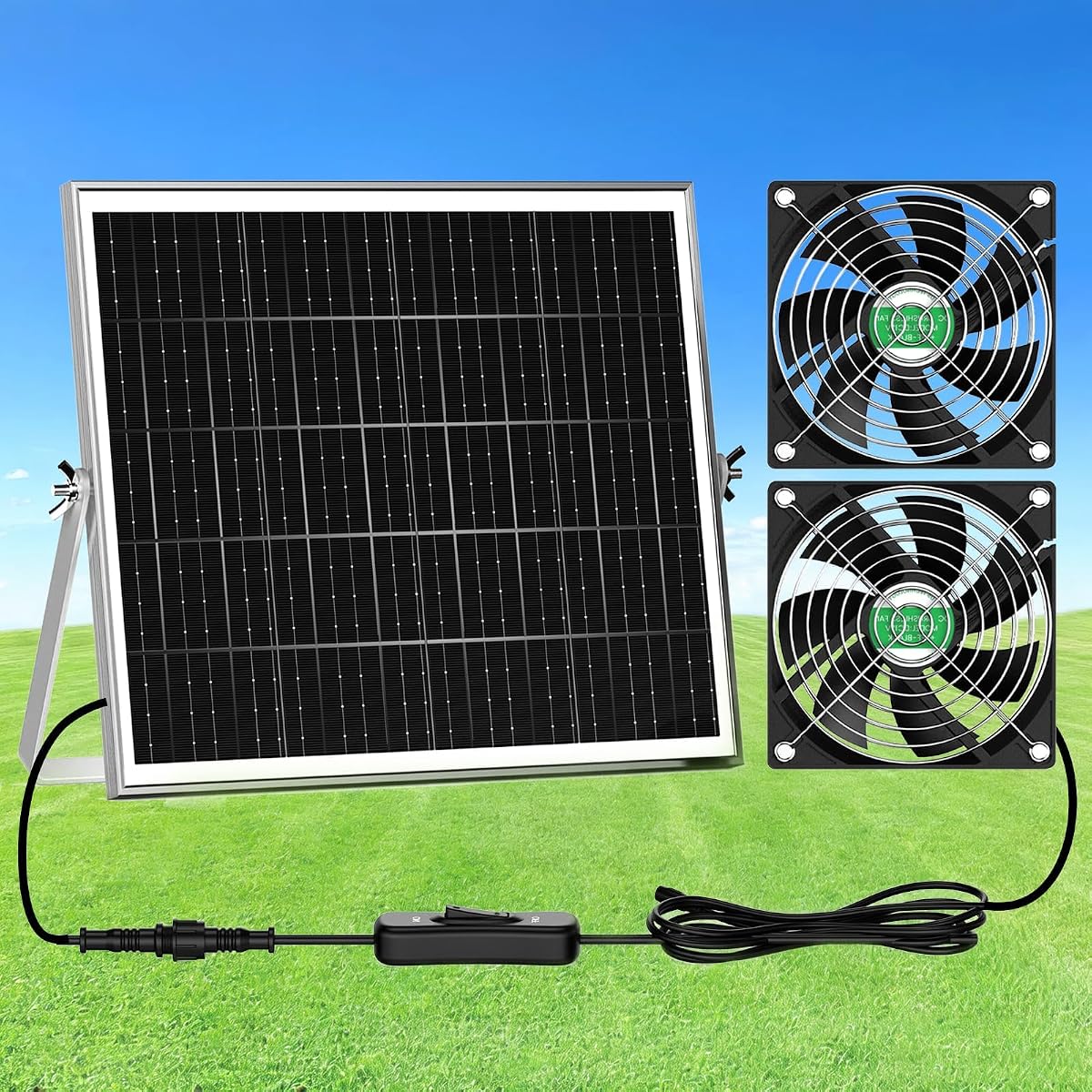
This 30W Solar Panel Fan Kit has a 3.9 rating and focuses on straightforward ventilation for small greenhouses, coops, sheds, pet houses, and window openings. Its dual-fan design is intended to exhaust hot air while supporting fresh-air circulation, with airflow naturally increasing under stronger sunlight.
We may earn a commission when you buy through this link, at no additional cost to you.
The kit avoids unnecessary complexity. It has no on/off switch, no speed selector, and no battery, meaning it operates automatically when the panel receives bright sunlight. This makes it straightforward to install and suitable for owners who prefer the fan to respond automatically rather than manage a timer or thermostat.
A 2,300- to 3,000-square-foot shed may be more than this compact kit can effectively ventilate, so the product is better aligned with small structures. The solar panel and fan use waterproof plug-and-play connectors, while pre-drilled holes simplify mounting on a wall or roof. A double-layer metal protective mesh helps protect people, pets, small animals, and the blades.
The main limitation is that the fan cannot continue at night without direct sunlight, and it must be placed where the panel can receive strong light. Despite that limitation, it is a useful low-complexity option for a small shed, greenhouse, or animal house where daytime ventilation is the main objective.
Because the kit has no manual controls, its output naturally follows available sunlight. This can reduce the need for intervention, although it also means airflow falls during cloudy periods and stops after sunset.
The double-layer metal mesh is especially useful where animals or people may approach the moving blades. It supports safer placement in small coops and pet houses without adding a complicated latch or control system.
We may earn a commission when you buy through this link, at no additional cost to you.
This Compact 6-inch Solar Exhaust Fan has a 4.1 rating and is specifically designed for enclosures under 30 square feet. It suits rabbit hutches, chicken coops, pet houses, mini sheds, and other small spaces where an 8-inch model could overwhelm the available opening or airflow path.
We may earn a commission when you buy through this link, at no additional cost to you.
Despite its smaller frame, the fan produces up to 380 CFM at 2,300 RPM. A brushless motor keeps operating noise at no more than 28 decibels, making it one of the quietest options in the guide. That lower noise level is particularly helpful near rabbits, small pets, or people who use an adjoining work area.
The 25W monocrystalline panel reaches a stated conversion rate of 21.5 percent and is protected by tempered glass, an aluminum frame, and an IP67 waterproof rating. The package also includes a 16.4-foot solar cable and a 4.66-foot AC adapter, allowing solar daytime use or household-powered operation when continuous ventilation is needed.
Installation requires a 5.6-inch hole, a bracket for the panel, and an independent on/off switch. An anti-backflow valve helps restrict outside insects and debris when the fan is off. This is the most compelling pick for a mini shed or pet enclosure, while shoppers with a medium shed should favor a larger 8-inch model.
The recommended area of under 30 square feet helps prevent a mismatch between fan output and enclosure size. A compact model can provide meaningful circulation without occupying an oversized vent opening.
At no more than 28 decibels, the motor is designed for spaces where fan noise would be distracting. The brushless design also supports smoother operation and long-term durability.
We may earn a commission when you buy through this link, at no additional cost to you.
The 25W Metal Solar Powered Fan holds a 4.4 rating and stands out for its rugged frame, built-in battery, and broad outdoor operating range. It is a practical alternative for sheds and coops that need ventilation after sunset without requiring a household outlet.
We may earn a commission when you buy through this link, at no additional cost to you.
Its 18,000mAh battery stores energy generated by the 25W solar panel, allowing operation on cloudy days or at night. A 16.4-foot waterproof cable gives owners flexibility to position the panel in direct sunlight while placing the fan near the best exhaust opening. Pre-drilled holes and included screws simplify mounting on walls, roofs, or windows.
The metal frame is described as more resistant to corrosion and long-term outdoor wear than plastic construction. An IP65 waterproof rating, steel mesh guard, and stated temperature range of 5 to 140 degrees Fahrenheit reinforce its outdoor orientation. The protective mesh is valuable in animal areas where the fan may be within reach.
This is a good fit for chicken coops, greenhouses, pet houses, barns, sheds, RVs, and attics where dependable off-grid ventilation matters. It does not list a thermostat, timer, or speed control, so it is simpler than intelligent systems but offers less control. Buyers should also consider the battery's charging time and expected runtime under local weather conditions.
The built-in battery distinguishes this model from direct-solar competitors. It allows the fan to run after sunset, making it a stronger option for locations where overnight heat or poor airflow is a recurring concern.
A metal frame, steel guard, and IP65 rating support use in exposed outdoor installations. These features are particularly relevant for barns, coops, and sheds where plastic components would face constant weather and temperature changes.
We may earn a commission when you buy through this link, at no additional cost to you.
This 5.5-inch Two-Fan Solar Kit has a 4.2 rating and provides an adaptable solution for greenhouses, chicken coops, sheds, pet houses, attics, camping areas, and windows. The detachable fan and panel can be positioned independently, giving the owner flexibility in how the system is installed.
We may earn a commission when you buy through this link, at no additional cost to you.
The package can be configured for exhaust or intake, and the included hardware supports wall, roof, or upright panel placement. It includes mounting plates, screws, nylon ties for pole hanging, and a plug-and-play cord. A switch on the fan cable provides manual control, which is helpful when conditions require a different operating state than automatic sunlight response.
The system reaches 3,200 RPM in equivalent sunlight and is intended for spaces around 130 square feet. Its heavy-duty aluminum construction, IP67 solar panel, and dual metal protective nets support outdoor use. A stated lifespan of up to five years is also included in the product information, although actual longevity depends on installation and conditions.
This kit is a good choice for a small shed owner who wants two fan units and several mounting methods. Its lack of a battery means output depends on daylight, so it is less suitable where ventilation must continue throughout the night. The smaller fan size and recommended area also make it better for compact structures than full workshops or garages.
The detachable arrangement allows the fan to be oriented for exhaust or intake, and the panel can sit separately in optimal sunlight. This flexibility is useful where fresh-air entry and hot-air removal need different mounting positions.
Brackets, mounting plates, screws, nylon ties, and a plug-and-play cord cover several common installation scenarios. The included options make the kit adaptable to a wall, roof, upright support, or pole.
We may earn a commission when you buy through this link, at no additional cost to you.
The 40W Solar Attic Fan is the highest-output choice in this comparison, with a 4.5 rating and airflow of approximately 1,800 to 2,000 CFM. Its 12-inch metal blades and 40W panel are aimed at attics, garages, workshops, barns, greenhouses, and larger sheds where substantial volumes of hot air need to be removed.
We may earn a commission when you buy through this link, at no additional cost to you.
The controller-free design is intentionally simple. Solar power activates the fan at sunrise and ends operation at dusk, eliminating thermostat wiring and complex controls. The panel and fan arrive preconnected, which can reduce setup time, although the larger components still require secure structural mounting.
Durability is a major selling point. The product includes a hail-resistant metal housing, a heavy-duty pure copper motor, and an IP65 weather-resistant design. Its managed sound level is described as comparable to a quiet conversation, providing a balance between the power needed for high airflow and the desire to avoid excessive hum.
This is the appropriate pick for a large shed, workshop, garage, or attic with restricted or hot conditions. It offers more capacity than every other model here but lacks a thermostat and battery, so it stops after dark unless paired with another power arrangement. Small pet houses and garden sheds would gain little from its scale.
The 1,800 to 2,000 CFM output is the key advantage for larger or poorly ventilated spaces. It can move air on a scale that smaller fans cannot match, making it relevant for workshops and substantial sheds.
With no controller or thermostat to configure, the fan begins operating with available sunlight and stops at dusk. This simplicity reduces potential control failures and suits owners who prefer hands-off ventilation.
We may earn a commission when you buy through this link, at no additional cost to you.
This Solar Fan with Battery and Timer has a 3.9 rating and focuses on continuing ventilation after dark. A 25W solar panel charges a 15,000mAh battery that is stated to provide 12 to 15 hours of operation after six to seven hours of sunlight.
We may earn a commission when you buy through this link, at no additional cost to you.
Its timer can be set to three or six hours, but the product information specifically states that the timer function is effective only at night. The fan also reaches a maximum speed of 3,500 RPM and supports both intake and exhaust configurations, giving it flexibility for sheds, coops, greenhouses, and pet houses.
The housing is described as corrosion resistant, waterproof, and rustproof, while a metal protective grill helps keep the blades safe. A 16.4-foot extension cable provides placement flexibility, and waterproof connectors plus pre-drilled panel holes make installation approachable. A manual is included for guidance on assembly and placement.
This model is best for buyers who need stored solar energy but do not require a sophisticated thermostat. Its timer is less flexible than it may initially appear because it is restricted to nighttime use, and a full charge depends on strong sunlight. It remains a useful middle ground between direct-solar fans and advanced dual-power systems.
The battery allows the fan to continue operating when the panel receives no light. A stated runtime of 12 to 15 hours offers useful overnight ventilation without requiring a household outlet.
The three- and six-hour settings give owners a straightforward way to limit nighttime runtime. Because the timer is intended for night use, it should not be treated as an unrestricted all-day scheduling control.
We may earn a commission when you buy through this link, at no additional cost to you.
The 7.1-inch Large Airflow Solar Fan has a 3.7 rating, the lowest in this group, but offers an interesting combination of high rotational speed, compact sizing, and flexible placement. It is intended for small greenhouses, chicken coops, sheds, pet houses, attics, campsites, and windows covering about 80 to 120 square feet.
We may earn a commission when you buy through this link, at no additional cost to you.
The fan reaches a maximum of 3,800 RPM under the same sunlight exposure as the listed operating conditions. Its unit and panel are separate, allowing the panel to be placed outdoors while the fan is positioned for either intake or exhaust. The fan cannot perform both functions simultaneously; changing its orientation switches its operating mode.
An IP65 rating, heavy-duty aluminum frame, and double-layer metal mesh guards support outdoor installation. The included adjustable bracket helps orient the panel toward sunlight, while an arrow on the fan indicates airflow direction. A 16.5-foot cord adds placement flexibility between the panel and fan.
The central trade-off is that the fan has no battery and stops automatically after sunset. It may also run at a lower speed under cloudy or low-light conditions. Buyers should therefore prioritize direct sunlight and accept variable output when selecting it for a small shed or greenhouse.
The listed maximum of 3,800 RPM indicates an emphasis on high-speed airflow under strong sunlight. This can be useful in compact spaces where quick air movement is preferred to a slower, high-volume design.
A long cord and adjustable bracket allow the panel to receive direct sun even when the fan must be installed elsewhere. This separation is particularly useful for window, wall, and roof arrangements.
We may earn a commission when you buy through this link, at no additional cost to you.
Choosing a solar vent fan for shed involves matching fan capacity and power behavior to the structure, sunlight exposure, and level of control required. The most important factors are shed size, available solar exposure, nighttime conditions, installation complexity, and animal safety.
Fan size and airflow should reflect both the shed's floor area and its height. Compact 5.5-inch and 6-inch models are better suited to pet houses, rabbit hutches, and mini sheds, while 8-inch units work well for small coops and garden sheds. A 12-inch fan is more appropriate for workshops, garages, sunrooms, and larger sheds where substantial volumes of stale, hot air need to move. Airflow resistance can also reduce real-world performance, so a larger capacity may be worthwhile when the structure has multiple compartments or narrow passages.
Direct-solar fans operate more effectively when the panel receives unobstructed sunlight. A roof location may work well for a simple shed, but a wall-mounted panel or an extended cable can find a better angle. Cloud cover reduces output in models without stored energy, and panel orientation matters throughout the year. Products with monocrystalline panels may be attractive where space is limited, while bifacial panels can capture light from both sides when installed in an appropriate position.
Direct-solar fans stop after sunset, while models with batteries or AC adapters can continue through the night. A battery-backed system is useful for off-grid structures that need overnight cooling. An adapter-equipped model offers steady power but requires access to household electricity. A dual-power system such as the HG Power model combines solar operation with adapter backup, making it versatile for locations where the need for airflow changes throughout the day.
Manual switches are simple and dependable, automatic sunlight operation requires no attention, and thermostat control offers the most precise temperature management. Energy Saving modes adjust output to available solar energy, while Performance modes may permit higher speeds when adapter power is used. A timer can limit nighttime runtime, but buyers should verify whether the timer applies only after sunset. The best control choice depends on whether the priority is convenience, precise temperatures, low energy use, or minimal installation complexity.
Solar ventilation equipment is exposed to rain, wind, snow, heat, and long periods of direct ultraviolet light. Compare the stated ratings of both the panel and fan rather than assuming the entire system has one rating. Metal housings and frames may be preferable for long-term outdoor installations, while tempered-glass panels and aluminum frames are common protective constructions. Vent openings also need secure flashing and sealing to prevent water intrusion.
Noise matters in pet houses, chicken coops, and any shed used as a workspace. Brushless motors can operate quietly, with listed figures around 28 to 36 decibels for several compact models. Protective metal guards and double-layer mesh help shield people and animals from the blades. Owners should also consider whether an anti-backflow valve is useful, since it can help restrict insects and debris from entering when the fan is stopped.
Some kits specify a hole size close to the fan diameter, while others require a larger circular or rectangular opening. The panel and fan also need separate structural support, especially on a roof. Included brackets, screws, waterproof connectors, and extension cables simplify setup, but drilling, wiring, sealing, and structural work may still be required. Large 12-inch fans and high-output roof units deserve more attention to support and safe clearances than lightweight compact kits.
Exhaust fans remove warm, stale air, while intake fans bring in fresher outdoor air. Some systems must be physically flipped to change direction, while others can be installed according to the desired flow. A proper ventilation arrangement may use one unit as intake and another as exhaust, creating circulation through the shed. Product descriptions often list both options, so check whether the supplied hardware supports both roles or requires additional equipment.
Before installation, inspect the box against the included parts list and read the model-specific manual. Measure the wall, roof, or window where the fan will be mounted, and verify the required opening size. Position the solar panel where it can receive direct sunlight, then install the fan on a secure, level surface with the required clearance around the blades.
Seal every cut opening appropriately and secure cables so they cannot interfere with doors, tools, animals, or sharp roof edges. Follow the supplied instructions for connecting waterproof plugs, mounting the panel, and selecting solar, adapter, battery, timer, or thermostat modes. Test the system in bright sunlight and confirm airflow direction before leaving it in service.
Clean the fan guard and remove dust, cobwebs, and debris that could reduce airflow. Keep the solar panel free of leaves, dirt, bird droppings, and heavy shade, and check the connectors and cables for damage at regular intervals. After severe weather, confirm that the panel, bracket, fan housing, and opening remain secure. If the unit behaves unusually, disconnect power as appropriate and consult the manufacturer's guidance rather than bypassing safety features.
The right size depends on the shed's dimensions, height, and airflow restrictions. A 6-inch model is generally more appropriate for pet houses, rabbit hutches, and mini sheds, while an 8-inch fan suits small coops and garden sheds. A 12-inch unit is better for workshops, garages, and larger sheds where greater airflow and more powerful exhaust are needed.
Most direct-solar fans stop when sunlight is unavailable because they have no battery storage. Models with a built-in battery can operate after sunset, while units with an AC adapter can run continuously when connected to household power. Dual-power systems offer the most flexible arrangement by using solar during available daylight and an adapter for backup or steady operation.
The panel should receive unobstructed direct sunlight for the best results. Cloudy, shaded, or dusty conditions can reduce fan speed because many direct-solar models vary their output with available light. A 25W or 30W panel is common for compact fan kits, while larger fans may use 40W panels. Keeping the panel angled toward the sun and clean can improve performance.
Many models are specifically designed for chicken coops and other animal enclosures. Look for protective metal guards, a brushless or otherwise quiet motor, and an anti-backflow valve that can help keep insects and debris out when the fan stops. It is also important to match the fan to the enclosure size and provide adequate ventilation rather than relying on one unit for every possible opening.
A panel that relies on sunlight can usually be placed outside while the connected fan operates indoors, provided the cable reach and installation guidance allow it. A battery is still required for a direct-solar system to run after sunset, because the panel itself cannot provide power at night. Some products with adapters can operate indoors, but the power source and cable routing must be checked carefully.
A thermostat is valuable when a space must remain within a target temperature without constant monitoring. It is especially useful in workshops, garages, greenhouses, and larger sheds with substantial heat buildup. For a small structure that only needs daytime airflow, a simpler sunlight-responsive or manually switched fan may be sufficient and easier to install.
First identify a suitable exhaust opening and verify the manual's required hole size. Cut the opening carefully, mount and seal the fan, install the panel where it receives strong sunlight, and connect the supplied cables using the specified waterproof connectors. Secure loose wiring away from edges, test the airflow, and check that the shutter, guard, and backflow mechanism move freely.
A solar vent fan primarily removes trapped heat, moisture, odors, and stale air rather than actively chilling the structure like an air conditioner. Its effectiveness depends on the shed size, sun exposure, fan capacity, and whether the building has a way for fresh air to enter. Matching the model to the enclosure and supporting airflow with adequate intake openings will usually produce better results.
The HG Power 12-inch model is the most complete option for a shed that needs automatic temperature control, 764 CFM of airflow, and backup power. The 40W 2000 CFM solar attic fan is the strongest high-capacity option for large spaces, while the 30W dual-fan kit delivers a straightforward, economical approach for small sheds and animal enclosures.
For most buyers, the ideal choice begins with accurate sizing rather than maximum output. Compact models are better for pet houses and mini sheds, 8-inch fans cover typical coops and garden sheds, and 12-inch systems suit workshops, garages, and larger structures. Next, decide whether direct solar operation is enough or whether nighttime ventilation requires a battery, adapter, or dual-power system.
Finally, review the current listing, included hardware, dimensions, ratings, and warranty information before purchasing. Product specifications and availability can change, and current prices fluctuate. Comparing the present listing details against the shed's size, sunlight exposure, ventilation goals, and installation requirements will help narrow the field and prevent an oversized or undersized choice.