
Car Dent Puller Kit
5.0Editor score
Three suction cup sizes
No glue or heat required
Compact storage box included
Best Tape for Removing Dents guide compares 10 paintless dent repair pullers, glue tabs, suction tools, and kits for DIY vehicle dent removal at home.
Removing a small dent without repainting the affected panel requires a purpose-built dent puller rather than ordinary household tape. The most useful options combine pulling tabs, suction cups, glue guns, and shaped metal tools to release shallow body damage while preserving the original finish.
The products in this guide were compared by their repair mechanism, range of included accessories, suitability for different dent sizes, surface limitations, and ease of use. The list covers glue-based paintless dent repair systems, suction-based pullers, tab-focused kits, and one decal removal tool for buyers with slightly different needs.
Each review explains what the product is best suited for, including whether it can handle broad shallow distortions, small isolated dimples, or larger pulls. Ratings and specifications reflect the supplied product information, while current prices, availability, and included accessories may change over time.
5.0Editor score

5.0Editor score

4.0Editor score
The table below compares all ten options by puller type, component count, adhesive method, and ideal repair scenario. These distinctions matter because glue tabs offer controlled pulls, suction tools require no residue, and multi-piece kits provide more flexibility for different dent shapes.
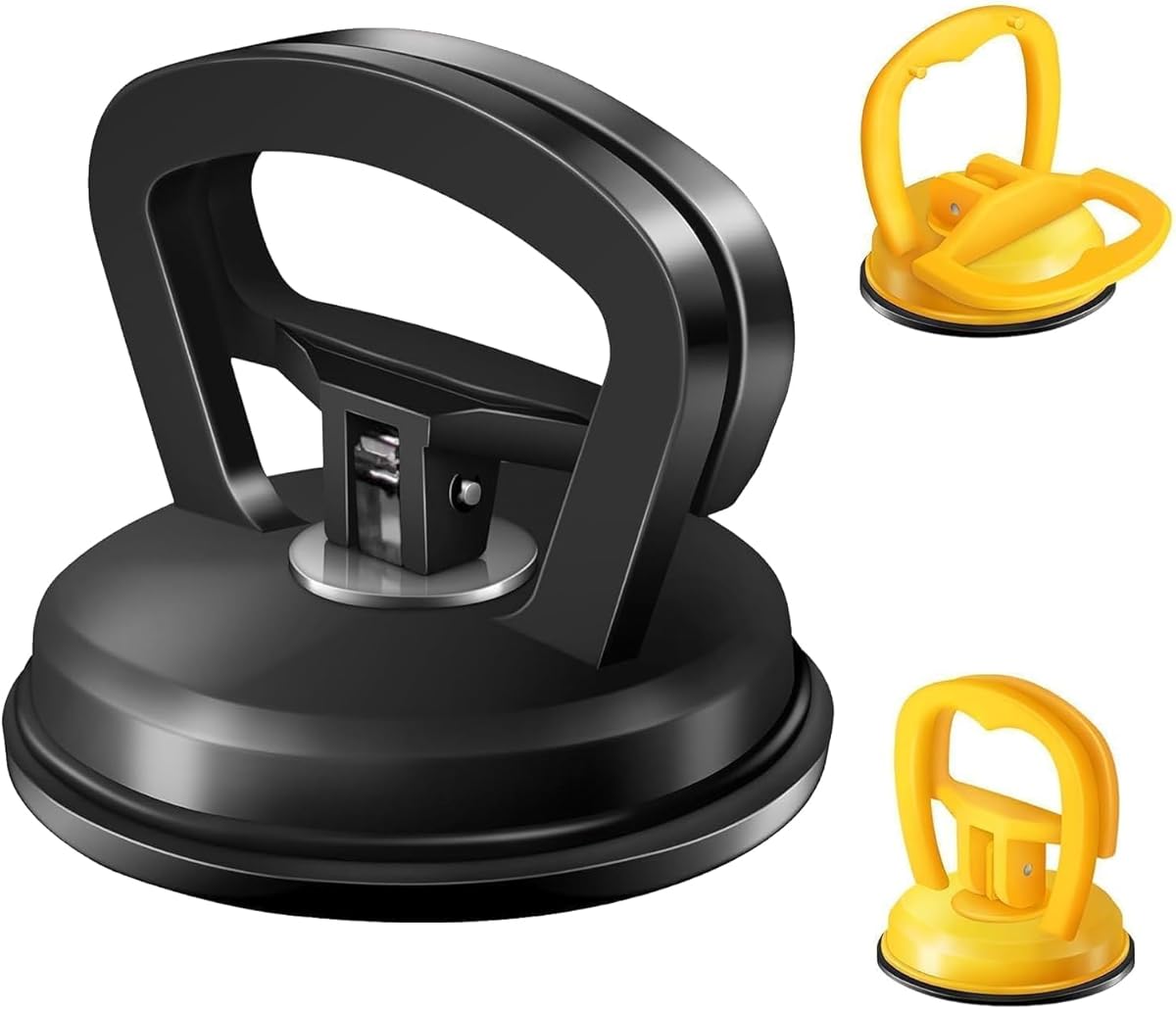


This three-piece suction-based dent puller has a 4.4 rating and stands out for offering a straightforward way to lift shallow depressions without hot glue or body-panel replacement. It combines one large puller with two smaller tools, allowing the user to select a cup that matches the width of the damage instead of forcing one tool onto every repair.
We may earn a commission when you buy through this link, at no additional cost to you.
The pullers use natural rubber suction surfaces and solid metal cores, while the spring-lock handles provide controlled tension. The large model is listed with maximum horizontal suction of 110 pounds and maximum vertical suction of 77 pounds. That level of pull is useful for broader distortions, while the smaller cups are better suited to tighter areas and more delicate corrections.
The principal limitation is that suction only works reliably on clean, dry, smooth surfaces, and the dent must be larger than the cup diameter. A dirty panel, trapped moisture, or a narrow crease can prevent an airtight seal. This is therefore not a universal solution for every type of collision damage, and it should not be used on sharp folds or deep structural deformation.
This is a strong option for drivers dealing with broad shallow hail marks, accidental shopping-cart impacts, or small door depressions. It is particularly attractive to beginners because there is no heating, adhesive cleanup, or separate tab selection involved. Choose this puller when convenience, portability, and repeat use matter more than the pulling force of a professional bridge system.
The biggest practical advantage is the absence of adhesive tabs. Once the rubber cup is firmly sealed, the handle can be locked and pulled without waiting for glue to cool. This makes the tool convenient for roadside, parking-lot, and occasional household lifting tasks.
Using the large puller for a broad shallow dent and the smaller cups for isolated dimples helps distribute force more appropriately. It also makes the kit more adaptable than a single-cup design, particularly around curved body panels and tighter sections.
We may earn a commission when you buy through this link, at no additional cost to you.
The GLISTON kit has a 4.0 rating and offers one of the broadest selections of paintless dent repair components in this guide. Its 45-piece assortment includes a hot glue gun, ten glue sticks, a plastic bridge puller, a golden dent lifter, five pry tools, and tabs in a wide range of dimensions.
We may earn a commission when you buy through this link, at no additional cost to you.
The upgraded dent lifter can adjust by more than 1 centimeter in height and 3.8 centimeters in width, while the arched bridge design is intended to reduce the chance of additional damage. Twenty-one tab options allow the user to select a shape and diameter that fits the dent rather than relying on a one-size-fits-all attachment.
This level of variety comes with additional setup. A glue gun must be heated, tabs must be attached, and each pull requires the adhesive to cool before force is applied. The tool is explicitly not suitable for corners or creases, so buyers should not interpret the large assortment as a guarantee that every dent can be corrected.
Despite that limitation, it is a practical choice for a vehicle owner who wants several repair approaches in one purchase. It is particularly useful for comparing a bridge puller against a lifter, working on different metal panels, and handling mixed dent types around cars, motorcycles, refrigerators, and washing machines.
A bridge puller and a lifter apply force differently, giving the user more choice than a single-tool system. The adjustable golden lifter and arched bridge can be matched to the profile of the damaged panel and the amount of correction required.
The wide assortment of tab sizes is valuable for shallow dents that do not provide much surface area for a large attachment. Smaller and more specialized tabs can enter a repair with less stretching of the metal than an oversized pulling head.
We may earn a commission when you buy through this link, at no additional cost to you.
The Dent Fix DENDF-705D is an offset-style decal eraser wheel with a 4.6 rating. It differs from the other selections because it is designed around surface cleanup rather than pulling a metal panel outward. It may be useful for removing unwanted decals or adhesive marks, but it should not be confused with a complete paintless dent repair kit.
We may earn a commission when you buy through this link, at no additional cost to you.
Its offset configuration separates the working wheel from the hand position, which can make it easier to roll across a flat surface with controlled contact. The universal fit designation, compact dimensions, and low package weight make it convenient to carry and use without a glue gun, pull tabs, suction cups, or added accessories.
The main drawback is simply that the product's stated purpose is decal removal. It does not include a bridge, lifter, suction cup, adhesive system, or other component intended to reshape a dent. Buyers whose main goal is lifting a body-panel depression will need a dedicated dent-removal product instead.
Choose this compact wheel if you want a simple tool for working on decals or adhesive residue and already have separate equipment for dent pulling. It is best viewed as a complementary surface-maintenance item rather than the primary solution for the keyword's core task.
The offset wheel layout gives the working element clearance from the user's fingers. That can support steadier rolling and more consistent contact when the tool is used across a smooth painted or decal-covered surface.
Because the package centers on one reusable wheel, there is no heating, cooling, adhesive bonding, or tab selection. It is a straightforward addition to a garage or detailing kit.
We may earn a commission when you buy through this link, at no additional cost to you.
This gold-colored paintless dent repair kit carries a 5.0 rating and centers on a professional lever-style puller with 18 tabs. Its arched bridge, adjustable height, rotating knob, reinforced pivot, and non-slip handle are designed to give the user controlled leverage when working on shallow dents and moderate hail damage.
We may earn a commission when you buy through this link, at no additional cost to you.
The pulling tabs are made from engineering plastic and are intended to work with the included gold puller as well as standard T-bars and slide hammers. Because the tabs come in multiple sizes and shapes, the user can choose an attachment based on the available surface area and the dimensions of the depression.
A hot glue gun and glue sticks are required but are not listed as included, which is an important distinction for buyers comparing complete kits. The tool is also limited to metal surfaces and should not be used on plastic bumpers or trim. Used outside those guidelines, adhesive residue could cause damage or leave marks that require additional cleanup.
This is an excellent choice for users who already understand basic paintless dent repair or want a compact professional-style setup for metal vehicle panels. Its adjustable bridge and broad tab selection offer a useful middle ground between simple suction tools and a large general-purpose workshop kit.
The puller's height adjustment and rotating knob allow the base to be positioned more closely to different dent contours. That control can improve access and make gradual pulling easier to manage than with a fixed-profile bridge.
The base is wrapped in soft rubber to reduce the chance of contact damage during a pull. Adhesive residue is described as removable with alcohol, which makes careful post-repair cleanup part of the normal process.
We may earn a commission when you buy through this link, at no additional cost to you.
These Dent Repair Glue Sticks have a 4.4 rating and are intended as a consumable adhesive component for hot-glue paintless dent pullers. The package contains ten yellow sticks measuring 11 millimeters, providing a standard size designed to suit standard glue guns and repair tabs.
We may earn a commission when you buy through this link, at no additional cost to you.
The product information identifies a melt time of approximately five to eight minutes with a 100-watt glue gun and an adhesive cooling time of about two minutes before pulling. The higher-viscosity yellow formulation is described as better suited to relatively harder parts of a car, where a secure bond is important.
These sticks are not a stand-alone dent-removal system. Buyers need a compatible hot glue gun, pulling tabs, and a puller, and they must follow the heating and cooling times to establish the bond. Incorrect heat or handling can also make the adhesive difficult to remove from the panel.
The kit is best for owners who already use pull tabs and need a dependable refill supply. It is especially convenient for repeatable repair work because the ten-stick pack provides multiple bonding cycles and the 11-millimeter format is broadly compatible with standard glue guns.
The higher-viscosity yellow adhesive is intended for harder vehicle sections where a weak connection could release before the metal moves. It is formulated for use with paintless dent puller tabs rather than general household crafting.
Ten individually packaged sticks make it easy to keep spares in a workshop. Because they use a standard size, they are convenient for owners of common hot glue guns who do not want a specialized adhesive dispenser.
We may earn a commission when you buy through this link, at no additional cost to you.
The 140-piece dent repair kit has a 3.4 rating but offers the largest assortment in the guide. It includes a slide-hammer T-bar, bridge puller, dent lifter, three suction cups, a hot-melt glue gun, rubber hammer, tap-down pen, ten glue sticks, and 100 pulling tabs.
We may earn a commission when you buy through this link, at no additional cost to you.
The range allows the user to reserve the T-bar for larger dents, the bridge for medium damage, and the lifter for smaller depressions. Soft rubber feet on the bridge and lifter are intended to protect original paint, while the supplied tabs can be attached with hot glue and removed using alcohol and a rubber scraper.
Its size can be a disadvantage. The product itself describes the kit as suitable for adults and professionals and recommends reading the complete manual, while numerous small components can make selection less intuitive for a first-time buyer. The lower 3.4 rating also gives a buyer less confidence than the more highly rated focused options.
Despite these concerns, the kit is compelling for a technician or serious DIYer who wants several pulling methods and abundant replacement tabs in one package. It is better suited to an organized workshop than a small glove compartment, and buyers should confirm that they will use the full range of components.
A T-bar, bridge, lifter, and suction cup each create a different type of pull. This makes the set useful for determining which technique fits a given dent instead of committing to a single tool before attempting the repair.
With 100 tabs and ten glue sticks, the package supports repeated repair cycles. It also includes a rubber hammer, tap-down pen, and other accessories that can help prepare the dent and clean the work area.
We may earn a commission when you buy through this link, at no additional cost to you.
This three-piece suction puller has a 5.0 rating and provides a simple alternative to glue-based paintless dent repair. The set includes one 4.5-inch puller and two 2.2-inch pullers, giving the user a large sealing face for broad damage and smaller cups for tight, curved areas.
We may earn a commission when you buy through this link, at no additional cost to you.
The tools are built with ABS housings, natural rubber pads, and metal cores. A smooth spring-lock handle secures the pull, while the rubber cups are designed to grip without scratching paint. The package also includes a compact storage box measuring approximately 4.9 by 4.7 by 4.3 inches.
The technique is quick: separate the handle, press the cup onto a clean, dry, flat surface, lock the handle, and pull. However, the tool is not intended for deep or sharp creases, and the dent must be larger than the cup diameter. Failure to clean the surface or create a complete seal will reduce performance.
This is a strong pick for beginners, drivers carrying a compact emergency repair tool, and anyone who wants to lift smooth objects around the garage. The absence of glue, heat, and power makes it more convenient than a full PDR kit for light, isolated dents.
The puller can be used immediately after cleaning the panel. That removes the need to heat a glue gun, cool adhesive tabs, and clean residue after every successful pull.
The large and small pullers address different repair areas without the bulk of a multi-tool kit. The included box also makes the set easy to organize in a trunk, backpack, or workshop drawer.
We may earn a commission when you buy through this link, at no additional cost to you.
This eight-piece set has a 4.5 rating and focuses on the pulling tabs used to transfer force from a paintless dent repair tool to a damaged metal panel. Eight different sizes make it possible to match the attachment to the shape and available surface area of a dent.
We may earn a commission when you buy through this link, at no additional cost to you.
The tabs are described as aluminum, offering a durable and reusable alternative to disposable adhesive approaches. They are compatible with most glue puller systems, including slide hammers, dent lifters, and other PDR hand tools, which gives experienced users flexibility in how they apply the pull.
This is not a complete repair kit. The buyer must already have a compatible puller, a hot glue gun, suitable glue sticks, and a way to clean adhesive residue from the panel. The product also focuses on metal applications rather than plastic panels or structural creases.
Choose these tabs when your existing PDR equipment needs additional sizes or when you want a durable set for repeated body-shop and automotive work. For a first-time buyer, the smaller GLISTON and compact PDR kits are more self-contained, while these tabs reward users who already understand the system.
Having multiple tab sizes helps a repairer avoid forcing a broad attachment into a small dent. It also allows the pulling point to move incrementally as the metal begins to move, which can support a more controlled correction.
Aluminum tabs are described as durable and resistant to breaking under normal use. Reusing a sound tab can reduce the need to replace every attachment after a pull, provided the surface and adhesive are properly prepared.
We may earn a commission when you buy through this link, at no additional cost to you.
This compact 28-piece paintless dent repair kit has a 3.7 rating and aims to provide the core tools without the size of a 100-plus-piece package. It includes a T-bar puller, 18 pulling tabs, a small hot-melt glue gun, five glue sticks, plastic shovels, an empty bottle, and a cleaning cloth.
We may earn a commission when you buy through this link, at no additional cost to you.
Its focus on common dent sizes makes it a more approachable choice for a homeowner than a workshop kit filled with numerous specialized pieces. The product information describes a straightforward process: clean the surface, attach a heated tab, wait approximately two minutes, pull with the T-bar, and remove residue using alcohol and a scraper.
The kit is less versatile because it contains only one primary puller and no bridge, lifter, or suction cup. Its 3.7 rating also indicates more mixed customer feedback than the top-rated options, so buyers should consider whether a more specialized kit better matches the shape of their damage.
It is a sensible choice for someone who wants a manageable DIY kit for shallow door dings, hail dents, and similar damage on metal surfaces. It may suit refrigerators, motorcycles, and washing machines as well, provided the surface is compatible with the high-viscosity adhesive.
The 28-piece format concentrates on the tools required for a standard tab-and-pull repair. That can make it easier to understand than a very large kit while still supplying the puller, adhesive, tabs, and cleanup supplies.
The included glue gun and sticks avoid a separate equipment purchase. Once the tab is attached and the adhesive has cooled for about two minutes, the user can select the T-bar and begin a controlled pull.
We may earn a commission when you buy through this link, at no additional cost to you.
This three-piece disc puller has a 5.0 rating and is built around one large black suction disc with two smaller orange discs. The large disc measures 4.5 inches, while the smaller discs measure 2 inches, creating a useful split between broad shallow distortion and precise dimple correction.
We may earn a commission when you buy through this link, at no additional cost to you.
The large disc is intended for flat or slightly curved sections such as hoods, roofs, and broad body areas. The narrow rims of the smaller discs are designed to reach tighter spaces around handles, mirrors, and character lines, where focused traction can help prevent excessive stretching of the metal.
Like every suction-based option, its performance depends on a complete seal. The panel must be clean, smooth, and sufficiently flat, and the tool is not designed to resolve sharp creases or deep edge nicks. The manufacturer also notes that the soft rims are intended to avoid glue residue and swirl marks, but careful surface preparation remains essential.
This kit is a good choice for quick repairs and general lifting tasks around vehicles, glass, tiles, appliances, and cabinets. The cord-free design needs no compressor or power outlet, while the included storage bag makes it convenient to carry for roadside or garage use.
The large disc provides a broad seal for shallow distortions, while the smaller cups isolate individual dimples. This makes the set more adaptable than a one-size tool without adding the complexity of a full adhesive kit.
The suction handles can also assist with moving smooth household objects such as glass sheets, ceramic tiles, and appliance panels. They should still be tested carefully on a small area to confirm that the surface can hold a reliable vacuum seal.
We may earn a commission when you buy through this link, at no additional cost to you.
The keyword is commonly associated with tape-like pulling tabs, but effective dent removal may rely on hot glue, reusable aluminum tabs, vacuum cups, or shaped bridge tools. Buyers should match the mechanism to the dent, panel material, and amount of surface damage before choosing an accessory-heavy or compact system.
Glue-based systems use a hot-melt adhesive to bond a tab to the panel, allowing a lifter, bridge, or T-bar to pull the metal outward. This approach provides powerful, controlled leverage and many tab shapes, but it requires a glue gun, cooling time, and residue cleanup. Suction pullers create a vacuum seal instead, making them cleaner and faster for light, shallow dents, although a dirty or uneven surface can prevent the seal from forming.
In short, choose glue and tabs when you need deliberate leverage, and choose suction when convenience and residue-free handling are the priority.
Small isolated dimples generally respond better to a narrow tab or compact suction cup, while a broad shallow depression may need a larger cup, bridge, or T-bar. The pull attachment should fit within the available surface area without forcing an oversized head onto a narrow section. Pulling from the center or edge of a larger dent can also stretch the metal if the method is not appropriate.
Look for several puller sizes and a broad tab assortment when repairs will vary. For one predictable dent, a smaller matched set may be easier to use and carry.
Paintless dent repair is primarily suited to metal surfaces on cars, trucks, motorcycles, refrigerators, washing machines, and similar appliances. Some products explicitly warn against plastic bumpers and trim because the material can deform, crack, or retain stress. Adhesive residue and pulling pressure can also cause problems on delicate coatings or textured surfaces that do not provide a secure bond.
Confirm that the manufacturer supports the exact panel and finish before applying heat, glue, or a suction cup. When material compatibility is uncertain, professional inspection is the safer choice.
Most of these tools are intended for shallow, paintless damage rather than crushed, creased, or deeply folded metal. Corners, body creases, structural rails, and sharp edges are particularly difficult because metal in those areas has lost its original shape and cannot usually be restored by a single pull. A tool that appears powerful is not necessarily suitable for severe collision damage.
Treat the word paintless as a description of the intended method, not a guarantee of a perfect result. Large or uneven damage may require body-shop techniques beyond a consumer kit.
A complete repair package may include a puller, tabs, glue gun, glue sticks, cleaning tools, and a hammer or tap-down pen. Extra components can improve flexibility, but they also increase bulk, cost, and the number of unfamiliar components. Some compact pullers include everything needed for a basic repair, while tab-only products require separate equipment.
Prioritize the essential missing items: a compatible puller, sufficient tabs, a correctly sized glue gun, and safe cleanup supplies. Choose a larger kit only when its additional tools match repairs you expect to perform.
Hot-melt tab systems can leave residue after the metal has been pulled, even when the finish is treated carefully. Product instructions commonly call for alcohol and a plastic or rubber scraper to lift the remaining adhesive. The repair should be completed in a ventilated workspace, away from hot surfaces, and without scraping aggressively against the paint.
A suction-only tool avoids adhesive residue entirely, making it attractive for quick corrections on valued vehicles. For glue systems, allow extra time for cleanup and keep a dedicated plastic scraper and suitable cleaning material on hand.
A compact suction puller can live in a trunk or backpack and be deployed without power, making it useful for parking-lot or roadside touch-ups. Full glue-based systems are bulkier and include a heated gun, sticks, and many small components that are better stored in a garage or dedicated toolbox. Even portable kits should be kept away from children and pets.
Choose a storage solution that protects small tabs, keeps the glue gun stable, and prevents tools from rolling around in a vehicle. Organized storage also makes it easier to find the correct tab and puller quickly.
Customer ratings can indicate overall satisfaction, but they do not reveal whether a tool suits a particular dent. Read the product's operating instructions, safety notes, material restrictions, and expected operating times. The supplied information for several kits recommends reading the manual, inspecting components for damage, and keeping hands clear of pinch and impact areas.
Use ratings as a general quality signal, then confirm the specifications. Correct preparation, compatible materials, and sensible pull direction matter more for the result than the number of pieces in the box.
Begin by identifying the damaged surface and checking whether the tool is compatible with the panel material. Wash the area thoroughly, remove dirt, wax, loose paint, and moisture, and allow the surface to dry. Inspect the dent, puller, tabs, and suction cups for cracks, deformation, sharp edges, or a compromised adhesive surface. Very deep creases, sharp folds, and corners are poor candidates for a basic pull.
For a suction puller, choose a cup that fits within the broad face of the dent, press it firmly until a complete seal forms, lock the handle, and pull steadily along the most effective direction. For a glue-based system, heat the tab until the adhesive flows, attach it to the center of the affected area, allow it to cool, and use a lifter, bridge, or T-bar to apply controlled leverage. Work in stages and stop if the metal resists rather than forcing a sudden high-force pull.
After the dent has moved, release the puller carefully and remove adhesive with alcohol and a plastic scraper without scraping the painted surface. Wipe rubber suction cups with a damp cloth, let all glue-gun parts cool before storage, and keep replacement tabs clean and free of hardened adhesive. Dispose of loose adhesive debris responsibly and store the complete kit in a dry place away from children and pets.
For a consumer repair, hot-melt dent puller tabs are often the most versatile tape-like option. They allow a tab to be bonded precisely to a metal panel and then pulled with a bridge, lifter, or T-bar. The best result depends on having a shallow dent, a clean surface, suitable tab dimensions, and controlled force rather than a sudden hard pull.
Dent puller tape can be used on original paint when the surface is prepared correctly and the method is appropriate for the material. A clean, dry panel, a suitable tab size, controlled leverage, and careful residue removal reduce the risk. These tools should not be used on plastic bumpers or trim unless the manufacturer specifically approves them.
Usually not by itself. Pulling tabs and suction tools are best suited to shallow depressions whose metal can still be pulled outward. Deep creases, sharp folds, corners, and structural damage usually need reshaping, heating, panel replacement, or professional body-shop work.
Suction pullers are faster, cord-free, and leave no adhesive residue, making them convenient for light dents on smooth surfaces. Glue-based pullers offer more control, greater pulling force, and a wider selection of attachment shapes, but they require heating, cooling, and cleanup. The better choice depends on the dent and how often you expect to use the tool.
Most kits are intended for metal surfaces on vehicles, motorcycles, refrigerators, washing machines, and similar appliances. They are not equally suitable for plastic, glass, coated panels, textured finishes, or surfaces that cannot form a secure suction seal. Check the product instructions before applying heat or adhesive.
The tab or suction cup may not have had a complete bond or seal, the attachment may have been too large for the depression, or the dent may be deeper and sharper than the tool can correct. Confirm that the surface is clean and dry, choose a smaller attachment, and pull gradually. Do not escalate to uncontrolled force if the metal does not move.
Allow the tab to cool, lift it carefully, and use a suitable plastic or rubber scraper to loosen remaining residue. Product instructions commonly recommend alcohol for cleanup. Work gently and avoid dragging sharp tools across the paint, since aggressive scraping can cause damage that is more serious than the original dent.
No. Suction-based kits require no glue, while tab-based systems require a compatible hot glue gun and suitable adhesive sticks. Some complete kits include both, but others list the glue gun as a separate requirement. Always verify the package contents before buying.
The Car Paintless Dent Repair Kit is the strongest all-around choice for controlled metal-panel repair, with an adjustable arched puller and 18 tabs. The Three-piece Suction Puller is the most convenient option for light dents because it works without glue, heat, or power. For maximum equipment variety, the GLISTON 45-piece kit offers the most extensive assortment of pullers, tabs, and supporting accessories.
Prioritize compatibility with the panel material, the shape and depth of the dent, and the amount of control you need. Suction cups suit clean, smooth surfaces and simple touch-ups, while glue-based systems are better for deliberate pulling and varied dent shapes. A compact kit is easier to master, whereas a large workshop package is more useful when several techniques and replacement parts are genuinely needed.
Finally, check the current product page for the included components, compatibility notes, and latest price before ordering. Product bundles and supplies can change over time, and the strongest choice is the one whose mechanism matches the repair you actually intend to make.
