
Avantree BoomByte
4.5Editor score
Dual seven-watt drivers
Four-in-one playback
Up to 18-hour battery
USB-C recharging
A portable radio with Bluetooth combines live broadcast reception with the flexibility of streaming music, podcasts, audiobooks, and files from a phone or storage device. The best model depends on antenna performance, speaker quality, battery options, controls, and the additional features you actually use.
We compared all 10 products using the supplied specifications, focusing on AM or FM coverage, Bluetooth capability, speaker output, power methods, portability, displays, alarms, weather-band support, headphone connections, and file playback. The list includes basic tabletop radios, compact travel models, and feature-rich versions.
Each review explains the standout benefits, practical trade-offs, and likely buyer for that model. Ratings reflect the supplied customer feedback, while feature details come from the product information. Product availability and pricing can change, so confirm the current listing and specifications before purchasing.
4.5Editor score

4.8Editor score

4.4Editor score
As an Amazon Associate we earn from qualifying purchases.
This side-by-side comparison highlights radio bands, Bluetooth and file playback, power options, portability features, and the extras that distinguish each portable radio with Bluetooth from the rest of the field.
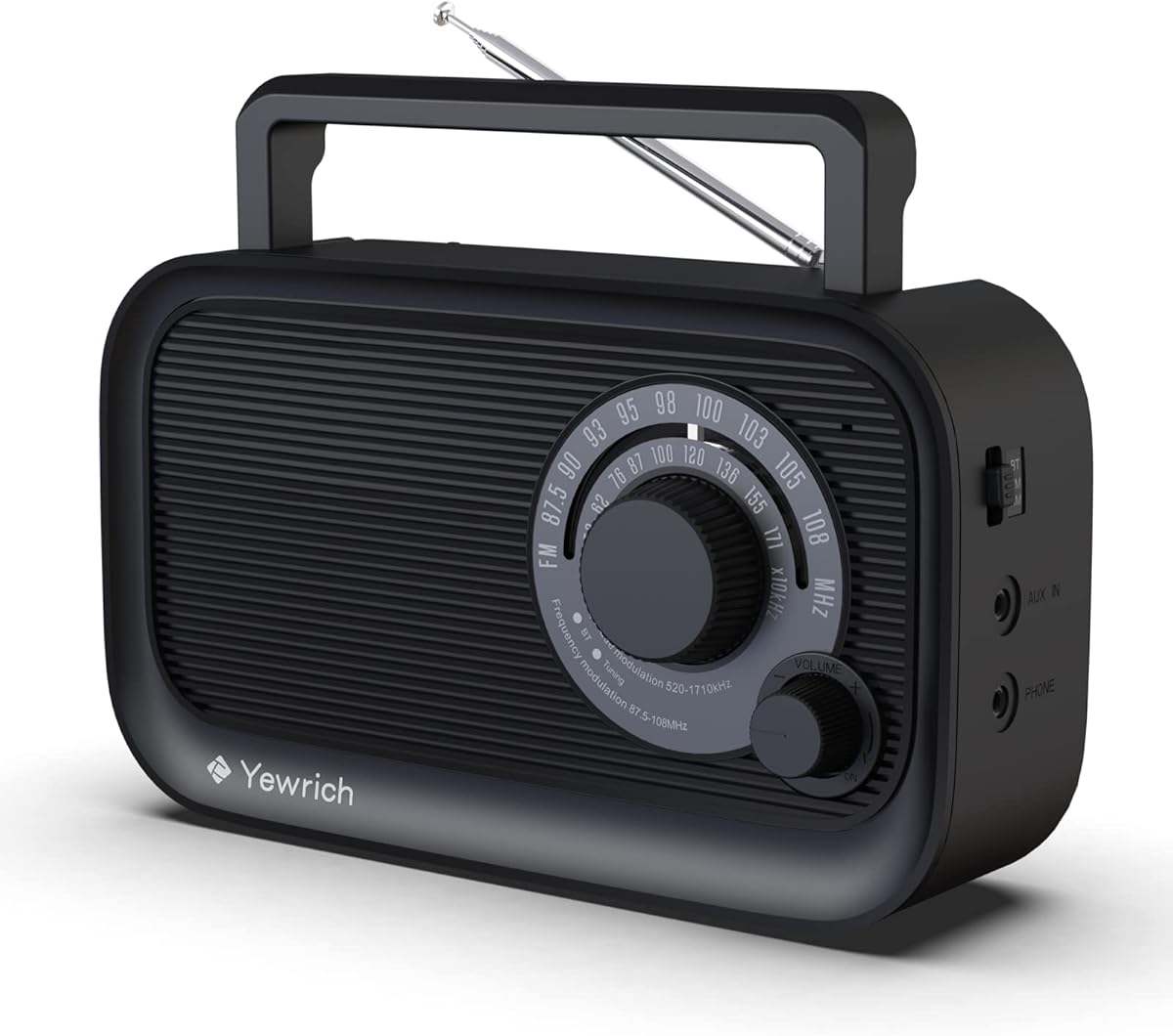


The Yewrich AM FM Radio is a straightforward tabletop and carry-along model with a 4.3 rating. It supports AM, FM, and Bluetooth, while its supplied information highlights a DSP chip, retractable antenna, built-in speaker, and 3.5mm headphone jack. The design is aimed at users who want uncomplicated access to broadcasts and phone audio.
We may earn a commission when you buy through this link, at no additional cost to you.
Its strongest feature is the choice of power methods. The included charging cable can power the radio from a wall outlet, and a compartment accepts four AA batteries for portable operation. That makes the unit practical for bedrooms, kitchens, offices, walks, and outdoor activities where outlet access may be inconsistent. The large dial also improves usability for older listeners or anyone who prefers physical controls.
Bluetooth is limited to streaming from a paired phone, with no stated Bluetooth version, multi-device support, or file-card playback. The product information also does not promise a digital display, alarms, weather alerts, or a rechargeable internal cell. These omissions keep the design focused, but buyers seeking modern conveniences may prefer a feature-rich alternative.
This is a sensible choice for households seeking a portable radio with Bluetooth and uncomplicated operation. Choose it when flexible power, AM and FM reception, a physical tuning dial, and private headphone listening matter more than a display or advanced playback features.
Using either the included AC charging cable or four AA batteries lets the radio move from a fixed indoor position to outdoor listening without requiring a wall outlet near every destination.
The large tuning knob, straightforward handle, and ABS housing create a straightforward device that should be approachable for older adults and anyone who wants fewer menu-driven functions.
We may earn a commission when you buy through this link, at no additional cost to you.
The Avantree SP850 earns a 4.4 rating and combines FM radio, Bluetooth streaming, and MP3 playback from a standard SD card. It is designed for personal, close-range listening rather than filling a large room, giving it a clear purpose for commuters, travelers, and users who want one compact device for radio and stored music.
We may earn a commission when you buy through this link, at no additional cost to you.
Station access is handled through auto-scan or numeric keys. Users can save a favorite by holding a number key until the channel-saved message appears, which makes returning to preferred stations more convenient than repeated manual tuning. Bluetooth can stream music, podcasts, or news from a phone, tablet, or computer, while the SD-card function provides an alternative when a paired device is unnecessary.
The built-in rechargeable battery and USB charging remove the need for disposable cells in normal use. The trade-off is that the product information does not list AC operation, AM reception, a display, weather-band access, or a headphone output. Its balanced audio is deliberately scaled for close listening rather than high-volume outdoor playback.
Choose the SP850 for a compact, three-source player that travels easily and places convenient station presets at the center of the experience. It is a strong match for FM listeners who also want SD-card music and uncomplicated Bluetooth streaming.
Numeric station presets reduce the need to scan repeatedly, making the radio especially useful for daily listening sessions where a short list of trusted stations is enough.
Standard SD-card MP3 playback allows stored music to remain available without keeping a phone connected, which can also reduce the need for mobile data during travel.
We may earn a commission when you buy through this link, at no additional cost to you.
The black JEUJUG portable radio has a 4.4 rating and a 5-watt speaker, making it one of the more powerful models in the group. It supports AM, FM, and Bluetooth 5.0, with fast pairing and automatic reconnection to the last Bluetooth device. The supplied information positions it as a versatile radio for travel, office use, hiking, and beach outings.
We may earn a commission when you buy through this link, at no additional cost to you.
Power flexibility is a major advantage. A built-in rechargeable battery supports more than 10 hours of AM/FM playback, four D-cell batteries provide backup power, and the AC cord can recharge the internal battery. That creates several ways to keep listening, including during an outage. A long 18-inch telescopic antenna and an enhanced magnetic rod antenna support reception, while the large clear dial favors easy physical tuning.
The 6-inch-high, 4.8-inch-diameter body and 1.45-pound weight remain portable despite the stronger speaker. It does not list microSD playback, USB file support, weather alerts, alarms, or a display. The rechargeable cell and disposable-cell options also add complexity compared with a single-power portable model.
This JEUJUG radio is a strong recommendation for users who prioritize audible output, flexible electricity options, and AM/FM reception. It is particularly useful for outdoor preparedness, a patio, garage, or travel kit where a more powerful speaker and backup battery capability are valuable.
The internal rechargeable battery, four-cell battery compartment, and AC charging path provide useful redundancy, helping the radio remain available when a wall outlet or charging cable is not close at hand.
The telescopic and magnetic rod antennas work alongside a five-watt speaker, balancing the ability to find stations with enough output for personal listening in several settings.
We may earn a commission when you buy through this link, at no additional cost to you.
The YOWGULF retro radio has the highest listed rating in the group at 4.8. It combines AM and FM reception with Bluetooth streaming for smartphones and tablets, all in a compact vintage-style housing. Rather than relying on a complex digital interface, it uses separate tuning and volume knobs, making it one of the most approachable choices here.
We may earn a commission when you buy through this link, at no additional cost to you.
The FM range is listed as 87–108MHz and the AM range as 520–1710kHz. A large speaker supports a retro listening experience, while clear dial marks help users identify the desired position. Bluetooth mode handles music and audiobooks, and a single-button mode switch moves between radio and wireless playback. The product is suited equally to bedside listening, cooking, studying, walks, camping, and picnics.
Two power options—AC power or four AA batteries—support use at home and away. Four AA cells are not listed as included, so travelers should plan accordingly. The design does not mention a rechargeable cell, display, alarms, NOAA reception, file-card playback, or a headphone jack. These are meaningful limitations for buyers who expect smart-clock or offline-library features.
This is the top general recommendation for a portable radio with Bluetooth because it balances broad band support, approachable operation, attractive styling, and flexibility. It is particularly suitable for older listeners and anyone who values physical controls over digital menus.
Tuning and volume knobs make the radio easy to understand quickly, while marked dials reduce the guesswork associated with tiny electronic displays.
The retro enclosure is intended to work as both a functional player and a decorative object, making it suitable for kitchens, studies, bedrooms, and living spaces.
We may earn a commission when you buy through this link, at no additional cost to you.
This feature-rich portable radio supports AM, FM, shortwave, and NOAA weather broadcasts, making it the broadest band coverage in the comparison. It carries a 4.3 rating and combines those reception options with Bluetooth 5.4, TF-card playback, a five-watt speaker, a 3.5mm headphone jack, and USB MP3 support. The digital tuner and bright display suit users who want more precise station selection.
We may earn a commission when you buy through this link, at no additional cost to you.
NOAA reception is the defining feature for campers, travelers, and households interested in weather updates and alerts. The stated shortwave range is 4.75–21.85MHz, while FM and AM cover their familiar broadcast bands. A built-in 1,250mAh rechargeable battery delivers up to 10–12 hours of music and news on a charge and uses USB-C charging. A flashlight adds another emergency-oriented function.
Audio can be enjoyed through the speaker, headphones, Bluetooth, a TF card, or USB media. Six EQ settings offer some tonal customization. The back clip and wrist strap make the radio easier to carry, although the long list of controls may feel unnecessary for a buyer who only wants basic FM and Bluetooth. It also lacks a stated AM/FM-only simplicity and does not mention dual alarms.
Choose this model when band variety, weather awareness, and multiple media inputs matter more than minimalism. It is a particularly capable travel and emergency companion, but a simpler model may better serve a kitchen or bedside radio role.
NOAA band reception, a rechargeable battery, and a built-in flashlight create a useful emergency package for camping, road trips, and power interruptions.
Bluetooth, TF-card, and USB MP3 playback keep the device useful when users want stored files or phone audio rather than a live broadcast.
We may earn a commission when you buy through this link, at no additional cost to you.
The LEOTEC AM FM Bluetooth Radio is a budget-oriented model with a 4.4 rating, AM/FM reception, Bluetooth, an LCD, and a 3.5mm headphone jack. Its most distinctive feature is a collection of white noise and nature sounds, including ocean waves, rain, and birds. That makes it more than a traditional radio for relaxation, sleep, and background listening.
We may earn a commission when you buy through this link, at no additional cost to you.
The adjustable sleep timer can be set from 5 to 90 minutes in 10-minute increments and powers the unit down when the selected time ends. This is especially useful in a bedroom or nursery because audio does not need to continue all night. A scalable antenna and large dial support basic station tuning, while the LCD provides a clear view of information and settings.
AC operation and four AA batteries give the radio flexibility during outages or travel. The product information does not state that batteries are included, and no internal rechargeable battery is listed. It also lacks microSD playback, NOAA reception, alarms, and a modern Bluetooth version in the supplied specifications. Its value therefore rests on radio, ambient sound, and timer functions rather than extensive media support.
This is the best budget pick for buyers who want a portable radio with Bluetooth and useful sleep features without paying for a complex shortwave or alarm-equipped model. It is well suited to bedrooms, offices, picnics, and quiet household listening.
The programmable sleep timer offers five different duration settings, making it easy to match playback to a nap, study session, or bedtime routine.
Ocean, rain, bird, and other ambient sounds create value for users who want a soothing background audio source without a separate sound machine.
We may earn a commission when you buy through this link, at no additional cost to you.
This radio combines FM, Bluetooth, NOAA weather broadcasts, a 2.4-inch color screen, dual alarms, and microSD playback. Its 4.5 rating and bedside-oriented feature set distinguish it from basic portable models. The display shows stations, battery status, settings, and a real-time clock in standby mode, while the dual alarms add obvious value for a bedroom, office, or kitchen.
We may earn a commission when you buy through this link, at no additional cost to you.
The built-in 3,000mAh battery is one of the largest capacities in the comparison. Supplied performance estimates reach up to 10 hours of microSD playback at maximum volume and up to 18 hours at 50 percent volume, depending on use. USB-C charging simplifies replenishment, while Bluetooth and microSD let users stream from a phone or listen to locally stored music, podcasts, and audiobooks without one.
A smooth multifunction knob handles volume, station browsing, menu navigation, and fine tuning. Six EQ modes and a headphone jack support different listening preferences. Most importantly for shoppers, the product explicitly supports FM and weather band reception only, not AM. The SOS alarm and language options are helpful, but those conveniences may not compensate for buyers who specifically require AM stations.
Choose this model for a modern alarm radio that also handles weather updates and portable music. It is best for a bedroom or home office where the color screen, clock, alarms, and rechargeable battery offer more daily utility than a simple tuning knob.
The bright color screen provides room for station details, battery status, clock information, and menu navigation without relying on a small monochrome display.
The 3,000mAh rechargeable cell supports extended listening, and the stated playback estimates provide a clearer sense of expected performance than a generic battery claim.
We may earn a commission when you buy through this link, at no additional cost to you.
The Avantree BoomByte is the premium selection, combining FM radio, Bluetooth, USB-drive playback, and SD-card playback in a portable speaker. Its 4.5 rating reflects a strong overall proposition, but the defining feature is the pair of seven-watt drivers, which provide considerably more output and stereo separation than the single-speaker designs elsewhere in the list.
We may earn a commission when you buy through this link, at no additional cost to you.
The device is aimed at listeners who want radio and personal audio in a garden, bathroom, park, or other location where a compact radio might sound too restrained. Enhanced FM reception is listed, and the multiple media inputs let users move between live stations, phone audio, and locally stored files. A portable form factor keeps the substantial speaker system practical for outdoor and casual use.
Battery life is stated at up to 18 hours, and the Type-C port makes recharging straightforward. The limitations are notable: the supplied information does not mention AM reception, weather-band access, a clock, alarms, or a headphone connection. It also carries more bulk than small digital or retro models, so buyers with limited storage or packing space should consider that before choosing it.
This is the recommendation for buyers who regard a portable radio with Bluetooth as a portable speaker first. Choose the BoomByte when volume, stereo separation, flexible file playback, and long battery life are the priority rather than AM stations or bedside-clock functions.
Two seven-watt drivers create left-right separation and more volume, making the BoomByte better suited to a patio, garden, or picnic blanket than small personal-audio models.
USB and SD-card playback broaden its use beyond broadcasts and Bluetooth, allowing stored music to remain available without a paired phone.
We may earn a commission when you buy through this link, at no additional cost to you.
The JEUJUG Retro 5-Watt Radio offers the same core capability set as the earlier black JEUJUG model but with retro styling. It has a 4.4 rating, supports AM and FM, includes a five-watt speaker, and provides Bluetooth 5.0 with automatic reconnection to the last paired device. The visual difference may be decisive for buyers who want a radio that blends into a living room rather than a modern digital device.
We may earn a commission when you buy through this link, at no additional cost to you.
Its power system is similarly flexible. The built-in rechargeable battery supports more than 10 hours of AM/FM playback, the rear compartment accepts four D cells, and the AC cord can recharge the internal battery. This gives the radio useful resilience during travel or an outage. The 18-inch telescopic antenna and magnetic rod antenna support reception, and the large dial is designed to be readable and easy to adjust.
The radio measures 6 inches high and 4.8 inches in diameter and weighs 1.45 pounds without additional batteries. It does not list microSD or USB playback, a digital screen, NOAA reception, alarms, or a headphone output. That keeps the interface focused, although buyers seeking private listening may need to consider a model with a documented headphone jack.
Choose this version for shoppers who prioritize the retro appearance as much as the electronics. It is a capable choice for AM/FM listening, phone streaming, home decor, and portable use, with particularly useful battery redundancy for campers and emergency kits.
The vintage enclosure adds character to a room, while Bluetooth 5.0 supplies quick pairing and automatic reconnection for daily phone listening.
Switching among the rechargeable cell, four D cells, and AC charging gives the radio several paths to continued operation when circumstances change.
We may earn a commission when you buy through this link, at no additional cost to you.
The SEMIER Small Digital FM Radio is a lightweight, multi-format player with a 4.4 rating. It combines FM reception, Bluetooth, USB MP3 playback, and microSD card playback in an enclosure measuring 6.3 by 1.2 by 3.1 inches. It weighs only 0.55 pounds and includes a lanyard, making it one of the more travel-friendly options in the group.
We may earn a commission when you buy through this link, at no additional cost to you.
The 16.6-inch rotary antenna is designed for FM reception from 88–108MHz, with automatic or manual station search, deletion, and automatic storage. Number keys and a clean LCD help users navigate quickly. A built-in 2,000mAh rechargeable battery and USB-C port support mobile use, while Bluetooth pairing retains auto memory for reconnection.
Dual four-watt speakers, six sound effects, and a 3.5mm earphone jack cover several listening styles. The radio supports MP3, WAV, FLAC, and APE files from USB or microSD media, with random, repeat, and all-play modes. Voice recording to USB or microSD is an unusual added function. The major limitation is FM-only reception: there is no AM, shortwave, or weather band.
This is a strong choice for a small digital radio with Bluetooth that also functions as a media player. Select it for travel, personal listening, and stored-file playback; choose a broader-band model when AM stations or NOAA weather broadcasts are priorities.
At 0.55 pounds without a phone or separate media player, the radio is easy to carry in a day bag, suitcase, or outdoor kit.
Support for MP3, WAV, FLAC, and APE files is more useful than a single-format player, especially for listeners who already maintain varied music libraries.
We may earn a commission when you buy through this link, at no additional cost to you.
The right portable radio with Bluetooth depends on where it will be used, which broadcast bands matter, how it will receive power, and whether sound, weather alerts, alarms, or offline files deserve more attention than simplicity.
AM and FM cover different stations, so the required bands should determine which models remain viable. AM is useful for talk radio, news, and local stations that may not appear on FM. FM-only models such as the Avantree SP850, Color Screen NOAA Radio, Avantree BoomByte, and SEMIER Digital Radio may deliver a more focused experience, but they cannot receive AM stations. The broad-band choices include the Yewrich, both JEUJUG radios, YOWGULF, LEOTEC, and the NOAA Shortwave Radio, which adds shortwave and weather-band reception beyond conventional AM and FM.
Reception depends on more than the label, and antenna design provides a useful clue. The Yewrich includes a retractable antenna, the LEOTEC uses a scalable antenna, the SEMIER has a 16.6-inch rotary antenna, and both JEUJUG models feature an 18-inch telescopic antenna plus a magnetic rod. The YOWGULF does not list an antenna length, while several digital models emphasize tuning and signal handling instead. Consider where you will listen: radios used indoors near transmitters may need less attention than a model taken to remote parks, campsites, or rural areas.
Power configuration determines whether a radio is convenient at home, dependable during outages, and easy to recharge. AC-powered or rechargeable models suit bedrooms and offices, while four AA or D-cell options are useful for remote operation. The Yewrich, YOWGULF, and LEOTEC use AC power or four AA batteries. Both JEUJUG models combine a rechargeable cell, four-cell backup, and AC charging. The SEMIER and NOAA Shortwave Radio use internal rechargeable batteries, while the Avantree models emphasize rechargeable operation. AA batteries are not stated as included for the relevant models, so disposable-cell buyers should plan to purchase them separately.
A portable radio must be heard clearly, but more volume is not automatically better for every environment. Compact personal players such as the Avantree SP850 target close-range listening. Single-speaker models provide a practical balance for a kitchen, bedside table, or picnic. The two JEUJUG radios state five-watt output, the NOAA Shortwave Radio also uses a five-watt speaker, and the SEMIER has dual four-watt drivers. The Avantree BoomByte leads with two seven-watt drivers and left-right separation, making it the most compelling choice for a garden, patio, or other area where shared listening is expected.
Bluetooth turns a radio into a speaker for a phone, tablet, or computer, but it depends on a paired device and a stable connection. Some models add valuable offline or standalone functions. The Avantree SP850 and SEMIER support SD-card playback, the BoomByte accepts USB and SD media, and the NOAA Shortwave Radio offers TF and USB MP3 playback. The Color Screen NOAA Radio uses microSD. The SEMIER supports several file formats, while other models focus on radio and Bluetooth alone. Buyers who want a self-contained music library should prioritize removable storage; occasional streaming users can concentrate on radio and sound quality.
Displays and timing features can make a radio more useful as a bedside device. The Color Screen NOAA Radio has a 2.4-inch color display, a real-time clock, dual alarms, an SOS alarm, and a 50 percent volume playback estimate of up to 18 hours. The LEOTEC includes a large LCD and a sleep timer adjustable from 5 to 90 minutes. The SEMIER uses a clean LCD and numeric station controls. By comparison, the Yewrich, YOWGULF, and both JEUJUG radios emphasize physical dials, which may be easier for some users but provide less visual information.
A NOAA weather band and backup power can be especially useful for camping, severe-weather awareness, and outages. The NOAA Shortwave Radio supports weather broadcasts and includes a built-in flashlight, while the Color Screen NOAA Radio provides NOAA access and an SOS alarm with a 3,000mAh battery. Both JEUJUG models offer four-cell battery backups. No model should be treated as a substitute for official emergency alerts, but these functions can complement a phone and provide an additional source of information when circumstances allow.
The smallest radio is not necessarily the easiest to carry if it has a bulky handle, large speaker, or multiple antennas. The SEMIER is notably compact at 6.3 by 1.2 by 3.1 inches and 0.55 pounds, while the JEUJUG models measure 6 by 4.8 inches and weigh 1.45 pounds before added batteries. The NOAA Shortwave Radio includes a back clip and wrist strap for attachment to a bag or belt. Consider handle position, weight, antenna stability, and whether the unit can sit securely on a table as well as travel in a pack.
Before first use, install any required batteries, connect the included charging cable or USB-C cable when applicable, and identify the antenna, tuning controls, mode button, volume control, and charging port. Extend the antenna fully before scanning stations. For Bluetooth, put the radio into its wireless mode, select it on the phone or other source device, and complete pairing before starting playback.
Tune in small increments and allow the radio a moment to acquire a signal. If reception is weak, reposition the telescopic or rotary antenna rather than assuming the station is unavailable. Use headphones for private listening or when the built-in speaker sounds too open, and lower the volume before switching modes. For file playback, insert a properly formatted USB drive, SD card, TF card, or microSD card as required by the specific model.
To preserve battery life, switch the unit off when it will not be used and avoid leaving it in Bluetooth mode unnecessarily. Keep the charging contacts and battery compartment clean and dry, and remove disposable cells when storing a rechargeable model for an extended period. Do not open the housing, and avoid exposing the radio to moisture, excessive heat, or impact. Check the current manual for model-specific battery, charging, and storage instructions.
No. Several models support FM and Bluetooth only, while others include both AM and FM. The Avantree SP850, Color Screen NOAA Radio, Avantree BoomByte, and SEMIER Digital Radio do not provide AM reception. Always check the listed band support before buying, especially if you regularly listen to AM talk radio or local news.
The radio itself continues to receive broadcast stations without a phone, but Bluetooth audio requires a paired source such as a smartphone, tablet, or computer. Some models also accept files from an SD card, microSD card, TF card, or USB drive, allowing offline playback without using mobile data or keeping a phone connected.
A built-in rechargeable battery is usually the most convenient for routine travel because it can be replenished through USB or USB-C. Disposable AA or D-cell support is valuable when outlets are unavailable or during outages. The Yewrich, YOWGULF, LEOTEC, and both JEUJUG radios provide combinations of these options.
Some models are better equipped than others. The NOAA Shortwave Radio includes weather-band reception, a flashlight, and a rechargeable battery, while the Color Screen NOAA Radio adds NOAA broadcasts, an SOS alarm, and a larger battery. Models with four-cell backup power can remain available during outages. A radio should supplement, not replace, official emergency information and a charged phone.
The right output depends on where the radio will be used. Compact personal players work well beside a bed or on a small table, while five-watt models provide more presence for kitchens, patios, and picnics. The BoomByte's dual seven-watt drivers are aimed at shared listening and fuller stereo separation rather than minimal backpack use.
Several models include a 3.5mm headphone jack, including the Yewrich, NOAA Shortwave Radio, LEOTEC, Color Screen NOAA Radio, and SEMIER. The supplied information does not list a headphone connection for every product, so verify the specification if private wired listening is essential. Bluetooth headphones may work on models with standard Bluetooth audio, but that depends on the device's implementation.
Physical knobs are often faster for basic tuning and volume control, and they are approachable for older users. A digital display can provide more information, presets, clock information, menus, and specialized functions. The best choice depends on the user: simple retro models suit quick daily listening, while screen-equipped radios are more convenient for alarms and detailed navigation.
Select a model that supports disposable batteries and keep a fresh set available, because the listed AA and D cells are generally not included. Models with rechargeable cells should be charged regularly, while AC-capable radios can remain connected to wall power. Test the radio and its alternative power sources before an emergency rather than waiting until service is interrupted.
The YOWGULF Portable AM FM Radio stands out as the editor's choice because it combines AM and FM reception, Bluetooth, simple physical controls, flexible power, and the highest listed rating. The Avantree BoomByte is the premium option for shoppers who want stronger stereo output and USB or SD playback, while the LEOTEC AM FM Bluetooth Radio is the best budget choice for ambient sounds and a useful sleep timer.
Start with the broadcast bands and setting. Require AM when talk radio is important, consider NOAA for weather awareness, and prioritize a rechargeable battery for daily portability. Add file playback when music should remain available without a phone, and choose a higher-output stereo model only when shared listening justifies the additional bulk.
Ratings and features provide a useful shortlist, but availability and pricing can change. Before making a final purchase, confirm the current product listing, included charging accessories, battery requirements, supported file formats, and port placement. Those checks help ensure the selected portable radio with Bluetooth fits your listening priorities and travel conditions.