
OHAYO A7 Open Ear Headphones
5.0Editor score
Four-point-seven-gram clip-on design
Forty hours with charging case
IPX6 sweat resistance
Bluetooth Headset for Glasses Wearers guide compares 10 open-ear, clip-on, and bone-conduction options for comfort, calls, battery life, fit, and daily use.
Bluetooth headsets designed for glasses wearers must balance secure positioning, lightweight construction, open-ear comfort, and reliable call quality. Traditional earbuds can interfere with prescription frames or sunglasses, while bulky over-ear headphones may create unwanted pressure. The best options keep the ear canal clear and distribute weight without fighting your frames.
We compared the ten products in this guide by examining their stated form factors, weight, glasses compatibility, audio technology, controls, microphones, wireless connections, battery claims, and water resistance. The list includes clip-on earbuds, external glasses headphones, flexible neckband bone-conduction models, and open-ear hooks, giving readers several ways to add audio without changing their eyewear.
Each numbered review identifies the most useful reason to consider that model, along with practical trade-offs involving fit, sound, calls, controls, and protection. The top selections represent different priorities rather than a single universal winner. Marketplace availability, promotions, and product details can change, so readers should verify the current listing and accessories before purchasing.
5.0Editor score

4.9Editor score
4.5Editor score
The comparison below highlights the main differences in attachment style, audio approach, connectivity, endurance, and weather protection, helping you find the headset most likely to coexist comfortably with your glasses.


This open-ear bone-conduction headset combines a flexible neckband, a 25-gram construction, Bluetooth 6.0, and three EQ modes. Its 4.6 rating reflects a versatile package for listeners who want music, calls, and environmental awareness without inserting traditional earbuds. It is particularly relevant to glasses wearers because the speakers rest near the cheekbones rather than inside the ear canals.
We may earn a commission when you buy through this link, at no additional cost to you.
The neckband adapts to different head shapes and is designed to avoid pressure inside the ears, which can be useful when the arms and nose pads of glasses already occupy space around the face. Anti-leak audio is intended to reduce sound escaping into the environment, while the open structure still allows traffic, conversations, and other nearby sounds to remain audible. That balance makes the headset more practical for outdoor exercise than a fully isolated design.
Bluetooth 6.0 supports fast pairing and stable wireless performance, while the dual-device function allows two devices to remain connected for switching among music, video, calls, and work tasks. The built-in microphone supports hands-free communication. Users can also select Vocal, Bass, or Balanced modes, although the headset lacks some of the deeper customization found in app-based models.
This is a strong general choice for glasses wearers who alternate among commuting, exercise, calls, and casual listening. The 10-hour runtime and IP65 sweat resistance support active use, though the headset is explicitly not intended for swimming or underwater operation. People who wear loose or highly unusual frames may want to confirm that a neckband design will not interfere with their temples.
Because the open-ear structure leaves the ear canal unobstructed, the headset reduces the insertion fatigue associated with conventional earbuds. Its skin-friendly flexible neckband and low stated weight also favor extended wear alongside prescription glasses or sunglasses.
Three EQ modes make it easy to move between vocal-heavy podcasts, music with stronger bass, and general balanced listening. Dual-device connection reduces the inconvenience of repeatedly disconnecting a phone to answer a laptop call.
We may earn a commission when you buy through this link, at no additional cost to you.
The OHAYO A7 is purpose-built for glasses wearers and holds a 5.0 rating. Each clip-on earbud weighs just 4.7 grams, making it one of the lightest options in the comparison. Rather than wrapping around the ear or sitting in the ear canal, it sits around the outer ear without pressing against glasses temples or blocking the ear opening.
We may earn a commission when you buy through this link, at no additional cost to you.
The 12mm dual drivers provide a conventional open-ear sound path, while Bluetooth 5.4 is advertised for stable connections, low latency, and smooth use across music, video, gaming, and calls. That combination makes the A7 suitable for users who want their glasses to remain the main visual accessory and the headset to add audio without changing their eyewear.
The stable clip-on structure is designed to remain in place during running, HIIT, walking, and other workouts. IPX6 protection helps resist sweat and light rain. For communication, ENC microphone technology is intended to improve call clarity, and a charging case supports a stated total of 40 hours of playback. Its low weight reduces the chance that the headset will pull against frame arms.
The A7 is an appealing choice for glasses wearers who put comfort and long battery life ahead of a neckband, external module, or large over-ear hook. The main trade-off is that clip-on products can fit differently depending on the shape and size of the ear. A careful fit check and preference for a case-based charging system are the main reasons to choose it.
The A7's design avoids the temple pressure associated with heavier headsets and leaves the ear canal open. Its stated 4.7-gram weight is especially helpful for long workdays, study sessions, and casual listening.
The included charging case extends the total stated playback time to 40 hours, reducing the need to find a charger between outings. Quick charging is also listed for short listening boosts when the battery is low.
We may earn a commission when you buy through this link, at no additional cost to you.
The LICAEVEY model takes a distinctive approach by attaching the audio hardware to the temples of existing glasses. Its 3.5 rating is the second-lowest in this list, but that figure should be considered alongside the unusual form factor. It does not require a separate earbud, neckband, or over-ear hook, making it one of the most integrated options for eyewear users.
We may earn a commission when you buy through this link, at no additional cost to you.
An elastic, adaptive silicone cover is designed to secure the device to the temples of most eyeglasses and sunglasses. The open-ear architecture keeps the canals free, helping users remain aware of traffic, conversations, and environmental activity while running, cycling, driving, or walking. This makes it particularly interesting for people who already wear stable frames and want one piece of equipment to serve both vision and audio.
Bluetooth 5.3 supports stable connectivity and low power consumption, while the integrated controls cover calls and music. Voice-assistant activation is also listed. The headset offers up to eight hours of continuous playback, which is adequate for many commutes and workouts but trails clip-on and case-based systems in total endurance.
This is a practical choice for consumers who value a glasses-integrated design more than a conventional headset. The trade-off is dependence on frame compatibility: unusual temple shapes, very thin metal arms, or glasses that are frequently removed may make the silicone attachment less convenient. Prospective buyers should compare the adapter with their own frames and accept the model's lower rating as part of that decision.
Because the speakers mount near the glasses temples, the headset stays with the eyewear instead of occupying either ear. This preserves the ear opening and avoids inserting anything into the ear canal.
The adaptive silicone attachment is intended to remain secure during running and cycling. Its open acoustic design also lets outside sounds remain audible, though listeners should still exercise appropriate attention near traffic.
We may earn a commission when you buy through this link, at no additional cost to you.
TOZO OpenEarRing is a compact clip-on headset designed with glasses users in mind. It carries a 4.3 rating and uses 5.1-gram earbuds that contour around the ear without entering the canal. Its design is intended to avoid clashing with frame arms while distributing weight across a broader contact area than a conventional in-ear bud.
We may earn a commission when you buy through this link, at no additional cost to you.
Sound is handled through TOZO's OrigX acoustic technology, with an emphasis on stereo detail for music, films, and spoken content. The companion app provides 32 EQ modes, allowing listeners to emphasize vocals or adapt the sound to genres such as jazz, blues, and classical music. That level of software control is a meaningful advantage for users who like to refine their settings.
The earbuds provide up to 10 hours per charge, while the digital-display charging case adds 30 hours for a stated total of 40. Bluetooth 5.4 is advertised for a stable connection extending to 15 meters. Simple button controls handle calls and playback, automatic pairing occurs when both earbuds leave the case, and IPX5 water resistance helps with sweat and light rain.
OpenEarRing is a good fit for glasses wearers who want customization, a visible battery indicator, and a conventional true-wireless case in a low-profile form. The trade-off is dependence on the app for the full EQ suite, and the 10-hour per-charge runtime is shorter than the total endurance offered by some competitors. Buyers should also accept a small degree of open-ear sound leakage.
The app-based EQ system makes this one of the more flexible options for listeners who move between genres. Skin-friendly silicone and the absence of an inserted earbud help preserve comfort during long glasses-wearing sessions.
A digital display on the charging case gives a visible indication of remaining power. Type-C charging and an additional 30 hours of case playback make the system convenient for travel and daily commuting.
We may earn a commission when you buy through this link, at no additional cost to you.
The O2 open-ear headset receives a 4.9 rating and stands out for its explicit glasses compatibility, 15mm drivers, flexible titanium frame, and 12-hour battery life. It is positioned for running, hiking, cycling, and commuting, but the open-ear design and pressure-free fit also make it relevant to people who spend long hours wearing prescription frames.
We may earn a commission when you buy through this link, at no additional cost to you.
Its stated 26.4-gram weight and flexible frame sit outside the ear canal rather than hooking directly over the top of the ear. This arrangement can reduce conflict with glasses temples, although actual comfort still depends on frame shape and head size. Air-conduction technology directs audio toward the ear while preserving environmental awareness, and the larger drivers are intended to provide richer bass and clearer highs than many compact open-ear products.
The headset supports 12 hours of continuous music and calls, with 150 hours of standby. A 10-minute magnetic fast charge provides one hour of playback, a useful feature during long hikes, marathons, and commutes. Bluetooth 5.3 provides pairing and a stated range of up to 33 feet, while dual-device connection allows a phone and another source to remain connected simultaneously.
The O2 is one of the strongest all-around recommendations in the guide because it balances a comfortable glasses-compatible design with large drivers, fast charging, and multipoint connectivity. It is not a swimming headset, and open-ear listening will not isolate the user from traffic. For the stated outdoor and everyday use cases, however, the feature set is unusually complete.
The open structure keeps both ear canals unobstructed and positions the electronics away from the exact area occupied by many glasses temples. Its low weight and flexible titanium frame are especially useful for runners who already wear prescription or sports glasses.
A 10-minute magnetic charge supplying one hour of playback helps bridge short breaks between longer sessions. The 12-hour runtime and 150-hour standby time further reduce battery anxiety.
We may earn a commission when you buy through this link, at no additional cost to you.
This 29-gram trucker-style headset has a 3.8 rating and is built around communication as much as music. It uses an open-ear structure with 3D rotating hooks, a rotatable microphone, AI noise reduction, and a dedicated mute control. The stated ability to sit comfortably alongside glasses, hats, or helmets makes it relevant to drivers and outdoor workers who already wear eyewear.
We may earn a commission when you buy through this link, at no additional cost to you.
The lightweight silicone construction is designed to remain stable without covering the ear canal. Its rotating hooks can be adjusted to different ear shapes, while the open architecture helps users hear their surroundings. That is useful for drivers, outdoor activities, and remote meetings where complete audio isolation is undesirable or inconvenient.
Bluetooth 5.3 and true multipoint support allow two devices to remain connected, making it possible to move between a laptop and phone. The microphone arm rotates through 270 degrees to improve voice pickup, and a multifunction button handles calls, playback, and track changes. A separate mute button gives users quick control over microphone privacy. The listed connection range reaches 49 feet.
This headset is most appropriate for people who take frequent calls in noisy or mobile settings and need a rotating boom microphone. The trade-off is that its open-ear format provides little isolation, and the 3.8 rating suggests mixed experiences. Buyers should assess the hook geometry and microphone position carefully, particularly if they wear thick frames or a helmet at work.
The 270-degree rotating microphone arm can be moved toward the speaker's mouth for better voice pickup. AI noise reduction and quick mute give the headset an advantage for trucking, driving, and online meetings.
True multipoint connectivity keeps two devices linked, supporting a smoother transition between work calls and personal audio. Physical button controls are also easier to locate than small touch surfaces during movement.
We may earn a commission when you buy through this link, at no additional cost to you.
The second bone-conduction neckband in this comparison has the same 4.6 rating, 25-gram weight, Bluetooth 6.0 connection, three EQ modes, 10-hour runtime, and IP65 protection as the first model. It provides the same practical proposition for glasses wearers: audio that rests near the cheekbones while the ears remain open to the surrounding environment.
We may earn a commission when you buy through this link, at no additional cost to you.
Its flexible neckband is designed to adapt to different head shapes and maintain a skin-friendly fit. The open structure improves airflow and avoids the pressure of an earbud inside the canal. Anti-leak audio is intended to preserve privacy, making the headset usable for commuting and work as well as exercise without completely shutting out nearby sounds.
Dual-device connection is a useful feature for people who alternate between entertainment, phone calls, and computer audio. The microphone supports hands-free calling, and the EQ profiles cover vocal-forward listening, stronger bass, and balanced general use. Type-C charging and IP65 sweat resistance suit workouts, while the product is not intended for swimming.
This model is a reasonable alternative for buyers drawn to the neckband format, especially if the availability or configuration of the similarly specified first listing is not ideal. Its main limitation is that the ten-hour runtime and physical design may be less convenient than a charging-case model. The duplicate feature set also makes direct differentiation difficult without checking the latest listing details.
A 25-gram flexible neckband reduces the pressure associated with heavier headsets. The open architecture also leaves the ears unobstructed, making it suitable for people who cannot comfortably wear in-ear products alongside glasses.
Listeners can move among Vocal, Bass, and Balanced modes without navigating a complex control system. This makes the headset convenient for shifting between music, spoken content, and calls.
We may earn a commission when you buy through this link, at no additional cost to you.
The O1 Open Ear Headset carries a 5.0 rating and centers on call clarity within a relatively compact open-ear design. It uses a 15mm dynamic driver, dual microphones with AI noise reduction, and a microphone arm that rotates 210 degrees. The result is aimed at drivers, meeting participants, and others who spend substantial time communicating in noisy environments.
We may earn a commission when you buy through this link, at no additional cost to you.
Unlike conventional bone-conduction models, the listing describes open-ear air conduction as providing better bass and clear mids and highs. That makes it well suited to podcasts, music, coaching cues, work calls, and gaming. The boom microphone can be repositioned toward the mouth, while the open-ear format leaves the user's ears less covered than a traditional headset with earcups.
Bluetooth 5.4 provides a stated stable signal up to 33 feet, and the headset supports up to 12 hours of talk time. A multifunction control handles playback, track changes, and calls. The dedicated quick-mute sequence uses three presses of the minus button, with voice prompts confirming whether the microphone is muted or unmuted.
The O1 is a compelling choice for glasses wearers whose priority is clear communication rather than complete isolation. Its 5.0 rating and flexible microphone are the key strengths. The trade-off is that open-ear audio can leak, and the 12-hour figure is framed around talk time, so buyers focused primarily on all-day music may want to compare a model with a larger charging case.
Dual microphones and AI noise reduction are designed to reduce road and background noise. The adjustable boom arm adds another layer of control by letting users optimize microphone placement for different environments.
Three presses of the minus button mute or unmute the microphone, and the spoken confirmation helps prevent accidental silence. Playback, calls, and track navigation are consolidated into the same control scheme.
We may earn a commission when you buy through this link, at no additional cost to you.
Xmenha's open over-ear earbuds receive a 3.6 rating and use ultra-thin memory-metal hooks to avoid pressure on glasses. The design is explicitly positioned for people who find conventional earbuds uncomfortable, and it leaves the ear canal completely open. Its understated structure is aimed at all-day wear, light exercise, podcasts, and casual music.
We may earn a commission when you buy through this link, at no additional cost to you.
The memory-titanium hooks are designed to be flexible and minimally noticeable, while the open acoustic arrangement provides environmental awareness. This is useful outdoors because users can hear warning sounds and nearby conversations. The manufacturer also notes a natural presentation for spoken content, which suits audiobook and podcast listeners who do not need deep bass.
Battery endurance is the principal limitation. Each earbud provides four hours of continuous playback, while the charging case extends total use to 12 hours. The case itself can recharge in approximately one hour. The product supports iOS and Android devices, although the listing provides a manual-pairing note for iPhone 17 series devices because automatic pairing is temporarily unavailable.
This headset makes the most sense for consumers who prioritize minimal frame contact and a barely noticeable hook over maximum battery life. Open-ear leakage is likely noticeable in quiet rooms, and the bass is intentionally mild. A buyer should also follow the listed charging guidance and use a suitable low-power adapter to avoid overheating the earbuds.
The ultra-thin hooks are designed to sit without creating the pressure associated with a conventional over-ear frame. That makes them a useful option for thin prescription glasses and lightweight sunglasses.
The open architecture favors vocals and natural everyday listening but allows some sound leakage. A four-hour earbud runtime is short for intensive use, so carrying the charging case is strongly advisable.
We may earn a commission when you buy through this link, at no additional cost to you.
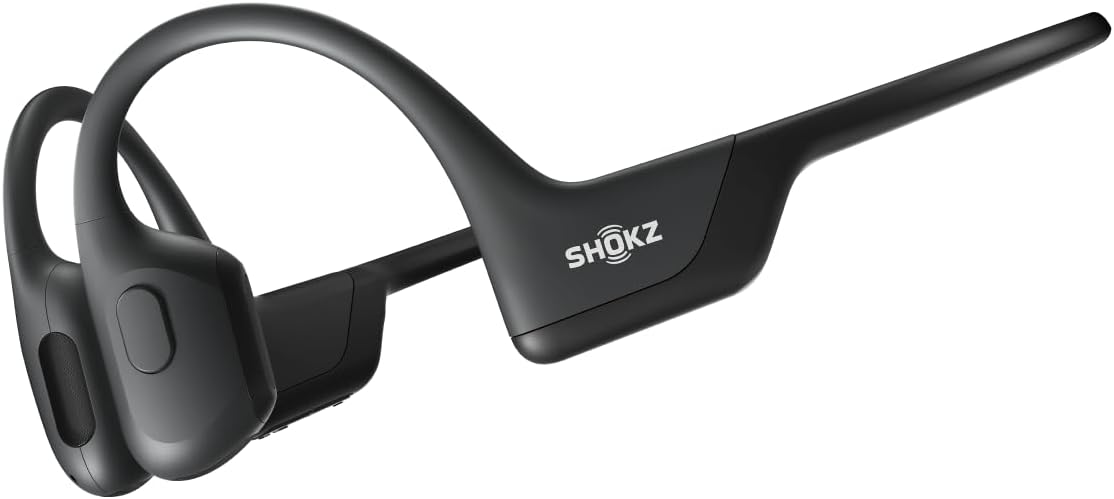
SHOKZ OpenRun Pro is the premium choice in this guide, combining a 4.5 rating, a wraparound titanium frame, ninth-generation bone-conduction technology, and a bundled headband. Its bud-free structure suits people who cannot comfortably wear earbuds and creates a relatively clear path for glasses frames, although the rear band must still fit behind the head without conflicting with the temples.
We may earn a commission when you buy through this link, at no additional cost to you.
The stated premium listening experience uses SHOKZ TurboPitch technology to deliver clear sound, volume, and richer bass through the cheekbones. This can be especially satisfying for runners who want music without covering their ears. The design also maintains environmental awareness, allowing users to hear traffic, companions, and training cues while reducing the isolation of standard earbuds.
The lightweight frame is designed to remain stable through intense training, and the product is sweat resistant. Battery life reaches 10 continuous hours for music, calls, and podcasts. A five-minute quick charge provides up to 1.5 hours of use, making the headset practical for workouts that begin with a partially depleted battery. It pairs with Android, iOS, Windows, and other Bluetooth-enabled devices.
OpenRun Pro is best suited to runners, active users, and dedicated bone-conduction listeners who value a refined established design and stable all-around performance. The trade-off is that it is the premium product selection in this roundup and does not provide an isolating listening experience. Glasses wearers should confirm that the wraparound arms and included headband sit comfortably with their preferred frames.
Ninth-generation bone-conduction technology and TurboPitch are intended to provide clearer, fuller sound than many basic bone-conduction headsets. The cheekbone placement avoids the insertion and pressure of conventional earbuds.
The lightweight titanium frame is built to remain in place during strenuous movement, while the sweat-resistant construction supports workout use. The included headband provides an additional way to secure the fit.
We may earn a commission when you buy through this link, at no additional cost to you.
The most important consideration is not merely whether a headset is labeled glasses-friendly, but whether its attachment method, weight, and geometry work with your particular frames. Audio quality, call performance, battery life, and environmental protection should then be matched to your normal listening environment.
Bluetooth headsets for glasses wearers generally use one of four attachment strategies: clip-on earbuds, flexible ear hooks, rear neckbands, or modules that attach directly to the glasses temples. Clip-on products keep the speaker near the outer ear and can be exceptionally light, but their security depends on ear shape. Hook-style devices wrap around the ear and may sit close to a frame arm. Neckbands leave the ears entirely free but can conflict with loose temples or high collars. Temple-mounted systems integrate with the eyewear itself, which is streamlined but less universal across frame styles.
Choose the attachment that matches how you normally wear and remove your glasses. A secure pair of frames may work well with a direct attachment, while frequently switching between glasses and sunglasses usually favors a standalone headset.
Glasses already create contact points at the bridge, nose pads, and behind the ears. A heavy headset adds pressure at precisely those areas, potentially causing discomfort over a long workday. Lightweight options range from individual earbuds weighing slightly more than four grams to complete headsets around 29 grams. The stated weight alone does not guarantee comfort, because balance, rigidity, materials, and the pressure of the frame all influence the result. Skin-friendly silicone and flexible frames are desirable, especially for extended wear.
Prioritize the lightest model that still feels stable and supports your preferred sound and call features. A headset that feels pleasant during a short trial may become uncomfortable after several hours of use.
Open-ear and bone-conduction designs keep the ear canal open, which helps preserve awareness of traffic, coworkers, and training cues. They are particularly useful for runners, cyclists, and drivers. The trade-off is reduced passive isolation and some sound leakage. Air-conduction open-ear models can provide stronger bass than traditional bone-conduction designs, while bone-conduction systems may avoid the feeling of speakers resting directly beside the ear. None of these designs will match the quiet environment created by sealed earbuds or noise-cancelling over-ear headphones.
Decide whether environmental awareness is a feature or a distraction. It is valuable outdoors, while privacy and focused listening may matter more indoors.
Call quality depends on microphone placement, noise-reduction processing, and the amount of environmental sound entering the recording. ENC, dual microphones, and AI noise reduction can improve speech pickup in traffic, offices, and outdoors. A boom-style microphone that rotates toward the mouth provides another level of positioning control. Basic open-ear models may handle quiet calls adequately but become less clear in noisy settings. Physical mute controls are also valuable for privacy, especially during meetings where background noise may otherwise be transmitted.
If calls are a primary use, prioritize a model with a dedicated microphone and noise-reduction features over a design chosen only for compactness or bass.
Battery comparisons should distinguish runtime per earbud or headset from total playback provided by a charging case. Ten to twelve hours from the main unit can cover a workday for many listeners, while a case can extend total use to 30 or 40 hours. Quick charging is useful for short gaps: the O2 is stated to add one hour from a ten-minute charge, while OpenRun Pro lists up to 1.5 hours from five minutes. Models without a case generally require access to a cable or compatible charger whenever the battery runs down.
Match the charging system to your routine. Frequent travelers may prefer a compact case, while users who charge at a desk can favor a simpler headset with dependable standalone runtime.
Bluetooth 5.3 and 5.4 are common across the newer models in this guide, while two products use Bluetooth 6.0. The version alone does not determine real-world quality, but modern chips generally support efficient pairing, stable connections, and lower latency. Dual-device or multipoint operation is particularly useful for people who move between a phone and computer. Physical buttons are easier to identify while running, while touch controls can offer a cleaner appearance. App-based EQ adds sound customization but introduces another piece of software to configure.
Check whether your primary devices support multipoint, and decide if adjustable EQ is valuable enough to justify an app. The most important control is the one you can operate accurately without looking.
An IP65 rating indicates resistance to dust and water jets, while IPX6 focuses on protection against powerful water jets and sweat exposure. These ratings make a headset more suitable for running, gym sessions, hiking, and wet weather, but they do not make every model safe for swimming. Bone-conduction and open-ear designs are not traditionally used underwater, and the product listings explicitly caution against such use. Buyers should also follow charging instructions, since some compact products are sensitive to high-power adapters.
Match protection to the expected environment rather than assuming all water-resistant headsets are submersible. Cleaning sweat and moisture from the contacts and case is also important for long-term reliability.
Begin by fully charging the headset and its case with the specified cable and an appropriate low-power adapter. Put on your glasses first, then position the headset so that speakers, hooks, clips, or neckband elements do not press against the temples. For clip-on models, adjust each earpiece independently until both remain secure without creating a painful pulling sensation. For bone-conduction or neckband models, place the transducers against the front of the cheekbones where the sound feels clearest.
Pair the headset through your device's Bluetooth menu, confirm that both sides are connected where applicable, and set a comfortable listening level before moving outdoors. Use the physical controls to test calls, playback, and microphone muting. If the product includes an app, configure EQ and update any available firmware while familiarizing yourself with the button layout. Multiparty users should connect their two primary devices and test switching between them before relying on it during a meeting.
After workouts or long wear periods, remove the headset, wipe away sweat with a soft dry or lightly damp cloth, and allow charging contacts to dry before placing the device in its case. Keep the charging port free of debris and avoid unsupported high-power adapters. Inspect hooks, clips, silicone covers, and frame contact points periodically, particularly if the headset begins to slip or press against the glasses. Store the headset in a dry place and use the case when it is not worn.
No single design fits every pair of glasses perfectly. Clip-on earbuds avoid much of the temple area, neckbands may conflict with loose frames, and temple-mounted products depend on arm shape and thickness. Consider whether you wear thick acetate, thin metal, prescription, or sports frames, and check whether the headset's arms or clips can be repositioned without creating pressure.
Their open design can improve awareness of traffic, people, and other environmental sounds compared with sealed earbuds. Many models also offer sweat resistance and secure hooks or clips for movement. Environmental awareness does not make distracted listening safe, so volume should remain low enough to hear vehicles and training cues.
No. Bone conduction is one audio technology, not a requirement for glasses compatibility. Clip-on and open-hook headsets can also remain outside the ear canal while avoiding frame arms. The right choice depends on whether you prioritize stronger bass, a compact case, environmental awareness, or a stable neckband-style fit.
Ten to twelve hours from the main unit is generally convenient for workdays, while a charging case can extend total use to 30 or 40 hours. Frequent travelers may favor a case, and users who already charge a phone at a desk may not need one. Quick charging is helpful when a full runtime is unavailable before a workout or commute.
Open-ear headsets can allow some audio to escape, particularly in quiet rooms, because there is no seal around the ear. Call quality varies by model: dual microphones, ENC, AI noise reduction, and adjustable boom arms generally help in noisy conditions. A close-fitting clip or properly positioned boom microphone can make a noticeable difference.
Most open-ear designs can be used with sunglasses because they do not rely on an ear seal. The important consideration is whether the headset or its temples contact the sunglass arms. Narrow metal frames may be less compatible with larger hooks, while lightweight clip-on models may offer more flexibility across frame types.
Usually not. IP65 and IPX6 ratings indicate protection against sweat, rain, and forceful water exposure, but they are not swimming ratings. None of the products in this guide should be assumed safe for submersion, and their controls, microphones, batteries, and charging ports may be damaged by water.
Physical controls are convenient during running, cycling, and driving because they are easier to locate without looking. Apps can provide deeper EQ customization and firmware updates, as seen with the TOZO OpenEarRing. The most useful system combines easy core controls with optional software features, but users should check whether they enjoy configuring the product before purchase.
The O2 Open Ear Headphones offer the strongest balance for active and general use, combining a glasses-tested titanium frame, 15mm drivers, 12-hour playback, fast charging, and dual-device connectivity. The OHAYO A7 is especially appealing for minimum weight and case-based endurance, while the SHOKZ OpenRun Pro delivers a premium bone-conduction experience for runners and active listeners who value established wraparound stability.
Your own glasses and listening habits should determine the winner more than any universal ranking. Test the attachment around the temple and behind the ear, listen for movement in the voice during calls, and consider how much environmental sound you want to hear. Battery life, microphone positioning, app support, and water protection should be prioritized according to whether the headset is mainly for work, commuting, exercise, or casual wear.
Before ordering, verify the current product listing, included accessories, supported devices, and return terms, especially for close-fitting clip or hook designs. Marketplace offers and availability can change, but a headset that remains comfortable with your frames is more likely to become a dependable everyday accessory than one selected only from a specification list.