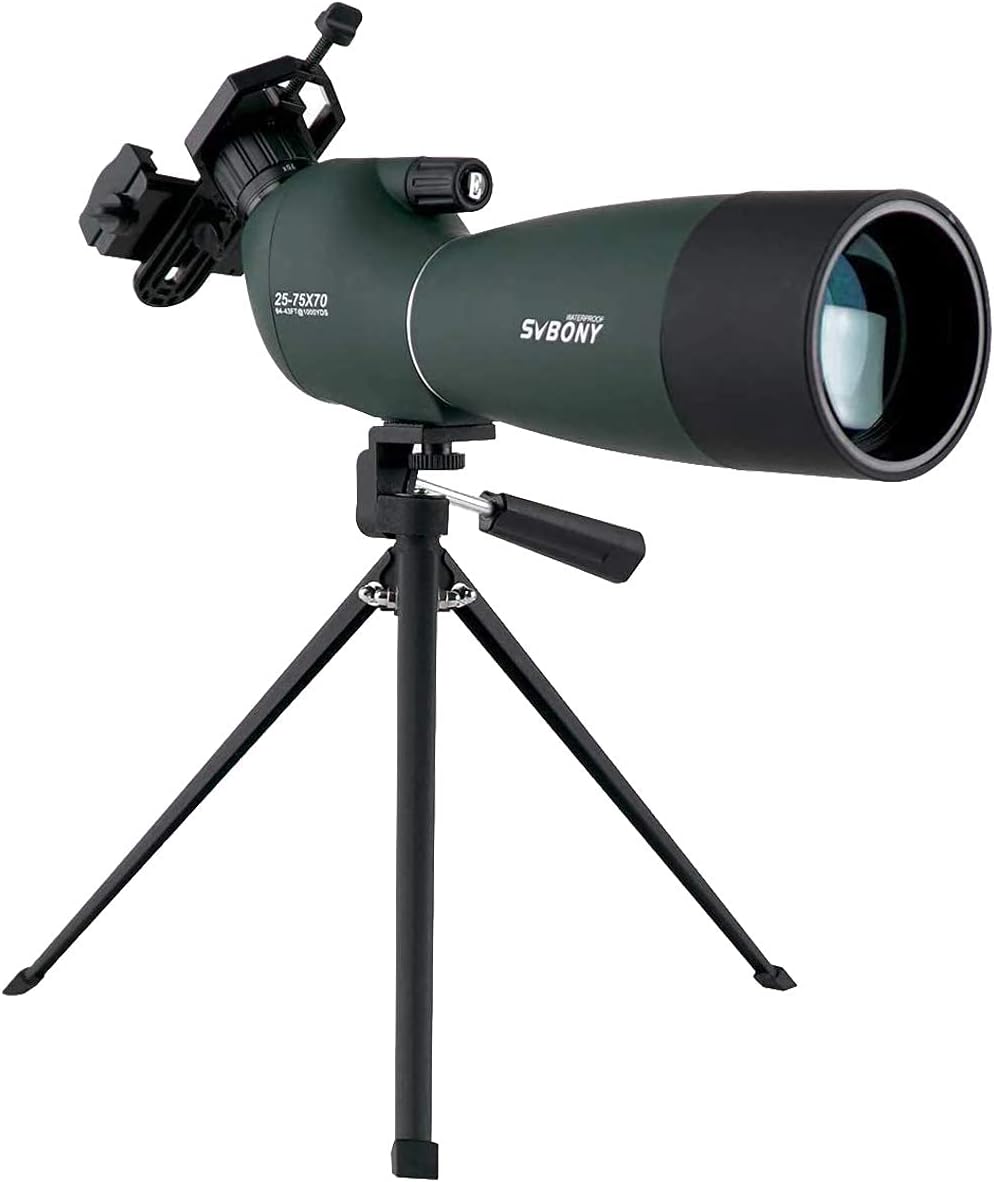
SVBONY SV28
4.4Editor score
25-75x magnification
70mm objective lens
Included phone adapter
Portable desktop tripod
Our spotting scope for wildlife photography guide compares magnification, objective size, optical clarity, stability, weather resistance, and digiscoping
A spotting scope for wildlife photography should combine enough magnification to isolate distant subjects with an image bright enough to preserve detail in shaded forests, open wetlands, and low evening light. Objective diameter, optical coatings, tripod compatibility, and a secure phone or camera connection matter as much as the advertised zoom range.
We compared ten scopes using their magnification, objective lens, prism and coating specifications, field of view, focusing system, weather sealing, tripod hardware, and included digiscoping accessories. The list covers entry-level bundles, general-purpose birding scopes, premium glass, and models designed for photographers who want to connect a camera.
Each review explains where a scope is strongest, where its specifications create limitations, and which kinds of wildlife photographers may benefit most. Product details and availability can change, while ratings reflect the information available when this guide was prepared, so readers should verify current specifications before purchasing.
4.4Editor score

4.7Editor score

4.0Editor score
This side-by-side comparison highlights the ten scopes by magnification, objective size, optical construction, outdoor protection, and included support gear, helping wildlife photographers identify the most suitable option for their field setup.




The Vortex Crossfire HD 20-60×80 Angled combines a broadly useful zoom range with an 80mm objective, making it one of the strongest all-around options for wildlife observation and digiscoping. Its 4.7 rating reflects a favorable balance of optical capability, practical controls, and field-ready construction. The angled eyepiece also improves comfort during extended viewing.
We may earn a commission when you buy through this link, at no additional cost to you.
Its HD optical system uses selected glass elements and anti-reflective coatings to improve resolution, color fidelity, edge-to-edge sharpness, and light transmission. A wide field of view helps photographers locate animals before zooming in, while the 80mm objective provides a useful advantage in shaded or lower-light settings. The helical focus mechanism supports both quick repositioning and more precise refinement when a distant subject is moving.
The scope does not include a phone adapter, so photographers using a smartphone must add their own compatible digiscoping accessory. Its 20-60x range also provides less reach than several 25-75x alternatives, and maximum magnification cannot replace a dedicated telephoto lens for very distant wildlife. These are modest limitations against the convenience of Arca-Swiss compatibility and the well-rounded optical design.
This is the strongest general recommendation for bird photographers, mammal observers, and outdoor users who want dependable sharpness without moving into specialist premium glass. It works particularly well for scanning habitats, tracking wildlife at moderate distances, and pairing with a phone or camera through a separate adapter. Those wanting the longest reach should compare one of the 75x models, but the Crossfire HD offers the most convincing combination of brightness, handling, and mounting flexibility here.
The wide field of view is valuable when animals move behind trees, reeds, or uneven terrain. A photographer can locate the subject at lower magnification, center it, and then narrow the view without repeatedly searching a narrow frame.
Arca-Swiss compatibility allows direct use with compatible tripod heads, while the included support system appears designed for immediate setup. That flexibility helps when switching between a field tripod, a vehicle mount, or a more permanent wildlife hide.
We may earn a commission when you buy through this link, at no additional cost to you.
The SVBONY SV28 is an approachable starting point for wildlife photographers who need substantial magnification without beginning with specialist equipment. It carries a 4.4 rating and pairs a 25-75x zoom with a 70mm objective, specifications that suit casual birding, landscape observation, and distant wildlife. The angled design makes it comfortable to use with its supplied support.
We may earn a commission when you buy through this link, at no additional cost to you.
The large objective gathers more light than a compact scope while remaining portable enough for family outings and travel. Its extendable sunshade helps control glare, and the seamless non-slip exterior should be easier to maintain when the scope is handled with damp hands. For photographers, the most useful included feature is the phone adapter, which makes basic digiscoping possible without immediately buying a separate accessory.
The desktop tripod is the clearest limitation. It works for stationary observation but offers much less flexibility than a full-height field tripod when tracking birds across open ground or following animals in woodland. The 70mm objective and unspecified premium coating design also place the SV28 below the more advanced scopes in raw light gathering and optical refinement.
Choose this model if the central goal is an inexpensive, portable introduction to wildlife digiscoping. It is well suited to beginners, casual photographers, and families who want the 75x reach of an included phone adapter. Serious wildlife photographers working from a vehicle or distant subjects should spend more on a larger objective, stronger tripod, and possibly a dedicated camera adapter.
The included phone adapter removes one of the most common obstacles for new wildlife photographers. Once the phone is aligned with the eyepiece, the scope can frame subjects that would otherwise appear very small, making distant behavior easier to observe and document.
Its portable form and included desktop support suit trips where carrying a full tripod would be inconvenient. The scope can also be moved to a car or campsite and set up quickly when a subject appears.
We may earn a commission when you buy through this link, at no additional cost to you.
The Flagship 20-60×80 is a balanced wildlife scope with an 80mm fully multi-coated objective, BAK4 Porro prism, and a 4.4 rating. It is designed for more than birdwatching, offering features that translate well to digiscoping: a wide field of view, dynamic focus, a metal tripod, a phone adapter, and a carrying case for field use.
We may earn a commission when you buy through this link, at no additional cost to you.
The 82.9-foot field of view at the low end helps photographers find wildlife without sacrificing too much context. Anti-reflective treatment on the objective and the BAK4 prism support brighter, clearer imagery, while the nitrogen-filled, sealed housing protects against rain, snow, and internal fogging. Rubber armor improves grip and impact resistance, and the stretchable eyepiece shield adds protection around the viewing end.
The smartphone adapter supports devices between 2.13 and 3.54 inches wide and up to 14 millimeters thick, so it will not accommodate every modern phone or case. At 60x, the scope has less reach than several rivals, and the bundled full-metal tabletop tripod is more suitable for stationary viewing than mobile wildlife tracking. Photographers needing greater reach should weigh a 75x model.
The Flagship is a good choice for users who want a complete general-purpose kit and want to begin photographing through a scope without buying a tripod, case, or phone mount separately. It is particularly attractive for birders who also enjoy wildlife observation. A serious photographer may eventually replace the tabletop support with a full-height tripod and add a camera adapter, but the core optical package is capable and well equipped.
The stated 82.9- to 48-foot field of view at 1000 yards provides a practical balance for locating wildlife. It gives the observer enough surrounding terrain to understand a subject's position before increasing magnification.
The carrying case, lens covers, cleaning cloth, phone adapter, and metal support reduce the need for separate purchases. That makes this scope convenient for beginners assembling a first wildlife-photography kit.
We may earn a commission when you buy through this link, at no additional cost to you.
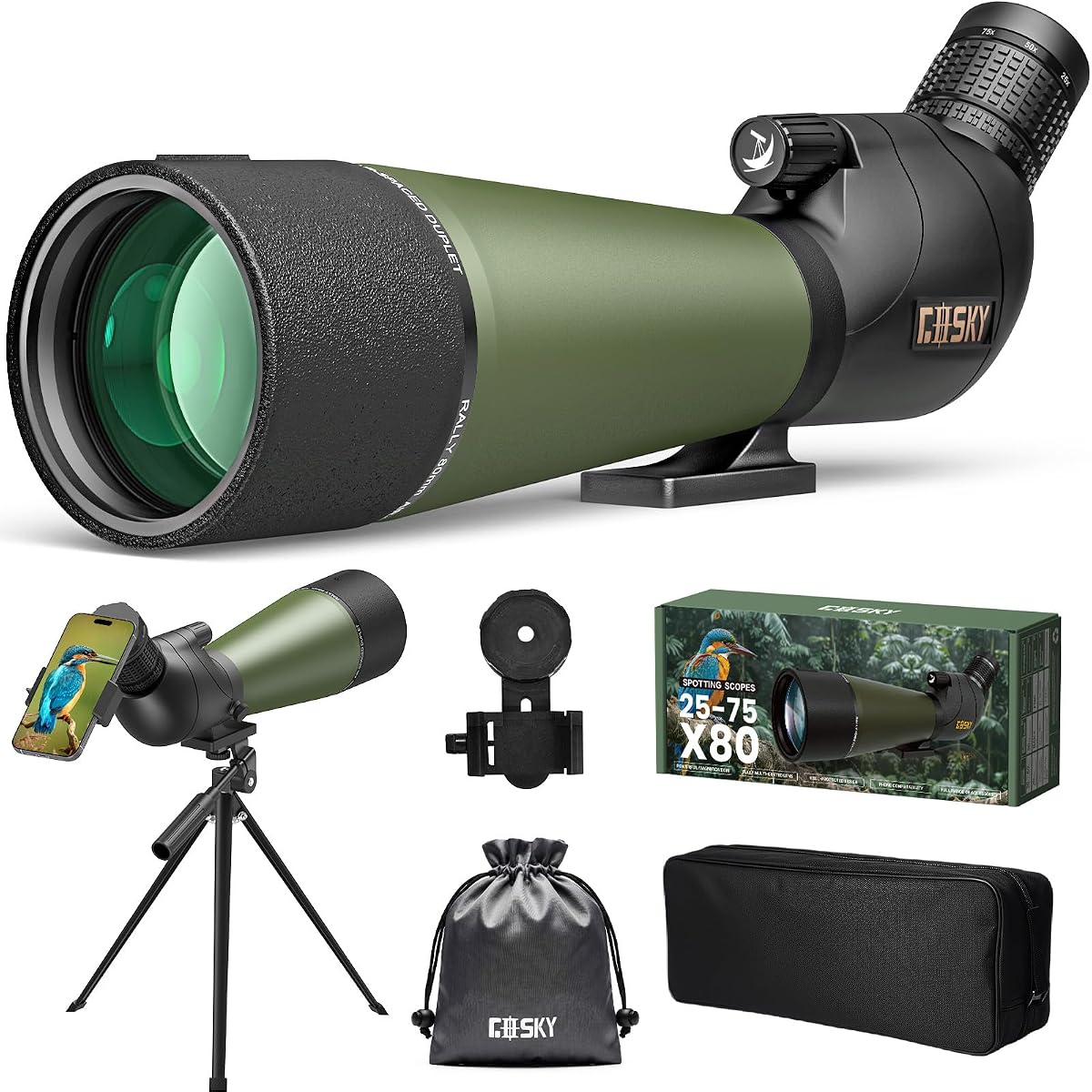
This 25-75×80 spotting scope stands out for including a genuinely adjustable full-size tripod, making it better equipped for mobile wildlife photography than many scope-and-desktop-stand bundles. It has a 4.4 rating, an 80mm fully multi-coated objective, and a BAK4 roof prism. The combination targets users who want more reach, a stable platform, and phone capture in one package.
We may earn a commission when you buy through this link, at no additional cost to you.
The tripod extends from 18.3 to 59.3 inches, allowing the scope to be used at different heights and viewing angles. That is particularly useful for photographing subjects near the ground or working from a seated position. A 45-degree angled eyepiece improves comfort, while the rubber-armored body, retractable sunshade, and waterproof and fogproof design suit outdoor conditions.
The stated field of view of 123 to 63 feet per 1000 yards is wide, which helps during target acquisition but may make distant details appear smaller than they would in a narrower-field scope. The full kit, including tripod, bag, covers, adapter, and cloth, is also more cumbersome to carry than a compact scope with a folding desktop support.
This model is a strong fit for beginners who want a complete setup for tracking and photographing wildlife across varied terrain. Its 75x magnification is useful for birds and mammals that appear at substantial distance, while the adjustable tripod helps reduce camera shake. Users willing to carry the larger support system gain more practical positioning than they would with a short tabletop stand.
The broad tripod adjustment range makes it easier to frame subjects without forcing the body into an awkward position. This is valuable when working around fences, vegetation, uneven ground, or low seating.
The BAK4 roof prism and fully multi-coated 80mm objective are intended to improve light transmission and image clarity. Those characteristics help when viewing animals under cloud cover, within forests, or during the softer light near dawn and dusk.
We may earn a commission when you buy through this link, at no additional cost to you.
The DiamondEdge 25-75×80 is an upgraded 80mm scope designed as a capable entry point for birdwatching, wildlife viewing, and outdoor observation. Its 4.4 rating and combination of a BAK4 prism, fully multi-coated optics, and a relatively large 23mm eyepiece make it appealing to users who prioritize a bright, comfortable view without moving directly to specialist premium glass.
We may earn a commission when you buy through this link, at no additional cost to you.
The 80mm objective and optimized optical design support a wide field of view, bright images, and strong color accuracy. A rotatable body allows the scope to be repositioned on a tripod, and the standard 1/4-20 base provides broad compatibility with universal support systems. For field comfort, the rubber armor protects the body while improving grip, and the retractable sunshade reduces glare.
The supplied tripod is a tabletop model, which is a meaningful limitation for tracking animals across long distances. Wildlife photographers should plan on adding a full-height tripod and a compatible phone or camera adapter. The listed general-purpose accessories are useful, but a more specialized camera connection is not included in the stated package.
The DiamondEdge suits photographers who want a bright 75x scope and a conventional 23mm eyepiece for comfortable observation. It may also appeal to users who want a rotatable body for switching between landscape and wildlife viewing. Once paired with a proper tripod, it is a versatile option for general nature photography, but it does not offer the same camera-ready feature set as the Maven CS2A.
The 23mm eyepiece is larger than many competing eyepieces and can provide a more natural viewing experience. A large eyepiece can make prolonged birding sessions and repeated wildlife tracking feel less tiring.
The rotatable body helps users find a comfortable angle on a standard tripod. It is particularly helpful when scanning open country, where moving between horizontal and angled positions may improve situational awareness.
We may earn a commission when you buy through this link, at no additional cost to you.
The Lightweight 25-75×60 is built for people who need to carry a spotting scope on foot while retaining enough zoom for meaningful wildlife observation. It has a 4.3 rating, a listed weight of 1.5 pounds, and a 60mm objective with BAK4 prism and fully multi-coated lenses. The included 14-inch tabletop tripod and carrying bag reinforce its travel-oriented design.
We may earn a commission when you buy through this link, at no additional cost to you.
Magnification ranges from 25x to 75x, allowing users to scan at a lower setting and isolate details at the upper end. The 60mm objective gathers more light than a very small lens, while the multi-coated optical system aims to maintain clarity and natural color. A standard 1/4-20 thread also allows the scope to be mounted on a full tripod or other compatible support.
A 60mm objective provides less light-gathering capacity than the 80mm and 85mm scopes in the list, which can affect image brightness in heavy shade, overcast weather, or toward dusk. The short tabletop tripod is not ideal for extended standing observation, and the scope's listed weight excludes the possibility of a larger camera being connected directly.
This is a good match for hikers, campers, and backyard birdwatchers who value portability over maximum brightness. A phone adapter is included for basic digiscoping, making it convenient to document discoveries without a separate purchase. Photographers working mainly in bright daylight will get more from it, while those regularly shooting in low light should favor a larger objective.
At a listed 1.5 pounds, the scope is easier to include in a day pack than a larger glass-and-frame setup. The included carrying bag further reduces the chance of damage during transport and helps keep the equipment organized.
The 25-75x range covers both general landscape scanning and closer observation of birds or animals. It is a useful compromise for mobile users who want more reach than a fixed-magnification compact scope.
We may earn a commission when you buy through this link, at no additional cost to you.
The Dual Focus 20-60×80 is a strong option for wildlife photographers who want precise focusing control, an adaptable eyepiece, and a bright objective. It holds a 4.5 rating and uses dual focus knobs to separate fast positioning from fine adjustment. The 80mm BAK4 optic with full broadband multi-coating is designed for bright, clear observation in difficult outdoor light.
We may earn a commission when you buy through this link, at no additional cost to you.
A detachable 1.25-inch eyepiece interface gives the scope more flexibility than a permanently fixed design and can expand future options. Twist-extendable eyecups are intended to accommodate both glasses wearers and users who view without glasses. The ergonomic 45-degree body reduces neck strain when sitting, standing, or crouching, while a 360-degree rotating tripod bracket allows flexible positioning.
Its 60x maximum is less than that of several alternatives, and the included phone adapter is more suitable for casual sharing than serious still photography. The stated low-light performance still depends on ambient conditions, objective quality, and the camera or phone used to capture the image. Users planning extensive camera work should verify adapter and sensor alignment before relying on it.
The scope is well suited to birders, nature photographers, and observers who appreciate detailed focus control. The dual knobs are especially useful when a subject changes distance unexpectedly, allowing quick movement followed by controlled refinement. It is a compelling mid-list choice for mobile wildlife work, though photographers prioritizing maximum reach may prefer one of the 75x models.
Dual focus knobs reduce the need to make tiny turns on a single control. The photographer can reposition quickly, then use the finer mechanism to settle focus when the subject stops moving or reaches a stable perch.
The detachable 1.25-inch interface adds flexibility to a scope that would otherwise have a fixed viewing assembly. The extendable eyecup can also be adjusted to suit different eyeglass profiles and preferred eye relief.
We may earn a commission when you buy through this link, at no additional cost to you.
The Maven CS2A is the specialist choice in this group for wildlife photographers who value optical quality, low-light brightness, and camera compatibility. Its 4.0 rating is the lowest among the ten products, but the stated design goes beyond ordinary observation: extra-low dispersion glass, an 85mm objective, and compatibility with standard adapters for smartphones, DSLRs, and mirrorless cameras.
We may earn a commission when you buy through this link, at no additional cost to you.
Extra-low dispersion glass is intended to reduce chromatic aberration while preserving sharp, high-contrast detail and accurate color. The 85mm objective gathers substantial light for dawn, dusk, overcast, and shaded viewing, where smaller objectives tend to produce dimmer images. Fully multi-coated optics further support transmission, making this scope particularly relevant to photographers who need to resolve fine detail rather than merely identify a distant subject.
Its magnesium-and-aluminum frame weighs a listed 60 ounces and measures 15 inches, combining large-objective performance with manageable field weight. The trade-offs are a 66x maximum rather than 75x and a premium-tier purchase cost. The 4.0 rating is still a positive score, and it should be evaluated against the exceptional specifications rather than treated as a direct comparison of image quality with every budget model.
This scope is best for serious bird and wildlife photographers, naturalists working at dawn or dusk, and users who already understand camera adapters and will use a full tripod. The angled body supports long viewing sessions, while its 85mm aperture provides the brightness needed to make digital capture practical. Users who need more reach may prefer a 75x scope, but the Maven CS2A offers the strongest premium imaging-oriented feature set here.
The 85mm objective provides the largest light-gathering aperture among these choices. That advantage is meaningful when animals are active in shaded woodland, under heavy cloud, or during the dim periods surrounding sunrise and sunset.
Compatibility with standard digiscoping adapters for smartphones, DSLRs, and mirrorless cameras makes the scope easier to incorporate into a serious photography workflow. The angled body and full-sized objective can provide a bright viewing image while supporting camera capture of the same subject.
We may earn a commission when you buy through this link, at no additional cost to you.
The Vortex Diamondback HD 16-48×65 Angled is a compact premium-brand alternative for wildlife photographers who need good low-light performance and convenient mounting without the size of an 80mm or 85mm scope. Its 4.6 rating is among the strongest in the list, and the redesigned body combines a streamlined exterior with a helical focus wheel.
We may earn a commission when you buy through this link, at no additional cost to you.
The HD optical system is designed to provide high resolution, reduced chromatic aberration, strong color fidelity, and edge-to-edge sharpness. Multiple anti-reflective coatings improve light transmission, while Armortek coatings help protect lenses from oils, scratches, and dirt. The 65mm objective is smaller than the 80mm options, but it remains capable for birds and mammals viewed in reasonably open or well-lit environments.
The 16-48x range provides less reach than most of the alternatives, making it more suitable for nearby or moderately distant subjects. It is not a substitute for a long telephoto lens, but the wide low-end power is useful for scanning. The scope accepts Arca-Swiss tripod heads and 1/4-20 threads, while also working with a car window mount, which expands its usefulness for mobile wildlife photography.
Choose the Diamondback HD if a trusted optical platform, fast focus, and flexible mounting matter more than maximum magnification. The compact objective and low weight also make it a logical travel scope. It is strongest for birding, general nature observation, and moderate-distance wildlife, while photographers chasing tiny subjects at extreme range should look to the 75x or premium 85mm options.
Compatibility with Arca-Swiss heads, 1/4-20 threads, and a car window mount makes the scope adaptable to several observation positions. This is useful for travel photography, roadside wildlife searches, and locations where a full tripod may be cumbersome.
The built-in helical focus wheel supports both rapid movement and fine correction. A photographer can follow a bird taking off, slow down when it lands, and refine the focus without searching for a separate control.
We may earn a commission when you buy through this link, at no additional cost to you.
The Swarovski Optik ATS 65 HD combines a 20-60x eyepiece with a 65mm objective and earns a 5.0 rating. It is particularly distinctive for its 10-foot close-focus distance, wide 118-foot field of view, and 17mm eye relief. These characteristics make it more than a distant-wildlife instrument, extending its usefulness to nearby subjects and prolonged observation.
We may earn a commission when you buy through this link, at no additional cost to you.
The objective gathers ample light for bright, clear images in challenging conditions, while the zoom eyepiece allows rapid scanning before narrowing to a distant subject. The angled body and generous eye relief improve comfort during extended sessions. Its waterproof construction, rated to 13 feet, and nitrogen filling provide dependable protection against rain and internal condensation.
The 60x maximum magnification trails the 75x scopes in this guide, and the 65mm objective gathers less light than the 80mm and 85mm models. A phone or camera adapter is not included, so photographers must confirm compatibility and obtain an appropriate mount separately. These limitations make it less convenient as an all-in-one digiscoping package.
The ATS 65 HD is an excellent choice for birdwatchers and wildlife photographers who value close focusing, a broad field, eye relief, and premium optical refinement. It is particularly useful when subjects can approach relatively close, such as garden birds, shoreline wildlife, or animals near a hide. Those primarily needing extreme reach should compare longer zoom ranges, while compact digital capture is possible with the correct separate adapter.
A stated close focus of 10 feet allows the scope to handle subjects much nearer than many general-purpose models. That makes it useful for detailed views of perched birds, grazing mammals, and wildlife encountered along paths or near water.
The 17mm eye relief and angled viewing design reduce the chance of eye strain during lengthy observations. Those features are valuable for photographers spending extended periods following subjects rather than taking quick looks.
We may earn a commission when you buy through this link, at no additional cost to you.
The most useful scope is one that balances brightness, magnification, focusing control, portability, weather resistance, and camera connection for the way you actually photograph. A large maximum number does not automatically create a better image, so begin with the distances and light conditions you expect to encounter.
Objective diameter is the number at the front of the scope and is one of the most important specifications for digital wildlife photography. A larger objective gathers more light, which helps maintain a bright, detailed image in forests, heavy cloud, dawn, and dusk. The models here range from 60mm to 85mm; the 85mm Maven CS2A should have the strongest low-light potential, while the 60mm model is the most portable but least generous in dim conditions. Objective size also affects physical bulk, so it must be balanced against how far you intend to walk.
Magnification determines how much a distant subject is enlarged, but useful image quality and stability decline as power increases. The 75x scopes offer the most reach, whereas the 16-48x Diamondback HD prioritizes a wide starting view. Field of view is equally important because wildlife rarely remains centered; a wide field makes animals easier to find, while a narrower field can make distant subjects larger. A good compromise is usually a low setting for searching and a higher setting for confirmation or framing.
ED glass, BAK4 prisms, and multi-coated lenses are central to producing a bright image with controlled color and contrast. ED glass can reduce chromatic aberration around fine branches, feathers, and high-contrast edges. BAK4 prisms support light transmission, while broad or full multi-coating improves brightness by limiting reflection within the optical path. These technologies do not create a perfectly corrected image by themselves, and barrel alignment, focus quality, and atmospheric conditions still influence the result. They do, however, give premium scopes a useful advantage in difficult light.
At high magnification, small movements become obvious, and camera shake can reduce both the live view and recorded image. A full-height adjustable tripod therefore offers more than convenience for mobile wildlife photography. Check the mounting thread, included bracket, and head compatibility before buying. Arca-Swiss support is useful for photographers who already own compatible tripod equipment, while standard 1/4-20 fittings provide broader options. A desktop tripod is adequate for stationary viewing but is less effective for following animals across a field.
Digiscoping turns a spotting scope into a viewing tool for a phone, DSLR, or mirrorless camera. Some products include a universal phone adapter, but compatibility varies with phone width, case thickness, and adapter design. Camera adapters may require a specific eyepiece interface, and the camera must be able to focus through the scope. The Maven CS2A is explicitly described as compatible with standard smartphone and camera adapters, while several other models include phone mounts. Buyers should verify the required adapter, prevent light leakage, and ensure the camera can hold focus at the desired magnification.
Wildlife photography often takes place in wet grass, misty wetlands, snow, and changing humidity. Nitrogen purging and sealed or O-ring-sealed construction help prevent internal fogging, while rubber armor improves grip and protects the body from impacts. Waterproof does not mean suitable for immersion unless the manufacturer states a specific depth, so lenses should still be protected from rain and spray. A retractable sunshade also helps by reducing glare and shielding the objective from larger drops. These features are especially important for scopes that remain outdoors for long sessions.
Wildlife rarely remains still, so focusing controls should be precise enough to follow movement without making every adjustment feel abrupt. A single helical wheel provides fast and fine control, while dual knobs separate rough positioning from fine adjustment. An angled eyepiece is usually more comfortable on a tripod, and adjustable eyecups help users with and without glasses find a suitable eye position. The DiamondEdge's rotatable body adds positional flexibility, while the ATS 65 HD emphasizes eye relief. Handling should be assessed with the tripod and camera in place, not while holding the scope alone.
The best scope is one you will carry to the location where the wildlife appears. Lightweight scopes are easier for hiking, while 80mm and 85mm models can require a more deliberate pack strategy. A carrying case, objective and eyepiece covers, cleaning cloth, phone adapter, and tripod can determine whether a package is ready for immediate use. The SVBONY and several 80mm bundles include useful accessories, but none of those features replaces choosing a tripod and camera connection appropriate to the photographer's equipment.
Set up the tripod before raising the scope, tighten the controls gradually, and position the eyepiece at a comfortable angle. Begin at low magnification, scan systematically, and center the animal before increasing power. Stabilize the camera or phone against the scope or adapter, align it with the optical axis, and eliminate light leakage around the phone case before focusing.
Focus slowly and avoid zooming while a subject is moving rapidly. Let the image settle, make small corrections, and use a faster shutter speed when the animal or camera is moving. If the phone or camera cannot hold focus through the scope, use the scope for precise observation and make the final image with a dedicated telephoto lens rather than forcing an unstable digital setup.
After use, retract the sunshade, cap both ends of the optical path, and allow the scope to acclimate before bringing it into a warm vehicle. Keep it in its case and away from moisture, dust, and direct heat. Clean lenses with the supplied cloth or an appropriate lens-cleaning method, avoid harsh chemicals, and inspect the seals, tripod thread, and adapter connection before the next outing.
A spotting scope can be useful for identifying, locating, and digitally photographing wildlife, especially with a phone or compatible camera adapter. Its fixed magnification and potential alignment issues make it less flexible than a dedicated telephoto lens. For serious wildlife images, a tripod, accurate focus, and a camera setup that supports the required magnification remain important.
A range of approximately 20x to 60x is versatile for scanning and photographing many birds and mammals. Models reaching 75x provide more detail on very distant subjects but can amplify shake and make framing more difficult. The best starting point is usually the lowest magnification that reliably allows you to identify the animal.
A larger objective generally gathers more light, producing a brighter and clearer view in shade, overcast weather, or near dawn and dusk. It may also help when a camera needs a usable exposure through the scope. The trade-off is extra size and weight, so the ideal objective depends on how portable your field setup must remain.
No. A phone adapter must match the scope's eyepiece size and geometry, and the phone or case must fit within the adapter's stated dimensions. Some products include a suitable adapter, while others require a separate purchase. Check both the eyepiece interface and phone size before ordering, and remove or position the case as required to prevent gaps.
A tripod is strongly recommended because it reduces shake, maintains framing, and makes it easier to keep both eyes on the wildlife. Desktop supports can work for stationary viewing, but a full-height tripod is more useful when tracking animals across changing terrain. It also makes long sessions less tiring and improves alignment between the camera and eyepiece.
Choose a waterproof, nitrogen-purged, or O-ring-sealed model for humid and changing conditions. After bringing a cold scope into a warm environment, leave it in its case and allow it to acclimate before removing the lens covers. Using the sunshade can also reduce glare and help protect the objective from rain and snow.
An angled eyepiece is generally more comfortable when the scope is mounted on a tripod, especially for prolonged wildlife observation and photography. A straight design can feel natural for quick casual viewing and may occupy less vertical space. For tripod-based digiscoping, an angled body is usually the more ergonomic choice.
A spotting scope is usually better for quickly locating and observing wildlife because it offers a wide scanning range and a bright, stable magnified view. A telephoto lens generally provides more consistent camera focusing, framing, and exposure control for finished photographs. Many wildlife photographers use both, relying on the scope to find animals and the lens to capture them.
The Vortex Crossfire HD is the strongest overall choice because its 80mm objective, HD optics, helical focus, and versatile mounting system balance visibility, convenience, and photographic potential. The SVBONY SV28 serves buyers who want a portable and approachable first setup with a phone adapter, while the Maven CS2A provides the premium case with its 85mm objective, ED glass, and camera-adapter support.
Prioritize light-gathering capacity and a stable tripod before treating maximum magnification as the decisive feature. Wildlife photographers working in shade or near dawn and dusk should favor an 80mm or 85mm objective, while travelers may accept a 60mm model to reduce weight. Verify phone or camera compatibility, tripod fittings, focus behavior, and weather sealing before making a final choice.
Specifications, ratings, and availability can change, so confirm the current product details before purchasing. Compare the complete accessory package with the equipment already owned, and consider whether the intended use is casual digiscoping, systematic bird photography, or serious camera work. A carefully matched scope, tripod, and capture device will produce a more dependable wildlife workflow than magnification alone.