
Mission Darkness TitanRF Faraday Tape
4.4Editor score
IEEE 299-2006 test support
Durable peelable backing
Designed for TitanRF fabric connections
Our Faraday Tape guide compares 10 conductive EMI shielding options for cable repair, grounding, RF enclosure sealing, electronic protection, and more today.
Faraday tape is a conductive adhesive material used to interrupt or redirect electromagnetic and radio-frequency interference, repair shielding, ground components, and create electrical bonds. Good tape should be easy to shape, maintain conductivity across overlapping seams, adhere to several surfaces, and remain dependable under the conditions of the finished project.
We compared ten products using their stated materials, dimensions, conductivity, shielding functions, adhesive characteristics, temperature resistance, intended applications, and supported test information. The list covers narrow repair tape, wide rolls for enclosure seams, long rolls for harnesses, and options explicitly intended for Faraday fabric, cages, bags, and RF equipment.
Each review explains where the tape is most useful, what stands out in its specifications, and where careful application may still be necessary. Ratings reflect the supplied customer feedback rather than personal testing, and prices and availability can change, so readers should confirm current product details before purchasing.
4.4Editor score

4.5Editor score

4.6Editor score
The comparison below organizes all ten rolls by their most useful traits, including dimensions, construction, and primary shielding or repair roles. It is intended to make it easier to match narrow, standard-width, or long rolls to a particular electronics, cable, guitar, or enclosure project.


This 2-inch by 59-foot roll is a strong all-around Faraday tape choice, combining double-sided conductive cloth with conductive adhesive. Its 4.5 rating reflects favorable customer feedback, while the broad width and extensive stated applications make it practical for EMI shielding, grounding, wire-harness wrapping, RF interference control, and electrical repairs.
We may earn a commission when you buy through this link, at no additional cost to you.
A major benefit is electrical continuity at overlapping seams. The conductive material on both the cloth and adhesive allows one strip to overlap another without creating a discontinuity, which is important when closing Faraday cages, repairing shielding, or joining conductive fabric. The metallized surface is described as providing stable conductivity and effective interference shielding.
The product is also unusually versatile. Its listed uses include laptop and phone repair, speakers, microphones, LCDs, keyboards, PCB heat dissipation, paper circuits, RFID signal blocking, electric-guitar noise reduction, cable wrapping, and the construction of shielded boxes or wallets. It can reportedly adhere to metal, aluminum, plastic, glass, copper, brass, and other surfaces.
Compared with narrower rolls, this option covers substantial area without requiring many parallel strips. That makes it a sensible general-purpose selection for makers, technicians, and enclosure builders. Although the 59-foot length is shorter than the longest roll in the list, it offers a balanced combination of width, continuity, and application flexibility for most projects.
Best for: users who want one broad, conductive roll capable of handling seams, harnesses, grounding, electronic repairs, and general EMI shielding. It is the strongest recommendation here for projects that do not fit neatly into a single category.
Overall recommendation: this tape is the most versatile option in the guide, with particularly strong potential for broad seams, cable wrapping, and projects that need both conductive bonding and shielding.
The main limitation is that broad cloth tape is not a substitute for verified RF engineering, especially in demanding or safety-critical installations. Operators should also isolate the material from energized circuitry because a conductive adhesive can create unintended electrical paths.
Its 4.5 rating, 2-inch width, 59-foot length, and double-conductive construction make it an easy choice for buyers who value flexibility. For most DIY shielding and repair jobs, it offers the most balanced feature set in this roundup.
Because both the cloth and adhesive are conductive, overlapping pieces can remain electrically continuous. This is especially useful when joining sheets, closing an enclosure, or covering a seam with a second pass.
The two-inch width covers cable bundles and enclosure seams efficiently, while the material can be cut into strips, squares, circles, or custom pieces for electronics repairs and grounding paths.
We may earn a commission when you buy through this link, at no additional cost to you.
This 2-inch by 50-foot conductive cloth tape combines high-strength polyester fiber, acrylic adhesive, and a copper-nickel conductive layer. The 4.6 rating is among the strongest in the collection, and the stated heat resistance and tensile strength set it apart as a practical option for electrical repair, sealing, grounding, and EMI or RFI shielding.
We may earn a commission when you buy through this link, at no additional cost to you.
Its double-sided conductive construction is useful when a repair must create more than an isolated patch. The manufacturer says it can establish reliable connections between non-solderable components, which is convenient for temporary or broad-area electrical bonds. The copper-nickel layer is intended to support stable conductivity while improving resistance to interference.
The range of listed applications is extensive. This tape is proposed for internal shielding repair, circuit work, ESD grounding, cable shielding, paper circuits, RFID blocking, PCB heat dissipation, EMP-related protection, guitar noise reduction, automotive harness wrapping, and sealing Faraday cages. It is also described as adhering to metal, plastic, foam, and glass.
Compared with the first pick, the most meaningful difference is the explicit emphasis on high-temperature resistance, polyester strength, and a stated military-grade shielding approach. The trade-off is a shorter 50-foot length, so buyers covering very long harnesses or entire large enclosures may need more than one roll.
Best for: technicians, electronics repairers, and builders who want a wide, high-strength tape with stated heat resistance and strong adhesion across several surface types.
Overall recommendation: this is a confident alternative to the top pick for users who place greater importance on material strength and heat performance than on maximum roll length.
As with every conductive tape in this guide, it should not be placed across live power rails or other energized paths unless the circuit has been properly de-energized and verified. The shielding claims should also be considered in the context of the actual enclosure, frequency, and grounding design.
With its 4.6 rating, durable construction, and strong application range, it is well suited to precision repair, automotive harness work, and shielding jobs where a two-inch format is convenient.
The stated polyester-fiber base and high-temperature resistance make this option more relevant to demanding repair environments. The copper-nickel layer adds conductivity while the acrylic adhesive supplies initial tack.
Conductive adhesion on both sides can be valuable when a non-solderable component needs a contact point. The resulting connection still depends on surface cleanliness, firm pressure, and sound grounding design.
We may earn a commission when you buy through this link, at no additional cost to you.
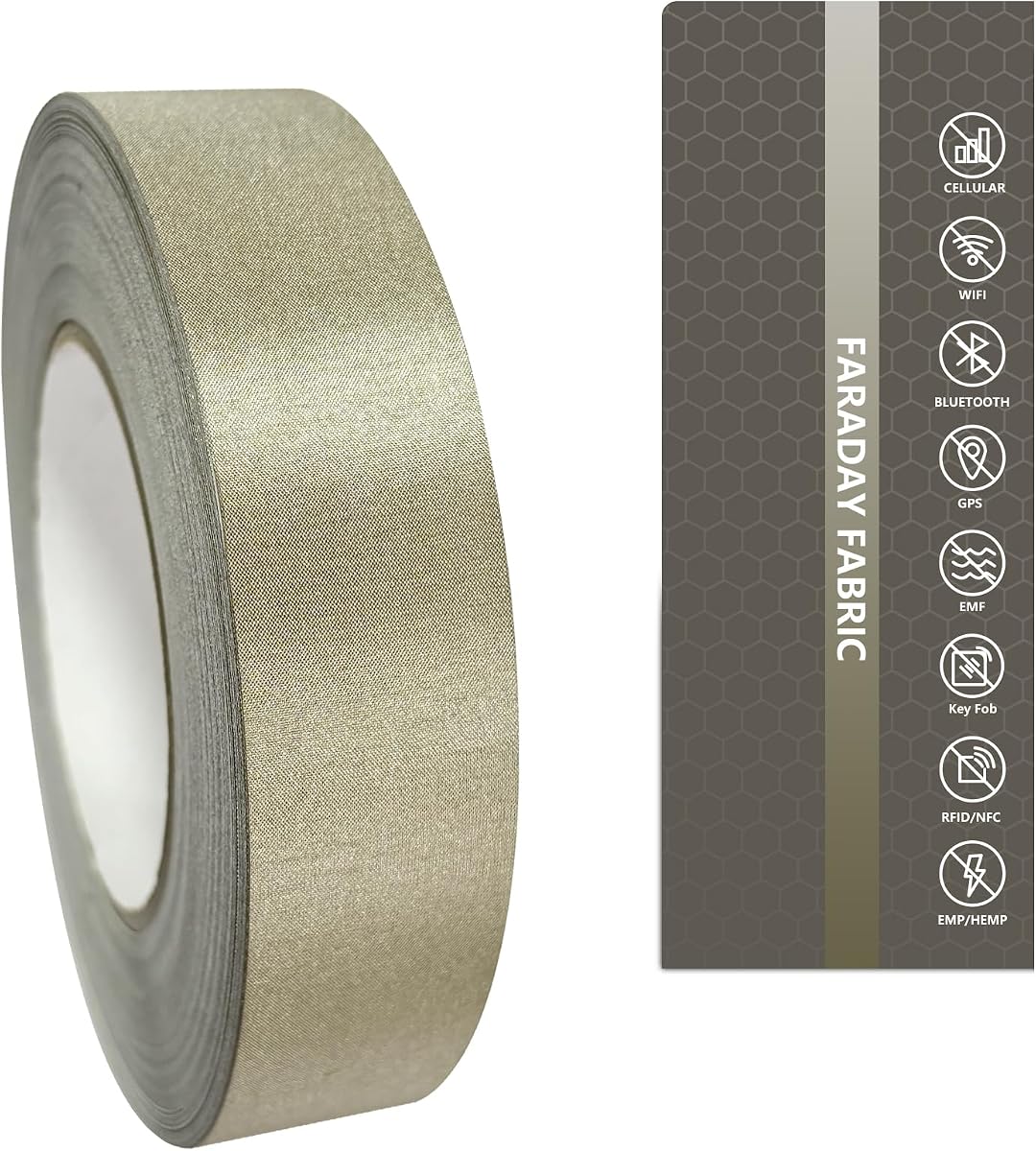
Mission Darkness TitanRF Faraday Tape is the most documentation-focused product in the guide. Its 4.4 rating is complemented by a stated IEEE 299-2006 shielding-effectiveness confirmation, with a full report available on request. It is explicitly designed to connect TitanRF fabric sheets and seal RF enclosures.
We may earn a commission when you buy through this link, at no additional cost to you.
The 2.5-inch-wide roll uses a peelable backing that is described as resistant to ripping or tearing without strong force or scissors. This construction supports controlled placement, and the included instruction card provides guidance for common uses. It suits industrial, military, construction, and IoT applications in addition to consumer DIY projects.
Most importantly for serious buyers, this product is not presented solely as a generic metallic tape. Its stated lab testing and intended use with a recognized shielding-fabric system provide a clearer technical rationale. It is aimed at users who understand enclosure continuity, access points, and the importance of joining conductive material without gaps.
The obvious trade-off is length. At 10 feet, this is the shortest roll listed, so it may be insufficient for extensive enclosure coverage unless several pieces are used. The specialized TitanRF focus may also make it less compelling for a household project that only needs a small grounding patch or guitar-noise repair.
Best for: RF engineers, industrial builders, serious Faraday-cage constructors, and users of TitanRF fabric who value test documentation and a system-specific seam-sealing solution.
Overall recommendation: this is the premium pick because documented shielding effectiveness and targeted enclosure use set it apart from rolls marketed only around general conductivity.
Even with test support, actual performance depends on the completed enclosure. Seam continuity, surface contact, grounding, and coverage of all openings collectively determine whether a shielded structure performs as intended.
For buyers who only need routine electronics repair, the tape may be more specialized than necessary. For those building or maintaining a serious RF enclosure, however, its tested and purpose-built design makes it the most technically compelling choice here.
The stated IEEE 299-2006 test report is the key differentiator for buyers who need more than general shielding claims. Buyers can request the report to review the conditions and results before specifying the tape.
Connecting separate conductive sheets without a gap is a common weak point in DIY shielding. This tape is specifically offered as a straightforward way to join TitanRF fabric or repair punctured shielding material.
We may earn a commission when you buy through this link, at no additional cost to you.
This 0.4-inch by 66-foot roll is the leading precision option in the roundup. Its 4.6 rating reflects strong customer feedback, and the narrow width makes it especially useful for tracing compact grounding paths, wrapping small harnesses, or reaching areas that are difficult to cover with a broad roll.
We may earn a commission when you buy through this link, at no additional cost to you.
The construction uses double-conductive cloth and conductive adhesive, providing conductivity on both sides. Listed shielding applications include RF, RFID, RFI, EMI, EMF, and LF interference. The manufacturer also highlights anti-static performance, flexibility, abrasion resistance, and resistance to aging as additional material properties.
The roll is not limited to a single substrate. It is described as usable on metal, aluminum, plastic, glass, copper, brass, ceramics, tiles, and floors. That makes it a flexible choice for electronics repair, wire-harness wrapping, paper circuits, grounding, guitar interference reduction, shielded cages, and joins between conductive fabric sheets.
The central disadvantage is efficiency on large surfaces. A narrow strip covers less area per pass, so enclosing a sizable device or shielding a long cable can require several overlapping lengths. That extra work may be worthwhile when the project needs controlled placement or when broad tape would be difficult to maneuver.
Best for: precision electronics work, narrow cable runs, small repair patches, compact grounding traces, and detailed fabrication that benefits from a manageable tape width.
Overall recommendation: this product balances a strong rating with a long roll and excellent maneuverability. It is a sensible first tape for many makers even though it is not the fastest option for large shields.
The narrow format should still be applied with care. Full-width contact is important, and a continuous overlapping seam is necessary if the tape is expected to carry a grounding path or preserve shielding continuity.
Its 4.6 rating, 66-foot length, and 0.4-inch width make it an attractive balance of precision and roll value for detailed projects.
The narrow format can follow small cables, circuit-board edges, and complex contours with less excess material. It is particularly useful when the repaired area does not justify a wide roll.
A 66-foot length provides plenty of material for repeated harnesses, small shields, and individual grounding paths. The continuous format also makes it convenient to cut custom pieces as needed.
We may earn a commission when you buy through this link, at no additional cost to you.
This 1-inch by 50-foot double-sided conductive tape offers a standard format for electrical repair and shielding. Its 4.4 rating, flexible construction, and stated 0.11-millimeter thickness make it a practical middle ground between narrow precision rolls and broad seam-covering options.
We may earn a commission when you buy through this link, at no additional cost to you.
A useful feature is easy installation. The manufacturer says the tape can be twisted, bent, and shaped by hand without extra tools, allowing it to conform to component contours or fit around cable bundles. The conductive cloth and adhesive also allow overlapping sections to remain electrically continuous.
The surface compatibility list includes metal, aluminum, plastic, glass, copper, brass, ceramics, tiles, and floors. Potential uses include creating electrical contact without welding, internal shielding, static grounding, circuit maintenance, and sealing Faraday-style enclosures.
Its one-inch width is less efficient than two-inch options for large seams but more useful in confined assemblies. The 50-foot length is also shorter than the 65- and 66-foot rolls elsewhere in the list. Nevertheless, it is easy to manage and can be cut into custom strips for several distinct repairs.
Best for: electronics repairers and makers who want a manageable roll that combines conductive bonding, shielding, grounding, and hand-shaping in one standard-width product.
Overall recommendation: it is a versatile option with fewer specialty claims than some alternatives, but its simple format and broad material compatibility make it easy to use.
The absence of prominent published shielding-test information in the supplied details may matter to buyers who need independently documented performance. The product should still be evaluated in relation to the required shielding range and installation quality.
For general repair kits, the one-inch format is intuitive and versatile. Its 4.4 rating, double-sided conductivity, and easy shaping make it a solid general-purpose choice.
The flexible format follows irregular components and curves without complex tools. This is helpful for repair work where the tape must sit close to a board, housing, or cable path.
Conductive cloth and adhesive allow adjacent pieces to form an electrically continuous path. This makes it useful for grounding strips and enclosure seam coverage.
We may earn a commission when you buy through this link, at no additional cost to you.
This radio-frequency blocking tape combines a metallic foil layer with conductive adhesive and earns a 4.6 rating in the supplied feedback. It is positioned as an easier-to-shape alternative to rigid aluminum foil, offering strong conductivity and electromagnetic-interference shielding performance.
We may earn a commission when you buy through this link, at no additional cost to you.
Its adhesive is intended to maintain electrical continuity across seams and joints. That property is especially relevant when users are closing an RF enclosure, modifying a device, or adding a grounding path. The material can be twisted, bent, and shaped, although the manufacturer recommends scissors to preserve the tape during cutting.
Audio-focused uses are a defining feature. Listed applications include repairing internal shielding layers, modifying electric guitars, reducing RF interference in audio devices, creating DIY Faraday bags, and attaching grounding pads. These are practical situations where a thin, conformal tape can reach spaces that are awkward to cover with sheet material.
Two width options are described: 1 inch by 65 feet and 2 inches by 65 feet. Buyers need to verify the selected variant because width changes the speed and reach of installation. A narrow version suits detail work, while the wider option is more efficient for seams and larger bonding areas.
Best for: audio builders, guitar modifiers, and electronics technicians who want a conformal conductive layer for grounding pads, internal shielding, and RF enclosure work.
Overall recommendation: the 4.6 rating, metallic layer, and conductive adhesive make this a compelling option when flexibility and reliable seam bonding are the priorities.
Because a metallic layer is highly conductive, accidental contact with live circuitry can create shorts. It should only be applied after isolation and testing, and it should not be used as a substitute for a properly engineered ground system.
For audio and RF repair projects, this tape's combination of conformability, strong adhesion, and selectable widths is especially useful.
The flexible foil-like construction can follow internal housings and irregular surfaces. It is useful for reducing interference paths or adding conductive contact in audio devices and modified guitars.
Conductive adhesive helps maintain continuity where separate tape sections meet. Firm, clean contact is still needed to obtain a continuous bond across the joint.
We may earn a commission when you buy through this link, at no additional cost to you.
This roll is identified as a one-inch, double-conductive Faraday fabric tape with high-temperature positioning and a 4.5 rating. The manufacturer also indicates that 0.2-inch, 0.5-inch, 1-inch, and 2-inch widths are available, with each roll measuring 66 feet, giving buyers a useful range of formats for the same general design.
We may earn a commission when you buy through this link, at no additional cost to you.
The tape uses two-sided conductive glue and conductive cloth, while the metallized nickel or copper surface is credited with stable conductivity and EMI shielding. Described properties include anti-interference performance, antistatic behavior, aging resistance, flexibility, and abrasion resistance. The material can be cut into several shapes for sensitive components.
The stated applications cover a wide range of electronics work: circuit connections, electrical repairs, wire-interference shielding, automotive harness wrapping, cable fixing, paper circuits, PCB heat dissipation, guitar noise elimination, data-cable wrapping, and use as a conductive circuit sticker. Laptop, mobile-phone, LCD, speaker, microphone, remote-control, and keyboard repairs are also listed.
The heat-resistance positioning differentiates it from more generic cloth tape, although the supplied information does not provide a specific temperature figure. Buyers should therefore confirm whether the adhesive and construction are appropriate for the actual thermal environment rather than relying on a general high-temperature description.
Best for: electronics technicians and serious hobbyists who want several possible widths in a conductive fabric system and need tape for both small repairs and larger shielding paths.
Overall recommendation: its 4.5 rating, 66-foot length, and flexible width selection make it a practical addition to an electronics-repair kit.
The wide range of advertised uses can make it difficult to judge without exact material and temperature data. Users with specialized high-temperature requirements should confirm the relevant specifications before installation.
Its double-conductive construction, metallized surface, and cut-to-shape flexibility make it a versatile option for everyday electronics and interference-control projects.
The available range supports very narrow grounding paths as well as broader cable wraps. This is helpful for buyers who may not know the final geometry before beginning a project.
A nickel or copper metallized layer provides the stated conductive surface. It is intended to work with the conductive adhesive to maintain continuity through overlapping sections.
We may earn a commission when you buy through this link, at no additional cost to you.
NIULAFR's 3/4-inch by 65-foot roll earns the highest supplied customer rating in the guide at 4.8. It uses high-strength polyester fabric with a copper-nickel plated layer and acrylic adhesive, combining stable conductivity with secure adhesion and a clean-removal claim.
We may earn a commission when you buy through this link, at no additional cost to you.
The double-sided conductivity is designed to support circuit connections for components that cannot be soldered. The stated material also offers heat resistance and tensile strength, while the acrylic adhesive provides strong initial tack and longer-term attachment in working environments.
ESD grounding is one of the clearest use cases. Other listed applications include Faraday-cage sealing, cable interference blocking, PCB heat dissipation, guitar noise reduction, RFID signal blocking, and internal shielding repair. Adhesion is reported on metal, plastic, glass, foam, and other common materials.
The 3/4-inch width is particularly useful when one-inch or two-inch tape would be cumbersome. It can create grounding traces and seam strips with less excess material while still moving quickly along cables. The 65-foot length is adequate for multiple repair jobs, although a large enclosure could consume it quickly.
Best for: ESD-conscious electronics work, internal shielding repairs, cable grounding, and users who want a controlled-width tape that removes cleanly from most surfaces.
Overall recommendation: its 4.8 rating, durable construction, and clean-removal positioning make it one of the most reassuring general choices in the roundup.
Clean removal does not mean the tape should be installed over energized circuitry. Its electrical conductivity makes isolation essential, and users should verify the adhesive's compatibility with the underlying material before leaving it in service.
The balance of rating, adhesion, durability, and manageable width makes this an excellent pick for both electronics repair and RF-enclosure work.
The composite construction provides a stable conductive layer over a strong fabric base. That balance supports both electrical continuity and resistance to tensile stress during installation.
The acrylic adhesive is described as having strong initial tack and removing without sticky residue on most surfaces. This makes the tape practical for repairs that may later need to be reopened.
We may earn a commission when you buy through this link, at no additional cost to you.
This 0.6-inch by 66-foot fabric tape is built around a detailed polyester, copper, and nickel construction. Its 4.3 rating is the lowest among the ten products, but that should be considered alongside the unusually specific description of the material layers and their intended resistance to oxidation and corrosion.
We may earn a commission when you buy through this link, at no additional cost to you.
According to the product details, polyester fiber receives nickel through chemical deposition or physical metal transfer, followed by a high-conductivity copper layer and an electroplated anti-oxidation and anti-corrosion nickel finish. The resulting composite is intended to provide strong conductivity and effective EMI shielding while resisting environmental degradation.
Double-sided conductivity, high initial adhesion, and tensile strength make it relevant to non-solderable connections, grounding, and internal shielding. The stated uses include cable shielding, paper circuits, PCB heat dissipation, EMP-related protection, automotive wiring harnesses, guitar noise reduction, and Faraday-cage sealing.
The roll can be hand-torn and is stated to adhere to metal, plastic, foam, and glass while leaving no residue after removal. Its narrow width supports detailed repair work, although it will take longer than a two-inch option to cover a broad panel or enclosure.
Best for: builders who value a clearly described multilayer conductive construction, especially for display repair, narrow grounding paths, compact cables, and shielded fabric connections.
Overall recommendation: although its rating trails the leaders, the specification detail gives technical buyers useful information about how the conductive layer is formed and why it is intended to resist corrosion.
Because its rating is the lowest in the group, prospective buyers may wish to consider recent customer feedback and confirm that the stated construction fits the exact application. The tape still requires proper electrical isolation and careful grounding.
Its 66-foot length, narrow format, and corrosion-resistant conductive build make it a capable option for detailed and long-term-oriented electronics work.
The nickel, copper, and outer nickel layers are designed to balance conductivity with oxidation and corrosion resistance. That makes the material relevant to projects where long-term stability matters.
The hand-tearable 0.6-inch format lets users create small patches and grounding paths quickly. Scissors may still provide cleaner edges on detailed electronics work.
We may earn a commission when you buy through this link, at no additional cost to you.
This extra-long Faraday tape is available in a 1.18-inch width with a stated length of 149.2 feet. It carries a 5.0 rating and stands out for providing more continuous material than any other roll in the comparison, making it attractive for long cable runs, large enclosure seams, and repeated repair work.
We may earn a commission when you buy through this link, at no additional cost to you.
The product uses double-conductive cloth with a copper-nickel conductive surface. One side is described as bonding strongly to different materials, while the conductive side creates sealed seams and patches. Its principal applications include sealing Faraday cages, bags, and RF enclosures, as well as repairing punctures or tears in existing shielding.
Electrical bonding and ESD grounding are additional strengths. The through-plane conductivity is intended to support connections between shielding and chassis, grounding components, and conductive traces in non-soldered work. It is also suitable for cable repair, and the manufacturer includes wide seams and harness wrapping among its intended uses.
Three practical widths are described: 0.5 inch for detail work, 1.18 inches for general sealing and long runs, and 2 inches for broad seams and harnesses. The selected 1.18-inch version balances coverage with maneuverability, making it a sensible default for extensive but not extremely broad coverage.
Best for: users covering long cable harnesses, multiple enclosure seams, or a series of grounding and repair points without changing rolls frequently.
Overall recommendation: the 5.0 rating and exceptional roll length make this a strong choice for high-volume and extended projects, provided the selected width matches the installation.
A perfect rating may reflect a limited number of customer reviews, so it should not be treated as a guarantee of every application. The tape's conductivity also creates a genuine safety concern around powered equipment, making de-energization and verification essential.
For long, continuous installations, its 149.2-foot length reduces interruptions and material waste. Combined with a practical 1.18-inch width, it is the most efficient option for extended seam and harness coverage.
A 149.2-foot roll supports long harnesses and multiple seams with fewer joins. This can improve workflow efficiency and reduce the number of separate pieces that must be coordinated.
The double-conductive construction is intended to carry a connection through the material, helping link shielding to a chassis or ground a component. Contact quality and the overall grounding path remain essential.
We may earn a commission when you buy through this link, at no additional cost to you.
Choosing Faraday tape requires matching conductive construction, physical size, adhesion, and intended use to the enclosure or electronic assembly. The most important distinctions are not merely whether a roll is called shielding tape, but how it is built, how large the project is, and what level of documentation the application requires.
For ordinary electronics repair, look for consistent conductivity, broad EMI and RFI applications, and a construction that creates continuity where strips overlap. For demanding RF work, documented test information is more valuable than a long list of general-purpose claims.
Match width to the smallest and largest surfaces in the project. A narrow precision roll is best for detail; a broad roll is best for fast, extensive coverage.
Estimate the total path length before purchasing, then add enough material to account for overlap, cuts, and unusable ends. Long rolls reduce interruptions, while compact rolls are more portable.
For a reliable electrical path, choose tape with conductivity on both sides and maintain firm, uninterrupted contact. A conductive face alone may not be enough for overlap-dependent grounding.
Prioritize tapes that explicitly match your surface and offer either strong initial tack or clean removal. Do not assume that residue-free removal applies to every plastic or coating.
For heat or mechanical stress, favor stated polyester strength, tensile resistance, and heat tolerance. Do not rely on a general durability claim when a specific temperature rating is required.
Choose based on the finished goal: narrow detail, long harness, broad seam, internal patch, or grounding bond. A purpose-built option is usually easier to justify than a general-purpose roll.
Always de-energize and verify the circuit before applying conductive tape. Treat the finished shield as part of an electrical system, not merely a decorative layer.
Begin by identifying the shielding path, grounding point, or damaged area that the tape must cover. De-energize the device, discharge capacitors where appropriate, and verify that the work area is safe. Clean the bonding surface thoroughly, because dust, oil, fingerprints, and loose oxidation can interfere with both adhesion and electrical contact.
Measure the area and plan the overlap before cutting. Use scissors for clean edges, particularly on foil-like options, even when hand tearing is possible. Press the tape firmly into place with full-width contact, avoid wrinkles and trapped air, and ensure that adjoining sections overlap enough to create a continuous conductive path.
For grounding, connect the tape to the designated chassis or ground point rather than simply wrapping it around an arbitrary surface. For enclosure shielding, cover seams, punctures, and openings systematically, then inspect the finished assembly. Keep conductive material away from energized components, and follow any manufacturer-specific instructions for the device or shield.
Faraday tape is used to shield, ground, repair, or redirect electromagnetic and radio-frequency interference. Typical applications include closing Faraday cages, repairing shielding bags, wrapping wire harnesses, reducing guitar noise, blocking RFID signals, connecting conductive fabric, and adding grounding paths around sensitive electronics. Its effectiveness depends on the material, coverage, enclosure design, and quality of the electrical connection.
No. Conductive cloth tape can look similar while differing in conductivity, adhesive construction, metallized coating, temperature resistance, and shielding performance. A useful Faraday tape should have a conductive adhesive and maintain continuity when sections overlap. Buyers should check the stated construction and application details rather than treating every metallic-looking cloth tape as equivalent.
Yes, particularly when overlapping sections need to carry an electrical or shielding path. Conductive cloth and conductive adhesive allow the junction between pieces to remain electrically continuous. This is helpful for cage seams, fabric joins, grounding traces, and patch repairs. Full surface contact and clean application are still necessary for the path to work reliably.
Yes. Conductive cloth tape is commonly proposed for shielding guitar cavities, pickups, and internal connections, where it can reduce RF pickup and unwanted noise. The application should avoid interfering with solder joints, controls, or high-current paths, and the tape should be grounded as appropriate for the instrument's design. Electrical safety is especially important because a bridge pickup can carry signal-level current.
A narrow roll such as the 0.4-inch or 0.6-inch option is usually easier to control around small components and circuit boards. One-inch tape is a versatile alternative when a repair needs slightly more coverage. Broad two-inch rolls are more efficient for large seams, cable bundles, and enclosure work but can be awkward to position in confined spaces.
No. Conductive tape can unintentionally bridge contacts or create new current paths, so it should not be installed on an energized circuit. Disconnect the power source, discharge appropriate capacitors, and verify isolation before applying it. If a specific device requires live work, consult a qualified technician and follow the manufacturer's service guidance.
Use a conductive tape broad enough to cover the seam securely, clean both surfaces, and apply the tape with firm, continuous contact. Overlap adjoining pieces rather than merely placing their edges against one another, and inspect the finished seam for gaps, wrinkles, or lifted edges. The cage must also be grounded correctly, and openings beyond the taped seams may still need dedicated RF shielding.
Performance can change if the adhesive or conductive surface is damaged during removal. Some products are described as leaving no residue and removing cleanly, but actual results depend on the substrate, age, heat, and removal method. If a tape will be reused, handle it carefully and replace it when the adhesive no longer holds firmly or the conductive face appears scratched or contaminated.
The best general-purpose choice is the 2-inch by 59-foot double-conductive cloth tape because it combines broad coverage, overlapping-seam continuity, and a wide range of electronics, harness, grounding, and RF uses. Mission Darkness TitanRF tape is the premium option for buyers who want stated IEEE 299-2006 test support and a purpose-built connection system, while the 0.4-inch by 66-foot roll is the value-focused precision pick.
Prioritize the job's geometry and required documentation rather than selecting solely by roll length. Narrow tape suits detailed repairs, broad tape covers enclosure seams efficiently, and long rolls help with extensive harnesses. Technical installations should also favor documented shielding performance, while every project needs proper surface preparation, secure grounding, and safe isolation from power.
Customer ratings and specifications provide a useful starting point, but current product details, availability, and prices can change. Review the selected size, conductive construction, adhesive compatibility, and intended use before purchasing, and follow the safety guidance supplied with the chosen tape.