
Ancable 300 Ohm T-Shape Dipole
4.5Editor score
300-ohm T-shape design
Simple plug-and-play setup
Extended coaxial cable
This guide compares the best antenna for FM radio options, including dipole, magnetic, telescopic, and AM/FM sets for home receivers.
An FM radio antenna can make a substantial difference in reception, particularly when a receiver’s built-in antenna produces static, intermittent stations, or weak stereo signals. The right model should match your receiver’s connector, suit the available space, and provide enough cable or extension to place the antenna away from interference.
The products in this guide cover 75-ohm coaxial antennas, 300-ohm dipoles, magnetic-base telescopic antennas, and combined FM and AM solutions. Their published ratings, connector types, cable lengths, mounting options, intended applications, and supplied accessories were compared without assuming that every antenna will perform equally in every location.
Each review explains the practical strengths and limitations of the selected model, while the buying guide focuses on compatibility, placement, impedance, and signal conditions. Product ratings and availability can change, and current prices should be checked on the linked listing before making a purchase.
A strong FM antenna does not need to be complicated or difficult to install. It needs a suitable connection, a practical way to remain in position, and enough separation from a receiver or other electronic equipment to capture a cleaner signal.
4.5Editor score

4.4Editor score

4.2Editor score
The comparison highlights antenna type, connection method, included adapters, and placement flexibility to help readers identify the most suitable option for their stereo receiver, compact radio, home theater tuner, or combined FM and AM system.


The Bingfu FM Radio Dipole Antenna is a 75-ohm indoor antenna designed for stereo receivers, music systems, home theater components, and FM tuners. It carries a 4.1 rating and stands out for its unusually generous selection of included adapters, which makes it a practical choice when the receiver’s antenna socket is not immediately clear.
We may earn a commission when you buy through this link, at no additional cost to you.
Its primary advantage is flexibility. The package includes a ten-foot coaxial extension, an F-type plug connection, and adapters for a TV female socket, a 3.5 mm audio plug, and a TV male plug. That range allows users to match common antenna inputs without replacing the receiver or buying a separate adapter. The adhesive mounting design also provides a way to keep the antenna elevated and away from the equipment housing.
The tradeoff is that compatibility still depends on selecting the right adapter, and the adhesive mount may not perform well on dusty, textured, painted, or frequently disturbed surfaces. Signal quality will also vary with local interference and placement. As the product information notes, repositioning the antenna, keeping it away from electronics, and placing it near a window can materially affect reception.
This antenna is best for someone with a household stereo receiver, home theater receiver, or music system that has a compatible FM input and needs more flexible placement than a stock antenna provides. It is a strong all-around choice for indoor users who value included accessories and a long cable. Verify the socket type and available mounting surface before ordering.
The ten-foot coaxial extension allows the antenna to be moved away from a receiver, power supply, television, or other electronics that may create interference. Keeping the antenna near a window or higher on a wall can also help it receive a clearer signal, although results depend on the building and local broadcast conditions.
The three supplied adapters cover several frequently encountered connections. Users should compare the receiver’s antenna socket with the included fittings before installation and tighten every coaxial connection to prevent signal leakage.
We may earn a commission when you buy through this link, at no additional cost to you.
This Magnetic Base Retractable FM Antenna combines a strong magnetic base, a five-meter coaxial lead, and a retractable antenna element. Its 4.2 rating and stated compatibility with major stereo receiver brands make it an attractive option for people who want simple placement without permanent installation.
We may earn a commission when you buy through this link, at no additional cost to you.
Cable length is the feature that most clearly distinguishes it from the other magnetic models in the guide. The sixteen-foot lead offers considerable freedom to move the antenna toward a window, onto a higher shelf, or away from a densely packed entertainment center. The retractable element adds another layer of adjustment, allowing the user to vary its extension without permanently changing the setup.
Its main limitation is dependence on a metal mounting surface. A refrigerator, metal shelf, entertainment cabinet, or similar object may work well, but the base will not remain in position on unsupported furniture. A magnetic base can also leave a visible mark on some delicate finishes, so placement should be chosen carefully. The product’s signal claims are most relevant in indoor home and home theater environments.
Choose this model if flexible positioning is your top priority and you have a suitable metal surface near the receiver. It combines a generous cable, a stable base, and a retractable element in one uncomplicated antenna. It is particularly useful for urban homes where the best reception position may change with interference or where a window location is more effective than the receiver’s immediate surroundings.
The five-meter cable is the longest listed among these picks, making it easier to place the antenna at a meaningful distance from the receiver. That separation can reduce interference from electronics and allows the user to test locations near windows or higher in the room.
The retractable design makes the antenna easier to store and fine-tune. Extending it can provide additional reach, while retracting it helps create a compact arrangement when the receiver is already receiving a strong local signal.
We may earn a commission when you buy through this link, at no additional cost to you.
The Bingfu Strong Magnetic Base FM Radio Antenna is a compact telescopic antenna for indoor stereo receivers and radio tuners. Its 4.4 rating is the highest among the ten products listed here, and the combination of a magnetic base, ten-foot coaxial cable, and three adapters gives it broad appeal.
We may earn a commission when you buy through this link, at no additional cost to you.
Compared with a basic telescopic antenna, this model offers much more freedom in positioning. The magnetic base can be placed on an appropriate metal surface, while the extended lead reaches toward a window, shelf, or other area that may receive a stronger signal. The telescopic element can also be adjusted as the user tests different orientations.
Users should not expect the magnetic base to hold on every surface, and it may be unsuitable around computers, speakers, or other metal objects if the position creates interference. The included F-type male plug and three adapters improve compatibility, but the receiver still needs to match one of the available connections. Placement should remain vertical on the metal surface for the best result, according to the product guidance.
This is a strong recommendation for a home stereo, Bluetooth-capable music system, or home theater receiver with a compatible antenna input. It combines a strong published rating with flexible placement and useful accessories. Choose it when an indoor magnetic mount is convenient and you want more reach than the receiver’s original antenna provides.
A magnetic base makes it easy to move the antenna without reconnecting the receiver. This is useful for comparing positions around a room, particularly when a local station is received better near a window than beside the stereo.
The ten-foot cable provides meaningful placement flexibility without becoming as cumbersome as a longer fixed lead. F-type and alternate adapter options cover many common indoor radio connections, making this a versatile package.
We may earn a commission when you buy through this link, at no additional cost to you.
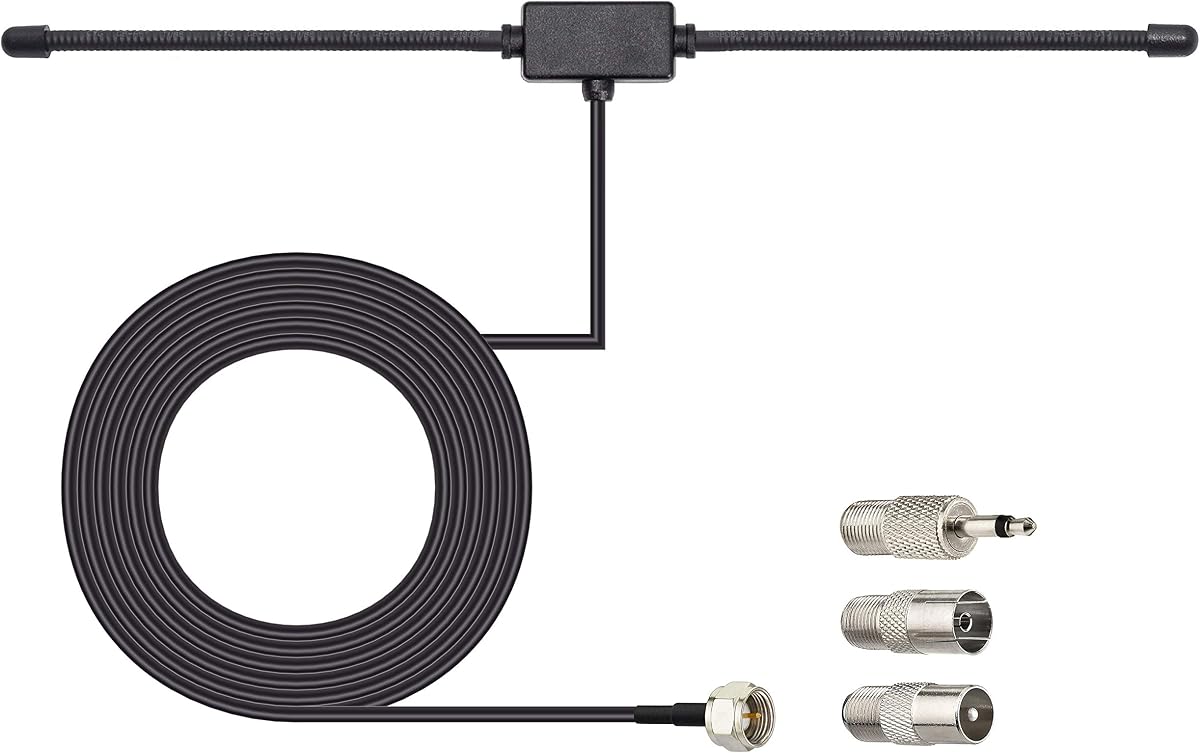
The Ancable 300 Ohm FM Antenna is a straightforward T-shaped dipole for receivers with a compatible clip or terminal-style FM socket. It has a 4.5 rating, the highest in this comparison, and offers a simple way to improve reception without adding powered components.
We may earn a commission when you buy through this link, at no additional cost to you.
The antenna includes a 5.9-foot coaxial lead, allowing the T-shaped element to be stretched away from the receiver. That separation is important because moving the antenna can help it find a clearer signal or reduce interference from nearby electronics. The product is suited to tabletop radios, home offices, garages, basements, and other indoor environments.
Its compatibility is narrower than that of the F-type models because it uses spade terminals rather than a threaded coaxial plug. Buyers should confirm the shape and type of the receiver’s FM socket before ordering. The terminals must also be attached correctly, and the antenna should be extended as far as practical for the intended result.
This antenna is a good choice for a receiver with clip or terminal FM connections and for users who value a compact, uncomplicated setup. It may be especially effective as a basic replacement for a short, permanently attached stock antenna. It is less suitable for receivers that require a type F connector, so checking the socket is essential.
The passive dipole design only needs a physical connection to the receiver. There is no power supply, amplifier, or pairing process, which keeps installation quick and makes the antenna easy to move between compatible devices.
Stretching the antenna away from the equipment gives the element a better chance of receiving a usable signal. A window, exterior wall, or upper shelf may work better than a position immediately behind the receiver.
We may earn a commission when you buy through this link, at no additional cost to you.
The Superbat FM Telescopic Antenna Kit is a compact 75-ohm antenna with a type F male connector. Its 4.0 rating reflects a basic but functional design, and the supplied alternative adapters allow it to serve a range of radio and receiver connections.
We may earn a commission when you buy through this link, at no additional cost to you.
The antenna uses steel and brass construction and extends to approximately twenty inches. That makes it easy to store and deploy, particularly for tabletop systems, portable radios, and receivers where a small footprint matters more than a long fixed cable. A threaded F-type connection can be straightforward to attach when the receiver has a matching female socket.
The package includes F-to-PAL male, F-to-PAL female, and F-to-3.5 mm adapters, which broadens its use with different equipment. Nevertheless, the maximum extension is relatively short, so it may not offer the same placement freedom as a dipole or magnetic model with a multi-foot lead. The listed compatibility also spans FM, DAB, and AV receivers, though actual performance depends on the device and signal.
This kit is best for someone who needs a compact replacement antenna and has a type F, PAL, or compatible 3.5 mm connection. It is especially convenient for a home radio or compact stereo. Users who have plenty of space and want to test distant placements should favor a model with a longer cable.
The telescopic format takes up little room and can be adjusted to suit the available area. It is a good fit for compact entertainment centers, kitchen radios, and office systems where a full dipole would be inconvenient.
The alternate fittings can prevent the need for an additional adapter when moving the antenna between compatible devices. Match both connector shape and intended radio service before installation.
We may earn a commission when you buy through this link, at no additional cost to you.
This FM Coax and AM Loop Set includes a 75-ohm FM coaxial antenna and a separate AM loop antenna. Its 4.1 rating and dual-band design make it useful for listeners who want to improve both FM and AM reception without sourcing two unrelated antennas.
We may earn a commission when you buy through this link, at no additional cost to you.
The FM portion uses a type F male plug and a 4.9-foot cable, allowing it to connect directly to many compatible receivers. The AM loop has a fold-out base and two bare-wire pins for receivers with a corresponding AM terminal. The package is portable and can be used in a home, garage, basement, attic, or office.
FM and AM signals behave differently, so the same placement advice does not always apply to both parts. The coaxial lead can be moved away from electronics, while the loop should be oriented and positioned according to the receiver’s instructions. The relatively short FM cable offers less freedom than the ten-foot and sixteen-foot alternatives, although it may be adequate in a strong-signal area.
Choose this set when your receiver supports both bands and has a type F FM input plus a two-pin AM terminal. It is a particularly useful all-in-one option for a home stereo or older receiver whose built-in antenna provides poor reception. Confirm both connection types before purchasing.
Including both an FM antenna and an AM loop provides a more complete setup than an FM-only model. This is helpful for older stereo receivers, garage radios, and hobby listening stations that remain in areas with accessible AM broadcasts.
The lightweight components are easy to move. The FM lead can extend toward a better location, while the fold-out AM base offers a simple way to orient the loop without permanent mounting.
We may earn a commission when you buy through this link, at no additional cost to you.
The Ancable Indoor FM Telescopic Antenna is a 75-ohm antenna with ten extension sections and a type F male connector. It has a 4.1 rating and is designed for compatible indoor receivers ranging from compact music systems to larger home stereo equipment.
We may earn a commission when you buy through this link, at no additional cost to you.
Its telescopic construction allows the user to adjust the antenna’s height and reach without adding a permanent cable. The listed brass and copper construction is intended to provide a sturdy, durable design, while the F-type connection and three included adapters offer flexibility across common devices.
The principal drawback is its maximum reach. Even with ten extension sections, it will not place the antenna as far from the receiver as a dipole with a multi-foot coaxial lead or a magnetic antenna on a sixteen-foot cable. Buyers with weak local signals should consider physical separation and placement as carefully as connector compatibility. The stated twelve-month warranty also adds reassurance for ownership.
This is a good option for a compact indoor receiver, especially one that supports a type F connection. It is easy to install without draping long wires and can be extended when a stronger position is needed. Choose it for a tidy setup with moderate placement requirements rather than for a difficult reception environment requiring maximum cable length.
The telescopic sections let the user change the antenna’s height and extension quickly. This makes it easy to compare a few positions around a radio or stereo without reconnecting the antenna each time.
The listed compatibility includes Bose Wave, Sangean, Cambridge Audio One, Pure Evoke, Tivoli Audio, Denon, Roberts, Sony, Marantz, Yamaha, Hitachi, and several other brands. Device names should still be checked against the actual connector type before purchase.
We may earn a commission when you buy through this link, at no additional cost to you.
The Bingfu Magnetic Telescopic Antenna in black is a 75-ohm-style indoor antenna option for stereo receivers, radio tuners, Bluetooth music systems, and home theater equipment. It has a 3.8 rating, the lowest in this guide, but its physical design remains useful for people who want easy repositioning.
We may earn a commission when you buy through this link, at no additional cost to you.
The magnetic base and ten-foot coaxial extension allow the antenna to be placed on a metal surface and moved toward a window or away from electronic equipment. A telescopic element adds some height adjustment. As with the other magnetic antennas, keeping it vertical on the metal surface is recommended for the best result.
Its lower rating suggests that customer experiences are less uniformly positive than the leading models, although ratings alone do not reveal why. The requirements are the same as those of similar magnetic products: a suitable metal surface and a compatible receiver socket. The included adapters reduce connection friction, but the correct one still must be selected.
Consider this antenna if you like the black finish, want the convenience of magnetic placement, and have a compatible ten-foot lead nearby. It is most appropriate for indoor systems in areas with reasonably accessible stations. For challenging reception or a need for maximum reach, one of the higher-rated alternatives may be a safer choice.
The black finish is designed to blend into a home theater or stereo setup better than a highly visible white component. It is useful where the antenna needs to remain accessible but should not dominate the room.
The extension provides enough slack to test several positions around a typical entertainment center. Moving the antenna can help identify whether a station is affected by nearby electronics or poor local coverage.
We may earn a commission when you buy through this link, at no additional cost to you.
The Superbat FM Antenna Replacement is a portable magnetic-base antenna for home stereo receivers, radio tuners, Bluetooth music systems, and home theater tuners. Its 3.7 rating is the lowest among the listed products, so it is best considered a practical option rather than the leading recommendation.
We may earn a commission when you buy through this link, at no additional cost to you.
Its physical design is straightforward: a magnetic base secures the antenna to a metal surface, while a ten-foot extension cable provides room to position it. The F-type male plug and supplied TV female, TV male, and 3.5 mm adapters cover several common connections. The receiver does not need any complicated setup beyond selecting the proper fitting and attaching the antenna.
The product claims improved, clear FM reception, but actual results depend on signal strength, local interference, and placement. A 3.7 rating indicates that experiences are mixed, making it particularly important to understand the installation conditions before purchasing. The magnetic base may also interfere with nearby sensitive electronics if placed too close to them.
This antenna is suitable for a portable or temporary setup where a metal surface is available and a receiver needs a replacement antenna. It may be useful for testing whether a different location resolves reception problems. Buyers with more demanding reception needs should investigate one of the higher-rated models, while checking current customer feedback before ordering.
The magnetic base eliminates brackets and adhesive, allowing the antenna to be installed or removed in moments. This makes it convenient for temporary listening locations and easy repositioning during signal testing.
The ten-foot lead is long enough to move the antenna away from a crowded equipment shelf. Testing near a window or different wall can help distinguish a positioning problem from a broader coverage issue.
We may earn a commission when you buy through this link, at no additional cost to you.
The Bingfu 75 Ohm FM and AM Antenna Set supplies both a 75-ohm unbalanced FM antenna with a type F connector and an AM loop with a two-pin bare-wire terminal. It has a 4.3 rating, placing it among the stronger-reviewed products in this comparison.
We may earn a commission when you buy through this link, at no additional cost to you.
This dual-band package is aimed at indoor home radio, stereo tuner, Bluetooth music system, and home theater receiver users. The FM component should connect directly to a compatible type F socket, while the AM loop is designed for a receiver with a two-pin AM connection. Including both antennas avoids the need to find a separate AM solution later.
Compatibility is the main factor to verify before ordering. The product guidance specifically advises checking that the receiver socket matches the listed type. The AM loop also needs correct positioning, and the FM antenna should be placed where it is not obstructed by electronic equipment. No specific cable length is stated, so buyers who require a long reach should consider that uncertainty.
This set is a good fit for a home stereo receiver that supports both FM and AM and has the appropriate connections. It offers a convenient, complete solution with a solid customer rating. Choose it over an FM-only model when AM listening matters, and use the included loop to improve reception of suitable local stations.
The included FM antenna and grounded AM loop make the package suitable for receivers that still support AM. It is a practical choice for users who want both antennas ready to connect without sourcing separate components.
A type F connector is common on many compatible home stereo receivers, allowing the FM element to attach without a complex adapter. Confirm the socket design and ensure the connector is firmly tightened.
We may earn a commission when you buy through this link, at no additional cost to you.
Choosing an FM radio antenna involves matching the physical connection, understanding the receiver’s requirements, and considering where the antenna can be placed. The most important factors are connector compatibility, usable cable or element length, mounting flexibility, and the nature of the local reception problems.
Start by identifying the exact antenna socket on the back of the receiver. Some equipment uses a threaded type F female socket, while older or more specialized radios may use clip terminals, spade connectors, PAL fittings, or a 3.5 mm input. A visually similar socket can still have different electrical or mechanical characteristics, so the manufacturer’s receiver documentation is the best source when available. The selected antenna should support the socket without forcing, altering, or adapting it in a way that risks a poor connection.
Choose an antenna with a direct, secure match whenever possible. If an adapter is necessary, make sure it supports the intended FM service and is listed for that connector combination.
Different reception issues require different solutions. Static or missing stations may indicate weak signal, interference, receiver problems, or an unsuitable antenna. A longer cable and greater separation from electronics can help when local interference is involved, but no indoor antenna can create coverage where the transmitter signal is extremely weak. Users should compare the behavior of the original antenna, check antenna connections, and note whether stations become clearer when the antenna is moved.
Match the antenna to the environment. Strong local signals may need only a compact telescopic model, while a weak or obstructed signal usually benefits from a dipole or magnetic antenna with more reach.
Cable length determines how far the antenna can be separated from the receiver and surrounding electronics. In the guide, the listed options range from a 4.9-foot FM lead to a five-meter magnetic model, while dipole and telescopic antennas provide other forms of reach. Longer is not automatically better, because excess cable can become untidy and may need careful routing. The useful measurement is whether the antenna can reach a window, upper wall, or shelf that produces a cleaner result during testing.
Prefer a length that permits meaningful position changes without requiring permanent installation. Secure loose cables so they do not move the antenna or create a trip hazard.
A dipole uses two opposing wire elements and can be effective when stretched away from the receiver. A telescopic antenna provides a compact single element that is convenient for smaller systems. A magnetic-base antenna combines an element and a cable with a movable mount, making it adaptable to different rooms. None of these formats guarantees better reception in every building, since antenna orientation, nearby structures, and electrical interference can matter as much as the design.
Choose the format that supports the placement you can realistically maintain. A simple antenna positioned near a window may outperform a more elaborate model hidden behind an entertainment center.
Impedance describes how an antenna and transmission line are matched to the receiver. The products in this guide include 75-ohm unbalanced coaxial designs and a 300-ohm dipole. The receiver’s antenna specification should take priority: use the impedance and connector type called for by the manufacturer. Although some systems tolerate a mismatch, choosing the intended design reduces guesswork and makes installation more predictable.
Do not assume that a visually similar plug is electrically compatible. Check both the connector format and the receiver’s stated antenna requirements before buying.
Consider where the antenna will live. Adhesive mounting is useful on a smooth wall or cabinet surface, while a magnetic base needs a suitable metal object. A telescopic model may be ideal where storage space is limited, and a dipole requires enough open span to stretch its elements. Portable systems should use a design that can be moved quickly rather than permanently fixed in one position.
Choose a mount that is stable and does not risk damage to the receiver, furniture, or nearby electronics. Magnetic bases should be kept away from sensitive equipment when their field could cause interference.
An FM-only antenna is sufficient when the receiver only offers FM listening or when the user has no interest in AM stations. A combined package is more convenient for older stereo systems with both bands. These sets commonly include an FM coaxial element and a separate AM loop with bare-wire terminals. The AM loop must match the receiver’s terminal arrangement and should be positioned according to the receiver instructions.
Choose a dual-band set when it can replace two separate accessories. Choose an FM-focused antenna when simplicity and a smaller package matter more.
Included adapters can be valuable, especially when a receiver uses an older or less common connection. Compare the supplied fittings with the receiver before ordering, and note whether the package includes a long lead, a mounting method, or only the antenna itself. Warranty coverage is also worth considering, particularly for a product that will remain installed for years. Accessories should complement rather than obscure the basic need for a compatible connection and good placement.
Prioritize a complete, clearly organized package that matches your actual equipment. Extra adapters are useful only when they fit and serve the receiver correctly.
Begin by disconnecting the receiver from power and identifying the correct FM antenna input. Connect the antenna using the specified connector or supplied adapter, then tighten threaded fittings securely. If the receiver already has an antenna attached, remove the original unit only after confirming that the replacement matches the socket and connection requirements.
Power the receiver and test reception in its normal position. Then move the antenna gradually toward a window, higher shelf, or area farther from computers, televisions, power supplies, and other electronics. For dipole models, stretch the elements as far as practical. For magnetic or telescopic models, adjust the height and orientation while comparing the reception of local stations.
Once a strong and stable position is found, secure the antenna without sharply bending the coax or putting strain on the connector. Keep joints dry and clean, check them periodically for looseness, and avoid placing the antenna near heat sources or heavy objects. After significant changes to the room layout, retest the position because nearby electronics and furniture can alter interference and signal quality.
The best type depends on the receiver connection and reception environment. A dipole or magnetic antenna with a longer cable is useful when the antenna must be placed away from electronics, while a compact telescopic model is convenient for a strong-signal location or limited space. Check the receiver’s required impedance and connector before choosing.
It can, but only if weak reception results from an inadequate antenna or poor placement. A better antenna may improve reception in areas affected by nearby electronics, an obstructed indoor position, or a poorly positioned built-in antenna. It cannot overcome extremely limited transmitter coverage, and receiver faults or incorrect tuning may also be responsible for poor sound.
There is no universal distance, but separating the antenna from the receiver and other electronics can reduce local interference. Start with a few feet of separation and then test closer to a window or on a higher shelf. Long cables provide more placement options, while short telescopic antennas are better suited to compact setups.
A type F connector is physical, while 75 ohms describes impedance, so the two terms answer different questions. A receiver may specify a 75-ohm unbalanced antenna with a type F socket, but some devices use a different impedance or termination. Confirm both the socket and the receiver’s antenna specification before purchasing an adapter or antenna.
No. An FM-only antenna is sufficient if the receiver only needs FM reception. A combined FM and AM set makes more sense for an older stereo receiver with an AM terminal or for a listener who wants access to compatible local AM stations. The included AM loop should match the receiver’s connection and be positioned according to its instructions.
FM signals can be affected by building materials, reflections, nearby electronics, and the antenna’s orientation. Moving the element changes how it captures the incoming signal and may place it in a cleaner area. If results change dramatically with location, keep the antenna at the position that provides the most stable reception and secure it there.
A magnetic base is normally used for mounting rather than for attaching directly to sensitive components. It should still be kept away from receivers, speakers, and other electronics that could be affected by magnetic fields. Also, a strong magnet can mark soft or delicate surfaces, so choose the mounting location carefully.
Power-cycling the receiver can clear some internal states and is a sensible final step after changing the antenna or connectors. It does not replace a compatible antenna or correct weak coverage, but it may help the receiver rescan the FM band using the newly connected setup.
The strongest general-purpose option in this guide is the Bingfu FM Radio Dipole because it combines a ten-foot cable, adhesive mounting, and several included adapters. The Bingfu Magnetic Base FM Antenna offers a highly rated alternative with a magnetic mount, while the Magnetic Base Retractable FM Antenna provides the greatest listed cable length and adjustable placement.
Prioritize the receiver’s connector and antenna specification first, then choose the physical design that can be positioned effectively in your home. Long leads, telescopic elements, and magnetic mounts are useful only when they help you move the antenna away from interference and toward a better signal. Dual-band sets make the most sense for receivers that also use AM.
Customer ratings, product availability, and prices can change over time. Before purchasing, compare the current listing details, confirm that the supplied connector fits your receiver, and read recent customer feedback. The linked product pages provide the most current information for making the final choice.
