
Baofeng Radio UV-5R
4.5Editor score
Compact dual-band handheld
Selectable high and low power
LED flashlight included
Our Ham Radio for Backpacking guide compares ten dual-band, digital, and QRP radios for range, battery life, charging, features, and trail readiness in 2026.
Ham radio for backpacking is most useful when cellular coverage disappears, terrain blocks signals, or a group needs dependable communication beyond the trailhead. The right radio balances usable range, battery endurance, physical size, charging flexibility, navigation, and features that remain practical in wet, cold, and dusty environments.
This guide compares ten handheld and lightweight radio options using their published specifications, including supported frequency bands, transmit power, battery capacity, charging methods, programming options, emergency features, displays, antennas, and physical design. It covers traditional dual-band analog models, a digital-and-analog radio, and a compact QRP transceiver for more experienced operators.
The recommendations show which model best fits a particular backpacking need rather than treating every radio as the same purchase. The 5RM-based handhelds are versatile all-rounders, the DM-32 adds digital functions and location reporting, and the Malahit offers a different low-power construction. Product listings, availability, and deal terms can change, so confirm current specifications before buying.
4.5Editor score
4.6Editor score

4.4Editor score
The comparison below highlights the major differences among the ten radios, including supported modes, display type, power options, emergency functions, and charging approach. It is designed to help backpackers identify the most suitable balance of capability and simplicity.


The Baofeng UV-5RM combines broad receiving coverage, licensed dual-band transmission, a color display, and a 2500mAh battery in a conventional handheld format. Its 4.6 rating reflects a favorable balance of features, and its published specifications make it a strong general-purpose choice for backpackers who want more than basic simplex communication. The radio supports 999 memory channels, which is useful for separating personal, group, and regional channel plans.
We may earn a commission when you buy through this link, at no additional cost to you.
Charging flexibility is one of its most practical trail advantages. The included USB-C cable and desktop charging base can draw power from wall outlets, power banks, laptops, car adapters, or other USB sources. That matters when a trip includes several days away from mains electricity. A one-touch frequency-copy function also reduces the need for repetitive manual entry when setting up compatible radios, while CHIRP support provides a more structured option for computer-based programming.
The receiving range extends across 108–136MHz, 136–174MHz, 220–260MHz, 350–390MHz, and 400–520MHz, while the listed amateur transmission bands are 144–148MHz and 420–450MHz. Transmitting on amateur frequencies requires the appropriate authorization. A built-in NOAA receiver supplies weather alerts, and the external speaker microphone keeps the radio accessible without holding it in the hand, although the added accessory can consume space.
This is the most versatile recommendation for ordinary multi-day backpacking because it combines useful emergency features with familiar handheld ergonomics and several charging paths. Choose it when you want programmable channels, weather reception, voice accessories, and a battery that can be replenished from a small power bank. It may not be ideal for someone seeking digital voice, built-in GPS, or the smallest possible antenna, but it offers the strongest general feature balance in this group.
Before packing it, program the exact channels needed for the trip and document them on paper. Confirm the antenna length, charging cables, and external microphone against the space available in your pack. Once those details are accounted for, the UV-5RM serves as a practical communications anchor for camps, trail teams, weather monitoring, and emergencies away from cellular networks.
The combination of USB-C and a desktop base charger lets a backpacker recharge from a power bank during a rest stop and top up the radio at camp. This reduces dependence on wall outlets and makes it easier to maintain a routine charging schedule across long routes.
NOAA alerts, a color screen, frequency copying, and an external speaker microphone provide useful backup capabilities in changing conditions. These features help keep the radio useful even when a primary navigation or communication device becomes unavailable.
We may earn a commission when you buy through this link, at no additional cost to you.
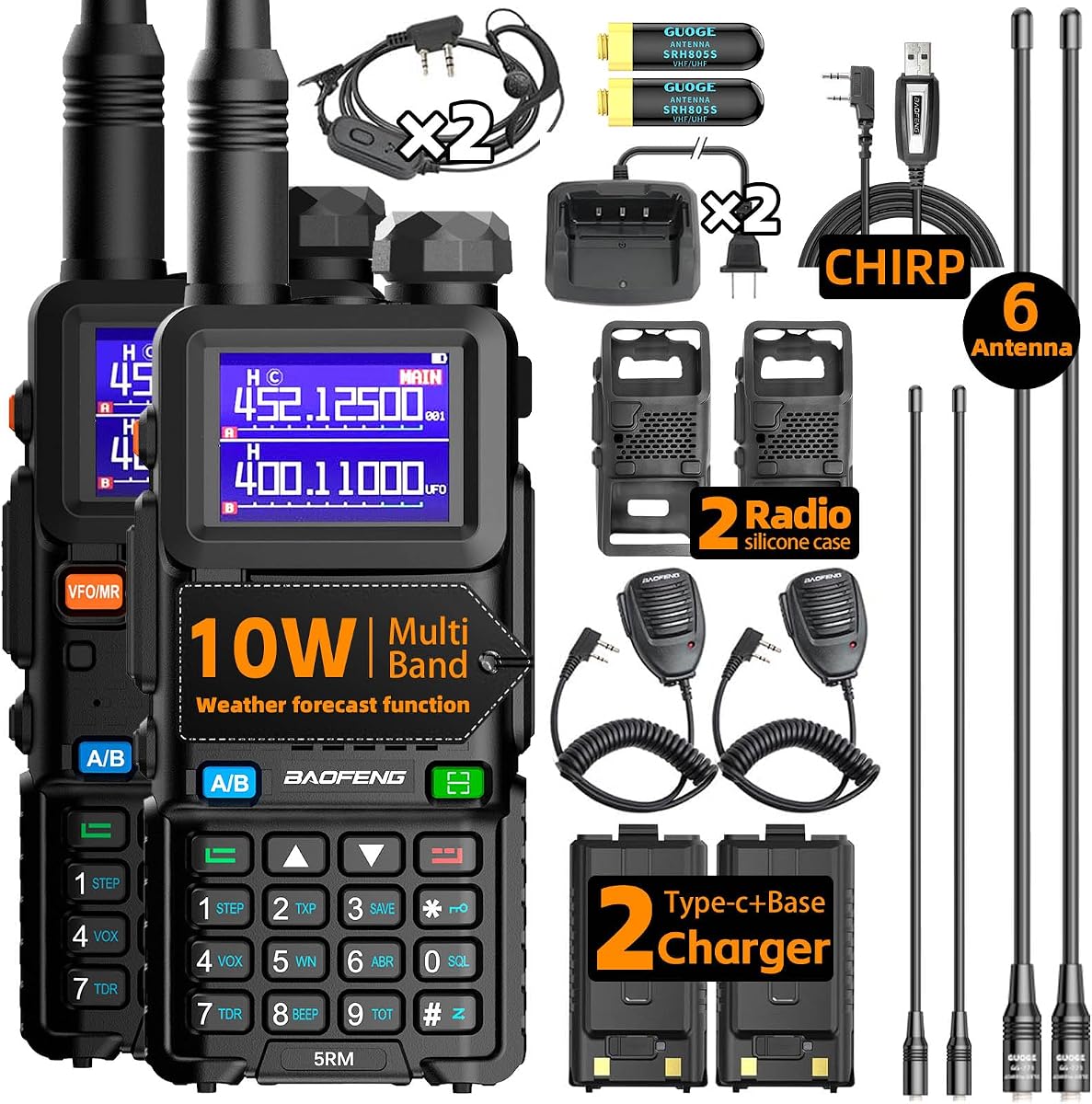
The AR-5RM two-pack is a practical choice for pairs, families, or small backpacking groups that need more than one radio. Each handheld has a 2500mAh rechargeable battery, a 1.77-inch color display, and support for up to 999 memory channels. Its 4.5 rating and broad feature set make the set appealing for users who prefer a ready-to-configure collection of common accessories.
We may earn a commission when you buy through this link, at no additional cost to you.
The published transmission range is 144–148MHz and 420–450MHz, with a much wider receiving range covering 108–520MHz across several segments. Frequency copying allows compatible radios to duplicate a channel quickly, while CHIRP compatibility gives more technically inclined users a computer-based programming path. The included programming cable supports that more structured setup method and reduces the need to purchase a separate programming accessory.
Charging can be handled with the included USB-C cables and desktop bases, using a power bank, computer, vehicle, wall outlet, or another USB source. The NOAA receiver is valuable for monitoring weather alerts, and the speaker microphones allow hands-free communication. The package also includes AR-771 and AR-805S antennas, earpieces, belts, hand straps, and a manual, creating a more complete trail kit than a bare radio.
The main drawback is the sheer amount of equipment. Two radios, two batteries, two bases, two speaker microphones, two antennas, two earpieces, and several cables can take more space than a solo backpacker wants. The antennas are also tall enough to affect storage. Nevertheless, for two people who need durable communication and redundancy, the complete set is more coherent than assembling accessories separately.
This two-pack works best when both participants will carry a radio throughout the outing. It is particularly useful for a parent and child, two guides, or a couple splitting up temporarily around camp. Preprogram both radios, agree on a primary and secondary channel, and carry only the earpieces and antennas required for the route. That preparation preserves the package's convenience without carrying unnecessary equipment.
The inclusion of batteries, bases, cables, speaker microphones, earpieces, spare antennas, and programming cable removes much of the guesswork from preparing a two-person radio kit. Each participant can have a primary radio and relevant accessories organized before departure.
USB-C charging lets the radios be replenished from a shared power bank, while the desktop bases provide a straightforward charging method at camp. Shared power management is easier when both units use the same connection standard.
We may earn a commission when you buy through this link, at no additional cost to you.
The BAOFENG UV-32 is the feature-rich choice in this roundup, with 10W high power, an 18.89-inch high-gain antenna, built-in GPS, NOAA reception, a flashlight, and a 2500mAh battery. Its 4.4 rating reflects a capable package, while the two-pack configuration makes sense for groups. The radio is built on the UV-5RM platform but adds a larger feature set for users who want more than ordinary analog simplex operation.
We may earn a commission when you buy through this link, at no additional cost to you.
Programming can be handled through the side keys, frequency duplication, or an application according to the product information. This gives users more than one route for adjusting frequencies, although the less experienced operator should practice before relying on the radio in the field. High, medium, and low power switching also permits a sensible balance between communication distance and battery use when terrain or group size does not justify maximum output.
The built-in GPS is particularly relevant to backpacking because it can provide position-related information independently of a phone. Other functions include AM reception, a stopwatch timer, FM radio, LED flashlight, DTMF, VOX, an alarm, and NOAA weather alerts. A base charger and USB-C cable support different charging locations, and the desktop charger offers a faster charging option than standard USB power when the available source is limited.
Its principal compromises are size and complexity. The 18.89-inch antenna is substantially longer than a compact stock antenna and must be considered when packing. Having GPS, multiple programming methods, broadcast reception, weather functions, and several power levels can also make the interface less approachable. A user who needs only two uncomplicated channels may find another model more efficient.
The UV-32 is best for an experienced backpacker or a group that values redundancy, location functions, and flexible emergency features. Its GPS and flashlight can support a broader safety toolkit, while NOAA reception adds useful weather awareness. Select the high-gain antenna when range and open-area communication matter most, and carry a shorter alternative if the trip demands a compact loadout.
Built-in GPS gives the UV-32 a location function without requiring a paired smartphone. For routes where a conventional map and compass remain primary tools, that redundancy can be valuable when visibility or battery conditions change.
The ability to switch among high, medium, and low output helps conserve battery during close-range camp communication. Maximum power remains available for broad valleys, ridgelines, or situations in which reliable group contact is more important than extended runtime.
We may earn a commission when you buy through this link, at no additional cost to you.
The Malahit tr usdx is a distinctive option for experienced amateur radio operators seeking a low-power shortwave transceiver instead of a conventional VHF/UHF handheld. It supports 80, 60, 40, 30, and 20-meter bands and arrives assembled in an army-green 3D-printed case. Its 4.5 rating is backed by a specification set that appeals to portable, station-oriented operators comfortable with more advanced programming.
We may earn a commission when you buy through this link, at no additional cost to you.
The mainboard is already supplied with a bootloader and programmed firmware, while the serial number is attached to a bag inside the package. That setup reduces the need to complete initial firmware installation. Users can still program a call sign, although the instructions must be followed carefully. The official firmware provides programming without a spectrum display, while the beta version includes a spectrum display but slightly fewer menu functions.
This radio differs substantially from the other products because it is designed around QRP and HF use. A QRP setup can be rewarding for a backpacker interested in worldwide shortwave communication, but it demands a suitable antenna system, more attention to operating conditions, and greater familiarity with bands and propagation. The radio is not a simple substitute for a two-meter handheld intended for camp or trail-group coordination.
The battery case is excluded, so a user must obtain one separately and confirm the power arrangement before setting out. The 3.5mm by 1.35mm power jack also requires attention to connector compatibility. The OLED does not display the serial number because the bootloader is already installed, but the label in the package preserves that information and a zero-filled sequence can be used if the original label is lost.
Choose the Malahit when portable HF operation is the objective and you already understand transceiver programming. It offers a compact, tailored solution for an experienced radio operator rather than a simple consumer walkie-talkie. For a beginner, one of the 5RM-based handhelds will provide a more approachable starting point with NOAA reception, simpler channel management, and integrated conventional antennas.
The five-band configuration opens communication possibilities far beyond local VHF and UHF repeaters. It is most attractive to operators who already understand antenna behavior, band selection, and the limits of low-power shortwave communication.
Preinstalled bootloader and firmware reduce initial technical work, and the enclosed serial number preserves the identity required during programming. Users should still read the included instructions before configuring call sign information or changing display options.
We may earn a commission when you buy through this link, at no additional cost to you.
The BTECH BF-F8HP PRO focuses on organization rather than maximum feature count. It provides 1,000 memories, ten named zones, a full keypad, and clear English menus for users who want to separate home, travel, club, event, simplex, and receive channels. Its 4.3 rating makes it a compelling option for backpackers who maintain several different channel plans and prefer a less opaque interface.
We may earn a commission when you buy through this link, at no additional cost to you.
The scanning system can combine selected named zones and temporarily skip a busy channel without changing the saved scan list. That makes it easier to monitor several regional or group sets without rebuilding the configuration every morning. Dual Watch alternates the receiver between two displayed channels, while Single Watch provides a full-screen view of the active channel. An approximate dBm reading adds signal context to that display.
Common changes can be made from the keypad, with BTECH CPS or supported CHIRP-next available for larger programming tasks when the separately sold PC03 cable is used. Firmware updates also require that cable, BTECH CPS, and model-specific instructions. USB-C charging simplifies the power connection, while Airband AM, NOAA weather reception, and broadcast FM remain receive-only functions.
The radio can exchange location information with another compatible BF-F8HP PRO on the same channel. That capability is useful for a brief position check, but it generally does not pass through repeaters and does not provide APRS maps, continuous tracking, or an emergency location service. Users should therefore treat it as direct radio-to-radio sharing rather than a complete tracking solution.
This model is ideal for an organized radio operator who wants flexible zones, readable controls, and expandable memory. It also suits users willing to learn computer programming and keep firmware current. Those who want a single cable-free handheld for immediate channel changes may prefer a simpler model, but the BF-F8HP PRO rewards users who organize their communications before the trip.
Separate channel groups make it possible to switch between regional repeaters, camp simplex, travel channels, and other needs without rebuilding a long memory list. Named zones also reduce confusion when a group changes location and requires a different set of frequencies.
Direct location sharing can help two compatible radios confirm approximate positions without a mapped tracking service. Because it does not provide continuous APRS tracking, maps, or repeater-based relay, it should complement rather than replace dedicated navigation and emergency procedures.
We may earn a commission when you buy through this link, at no additional cost to you.
The original UV-5R remains a straightforward option for backpackers who want uncomplicated dual-band communication. It provides 128 channels, 50 CTCSS and 104 CDCSS tones, a dual-frequency display, dual standby, and independent A/B band operation. Its 4.5 rating and long-standing feature set make it a practical radio for basic group communication, provided the user is comfortable programming it before the trip.
We may earn a commission when you buy through this link, at no additional cost to you.
The radio's licensed transmitting range is 144–148MHz and 420–450MHz. High and low transmit power can be selected, giving the user a way to balance range and battery life. A large LCD, keypad lock, VOX, adjustable background light, and an LED flashlight add utility without requiring a complex touchscreen. Emergency alert functionality and selectable 12.5kHz or 25kHz spacing broaden the familiar control set.
Programming is available manually, through a computer, or with CHIRP, although a suitable programming cable is not included in the stated package. That makes the radio less convenient for a last-minute purchase than a bundled set. Once programmed, however, a small group can agree on a few channels and use the keypad for daily adjustments without carrying a computer on the trail.
Compared with the 5RM and UV-32, the UV-5R offers a smaller feature set and a less advanced display. It does not list the same large color screen, expanded 999-channel memory, NOAA reception, or high-gain tactical antenna. The trade-off is a straightforward radio that can be configured around a narrow list of practical channels rather than filled with features that may never be used.
The UV-5R is a good choice for a new operator who wants a conventional handheld without paying for functions that add complexity. It is also suitable for a group that mainly needs local simplex or repeater communication. Program and test the radio thoroughly at home, carry a paper channel list, and bring an appropriate charging arrangement for the battery in the chosen kit.
The large display, numeric keypad, dual-standby mode, and simple power selection keep the core functions easy to locate. A user who learns a small set of controls can operate the radio without navigating an extensive feature menu.
High and low output settings allow a backpacker to use stronger transmission when group separation requires it and reduce consumption during close-range camp use. The setting should match the terrain rather than remaining permanently on maximum.
We may earn a commission when you buy through this link, at no additional cost to you.
The K5PLUS combines a conventional handheld body with a 15.35-inch flexible high-gain antenna, 10W transmission, NOAA weather reception, and 999-channel memory. Its 4.5 rating suggests a well-received balance of familiar and upgraded functions. It is particularly appealing to backpackers who want more antenna performance without moving to a larger digital radio or QRP setup.
We may earn a commission when you buy through this link, at no additional cost to you.
One-click frequency copying is a major convenience for group preparation. Pressing the band control allows a compatible radio to copy a frequency, reducing the need to enter every channel by hand. The radio also supports 10 NOAA channels, FM reception, an LED flashlight, a stopwatch, DTMF, VOX, an alarm, CTCSS, DCS, and a time-out timer. That collection covers common campsite and emergency-support functions.
Charging is available through a desktop base charger and a USB-C cable. The USB connection can draw power from a power bank, vehicle, wall adapter, or other USB source, which is useful for multi-day travel. The published 10W rating applies to high-power operation, while lower-power use can be more appropriate when the group is close together or when preserving runtime becomes more important.
The high-gain antenna is the most visible packing compromise. Although flexible, a 15.35-inch antenna is longer than a compact stock unit and may be awkward when the radio is carried inside a small shoulder pouch. The listed package also appears to be for a single radio, so anyone planning to communicate as a pair should account for buying a second matching unit.
Choose the K5PLUS for a solo backpacker or a group member who wants a capable conventional handheld and values simplified frequency setup. Its NOAA receiver, flashlight, and high-gain antenna make it useful beyond ordinary camp chatter. Users should confirm the final antenna length and battery arrangement before committing space in the pack, especially in dense vegetation where a shorter antenna may be more manageable.
The 15.35-inch flexible antenna is intended to improve signal strength and communication distance, making it useful across open terrain and uneven group spacing. Backpackers with limited pack volume should weigh that benefit against the extra length before selecting the radio.
One-click frequency copying reduces setup time and lowers the chance of entering incorrect channels. It is particularly useful when a party is assembling at the trailhead and needs to synchronize radios quickly.
We may earn a commission when you buy through this link, at no additional cost to you.
The DM-32UV is the most technically advanced conventional handheld in this list because it supports both DMR digital mode and traditional analog communication. It also includes GPS, APRS, text messaging, call recording, remote monitoring, digital encryption options, and support for up to 4,000 channels. Its 4.3 rating makes it attractive to operators who need modern amateur radio features rather than a basic local simplex handheld.
We may earn a commission when you buy through this link, at no additional cost to you.
Maximum output is listed at 10W, with medium and low settings available to conserve power. The radio uses TDMA dual-time-slot technology, which can improve frequency efficiency in compatible digital systems. FM, AM, and NOAA reception add passive monitoring functions, while the emergency alarm provides another option during a safety event. A 2.0-inch screen and full keyboard support direct on-device programming.
GPS and APRS make this model especially relevant to backpackers who already understand amateur digital networks. Position reporting can add context to team communications, although the value depends on compatible infrastructure, coverage, and the availability of gateways. A digital radio is not automatically the best choice for an isolated trail where all group members use traditional analog simplex.
Programming and compatibility require more planning. The Type-C port supports charging, frequency writing, and firmware updates, which simplifies connections, but users must understand color codes, talk groups, slots, and other DMR settings. Encryption options should be used responsibly and only where legally permitted. The radio may also demand more attention to menu navigation than a standard 5RM or UV-5R.
This model is best for a backpacker joining a digital amateur network, a search-and-rescue organization using compatible equipment, or a technically experienced user who values location reporting. It is less suitable for someone who only wants a simple radio for talking to companions around camp. For that latter need, a conventional dual-band handheld is lighter in complexity and more universally understood.
Operating in both digital and analog modes lets the radio connect with established analog equipment while taking advantage of DMR features where compatible systems are available. This flexibility is useful for organizations that may operate more than one radio format.
Built-in GPS and APRS can transmit position information through compatible networks, helping teams understand where members are located. Coverage and gateway availability remain important limitations, so digital location features should complement paper maps, compasses, and established emergency procedures.
We may earn a commission when you buy through this link, at no additional cost to you.
This AR-5RM two-pack stands out with the highest listed user rating in the roundup at 4.8. It combines two radios with 999-channel memory, a 1.77-inch LED color screen, 2500mAh batteries, CHIRP support, NOAA alerts, and broad receiving coverage. For a pair of backpackers, that combination provides a strong balance of usability, emergency awareness, and communication flexibility.
We may earn a commission when you buy through this link, at no additional cost to you.
The receiving range covers 108–136MHz, 136–174MHz, 220–260MHz, 350–390MHz, and 400–520MHz. Licensed amateur transmission is limited to the listed 144–148MHz and 420–450MHz bands. This distinction matters: the wide receiver can monitor more than the radio can retransmit, and users must respect their authorization and the rules applicable to any selected frequency.
Quick frequency copying makes it convenient to synchronize the two radios, while CHIRP gives users a more structured way to create larger channel lists. USB and base charging options allow recharging through a power bank or desktop setup. The radio also includes a flashlight, VOX, DTMF, alarm, time-out timer, CTCSS, and DCS functions, all of which can support routine trail communication.
The main limitation is that a two-radio package naturally carries more equipment than a single-radio purchase. Long antennas, spare charging components, and batteries can become noticeable in a lightweight trekking setup. The broad receiving specification should also not be mistaken for universal or unrestricted ability to communicate on every monitored band. Local authorization and frequency rules always apply.
Choose this set when two people need matched radios and value a high-rated, full-featured package. It is a strong option for a hiking couple, parent and child, or two leaders who want redundant equipment for a multi-day outing. Program the radios before leaving, agree on primary and backup channels, and test both units under the range conditions expected on the route.
Carrying two matched radios gives each traveler an independent unit and a spare if one device develops a problem or runs out of power. A second radio can also remain available while one is being charged.
The extensive receiving range can be useful for monitoring aviation, broadcast, and multiple radio segments. Transmission remains limited to the specified amateur bands and the operator's legal authorization, keeping the distinction clear.
We may earn a commission when you buy through this link, at no additional cost to you.
The BTECH BF-F8HP is an established 8-watt dual-band handheld with a 2100mAh battery, a V-85 high-gain antenna, three power levels, and a full accessory kit. Its 4.5 rating and emphasis on user guidance make it a supportive choice for backpackers who want a traditional analog radio with a generous collection of included components.
We may earn a commission when you buy through this link, at no additional cost to you.
The radio provides high, medium, and low power settings at 8 watts, 4 watts, and 1 watt. Users can also select broad or narrow bandwidth. VHF operation covers 136–174MHz and UHF operation covers 400–520MHz. The hardened shell and larger battery are designed for field durability, while the V-85 antenna is intended to improve signal performance compared with a basic stock antenna.
The kit includes the radio, 2100mAh battery, V-85 antenna, CH-5 charger, 110-volt adapter, earpiece kit, wrist strap, belt clip, and user manual. A PC03 programming cable is recommended for easier computer programming, which means the purchaser may need to add that item separately. The included guide and stated customer support are valuable for users who are unfamiliar with radio programming.
Compared with newer models, the BF-F8HP does not list NOAA reception, a color screen, 999-channel memory, GPS, or USB-C charging in the supplied description. It also has fewer organized controls than the BF-F8HP PRO. These omissions matter if weather alerts or extensive channel management are central to the intended use.
The BF-F8HP is well suited to a pair seeking a complete traditional kit with a high-gain antenna, multiple charging components, and straightforward support. Its high-to-low power switching is particularly useful for managing battery use across different terrain. For a modern digital-oriented operator, choose a radio with GPS and DMR; for a beginner focused on local group communication, the BF-F8HP remains a proven and approachable alternative.
The 8-watt, 4-watt, and 1-watt settings allow communication strength to match group distance and battery demands. Low power can be useful at camp or on a narrow trail, while higher output helps when terrain or separation increases.
The included charger, adapter, antenna, earpiece, strap, clip, and guide reduce the number of separate items a new user must source. Adding the recommended programming cable creates a more complete setup for computer-based channel management.
We may earn a commission when you buy through this link, at no additional cost to you.
Backpacking radio selection should begin with the trip, the size of the communication group, and the user's experience with amateur radio. Range, battery life, antenna length, programming demands, legal authorization, and emergency features all influence the right balance.
Begin by identifying the frequencies that the group will actually use. Most backpackers need 2-meter and 70-centimeter amateur bands for local simplex and repeater communication, while an experienced shortwave operator may prefer the Malahit tr usdx for HF operation. Wide receiving ranges are useful for monitoring, but they do not mean the radio can transmit across every monitored frequency. Check the licensed transmission bands, your authorization, local emergency channels, and any repeater coverage expected along the route.
Battery capacity is only one part of runtime because transmit power, display use, high-gain antennas, scanning, GPS, and digital functions also affect consumption. The UV-5RM, AR-5RM, UV-32, and K5PLUS list 2500mAh batteries, while the BF-F8HP lists a 2100mAh battery. A radio carrying GPS or APRS may consume power differently from a simple analog handheld. Backpackers should estimate their own usage pattern, carry a suitable power source, and avoid assuming that a stated capacity translates into a fixed number of days in every environment.
USB-C charging is convenient because it reduces the number of proprietary connections that must be carried. The UV-5RM, AR-5RM, UV-32, K5PLUS, and BF-F8HP PRO support USB-C according to their descriptions, while some packages also include desktop bases. Check whether the radio charges directly from a power bank, whether a proprietary adapter is required, and whether the included cable actually serves both charging and programming. A small solar panel can be useful for a long trip, but it should supplement rather than replace a charged battery bank.
A longer high-gain antenna can improve communication distance, but it also affects how the radio fits inside a pack. The UV-32 includes an 18.89-inch tactical antenna, the K5PLUS lists a 15.35-inch high-gain antenna, and the BF-F8HP includes the V-85 antenna. Consider a flexible antenna that can be removed or repositioned, and protect its connector from bending. A compact radio is easier to access quickly, while a high-gain setup is often more useful across open country or when group members are separated.
A radio that is difficult to configure can be a liability in the field. Frequency-copy functions on the 5RM family, K5PLUS, and UV-32 simplify quick matching, while CHIRP support enables computer-based channel lists. The BF-F8HP PRO provides named zones, 1,000 memories, and detailed computer programming options. New operators should use a small set of primary and backup channels, write them on paper, and practice changing channels before the trip rather than expecting to configure everything outdoors.
Digital voice, APRS, and GPS can be valuable when the group uses compatible networks, but they add complexity and may not work in remote areas. The DM-32UV supports DMR, analog mode, GPS, APRS, and text messaging. The UV-32 includes GPS, while the BF-F8HP PRO offers direct radio-to-radio location sharing without mapped tracking. These features should complement conventional navigation tools and established emergency procedures. If the main goal is camp or trail-group voice contact, analog models may provide a more dependable and understandable experience.
NOAA reception is available on the UV-5RM, both AR-5RM sets, UV-32, K5PLUS, and DM-32UV, making it a common feature among the recommended models. A flashlight, alarm, emergency alert, and broad monitoring range can also support a backcountry safety kit. Weather alerts are supplements rather than forecasts for every specific microclimate, so hikers should still monitor official forecasts, observe changing conditions, and carry an appropriate emergency shelter and communication plan.
Look for a housing that is comfortable to hold, a screen that remains readable in changing light, and controls that can be operated with cold or gloved hands. The BF-F8HP emphasizes a hardened shell, while the 5RM family focuses on an ergonomic handheld design. Whichever model is selected, use a protective pouch, keep the connector dry, and do not rely on a radio that is the sole member of a communication plan. A small second radio, written procedures, and regular check-ins can provide valuable redundancy.
Before the trip, program every radio that will be carried, confirm that the transmit and receive channels match, and test the range with the actual antennas and accessories. Agree on a primary channel, a backup channel, scheduled check-in times, and a procedure for missed contact. Write the plan on paper and store a copy somewhere separate from the radio. If the model supports NOAA reception, verify that alerts are audible and understand the difference between a broadcast alert and a route-specific forecast.
On the trail, begin with low transmit power when group members are close, then increase it when terrain or separation makes reception uncertain. Avoid transmitting unnecessarily because it consumes battery and may interfere with others. Keep the antenna upright and away from backpack straps, metal objects, and tightly packed clothing. A radio carried in a pack should be checked at the agreed intervals, while one used as a base station should be placed where it can receive a weak signal without being buried.
After each use, turn the radio off, inspect the antenna and connector, and clean dirt or moisture from the controls with a lightly damp cloth. Avoid charging a wet radio, and keep the battery from remaining completely depleted for long periods. Store the unit in a dry pouch away from extreme heat and direct sun. Periodic home testing of the programmed channels, battery condition, accessories, and emergency functions is more useful than assuming a radio that worked at the trailhead will remain reliable several days later.
Yes, transmitting on amateur frequencies requires the appropriate amateur radio authorization, and operators must follow the rules for their jurisdiction, frequency, power level, and operating mode. Wide receiving specifications do not grant permission to transmit on every monitored band. A person can listen with many modern transceivers, but they should obtain the required license before relying on amateur-band communication for a backpacking trip.
The UV-5R is among the simplest choices because it uses a conventional keypad, 128 channels, and established CHIRP programming support. The AR-5RM and K5PLUS add one-touch frequency copying, which can speed synchronization between compatible radios. Whichever model is chosen, program the channels at home and carry a paper list so nobody depends on a menu or computer in poor weather.
No. A longer high-gain antenna may improve range, but it also takes more pack space and can be more awkward to position. The UV-32 and K5PLUS include notably long antennas, while the Malahit uses a different portable-HF approach. Choose antenna length based on terrain, group spacing, available pack volume, and how quickly you need to access the radio.
Yes, direct radio communication can work without cellular infrastructure, provided the participating radios can hear one another or reach a suitable repeater. Mountains, dense forests, deep valleys, and distance can still obstruct even conventional radio signals. Digital systems such as DMR may also depend on compatible infrastructure, so local and analog simplex channels should be part of the plan.
Not necessarily. GPS inside a radio can be a useful backup or location-sharing tool, but it is not automatically more reliable than a dedicated handheld GPS, phone, map, and compass. The DM-32UV and UV-32 include GPS-related functions, and the BF-F8HP PRO supports direct position sharing, while simpler analog models concentrate on voice communication. Select GPS features when they complement your navigation and emergency strategy.
Use the lowest transmit power that provides reliable contact, keep the display and backlight within reasonable levels, and avoid unnecessary transmissions. Carry a suitable power bank and confirm that the radio's charging connection works with it. For longer trips, reduce scan use and consider how GPS, FM reception, the flashlight, and a high-gain antenna affect consumption. The 2500mAh batteries listed for several models do not guarantee an identical runtime under every operating pattern.
The most appropriate arrangement depends on group size, terrain, and the consequence of separation. Carrying a matched radio for every leader or family unit can prevent one person from becoming isolated, but distributing equipment also spreads weight and provides redundancy. Agree on a check-in plan, keep backup channels programmed, and make sure everyone knows what to do when contact is lost.
They can support emergency communication, but they are not a guaranteed link to rescuers. Reachability depends on terrain, antenna positioning, battery condition, repeater coverage, and whether a nearby compatible station can pass a message. Use the radio as part of a broader emergency plan that includes first aid, shelter, navigation tools, a trip plan shared with someone at home, and any locally required emergency procedures.
The Baofeng UV-5RM is the strongest all-around recommendation because it combines a 2500mAh battery, 999 channels, a color display, NOAA reception, flexible charging, and CHIRP support. The AR-5RM two-pack is particularly useful for pairs that want a more complete matched set, while the UV-32 adds GPS, 10W operation, a long high-gain antenna, and a broad collection of outdoor functions.
For a new or occasional operator, simplicity and preparation matter more than having every possible feature. The UV-5R, K5PLUS, BF-F8HP, and BF-F8HP PRO cover different levels of conventional operation, while the DM-32UV makes sense for digital networks and APRS users. The Malahit tr usdx is a specialized portable-HF option for experienced operators. In every case, prioritize legal authorization, battery planning, antenna fit, and a practiced communication procedure.
Before purchasing, verify the current model specification, included accessories, charging method, and programming requirements on the product listing. Availability, bundle contents, firmware behavior, and deal terms can change over time. Comparing the final radio against your route, group size, and emergency plan is more useful than choosing solely by the longest advertised range or the largest number of features.