
Motovera Self Leveling Laser Level 100ft
4.2Editor score
Green cross-line projection
Includes adjustable tripod
Four brightness modes
IP54 water resistance
Two AA battery operation
Our expert guide compares the best laser level for tile work, covering accuracy, coverage, mounting, visibility, power, and accessories for DIYers and
A laser level for tile work turns alignment, squaring, and layout into a repeatable visual process instead of a chain of tape measurements. The best model projects sharp enough lines to trace across walls and floors, maintains a level reference, and provides enough coverage and mounting flexibility to work through an entire room without constant repositioning.
We compared all ten products by examining their stated accuracy, beam coverage, self-leveling range, operating modes, included stands, mounting hardware, environmental protection, and intended installation tasks. The list includes compact cross-line tools for simple layouts as well as four-plane and three-plane 360-degree models suited to more demanding tile, flooring, and renovation work.
Each pick demonstrates a different balance of coverage, convenience, and construction. Some prioritize a ready-to-use bundle, while others emphasize rechargeable power, remote operation, app control, or 360-degree lines. Product prices and configurations can change, so compare the current listing, included accessories, and manufacturer specifications before making a final purchase.
4.2Editor score

4.8Editor score

4.4Editor score
The comparison below covers ten laser levels suited to tile layout, installation, and related finish work. Pay particular attention to the number of laser planes, stated accuracy, usable range, power source, and what is included for positioning the tool.





The Motovera 100ft Green Cross Line combines a two-line laser, an adjustable tripod, and a carry bag in a straightforward package for tile layout. Its 4.2 rating reflects a practical balance of features and convenience, while the stated accuracy of plus or minus 1/9 inch at 33 feet is appropriate for establishing tile courses, wall baselines, and cabinet references.
We may earn a commission when you buy through this link, at no additional cost to you.
The green diode is stated to deliver four times the brightness of standard red lasers and remains visible indoors to 100 feet. Four brightness modes let the user adapt to a bright kitchen, a shaded bathroom, or a partially enclosed construction area. The 110-degree projection angle broadens the line across a wall, and the included tripod makes the tool usable immediately without sourcing a separate stand.
Its limitations are important. A cross-line model cannot maintain vertical references around an entire room as a four-plane laser can, so some layouts will still involve moving the tool. It also uses two AA batteries rather than a rechargeable pack. The product information also notes that the protective acrylic window may create tiny gaps in the line, which are described as normal and not as an accuracy problem.
This is a sensible choice for a homeowner laying a backsplash, a small floor, or a first tile project who wants a complete starter kit without a complicated control system. The Motovera is also useful for shelves, pictures, framing, and other household alignment tasks. For buyers who need one visible horizontal and vertical reference and value the included tripod, it is a budget-focused package with useful versatility.
The four brightness settings make it easier to keep the green lines visible as ambient light changes, while the self-leveling pendulum handles ordinary unevenness within plus or minus 4 degrees. Manual mode allows angled lines for staircases and decorative patterns, but those lines should not be treated as level references.
The adjustable tripod, two AA batteries, carry bag, and user manual make the package approachable for new users. Before a large installation, confirm that the tripod is stable, the laser is centered carefully, and the projected line has been checked against both edges of the work area.
We may earn a commission when you buy through this link, at no additional cost to you.
The CinusLinus 4D Lazer Level is built around four 360-degree planes and 16 green lines, offering a more complete reference system than a basic cross-line model. It carries a 4.4 rating and includes a 47-inch tripod, a standard quarter-inch quick-release plate, and a remote control for changing settings without approaching the tool.
We may earn a commission when you buy through this link, at no additional cost to you.
The two horizontal and two vertical planes are intended to cover floors, walls, and ceilings at once, which is useful when tile must remain aligned around a room. The manufacturer states indoor visibility up to 165 feet, although direct sunlight and intense natural light can make the beams difficult to see. A compatible receiver and pulse mode are intended for dimmer conditions, but the receiver is not included.
The 4800mAh rechargeable battery is specified to provide up to eight hours of continuous work, reducing the need for disposable batteries during a renovation. Brightness can be adjusted for different indoor conditions, although brightness adjustment cannot operate simultaneously with pulse mode. Remote control is convenient in large rooms or when the laser is mounted close to a wall.
This is a strong fit for remodelers, flooring installers, and serious DIY users laying tile across multiple walls. The four-plane configuration is especially helpful when one central placement can establish walls, floor baselines, and perpendicular references. The trade-off is that it remains a line-only instrument, and its longest stated visibility applies to indoor conditions rather than being an unrestricted outdoor claim.
Two 360-degree horizontal planes and two vertical planes create a broad spatial grid from a single setup. This is particularly useful for checking whether a tiled wall, floor line, and adjacent return wall meet at consistent right angles.
The included remote duplicates the main function controls, allowing users to change lines without climbing a ladder or walking around an obstacle. Its 360-degree tripod head also supports portrait, landscape, tilt, and swivel positioning when the installation geometry demands it.
We may earn a commission when you buy through this link, at no additional cost to you.
The CIGMAN CM-G16 stands out as the most complete option in this guide for projects that demand room-wide layout control. Its 4.8 rating is the highest listed, and the tool projects four 360-degree green planes with 16 intersecting lines across floors, walls, and ceilings. That geometry is directly useful for tile grids, square layouts, cabinet runs, and renovation planning.
We may earn a commission when you buy through this link, at no additional cost to you.
Stated accuracy is plus or minus 1/8 inch at 33 feet, with indoor working range up to 100 feet. It self-levels within plus or minus 3 degrees, offers manual mode for angled projections, and includes pulse mode for use with a compatible receiver in larger or brighter environments. Each plane can be switched on or off independently, and four brightness levels help match the line to the room lighting.
Control and accessory support are unusually thorough for this category. A built-in 4000mAh rechargeable battery is charged with the included USB-C cable, while the Smart Leveling app and included remote provide alternate control methods. The package includes a hard case, magnetic L-shaped bracket, remote, charging cable, and five-eighth-inch-to-quarter-inch adapter for tripod compatibility. IP54 protection and a three-year warranty add further support for regular jobsite use.
This is the recommendation for contractors, remodelers, and advanced users who want a single placement to serve an entire room. It is particularly compelling when installing floor tile, kitchen cabinetry, wall tile, ceilings, or multiple intersecting finish surfaces. Users should verify app compatibility and remember that the extended receiver-based range requires a separate detector, but the core feature set makes this the strongest all-around layout package here.
Turning individual planes on and off removes unnecessary lines from the work area, making grid points easier to identify. This is helpful during tile installation because a wall-to-wall reference can be isolated without visual clutter from ceiling or floor lines.
The rechargeable 4000mAh battery, USB-C charging, hard case, and three-year warranty support repeated renovation work. The magnetic L-shaped bracket also offers a quick way to position the tool near walls and cabinetry, though a tripod is still useful for stable, hands-free layouts.
We may earn a commission when you buy through this link, at no additional cost to you.
The Huepar HM03CG uses one 360-degree horizontal plane and two 360-degree vertical planes to create a balanced three-dimensional reference system. Its 4.6 rating, stated accuracy of plus or minus 1/9 inch at 33 feet, and 98-foot indoor working range make it a credible choice for tile walls, floors, shelving, and general construction layout.
We may earn a commission when you buy through this link, at no additional cost to you.
The ABS body is covered with TPR soft rubber for grip and protection, while the rechargeable battery is specified to run for up to eight hours. A Type-C port allows charging from a laptop, power bank, or car charger. The included magnetic bracket has both quarter-inch-20 and five-eighth-inch-11 threads, plus nail holes, making it adaptable to tripods, poles, walls, and metal surfaces.
The most significant tile-specific warning concerns reflections. Huepar notes that the glass laser window can create multiple apparent lines near mirrors, glass, glossy tiles, and other reflective surfaces. These artifacts should not be mistaken for a second true plane. Outdoor pulse mode can extend the range to 200 feet, but it requires a compatible Huepar receiver, which is not included.
This model suits users who want more complete spatial coverage than a cross-line laser without carrying a four-plane tool. The long warranty, rechargeable runtime, and flexible magnetic bracket are particularly attractive for frequent installers. Buy it if your work regularly includes wall-to-floor alignment or suspended layouts; for a glossy-tile-heavy installation, test the line visibility in the actual room first.
The strong magnetic bracket supports quick repositioning around metal surfaces and offers two standard mounting threads. Wall holes add another option when stable reference lines are needed near a backsplash, shower surround, or kitchen run.
One horizontal and two vertical planes provide enough references for most interior tile work while remaining easier to manage than a four-plane grid. Individual horizontal and vertical line controls also help reduce visual clutter.
We may earn a commission when you buy through this link, at no additional cost to you.
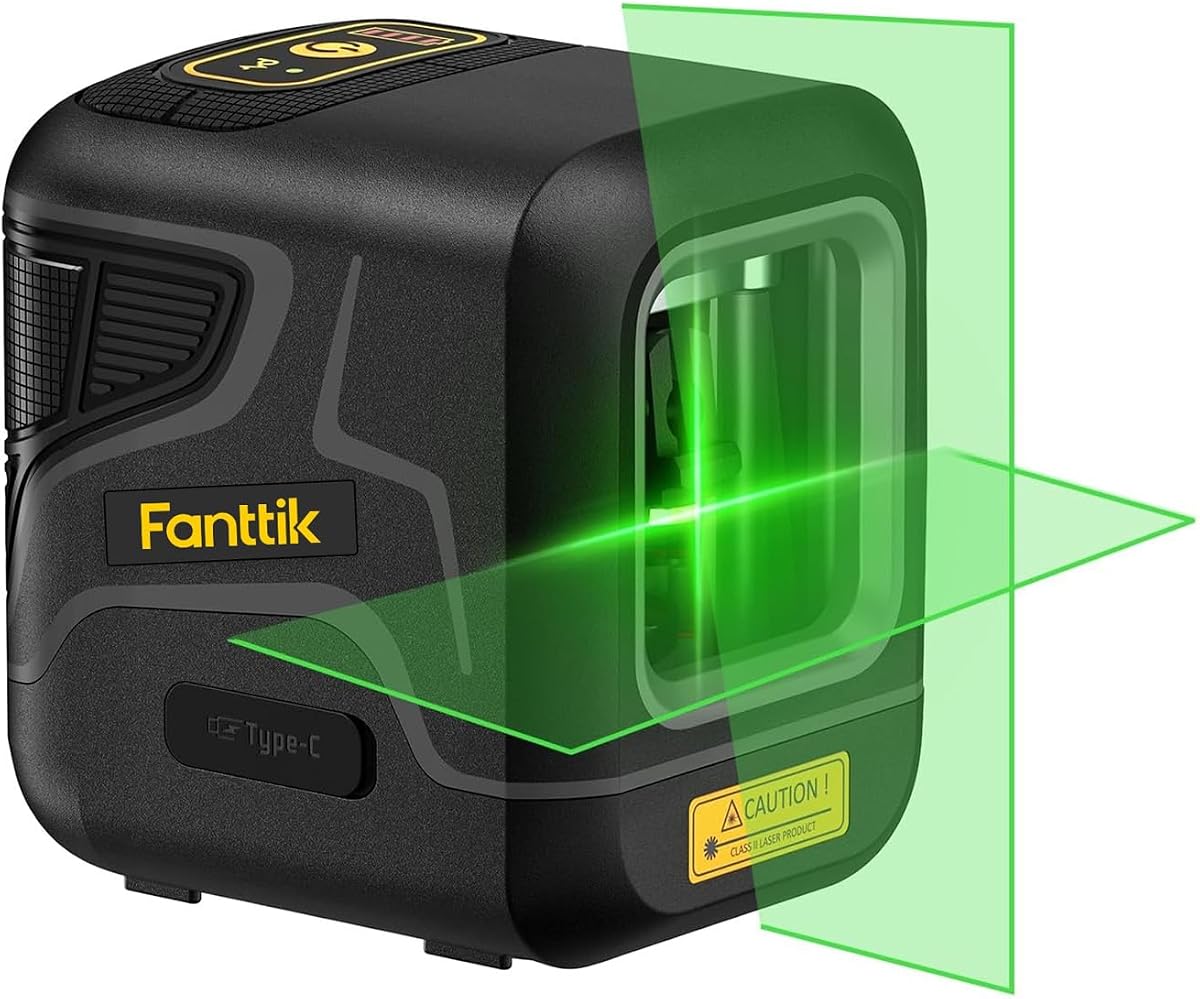
The Fanttik D2 is a compact green cross-line tool designed for picture hanging and general home DIY, with clear relevance for smaller tile projects. Its 4.5 rating reflects a simple, approachable design, and the stated accuracy of plus or minus 1/8 inch at 30 feet is useful for aligning backsplash courses, shelves, trim, and modest floor-tile layouts.
We may earn a commission when you buy through this link, at no additional cost to you.
It weighs 0.56 pounds and includes a magnetic bracket that allows 360-degree rotation. The integrated 2200mAh rechargeable battery is rated for up to 10 hours of continuous use and can be recharged more than 500 times, according to the supplied product information. The green diode is described as four times brighter than a red laser under the same light source.
The tool self-levels when the pendulum is unlocked and alerts the user by flashing if tilted beyond four degrees. Locking the pendulum provides manual mode for angled projections. Pulse mode can work with a receiver for a stated range up to 164 feet, but no receiver is supplied, and the tool is not a substitute for a room-wide 360-degree laser.
The Fanttik D2 is best for homeowners who need a portable line tool for a bathroom, kitchen backsplash, or limited section of floor rather than a complete commercial layout grid. Its small size is an advantage in tight spaces and around obstacles. Choose it for portability, straightforward controls, and long rechargeable runtime, while considering a larger tripod-mounted model for full-room precision work.
The rechargeable design eliminates disposable batteries for routine household use, and the stated 10-hour runtime is ample for a long installation day. The drawstring pocket is convenient for storage in a toolbox or between jobs.
The pendulum switch provides a clear choice between automatic leveling and fixed-angle manual projection. Flashing warnings tell the user when the surface exceeds the self-leveling range or when manual mode is active, helping prevent an angled line from being mistaken for a level reference.
We may earn a commission when you buy through this link, at no additional cost to you.
The Huepar BOX-1G combines a 150-foot laser level with a portable 40-inch tripod, creating a useful package for installers who want an immediate setup. It has a 4.4 rating and stated accuracy of plus or minus 1/13 inch at 33 feet. Its wide 130-degree horizontal and 150-degree vertical projections help cover substantial wall and floor areas.
We may earn a commission when you buy through this link, at no additional cost to you.
The tool supports single-line and cross-line output, allowing users to conserve power when only one reference is needed. It self-levels within four degrees, provides manual mode for angled lines, and offers pulse mode for brighter conditions. Outdoor range is stated to extend to 197 feet with a compatible Huepar receiver, while direct sunlight may still make the naked-eye line difficult to see.
The included aluminum tripod has a quarter-inch-20 mount and three-way pan head, with an adjustable height from 11.4 to 40 inches. It is intended mainly for indoor use on flat ground without wind. Because the height is limited, a table or chair may be needed to raise the tool, and the manufacturer recommends a larger tripod for outdoor work.
This is a good choice for a contractor who frequently installs tile in ordinary rooms and values a compact, complete cross-line kit. Its fine stated accuracy and broad projection are useful for long wall runs, although it cannot provide 360-degree planes. Buy it when the included stand and single-line flexibility matter more than comprehensive room coverage, and use a detector when outdoor conditions require one.
Single-line mode keeps only the required reference visible and extends operating time. This is useful when tracing one long tile baseline or checking a single wall without the distraction of a full cross.
The 40-inch tripod gives the package immediate utility for cabinets, backsplashes, and wall tile. Its three-way head permits portrait and landscape placement, while the limited height and indoor recommendation make it less suitable for exposed outdoor work.
We may earn a commission when you buy through this link, at no additional cost to you.
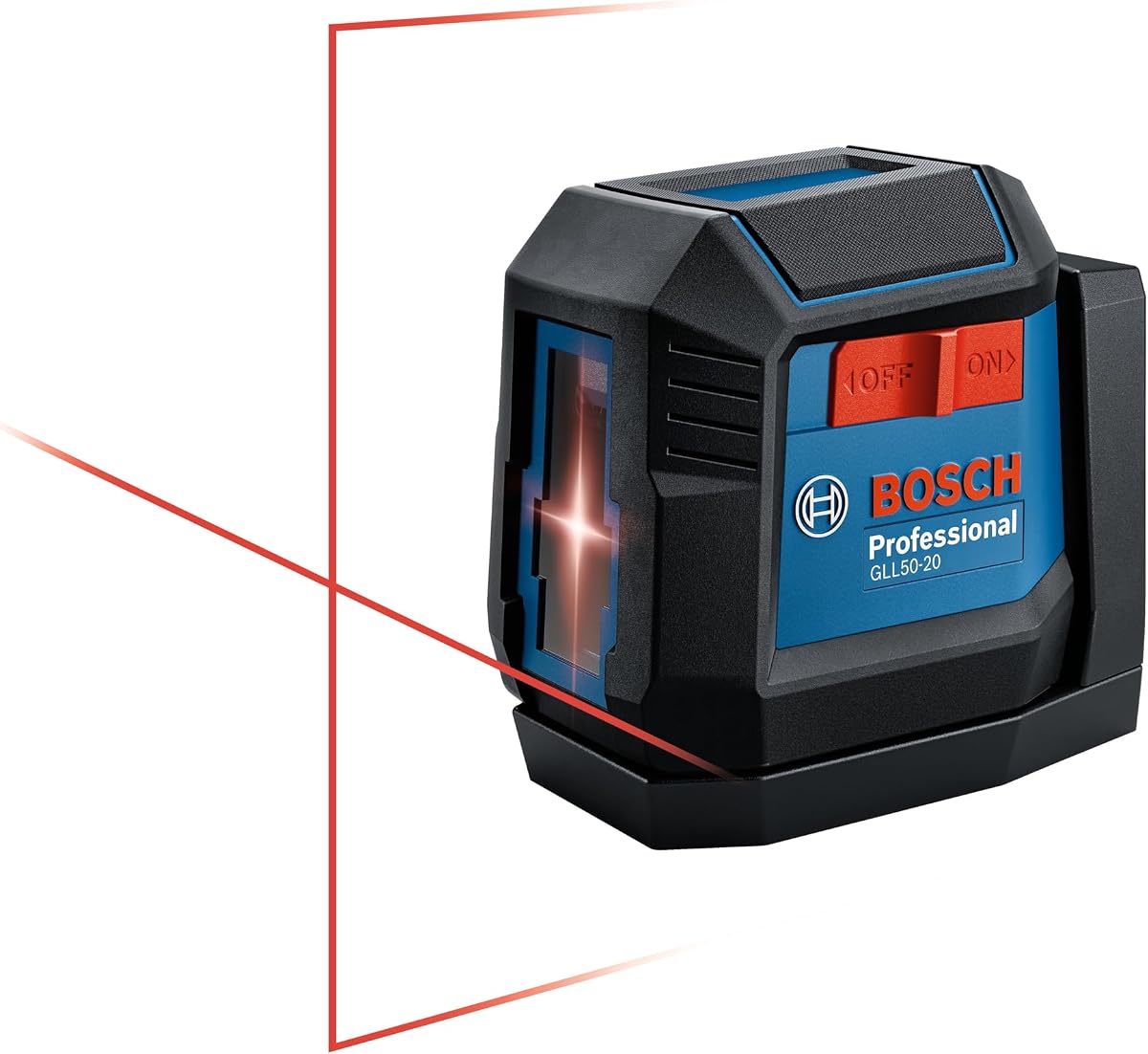
The Bosch GLL50-20 is a compact self-leveling cross-line laser focused on durability and uncomplicated installation work. Its 4.4 rating, full rubber overmold housing, and IP55 rating make it relevant to contractors who need a compact line reference in a dusty or wet work area. It projects one level and one plumb line for wall, floor, cabinet, and tile baselines.
We may earn a commission when you buy through this link, at no additional cost to you.
The stated range is 50 feet with accuracy of plus or minus 5/16 inch at 30 feet. That is less precise and less expansive than several green 360-degree alternatives, but it remains a functional choice for short- to medium-range layout work. The integrated mount accepts magnets or quarter-inch-20 threaded mounts, allowing use on metal surfaces and standard tripods.
Power flexibility is another strength. It runs with two included AA batteries or Bosch's separately sold 3.7-volt lithium-ion battery. The Smart Pendulum System self-levels, blinks to identify an out-of-level condition, and locks when switched off for transport. That transport lock is useful in a crowded van or toolbox.
Choose the GLL50-20 for compactness, impact resistance, and simple cross-line references rather than extensive room-wide coverage. It is a sound secondary tool for checking tile alignment, cabinet heights, wall plumb, and short floor runs. Users undertaking a large-format room should account for its stated 50-foot range and consider a model with broader projection or additional planes.
The rubber-covered housing helps shield major impact points, while IP55 protection is intended to resist dust and water. These traits suit renovation environments where a larger laser may be exposed to knocks, debris, and damp surfaces.
The integrated multipurpose mount combines magnetic placement with quarter-inch-20 threading. Users can set the laser on a suitable metal surface for quick checks or attach it to a tripod for stable, hands-free tile layout.
We may earn a commission when you buy through this link, at no additional cost to you.
The Huepar 9011G is a straightforward green cross-line laser with a 4.3 rating and a stated accuracy of plus or minus 1/16 inch at 16.4 feet. It is especially relevant for laying out wall tile, hanging pictures, and establishing level lines where a wide field and a simple setup matter.
We may earn a commission when you buy through this link, at no additional cost to you.
The 110-degree field of view creates broad horizontal and vertical lines, and the green source is stated to be twice as bright as a traditional red laser. The self-leveling pendulum adjusts within plus or minus four degrees and starts in under three seconds. A quarter-inch-20 thread supports tripod mounting, and the included magnetic bracket offers an alternative around metal surfaces.
The switching method is intentionally simple: the pendulum locked position produces manual-mode lines, while unlocking it enters self-leveling mode. If the tool is held in the hand, placed on an uneven surface, or mounted on an unstable tripod head, the line flashes. Huepar recommends confirming the surface with another leveling method or placing a flat board beneath the tool.
This model works well for users who want a familiar cross-line reference and excellent close-range accuracy without a complicated remote or app. It is less appropriate when a project requires vertical lines to continue around an entire room. For a backsplash, single wall, shelving run, or small floor area, the 9011G provides a portable and capable layout tool with a two-year warranty and online support.
Using the pendulum lock as the main control lets the user distinguish automatic leveling from fixed-angle projection. Paying attention to the flashing warning prevents a tilted setup from being mistaken for an accurate horizontal or vertical reference.
The stated plus or minus 1/16-inch accuracy at 16.4 feet is useful for close layout work. The broad 110-degree field also helps a line remain visible across more of a wall than a narrow projection would allow.
We may earn a commission when you buy through this link, at no additional cost to you.
The Klein Tools 93CPLG combines a compact body with three bright green 360-degree laser planes, giving it uncommon spatial coverage for a portable tool. Its 4.4 rating and stated 100-foot range make it a premium choice for installers who want vertical and horizontal references without carrying a large grid laser.
We may earn a commission when you buy through this link, at no additional cost to you.
All three planes are visible around the tool, allowing lines to continue across floors, walls, and ceilings. The green source is stated to shine up to twice as brightly as standard red beams, improving visibility in many interior work areas. The compact, lightweight enclosure is useful in tight bathrooms, kitchens, and renovation zones where a larger tool is inconvenient.
The built-in, non-removable rechargeable battery provides more than six hours of runtime according to the supplied information. Tilt mode locks the pendulum so the laser can project at different angles. That is useful for stairs or patterned layouts, but users should understand that locked-angle lines are not automatically a level or plumb reference.
This model is best for premium users who prioritize full-plane coverage, a compact footprint, and a simple integrated power system. It is a strong candidate for wall tile, flooring, ceilings, cabinetry, and general interior installation. The product information does not state a receiver-based outdoor range or elaborate accessory bundle, so the buyer should consider those needs separately.
Three 360-degree planes create a useful intersection of horizontal and vertical references while preserving a relatively small footprint. This makes the tool attractive for tight spaces where a full four-plane model would be cumbersome.
The integrated rechargeable battery is stated to last more than six hours, sufficient for many installation days without disposable battery replacement. Tilt mode adds flexibility for angled work, provided the user distinguishes it from automatic leveling.
We may earn a commission when you buy through this link, at no additional cost to you.
The DEWALT DW088K is a self-leveling red cross-line laser with a 4.7 rating, combining proven-style construction with a generous detector-based range. It projects one horizontal and one vertical line for tile baselines, wall plumb, shelving, framing, and general layout, while its 1/4-inch-20 mount accepts a standard tripod.
We may earn a commission when you buy through this link, at no additional cost to you.
The stated accuracy is approximately 1/8 inch at 30 feet. With a compatible detector, the tool can achieve a range of up to 165 feet. The detector is not included, so that maximum figure matters primarily for users who already own or plan to add one. The integrated magnetic bracket provides a quick positioning option on suitable metal surfaces.
Durability is a central selling point. The overmolded housing has a stated one-meter drop rating, and the tool carries an IP54 rating for resistance to water and debris. A durable storage case is included, helping protect the instrument between jobs and during transport. The red beam is less conspicuous than many green alternatives, especially in brighter spaces.
The DW088K is a good choice for builders who want a straightforward cross-line reference from a recognizable tool platform rather than a 360-degree system. It is well suited to individual walls, bathroom projects, and medium-sized interiors. Buyers should budget separately for a tripod and detector if needed, and may prefer a green model when maximum line visibility is the priority.
The one-meter drop rating, overmolded housing, and IP54 protection support use in active construction environments. The included case helps prevent impact damage and keeps the laser and accessories together during transport.
The DW088K can work with a separately purchased detector for a stated maximum of 165 feet. This expands its usefulness in large rooms and brighter work areas, although the bare laser line may be difficult to see at long distances.
We may earn a commission when you buy through this link, at no additional cost to you.
The right laser level for tile work depends on room size, installation complexity, mounting conditions, and how often the tool will be used. Accuracy and line visibility matter, but coverage, stability, power, and included accessories can have an equally large effect on a smooth installation workflow.
Accuracy is one of the first specifications to compare because a tile layout depends on a consistent horizontal or vertical reference. The listed models range from approximately plus or minus 1/16 inch at 16.4 feet to plus or minus 5/16 inch at 30 feet. These figures are not all measured under identical conditions, so compare both the distance and stated tolerance rather than judging by the fraction alone. A tight tolerance is helpful for precise wall layouts, but practical results also depend on whether the laser is stable, centered, and operating within its self-leveling range.
Choose the most accurate model that meets your project size, but verify the operating conditions. For everyday tile installation, a stated tolerance around 1/8 inch or finer is a practical target, while very large-format tile and detailed mosaic work may justify greater precision. Always check the tool on the actual floor, wall, or tripod head because an uneven mounting surface can cause warnings or distorted references.
Coverage determines how many references the tool can project at one time. A basic cross-line model supplies one horizontal and one vertical line, which is adequate for individual walls or short floor runs. A three-plane 360-degree laser adds a full horizontal plane and two vertical planes, while a four-plane model provides two of each. Those wider systems can create an entire room grid from a central position, reducing the need to move the unit and improving alignment between multiple tiled surfaces.
Choose two lines for a contained backsplash or single-wall installation. Choose three or four planes for full rooms, cabinetry, drop ceilings, and projects involving several intersecting surfaces. Remember that more lines can create visual clutter, so individual line controls and brightness adjustment are valuable. Bright green beams are generally easier to see indoors than red beams, particularly when the room is well lit.
Laser visibility depends on beam color, ambient light, distance, surface finish, and the sensitivity of your eyes. The products in this guide use mostly green lasers, which are often conspicuous indoors, while the DEWALT model uses a red beam. Bright sunlight can wash out any visible line, and highly reflective tile can generate extra lines from the laser window or surrounding surfaces. Pulse mode helps when used with a compatible receiver, but the receiver is not included with any model mentioned in the supplied data.
Prioritize brightness controls for indoor work and plan on a detector for large, bright, or outdoor areas. If your tile is glossy, test the beam in the actual installation space and interpret stray lines cautiously. A 360-degree model does not guarantee a clean visual field around mirrors, glass, polished metal, or reflective cabinetry.
A stable mount is essential because any movement of the laser changes the projected reference. Some products include a tripod, while others provide only a magnetic bracket, wall-mounting holes, or a threaded adapter. Quarter-inch-20 is a common tripod connection, and five-eighth-inch-11 mounts are common on professional poles and heavier stands. The three-dimensional models are most useful with a stand or pole, allowing the tool to sit at a convenient working height.
Choose a bundled tripod if you want an immediately usable package, but check its maximum height and stability. A short indoor tripod may need to be placed on a table or chair, while a narrow or lightweight stand may be unsuitable outdoors. Magnetic brackets are convenient for quick checks, while a stable tripod is better for long layouts. Whichever support you choose, confirm that the head is level and that the tool will not be bumped during adhesive placement.
Disposable batteries are simple and widely compatible, while rechargeable models reduce interruptions and are convenient for repeated work. Runtime claims range from more than six hours on the Klein Tools 93CPLG to up to eight hours on the CinusLinus and Huepar HM03CG, and ten hours on the Fanttik D2. These are manufacturer-stated figures, so battery condition, line selection, brightness, and pulse mode can affect actual performance.
Rechargeable power is usually preferable for frequent tile installation because it avoids searching for spare cells. Check the charging connector, battery indicators, and whether the battery is removable. For occasional household use, included AA batteries may be adequate. Carry a backup power option if a job may extend beyond the stated runtime or if the tool cannot be charged on site.
A self-leveling pendulum automatically establishes a level reference within a stated angular range, normally around three or four degrees. This is the primary mode for horizontal and vertical tile lines. If the surface or tripod exceeds that range, the laser typically flashes as a warning. Manual or tilt mode locks the pendulum so the beam can be angled, which is useful for stairs, diagonal patterns, or artistic layouts, but those lines are no longer dependable level references.
Use self-leveling mode for standard square tile installation and reserve manual mode for explicitly angled work. Learn the warning behavior before beginning so you do not mistake flashing for a defect. A stable setup, correct battery installation, and a level mounting surface are still required even in self-leveling mode, because the tool can only level within its specified range.
Tile installation can expose a laser to adhesive, grout, dust, splashes, and accidental knocks. IP54 appears on several choices, while the Bosch GLL50-20 has an IP55 rating, and the DEWALT DW088K features a stated one-meter drop rating. Rubberized housings and secure transport locks add further protection. A hard case is valuable for transport, whereas a soft bag may be adequate for occasional household use.
Match the protection level to your environment and the value of uninterrupted work. Consider the included bracket, tripod, adapter, batteries, charging cable, remote, and case as a complete system rather than looking only at the laser body. Accessories that solve an actual setup problem are more valuable than extras that remain unused.
Basic users may prefer simple physical buttons and a pendulum lock, while contractors working in large rooms can benefit from remote or app control. The CIGMAN CM-G16 includes both a remote and a Smart Leveling app, while the CinusLinus includes a remote. Individual plane selection is useful when only one or two references are needed. Warranty duration also varies, with the CIGMAN providing three years and the Huepar HM03CG listing a five-year device warranty.
Choose advanced controls if they remove real friction from your workflow, not simply because more buttons appear. Verify app compatibility before relying on phone operation. Longer warranty coverage can be reassuring for professional use, but support availability, replacement terms, and included accessories should also be considered when comparing complete ownership value.
Begin by inspecting the room and planning the tile layout. Identify the finished floor or primary reference surface, mark the intended tile boundaries, and determine the height at which you will mount the laser. Set the tool on a stable, level stand or a suitable secured bracket. If the line flashes during self-leveling, correct the level of the surface, tripod head, or mounting point rather than ignoring the warning.
Confirm the tool's accuracy before transferring the reference to the wall or floor. Check the projected line against an independently measured level or straightedge in at least two locations, especially when working across a long surface. Mark the line lightly, verify the direction of the line you intend to trace, and keep the beam unobstructed. Use manual mode only for a deliberately angled layout, and never treat a locked-angle line as a level or plumb reference.
After the layout is complete, switch the tool off so the pendulum locks for transport, remove the batteries if the model uses disposable cells, and store the instrument in its case. Keep the laser window clean and avoid aiming it at people or reflective surfaces at close range. Protect the unit from excessive impact, moisture beyond its rating, and temperature extremes, and recharge or replace the power source before the next job.
A cross-line laser is usually sufficient for a single wall or small floor because it projects level and plumb references. A three- or four-plane 360-degree model is better for whole-room layouts, multiple walls, cabinetry, and tile that must align across floors and ceilings. Choose based on the number of reference lines you need rather than range alone.
No, but it can reduce repositioning and make a full-room grid easier to maintain. A compact cross-line tool is often more practical for a backsplash, shower wall, or modest floor area. A 360-degree model becomes more valuable when tile must meet other tiled surfaces at consistent right angles or when the room is too large for a cross line to cover comfortably.
A stated accuracy around 1/8 inch or finer is generally useful for standard tile layout, while tighter figures can help with detailed work. Always consider the measurement distance attached to the accuracy claim, because tolerances often increase over longer distances. Stability and correct leveling remain as important as the printed specification.
Green lines are commonly easier for many users to see indoors, especially in well-lit rooms, because the human eye is highly sensitive to green light. Red lasers can still work well and may suit users who perceive green less clearly. Neither color guarantees strong visibility in direct sunlight or against highly reflective glossy surfaces.
A compatible receiver is strongly recommended when sunlight makes the line difficult to see or when the work distance is long. Pulse mode is designed for use with a detector, but no receiver is included with the products in this guide. Check receiver compatibility before purchase and verify the usable range in the actual lighting conditions.
Flashing commonly indicates that the tool is outside its self-leveling range, the pendulum is locked in manual mode, or the mounting surface is unstable. Level the tripod head, place the unit on a flat surface, and confirm the pendulum is unlocked. Persistent flashing in a level setup may indicate a setup or device issue that should be addressed before layout continues.
A laser level is excellent for transferring level and plumb references over a distance, but it does not eliminate every traditional measuring step. Verify the tool before use, measure from the laser line to the finished surface, and use separate checks for exact distances and dimensions. A conventional bubble level or straightedge can still be useful for initial setup.
A stable tripod is the most useful addition, followed by a detector if working outdoors or across long spaces. Carry a suitable battery or charging cable, a case for protection, and the correct mounting adapters for a tripod or laser pole. A soft bag can be convenient, but a hard case offers better impact protection in a crowded work vehicle.
The Motovera 100ft Green Cross Line is the most practical budget package because it combines a visible two-line laser with a tripod and carry bag. The CIGMAN CM-G16 is the strongest overall choice for room-wide work, offering four 360-degree planes, individual line control, app and remote operation, USB-C charging, and strong accessory support. The Klein Tools 93CPLG stands out as a premium compact option with three 360-degree planes and an integrated rechargeable battery.
Before choosing, prioritize the references your tile project actually requires. A cross-line laser is economical and effective for one wall, while three- and four-plane tools are more valuable across entire rooms. Accuracy, visible line color, stable mounting, power runtime, and included accessories should be weighed together, and any receiver needed for outdoor or long-distance visibility must be purchased separately.
Finally, check the current product listing and manufacturer details before ordering. Included stands, batteries, cases, adapters, warranties, and even the exact bundle configuration can change, and specifications may be updated. Comparing the current package with the type of installation ahead will help you select a laser level for tile work that is accurate, practical to position, and ready for the job.