
OCuLink eGPU Dock, PCIe 4.0 x4 64Gbps, ATX External GPU Enclosure
5.0Editor score
PCIe 4.0 x4 bandwidth
Standard ATX power support
Shielded 50cm OCuLink cable
Unrestricted GPU lengths
Explore the best Oculink enclosure options, comparing bandwidth, cables, power support, compatibility, construction, and setup for laptops and mini PCs in 2026.
An Oculink enclosure adds desktop-class graphics to a compatible laptop, mini PC, or handheld through a native OCuLink connection. The best models provide ample PCIe bandwidth, stable power delivery, flexible GPU support, and a cable long enough for practical placement without introducing unnecessary clutter.
We compared the listed enclosures by interface compatibility, PCIe generation, cable length and shielding, ATX power support, physical construction, monitoring features, installation requirements, and suitability for gaming, rendering, AI, and other GPU-accelerated workloads. The list includes conventional OCuLink docks, one dual-mode model, and an adapter that expands OCuLink into an internal M.2 storage solution.
Each review explains what distinguishes its enclosure from the alternatives and identifies the types of builders for whom it makes the most sense. Ratings and specifications reflect the supplied product information, while component availability and current prices can change, so confirm the graphics card, power supply, host interface, and operating system before purchasing.
5.0Editor score

4.5Editor score
5.0Editor score
This side-by-side comparison highlights the major differences among the ten listings, including interface type, stated bandwidth, included cable, power support, and enclosure design.


This OCuLink enclosure earns the Editor's Choice position because it combines a straightforward PCIe 4.0 x4 design with practical monitoring and power-management features. Its supplied rating is 4.5, and the product information highlights compatibility with NVIDIA, AMD, and Intel graphics cards. That broad support makes it a natural first choice for builders assembling a portable gaming or productivity system around an existing GPU.
We may earn a commission when you buy through this link, at no additional cost to you.
The dock uses an SFF-8612 enclosure interface, a PCIe x16 slot, and a detachable 50-centimeter SFF-8611 cable. Its stated 64Gbps transfer rate corresponds to PCIe 4.0 x4 operation, while the thin, fully shielded cable is intended to resist interference. LED indicators show operating status, and both auto-start and forced-start modes provide flexibility in how the external graphics system behaves.
The open-frame bracket removes a common source of frustration in compact eGPU designs: a rigid length limit. It also includes a bracket for an ATX power supply, while routing power behind the frame to keep the front relatively clean. The trade-offs are practical rather than fundamental: the graphics card and ATX power supply are separate purchases, and initial assembly requires a screwdriver and roughly 15 minutes according to the supplied guidance.
This enclosure is best for a laptop or mini PC owner with a native OCuLink port who wants modern GPU compatibility without paying for a closed chassis. Buy it when the host already supports OCuLink, you own or plan to use a standard ATX power supply, and you value straightforward expansion more than a compact, fully enclosed industrial design.
The SFF-8612-to-PCIe x16 conversion gives compact computers direct access to desktop-class graphics. It is particularly useful for rendering, AI experimentation, video editing, and gaming when the built-in GPU cannot provide sufficient performance.
LED indicators make system status easier to inspect, while auto-start and forced modes let users choose between automatic and manual activation. These details are particularly helpful during initial setup and troubleshooting.
We may earn a commission when you buy through this link, at no additional cost to you.
This detachable PCIe 4.0 dock has a supplied rating of 4.4 and emphasizes connector longevity, compact storage, and reliable electrical contacts. It converts an OCuLink SFF-8612 host connection to a PCIe x16 slot for an external graphics card, making it a practical choice for mini PCs and laptops that expose the proper interface.
We may earn a commission when you buy through this link, at no additional cost to you.
The enclosure's detachable cable design allows the cable to be removed for storage and reduces strain on the host port. Ten-micron gold-plated contacts are specified to support conductivity and resist the oxidation-related resistance that can contribute to crashes or blue-screen errors. The included 50-centimeter male-to-male SFF-8611 cable uses a flat, flexible construction with comprehensive shielding.
It accepts standard ATX power supplies and uses dual screw mounting on the top and bottom for stability. Graphics cards of different lengths are supported, including large models such as the RTX 4090 and AMD RX 7900 XTX. The main limitation is that SFX power supplies are not supported, and OCuLink cannot be hot-plugged, so the computer must be shut down before the cable is removed.
Choose this dock when you value a detachable, protected cable and a straightforward ATX-powered enclosure more than compactness or operating-system flexibility. It is especially suitable for builders who already understand OCuLink limitations and want a flexible cable without giving up support for full-length graphics cards.
Detachable ends make the system easier to pack and can reduce mechanical stress during transport. Combined with gold-plated contacts, the design focuses on both portability and long-term connection reliability.
The open enclosure accommodates cards of varied lengths. That flexibility is valuable for builders who may move between compact GPUs and large, power-hungry desktop models.
We may earn a commission when you buy through this link, at no additional cost to you.
This OCuLink enclosure combines a supplied 5.0 rating with a notably focused feature set. It provides a PCIe 4.0 x4 SFF-8612-to-PCIe x16 enclosure, a 50-centimeter OCuLink cable, and a user manual, allowing an owner to connect an existing graphics card and standard ATX power supply to a compatible compact computer.
We may earn a commission when you buy through this link, at no additional cost to you.
Its cable has a metal shielding layer and EMI-shielded conductive polymer intended to maintain a stable, high-speed connection. The open-frame design has no stated graphics-card length limit and supports NVIDIA, AMD, and Intel cards. The included manual and explicit driver-installation notice help reduce common first-use problems, especially when the host does not immediately recognize the new graphics adapter.
The trade-off is its intentionally limited package: no graphics card and no ATX power supply are included. It also uses a standard ATX supply rather than a smaller SFX model, so the completed system will not be especially compact. OCuLink does not support hot-plugging, requiring both the computer and enclosure to be powered down before changing connections.
This is the best option for a straightforward desktop conversion when the buyer already has suitable components and wants a simple open enclosure. It is well suited to NVIDIA, AMD, or Intel graphics cards and to mini PCs with the required native OCuLink port.
Metal shielding and conductive polymer layers are intended to limit electromagnetic interference. That attention to signal stability is valuable when the enclosure sits near other electronics or handles sustained gaming and rendering workloads.
The open construction avoids a fixed card-length restriction. Builders can select a compact GPU for portability or a larger desktop card when compute performance is the priority.
We may earn a commission when you buy through this link, at no additional cost to you.
The AOOSTAR EG02 is a compact OCuLink graphics dock with a supplied rating of 5.0. Its stated dimensions of 26.8 by 17.5 by 2.2 centimeters distinguish it from bulkier open-frame models, making it appealing for builders who want to transport an external graphics setup without dedicating substantial desk space.
We may earn a commission when you buy through this link, at no additional cost to you.
The dock supports a PCIe 4.0 x4 OCuLink port and works with either ATX or SFX power supplies. That power flexibility can help control the completed enclosure's size and weight. The host system must have a native OCuLink port, so buyers should verify the exact SFF-8611 and SFF-8612 arrangement before ordering.
The supplied information is more concise than for the other eGPU docks and does not detail cable length, operating-system support, or graphics-card dimensions. It therefore offers less information for preliminary planning. While the compact dimensions and dual power-standard support are clear advantages, the limited documentation makes host compatibility and cable routing especially important to confirm.
The EG02 is best for a portable workstation that already has OCuLink and may benefit from an SFX power supply. It is less appropriate for a first-time eGPU buyer who needs detailed guidance, automatic startup modes, or extensive operating-system information.
The stated enclosure dimensions are notably compact for an external graphics dock. This can make the EG02 easier to place beside a laptop or transport between work locations.
Support for both ATX and SFX supplies gives builders more options for balancing physical size, weight, and electrical capacity. The correct supply should still be selected for the installed graphics card.
We may earn a commission when you buy through this link, at no additional cost to you.
This enclosure stands out through its included 100-centimeter, or 39.4-inch, SFF-8611 cable. The greater reach allows the host computer to remain on a desk while the graphics enclosure sits elsewhere, an advantage in setups where the laptop is used in a cramped environment or where a vertical display is involved.
We may earn a commission when you buy through this link, at no additional cost to you.
It converts the OCuLink interface to PCIe x16 with stated PCIe 4.0 x4 bandwidth of 64Gbps. The thin male-to-male cable includes shielding and electromagnetic interference suppression. Its open frame accepts different GPU sizes, while an independent side bracket holds the ATX power supply and graphics card to reduce wobble.
Multiple status LEDs, auto-start behavior, and a forced-start mode add practical control. As with the other OCuLink docks, the ATX supply and GPU are not included, hot-plugging is unsupported, and the guidance recommends a supply with approximately 40 percent more wattage than the GPU's full-load demand. Drivers must also be installed before expecting display output.
Choose this model when cable reach matters more than minimizing desk clutter. It suits a mini PC or laptop owner who wants the external GPU enclosure positioned at a comfortable distance and values a stable bracket around the power and graphics hardware.
A one-meter cable offers more freedom in arranging a portable workstation. It can connect a compact host to an enclosure placed under a desk, beside a monitor, or within a separate equipment area.
The independent side bracket supports both the ATX power supply and graphics card. That added restraint is useful with large, heavier cards and reduces movement during maintenance or cable changes.
We may earn a commission when you buy through this link, at no additional cost to you.
This 29.5-inch cable balances placement flexibility and manageable cable length. It is a useful middle ground between compact 50-centimeter cables and one-meter alternatives, allowing the external graphics enclosure to sit farther from the host without creating as much excess cable as the longest option in the roundup.
We may earn a commission when you buy through this link, at no additional cost to you.
The enclosure provides PCIe 4.0 x4 bandwidth through an SFF-8612 OCuLink interface and a PCIe x16 slot. Its flat 0.5-millimeter cable is fully shielded to limit interference and signal degradation. An independent side bracket secures the ATX power supply and GPU, while the open design accommodates varying graphics-card sizes.
Status LEDs and selectable auto-start or forced-start behavior make the dock convenient for repeatable setups. The graphics card and ATX power supply are not included. The same OCuLink limitations apply: the computer must be off before connecting or disconnecting the cable, drivers need to be installed, and the recommended power headroom is approximately 40 percent above the GPU's full-load wattage.
This dock is a strong choice for a desk where moderate separation is needed. It is particularly suitable for users who want the tidy appearance of an open-frame system, the flexibility of a 75-centimeter cable, and explicit support for large desktop graphics cards.
The 75-centimeter cable provides enough separation for many desk arrangements without the storage burden of a one-meter lead. It is a sensible compromise for frequently portable systems.
With the GPU and power supply visible and independently supported, the enclosure is straightforward to assemble and inspect. It also avoids a potentially limiting fixed internal length.
We may earn a commission when you buy through this link, at no additional cost to you.
This product is not a traditional external GPU case, but it is a specialized OCuLink enclosure for M.2 NVMe storage. It converts an OCuLink interface into an M.2 M-key slot that can hold a PCIe NVMe solid-state drive. It therefore deserves consideration when the term OCuLink enclosure is being used more broadly to describe an enclosure or adapter for OCuLink-connected hardware.
We may earn a commission when you buy through this link, at no additional cost to you.
The adapter supports 2280, 2260, 2242, and 2230 NVMe formats. It can be installed internally through SFF-8611 and SFF-8612 connections, and the supplied information describes configurations with one OCuLink connection and one NVMe drive or two OCuLink connections and two NVMe drives. The stated transfer rate reaches 64Gbps over PCIe 4.0 x4 and remains backward compatible with PCIe 3.0.
Its limitations are important. It cannot convert NVMe to SATA or SAS, and it cannot convert NGFF, SATA, or SAS to OCuLink. SAS and Slimeline SAS hard drives are also not supported. It should not be purchased by someone expecting a desktop graphics card enclosure, and no supplied customer rating is available for this listing.
Choose the adapter for a compact system that has an internal OCuLink connection and needs fast NVMe storage. It is less relevant to gaming, rendering, or external GPU expansion, where one of the dedicated PCIe graphics docks is the appropriate choice.
The adapter provides a route to attach a standard PCIe NVMe drive through an OCuLink connection. This can be useful in compact motherboards that lack a convenient internal storage slot.
OCuLink transport does not make every storage protocol compatible. The adapter is limited to NVMe PCIe drives and cannot bridge SATA or SAS hardware.
We may earn a commission when you buy through this link, at no additional cost to you.
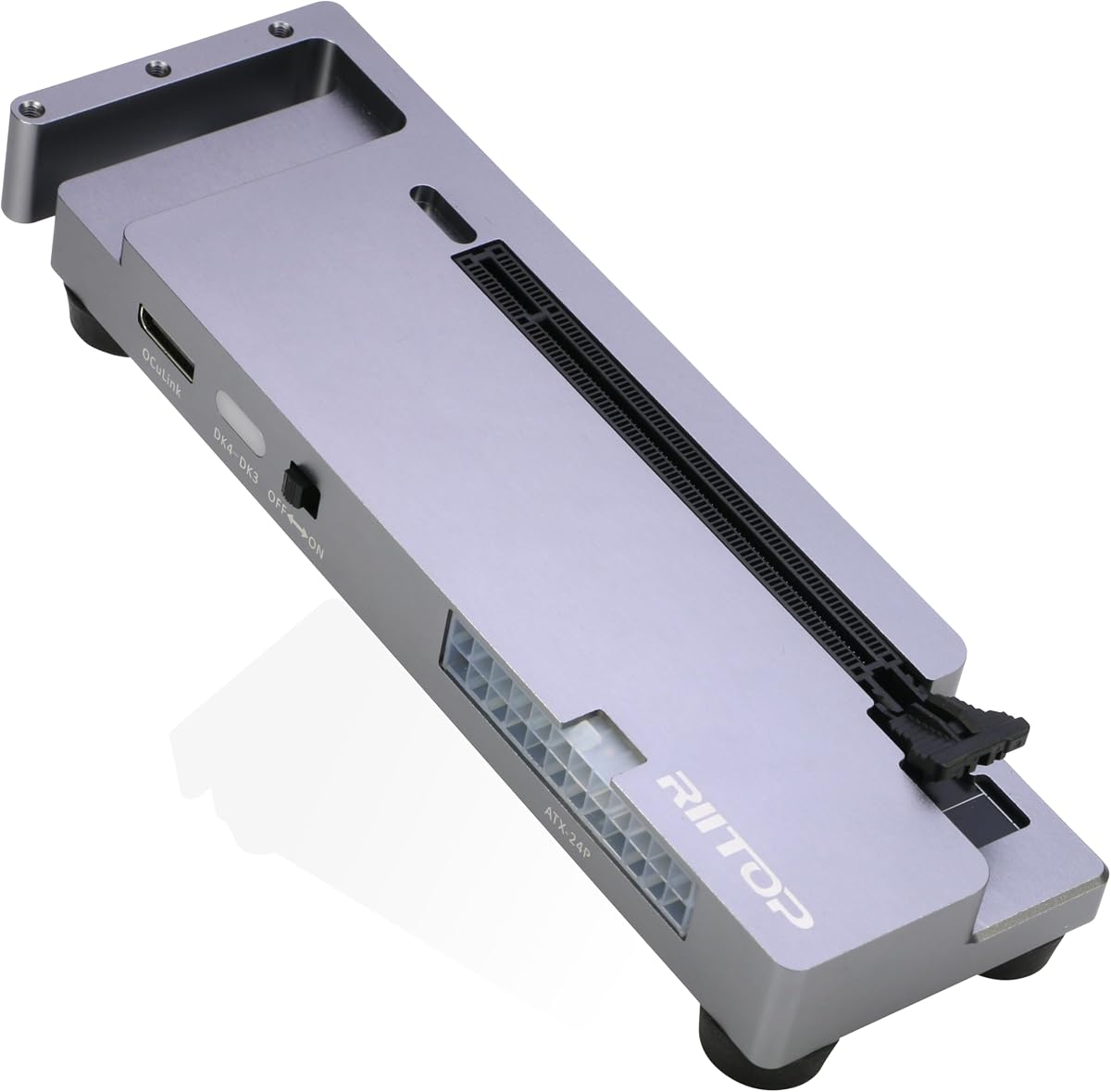
The RIITOP OCuLink enclosure stands out for its broad platform coverage and a supplied rating of 5.0. It supports modern NVIDIA RTX 50 Series and AMD RX 7000 Series graphics, along with older cards that meet the enclosure's PCIe requirements. The stated use cases include AI computing, rendering, video editing, gaming, and other creative workloads.
We may earn a commission when you buy through this link, at no additional cost to you.
Its 64Gbps OCuLink interface connects to an available SFF-8612 port on a laptop, mini PC, or another compatible device. The open design has no graphics-card length restriction. A dedicated support pillar secures the card, while a retention bracket holds the power supply. Both ATX and SFX supplies are supported, offering more flexibility than docks limited to one form factor.
The listing identifies Windows 10 and 11 64-bit, Linux, and Mac compatibility, but with an important platform limitation: Mac support is stated for AMD graphics cards only, and NVIDIA is not supported on Mac. The OCuLink connection also uses a fixed-lock design that requires pressing the release switch before removal, and hot-plugging is prohibited.
This is the best premium option for a builder who values operating-system breadth, current high-end GPU support, and both ATX and SFX power options. It is a strong fit for a cross-platform workstation, although Mac users must choose an AMD card and every platform requires careful attention to the fixed-lock cable.
Explicit references to current RTX 50 Series and RX 7000 Series cards make the enclosure relevant to recent desktop graphics. Support for Windows, Linux, and Mac broadens its usefulness beyond a single-platform gaming setup.
The supplied installation sequence moves from card fitting and power-supply mounting through cabling, startup, and driver installation. Dedicated retention hardware helps keep the large components secure.
We may earn a commission when you buy through this link, at no additional cost to you.
This enclosure is the most flexible in the roundup because it can operate from a native OCuLink port or an MCIO port. Its standard configuration uses the included 50-centimeter SFF-8611 cable for PCIe 4.0 x4 operation. An optional MCIO-to-dual-OCuLink cable can unlock PCIe 4.0 x8 bandwidth of up to 128Gbps, although that cable is not included.
We may earn a commission when you buy through this link, at no additional cost to you.
The frame is made from glass-fiber-reinforced ASA, a heat-resistant material selected for greater structural strength. It retains the open-frame format, supports varying GPU sizes, and includes an ATX power bracket. Rear-routed power cables improve the appearance of the front, while a repositioned power button is easier to reach during operation.
The enclosure also provides LED indicators, auto-start and forced modes, and compatibility with NVIDIA, AMD, and Intel graphics. A screwdriver, illustrated manual, and video guide are included, although some assembly remains. Its listing has no supplied customer rating, so the design information and compatibility notes are more important for evaluation than a numerical score.
This dock is best for an enthusiast with an MCIO-capable system who may later want more bandwidth than a standard four-lane OCuLink cable provides. For ordinary OCuLink use, the included cable is sufficient; MCIO users should budget for the additional dual-OCuLink cable.
The optional MCIO mode can double the stated lane width to PCIe 4.0 x8. It offers additional headroom for demanding graphics and compute workloads, provided the host and extra cable support that configuration.
The glass-fiber-reinforced ASA frame is designed to provide structural rigidity and heat resistance. Rear cable routing further reduces visual clutter without concealing the card.
We may earn a commission when you buy through this link, at no additional cost to you.
The ASUS TUF Gaming A2 is included because it is a prominent product named as an enclosure, but it serves a different function from the OCuLink docks. It is a rugged USB-C storage case for up to two M.2 drives rather than an external graphics enclosure. It therefore should not be considered for a laptop or mini PC that needs desktop graphics expansion.
We may earn a commission when you buy through this link, at no additional cost to you.
The enclosure supports M.2 NVMe PCIe and SATA SSDs in 2242, 2260, and 2280 sizes. USB 3.2 Gen 2×2 provides a stated maximum transfer speed of 20Gbps. A Q-Latch mechanism permits screw-free drive swaps, while the aluminum alloy chassis and thermal pad help dissipate heat from the storage devices.
Its strongest differentiators are durability and environmental resistance. The product has been subjected to U.S. MIL-STD-810H and IP68 testing, and the protective silicone-rubber exterior adds another layer of handling protection. A one-year warranty is also listed. However, none of these attributes provides the native PCIe graphics path of an OCuLink enclosure.
Choose the TUF Gaming A2 when the goal is a portable, durable way to carry or use two M.2 SSDs. Users specifically searching for an OCuLink graphics enclosure should instead choose one of the SFF-8612-to-PCIe x16 docks in the preceding reviews.
The USB-C 3.2 Gen 2×2 interface supports transfer speeds up to 20Gbps, while the dual M.2 layout lets a user carry or clone data between compatible NVMe and SATA drives.
MIL-STD-810H testing, IP68 protection, a rubber exterior, and an aluminum chassis make the enclosure suitable for mobile storage. The tool-free Q-Latch system simplifies routine drive changes.
We may earn a commission when you buy through this link, at no additional cost to you.
The right OCuLink enclosure depends first on host compatibility, then on power, GPU size, cable reach, and construction. Reviewing these factors before ordering prevents the most common and expensive mistakes.
Check the exact port on the laptop or mini PC before buying. A USB-C port alone is not evidence of OCuLink support.
Choose x4 for a conventional OCuLink setup and investigate x8 only when the host and workload clearly justify it.
Verify connector requirements, physical space, and recommended wattage before completing the enclosure.
Measure the card and power supply, and confirm that the enclosure's brackets can support their weight.
Choose the shortest cable that provides comfortable placement, and route it so it is not sharply bent or pinched.
Prioritize visible status indicators and a startup mode that matches how the enclosure will be used.
Confirm the host operating system, card vendor, and available drivers before installation.
Look for a PCIe x16 graphics slot and power bracket when the intended upgrade is an external GPU.
Before assembly, confirm that the host has the correct native OCuLink connection, choose a compatible graphics card, and select an appropriate ATX or SFX power supply. Read the enclosure instructions, install the graphics card and power supply, secure every bracket, and connect the display output as required. Install the current graphics-card drivers before attempting the first powered connection.
Operate the system with the computer fully shut down whenever attaching or removing the OCuLink cable. Hot-plugging is not supported and can lead to instability or hardware damage. Route the thin cable away from sharp bends, hot components, and sources of severe interference. Do not unplug the cable merely because the operating system is idle; power the computer off completely first.
For ongoing care, keep the enclosure stable, avoid lifting it by the graphics card or cable, and ensure the power supply receives unobstructed cooling. Check brackets and connectors after moving the system. Clean dust from the enclosure and power supply with appropriate tools, preserve the shielding and strain relief, and use the illustrated manual or video guide if the construction changes.
No. A dedicated OCuLink enclosure generally needs a native SFF-8611 or SFF-8612 port or an appropriate separately sold adapter. USB-C, USB4, and Thunderbolt are not automatically OCuLink-compatible, even when they use the same physical connector. Check the exact host specifications before ordering.
It depends on the specific Thunderbolt generation and the OCuLink link width. The docks reviewed here generally state PCIe 4.0 x4 and 64Gbps transfer capability, while the optional MCIO configuration can reach PCIe 4.0 x8. Actual application performance also depends on the host processor, graphics card, drivers, and workload.
No. The product descriptions consistently warn that OCuLink does not support hot-plugging. Shut the computer down completely before connecting or removing the cable. The RIITOP model also uses a fixed-lock connector, so its release switch must be pressed before disconnection.
The dedicated graphics docks generally include the enclosure, an OCuLink cable, mounting hardware, and documentation, but not the GPU or ATX power supply. Buyers must choose a graphics card and an appropriate ATX or SFX supply according to the dock's requirements and the card manufacturer's guidance.
Most of the listed open-frame designs do not impose a stated graphics-card length limit, but the card must physically fit and the enclosure must support its weight. Check width, cooler height, power connectors, and bracket placement. A dedicated support pillar is especially helpful for large or heavy cards.
First confirm that the host has a working native OCuLink port and that the power supply is properly connected. Install the current drivers for the graphics card before first use, make sure the enclosure is fully assembled, and verify that the display output is connected to the external card. Also check that the power supply is suitable for the GPU's requirements.
No. It is an internal adapter designed to connect M.2 NVMe storage through OCuLink. It supports PCIe 4.0 x4 storage signals but does not provide a desktop graphics-card enclosure and cannot convert SATA or SAS devices to OCuLink.
Support is product-specific. The RIITOP listing states Mac compatibility for AMD graphics but explicitly excludes NVIDIA support on Mac. The other listings focus primarily on NVIDIA, AMD, and Intel card compatibility without equally detailed operating-system guarantees, so verify the vendor's documentation for the exact host and card.
The Best Budget pick is the straightforward OCuLink ATX external GPU enclosure, which offers PCIe 4.0 x4, a shielded 50-centimeter cable, broad GPU support, and no fixed card-length limit. The Editor's Choice OCuLink Dock 19.7in adds status indicators, automatic and forced startup modes, and a stable ATX bracket, while the Best Premium RIITOP model stands out for current GPU support, ATX and SFX flexibility, and broad operating-system coverage.
Prioritize native host compatibility above every cosmetic or convenience feature. Then select a power supply suited to the graphics card, verify that the enclosure physically supports the card, and choose a cable length that matches the intended layout. Builders with MCIO hardware can investigate higher-bandwidth operation, while cross-platform users should pay close attention to operating-system restrictions.
Component specifications and current prices can change, so confirm the latest listing details before purchasing. The graphics card, power supply, host interface, drivers, and any required adapter are separate parts of the finished system, and treating them as a coordinated package is the best route to a dependable OCuLink graphics setup.