
Ikarao Shell S3 Karaoke Machine
4.5Editor score
Large karaoke song library
Two wireless microphones
HDMI TV connectivity
Seven-hour built-in battery
Discover the best Karaoke Machine for TV HDMI, comparing screens, microphones, connectivity, sound, portability, and features for home karaoke.
A karaoke machine for TV HDMI setup should do more than send audio to a television. The strongest systems combine readable lyric displays, clear vocal amplification, wireless microphones, flexible source connections, and controls that make it easy to balance music with singing. A built-in screen is especially useful when the machine itself must handle lyrics and entertainment.
This guide compares ten karaoke systems using their published specifications, including display design, speaker configuration, microphone count, connection options, sound effects, portability, and rated customer feedback. The list covers all-in-one machines with screens, soundbar-style karaoke systems, and wireless microphone mixers designed to blend TV audio with live vocals.
Each review highlights the features that distinguish its product while identifying trade-offs such as limited song libraries, required external devices, or more involved TV routing. The top selections reflect the strongest combinations of usability, functionality, and value, although product prices and configurations can change over time.
4.5Editor score
4.3Editor score

4.4Editor score
The comparison highlights the differences that matter most when connecting karaoke equipment to a television: whether lyrics come from a built-in screen or casting system, how many microphones are included, which audio and video ports are offered, and how much the system can function without a separate phone or media player.





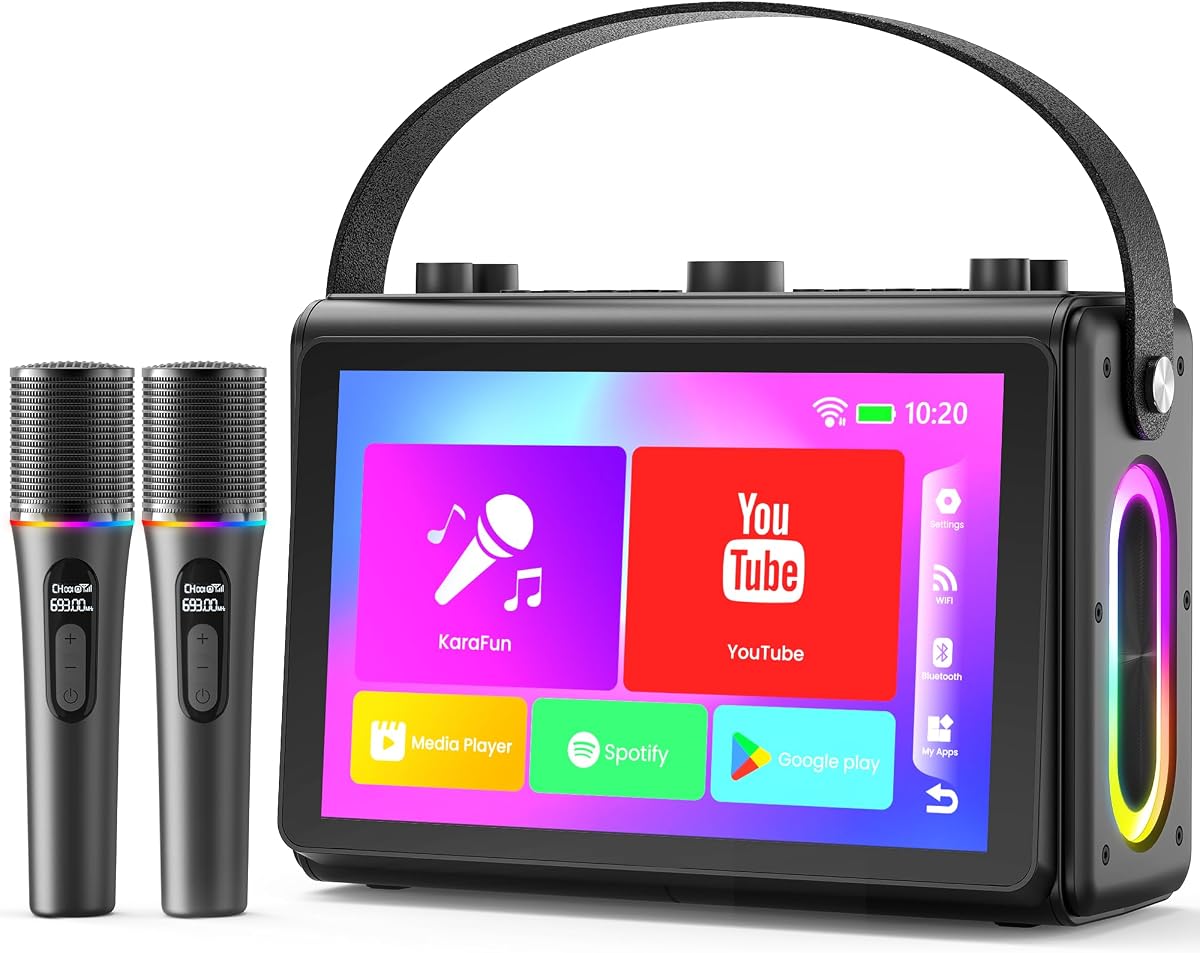
The Verkstar Karaoke Machine with Lyrics Display is a 4.3-rated all-in-one system built around a 10.1-inch full-laminated HD touchscreen. It stands out because it does not force users to choose between a portable karaoke unit and a television-based setup: lyrics can be viewed on its own screen or projected through HDMI to a larger television.
We may earn a commission when you buy through this link, at no additional cost to you.
Its audio section uses two 3.5-inch woofers and two 1.5-inch tweeters, with a built-in noise-reduction function intended to keep vocals clear. Two wireless microphones are included, while Bluetooth 5.3, WiFi, USB, TF card, mobile device, tablet, and television connections broaden the ways to play accompaniment. The machine can also reach YouTube and other supported karaoke applications over WiFi.
The principal trade-off is that some of its versatility depends on compatible apps and a functional network connection. It also includes a 6000mAh battery, but the manufacturer warns against using the unit while it is charging. Its licensed-looking design and portable leather wristband make it more attractive for parties than a plain mixer, although the built-in screen remains the feature that most clearly separates it from basic PA systems.
This is a strong recommendation for households that want one device to handle music, microphones, lyrics, portable use, and TV projection. Choose it over minimalist mixers when touch navigation and a visible lyric interface are priorities. Buyers who only need microphone mixing and already have a reliable karaoke app may prefer a less elaborate system.
The 10.1-inch laminated display provides a self-contained way to follow songs, while HDMI projection makes the lyrics visible to a larger group. That dual-display approach works well for both individual practice and social gatherings.
Bluetooth, WiFi, USB, TF card, and device connections let the system accommodate different music sources. The included wireless microphones then provide a simple path from casual playback to a genuine karaoke session.
We may earn a commission when you buy through this link, at no additional cost to you.
This soundbar-style karaoke system carries a 4.4 rating and focuses on delivering substantial home-theater sound with two included wireless microphones. Its 2.1-channel arrangement pairs a soundbar with a 6.9-inch subwoofer, making it more appropriate for filling a living room with music and vocals than a lightweight practice speaker.
We may earn a commission when you buy through this link, at no additional cost to you.
Audio is rated at 80W with a 280W peak output, while four sound modes—3D, Music, Movie, and News—cover common listening situations. Separate bass and treble adjustment gives users greater control over the mix. The microphones offer stable connectivity up to 66 feet and include noise reduction, which can make them useful for group singing in a normal room.
Its primary limitation is that it has no built-in screen or dedicated karaoke song library. The system is designed to work with a phone, tablet, television, or another media source. HDMI ARC is the most convenient television connection, but optical, AUX, USB, and Bluetooth 5.3 make the hardware adaptable to different home entertainment arrangements.
This is a compelling value choice for a family that wants a soundbar, wireless karaoke microphones, and a subwoofer in one package. It suits users who already have a karaoke application or plan to cast lyrics from another device. For a completely self-contained machine with a large display, one of the screen-equipped alternatives is the better fit.
The separate 6.9-inch subwoofer gives this system more low-end weight than a compact all-in-one unit. Its 3D mode can also create a broader presentation when the goal is a more cinematic home-party atmosphere.
HDMI ARC provides a direct route for television audio, while optical and AUX cover common legacy and soundbar arrangements. A remote control makes switching modes and adjusting the mix more convenient during a gathering.
We may earn a commission when you buy through this link, at no additional cost to you.
The RHM L268 is a 4.1-rated indoor karaoke speaker with a straightforward emphasis on vocal participation, room-filling audio, and a relatively large microphone capacity. Two rechargeable wireless microphones are included, and two 6.5mm inputs allow additional wired microphones to be added, creating a potential four-person singing setup.
We may earn a commission when you buy through this link, at no additional cost to you.
Its two 15W tweeters and 30W subwoofer are intended to provide clear vocals, balanced bass and treble, and enough volume for a house party. The microphones recharge in about two hours and operate for about four hours. Color-changing LED lights offer two lighting modes, while direct bass and treble controls make it possible to tune the presentation without navigating a menu.
The L268 connects to televisions through HDMI or optical, and phones, tablets, and computers can provide accompaniment through Bluetooth and compatible singing applications. It does not have an integrated display, and the wired microphones needed to reach four performers are not included. The unit also has no battery and is explicitly designed for indoor use with its power adapter.
This model is a good fit for indoor family parties, karaoke battles, and groups that want to add microphones over time. It is less suitable for outdoor use without power or for buyers seeking lyrics and a song library directly in the hardware. Its value lies in the combination of HDMI flexibility, wireless microphones, expandable inputs, and party lighting.
The two included wireless microphones support duets, while open 6.5mm inputs provide a straightforward route to add two wired units. The manuals and bags supplied for the wireless microphones help keep the setup organized.
Physical bass, treble, and lighting controls make it easy to change the sound and appearance without stopping the music. The microphones work best when kept within ten feet of the machine for voice effects.
We may earn a commission when you buy through this link, at no additional cost to you.
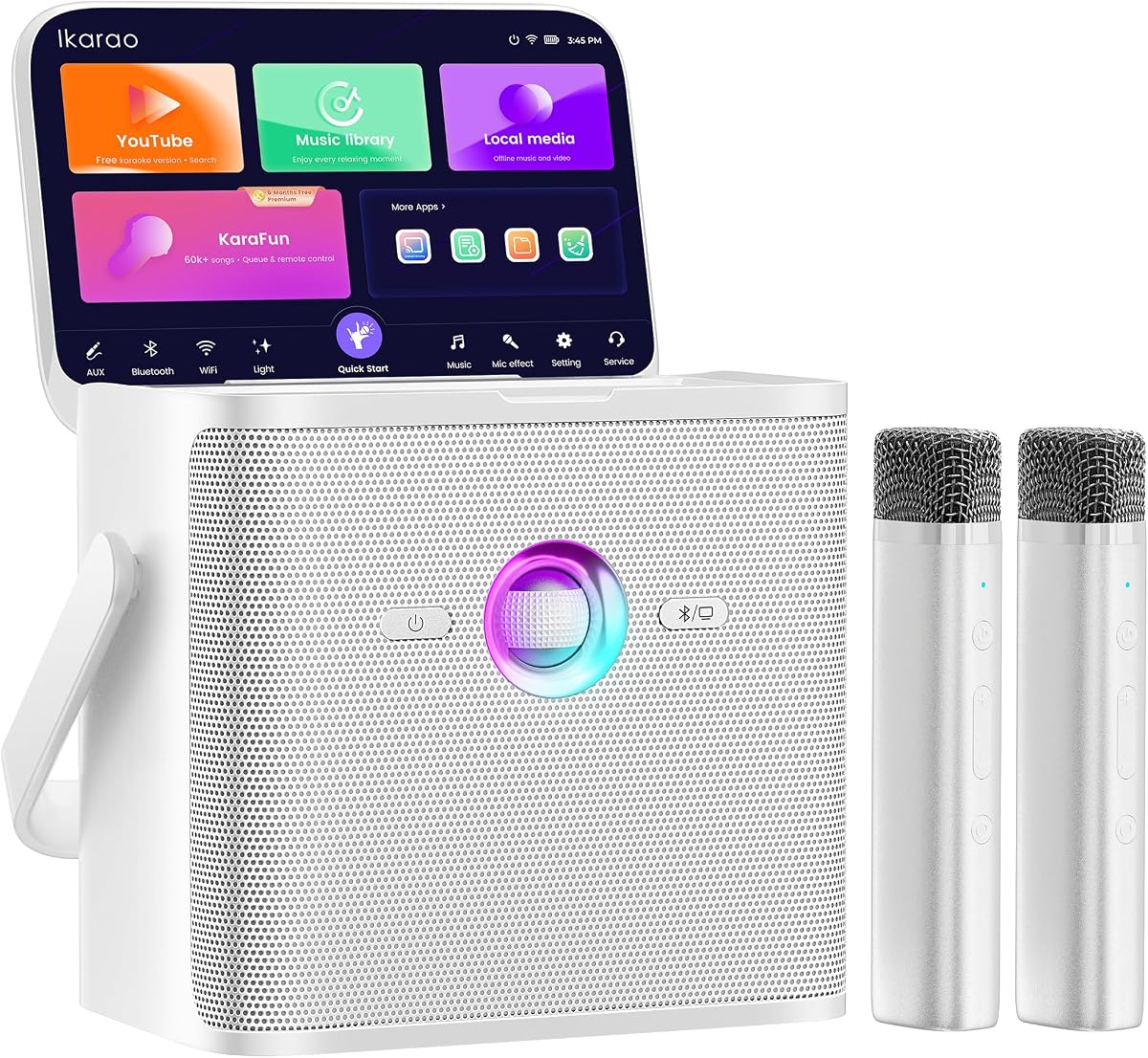
The Ikarao Shell S3 earns a 4.5 rating, the highest among the systems in this guide, and combines a built-in lyrics display, an 80W speaker, two wireless microphones, and a substantial music library. It is the most complete premium option for a household that wants singing, entertainment, and portability in one device.
We may earn a commission when you buy through this link, at no additional cost to you.
Six months of KaraFun Prime are included, with access to more than 50,000 songs and new additions each month. Users can select different lyric modes, change the key and tempo, customize songs, play karaoke games, and synchronize offline content. The microphones add pitch correction and echo, while a DSP chip and sound algorithms are designed to suppress noise and howling.
Three playback modes, eight sound effects, and equalization controls offer considerable adjustment. The speaker uses separate bass and treble processing intended to maintain clarity at different levels. Bluetooth 5.4 and WiFi support modern content, while the foldable handle and seven-hour battery distinguish it from permanently powered home units. The main limitation is dependence on the availability and setup of its included music service.
This is the premium recommendation for users who value a large catalog, polished vocal processing, and minimal dependence on a separate phone. It is especially useful for family events, parties, vocal practice, and travel. A simpler machine may be better for people who only need microphone mixing and already maintain their own app-based song collection.
The integrated music offering is the decisive advantage over basic mixers. A large catalog, regular additions, lyric modes, and offline synchronization make the system useful even when the primary goal is practicing familiar songs.
Pitch correction, echo, noise suppression, and howling control help singers sound more consistent. The folding handle and long battery life allow the same system to move from a living room karaoke night to an outdoor gathering.
We may earn a commission when you buy through this link, at no additional cost to you.
The PPMIC MS75-T is a 4.3-rated portable party speaker with a 300W output, three included wireless microphones, and a 7000mAh battery. Its greatest distinction is microphone quantity: families or groups can use the three wireless units for a trio performance without purchasing additional handheld microphones.
We may earn a commission when you buy through this link, at no additional cost to you.
A dedicated 6.5-inch woofer and 2-inch tweeter produce the main sound, with illuminated silicone drivers and a leather-wrapped exterior adding a party-oriented appearance. A MIC Mode provides pitch correction, while the echo control ranges from subtle room ambience to a pronounced hall effect. These controls make the system accessible to casual singers as well as hosts who want to shape the vocal presentation.
The system connects to a television through the included AUX cable or Bluetooth when the television supports Bluetooth audio output. That flexibility makes it usable with many smart televisions, but it is not a dedicated HDMI karaoke product. It also has no built-in screen or song library; users play accompaniment and display lyrics through a phone, tablet, or television. Two units can be paired in TWS mode for a wider stereo soundstage.
The MS75-T is best for larger gatherings, rotating singers, and anyone who values three wireless microphones more than an integrated display. It is also a practical portable PA for music playback. Those seeking direct HDMI video output and on-device lyrics should choose a screen-equipped or casting-focused model instead.
The three included wireless microphones make group singing immediately possible. Their separate presence also allows the host to pass the microphones among friends, family members, or performers at an event.
The large battery reduces dependence on a nearby outlet, making the speaker useful for indoor parties and outdoor gatherings. TWS pairing can extend the stereo presentation when two identical systems are available.
We may earn a commission when you buy through this link, at no additional cost to you.
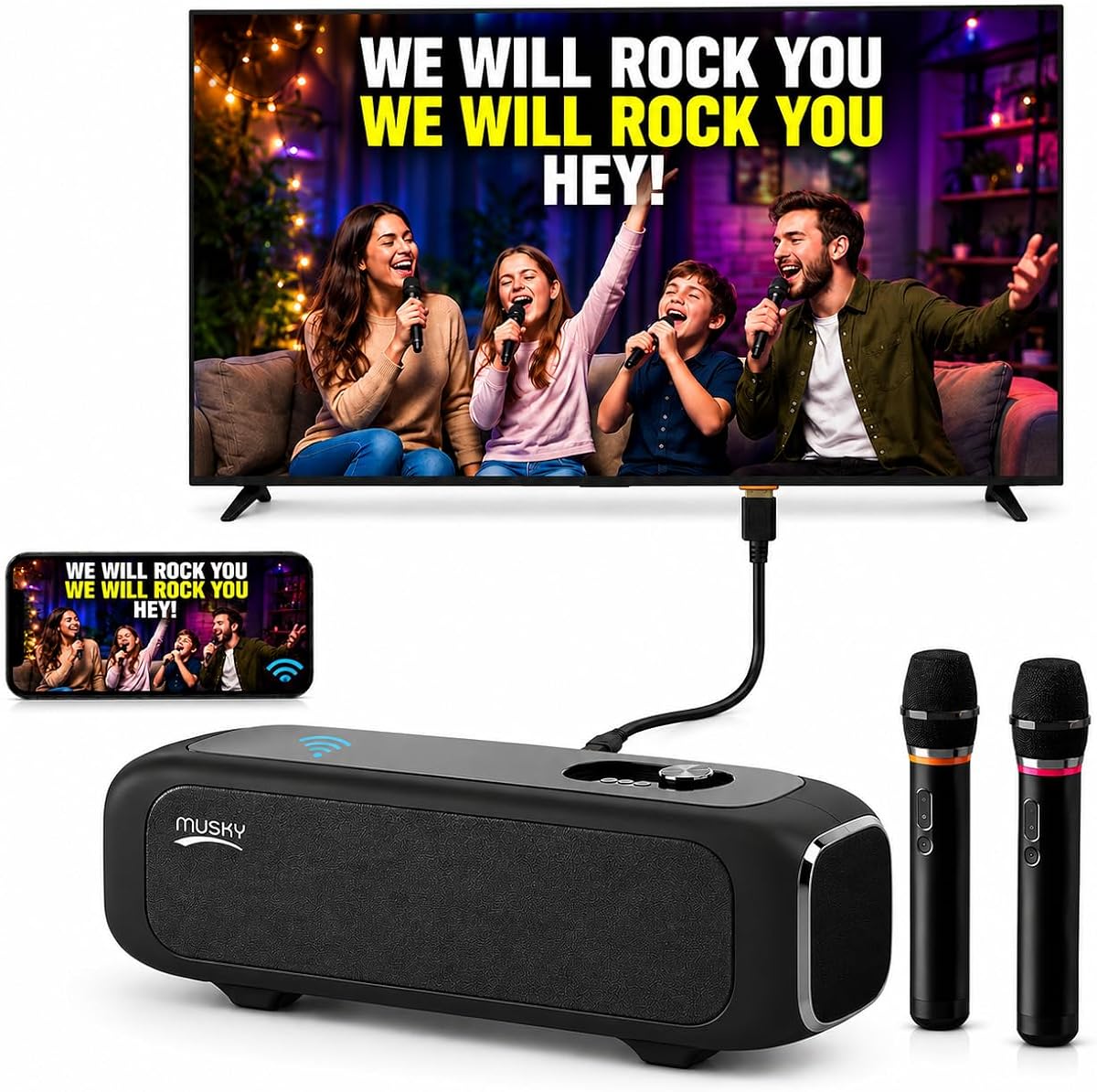
The MUSKY MS5 is a 4.2-rated six-speaker home karaoke system designed to turn a television into the visual centerpiece of a singing session. It supports HDMI 1080P output and Miracast wireless casting, allowing compatible smartphones to send karaoke videos and synchronized lyrics to the screen.
We may earn a commission when you buy through this link, at no additional cost to you.
Its six-driver configuration consists of four front speakers and two side bass units. AI-powered audio processing balances levels and reduces harsh high-frequency noise, which is intended to create a smoother and more comfortable listening experience. The system can serve as a karaoke machine, television speaker, movie audio system, or conventional Bluetooth speaker rather than being limited to one role.
Two rechargeable wireless microphones are included, with a stated battery life of up to 16 hours. Connection options include HDMI, Bluetooth, AUX, USB, and wireless casting. The absence of a built-in display means the MS5 relies on a phone, tablet, or television for visual content, although the HDMI output is specifically oriented toward large-screen lyrics.
This is an excellent choice for family karaoke nights where a phone already serves as the music and lyric source. It is more video-focused than basic AUX karaoke speakers and offers a larger speaker array than many portable alternatives. Buyers who want everything—including lyrics and a song library—inside one appliance should consider the Verkstar or Ikarao systems.
HDMI output gives the MS5 a direct path to a television, while Miracast offers a wireless alternative for compatible phones. Either route can turn ordinary home entertainment into a shared karaoke experience.
The front and side-speaker arrangement expands the sound beyond a compact single-box design. AI processing adjusts levels and tames harsh frequencies, making the system useful for movies and music as well as singing.
We may earn a commission when you buy through this link, at no additional cost to you.
The Sound Town SWM16-MAX is a 4.0-rated wireless microphone mixer for users who already own a television, soundbar, amplifier, or home receiver. Its defining strength is flexible audio routing: HDMI input, HDMI output with TV ARC return, optical input and output, and 3.5mm auxiliary connections are all available.
We may earn a commission when you buy through this link, at no additional cost to you.
Two metal handheld wireless microphones are included. The system operates in the UHF 550–590MHz range and offers 16 selectable frequencies, eight for each channel, which helps reduce interference when several wireless systems operate nearby. Separate volume knobs control Mic A and Mic B, while shared echo and tone controls shape both vocal channels.
The mixer is not an all-in-one speaker or karaoke entertainment center. The TV's audio must be extracted and blended with the microphones, then sent to an external sound system through HDMI ARC, optical, or another supported output. The instructions recommend enabling the television's ARC function, selecting PCM, and choosing external speakers.
This system is ideal for a home theater, church, school, wedding, or meeting room that already has a capable amplification setup. It offers more routing flexibility than a basic wireless microphone set, though buyers without an external speaker may find the setup less convenient. It is best viewed as a professional-style karaoke mixer rather than a complete party machine.
Multiple input and output formats make the mixer useful with smart televisions, media boxes, receivers, soundbars, and other equipment. The optical and auxiliary paths offer useful alternatives when HDMI ARC is unavailable or inconvenient.
Separate controls for the two microphones make it easier to balance singers with different speaking or singing levels. Shared echo and tone controls simplify coordinated vocal treatment across a small group.
We may earn a commission when you buy through this link, at no additional cost to you.
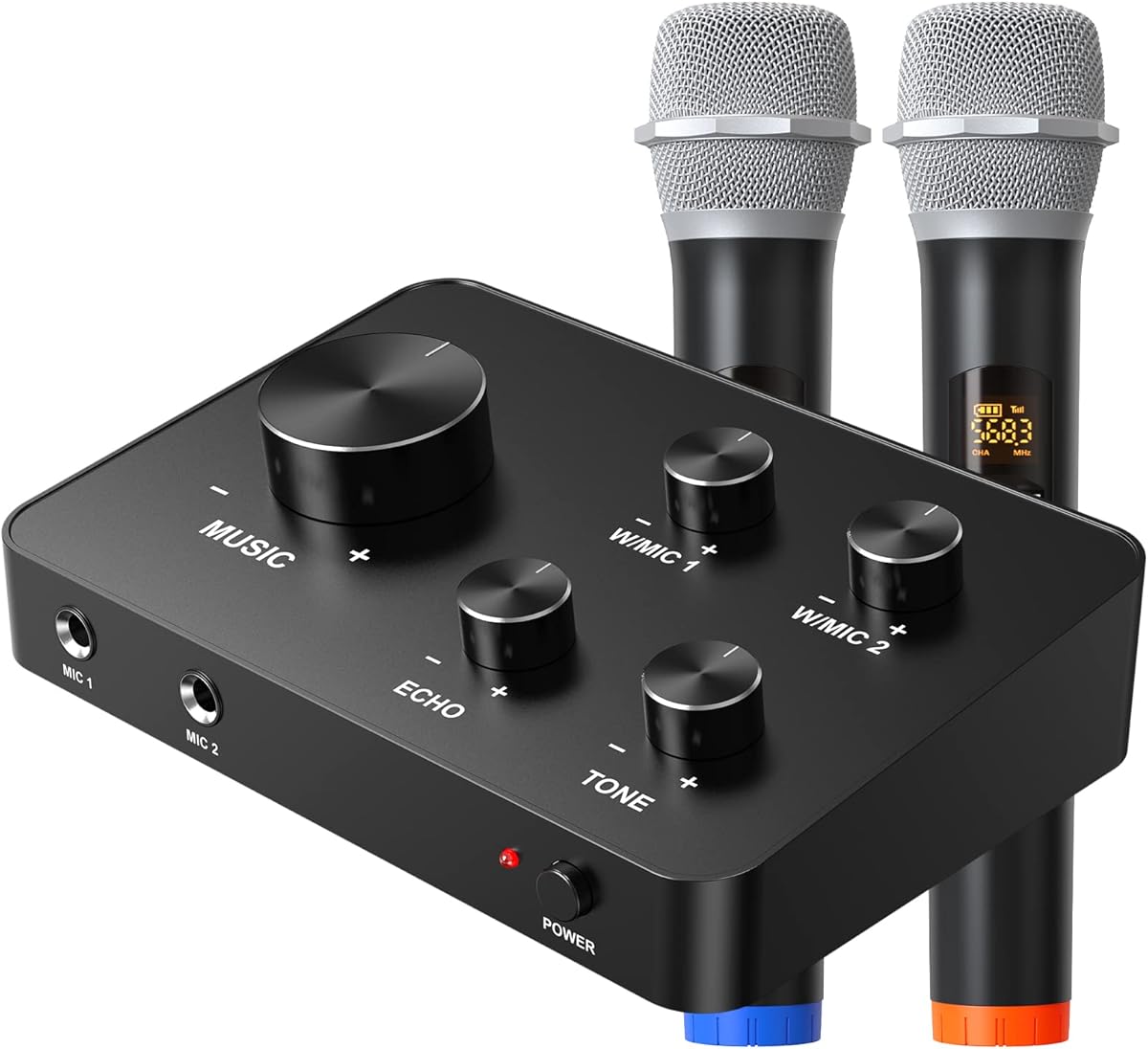
The Rybozen Wireless Microphone Mixer is a 3.8-rated, straightforward karaoke microphone system for people who want to add singing to an existing television or sound system. It includes two handheld wireless microphones, and the receiver/mixer can output the combined music and vocal signal through HDMI or 3.5mm auxiliary connections.
We may earn a commission when you buy through this link, at no additional cost to you.
The microphones use UHF wireless technology with an advertised operating range of up to 100 feet. Five rotary dials on the receiver adjust music volume, microphone volume, echo, and tone, allowing the user to shape the mix without navigating complex menus. Individual wireless microphone volume controls add further flexibility when one singer needs to be more prominent.
Two additional wired microphone inputs allow the system to expand beyond the included pair. It is compatible with smart televisions, Blu-ray players, computers, laptops, tablets, smartphones, PA systems, DVD players, home theaters, receivers, and speakers. However, the unit has no built-in screen, speaker, or song library, and its 3.8 rating is the lowest among the ten products reviewed here.
The Rybozen is a useful option for a home karaoke setup that already has a television and powered audio equipment, as well as for weddings, churches, schools, and house parties. It prioritizes familiar controls and broad compatibility over integrated entertainment. A buyer seeking a ready-made system should look to the soundbar or screen-equipped models instead.
Five clearly accessible dials let users adjust the balance of music, microphones, echo, and tone. This makes the mixer approachable for gatherings where a volunteer host may need to make quick changes.
HDMI and auxiliary outputs let the system feed many common entertainment setups. Two wired microphone inputs also make it possible to build a larger session without replacing the receiver.
We may earn a commission when you buy through this link, at no additional cost to you.
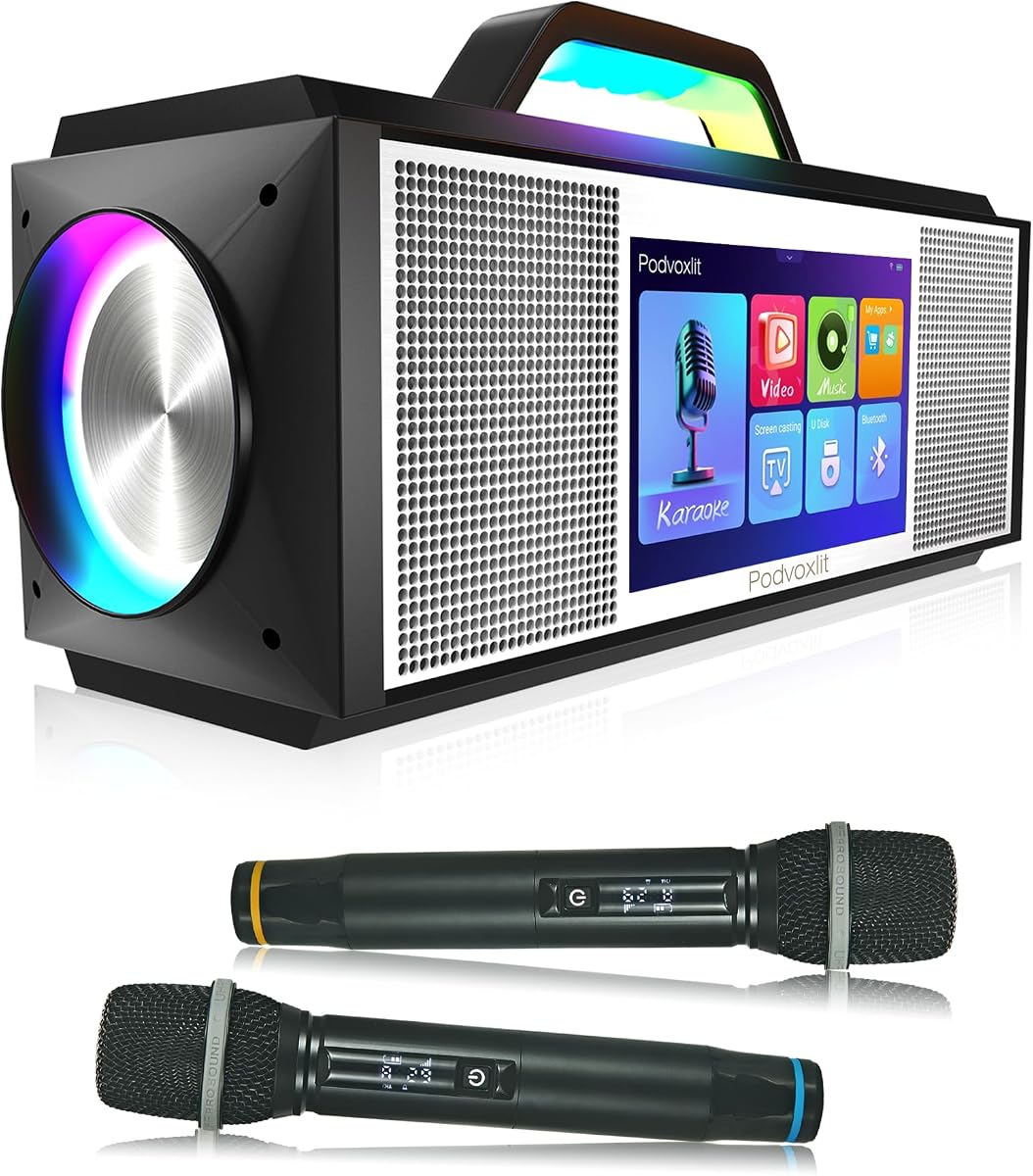
The Podvoxlit X5 is a 4.1-rated smart karaoke machine with an integrated eight-inch tablet, two wireless microphones, a five-speaker system, and HDMI television output. It is designed to operate independently for many activities, without requiring the user to continually operate a separate phone.
We may earn a commission when you buy through this link, at no additional cost to you.
Its 4.1-channel system is rated at 100W RMS with a 480W peak level, combining dual one-inch tweeters, dual three-inch midrange drivers, and a five-inch subwoofer. A dual-core DSP chip, adjustable equalization, and controls for bass, treble, reverb, and echo provide extensive sound shaping. The microphones use UHF technology with a stated range up to 100 feet and automatically connect to the machine.
The X5 supports YouTube and the iKTV app, including an extended global cloud song library. It also supports Bluetooth, WiFi, USB, OTG, AUX, HDMI, Apple AirPlay, and Huawei wireless projection. Some app benefits depend on membership availability, while updated software enables mobile screen casting and phone-based remote control. Unlike many systems, the X5 may be used while charging.
This is a strong recommendation for a user who wants a generous app-based catalog, a large touch interface, and direct television lyrics. Its built-in tablet, handle, shoulder strap, and 10.5-pound weight make it portable for family events and outdoor gatherings. It is more feature-rich and more complex than a basic mixer, so the included apps and charging options should be reviewed before purchase.
YouTube support and the iKTV catalog give the machine access to a broad range of material beyond a built-in local song collection. Customized content, multiple languages, and regular cloud updates make the software side a major strength.
The included HDMI cable supports synchronized lyrics on a television, while AirPlay, Huawei projection, and the tranScreen app broaden mirroring and remote-control options. A phone can therefore serve as a convenient controller without being the only playback device.
We may earn a commission when you buy through this link, at no additional cost to you.
The Sound Town SWM15-MAX is a 3.7-rated wireless karaoke mixer with a broad collection of connections. It supports HDMI with TV ARC, Bluetooth, optical Toslink, 3.5mm auxiliary input and output, and 1/4-inch mono jacks for dynamic microphones and instruments such as electric guitars.
We may earn a commission when you buy through this link, at no additional cost to you.
Two wireless microphones are included, with 16 available frequency selections and a stated range of up to 100 feet. Independent volume controls support the two wireless or wired microphone channels. An Effect Mode offers vocal reverb and echo as well as instrument tune and guitar effects, while a vocal-cut option is intended specifically for karaoke.
Like a conventional mixer, it does not contain a large speaker or a lyric display. To blend television audio with the microphones, the TV's ARC and PCM functions must be enabled, and the mixed output must be sent to a soundbar or amplifier. The system's lower 3.7 rating should be considered when comparing it with higher-rated all-in-one options.
The SWM15-MAX is most appropriate for musicians, small venues, churches, schools, and homes with an external sound system. Its combination of microphone, instrument, and television connections is more versatile than a basic karaoke speaker. For consumers seeking a self-contained television karaoke appliance, a powered system with a screen or casting function will be easier to operate.
Quarter-inch instrument inputs and guitar-oriented effects expand the system's use beyond singing. That makes it useful for rehearsals, live demonstrations, and small events as well as home karaoke.
HDMI ARC and optical paths make it possible to extract television audio, combine it with the vocal channels, and return the result to an amplifier or soundbar. The mixer is flexible, but the setup requires attention to the television's audio settings.
We may earn a commission when you buy through this link, at no additional cost to you.
The most suitable HDMI karaoke machine depends on whether you want a self-contained entertainment appliance or a mixer for an existing audio system. Display, music library, microphone capacity, television routing, speaker power, and portability should be evaluated together because every feature affects setup and usability.
A built-in screen gives you an immediate place to read lyrics without a second display, while HDMI output can enlarge those lyrics for everyone in the room. Machines with a screen often provide touch controls, lyric modes, and integrated app access, but they may have less powerful speaker hardware than a dedicated soundbar or PA system. If your main goal is immediate, uncomplicated family karaoke, an integrated display is convenient. If you already have a large television and use a reliable karaoke application, a screenless casting or mixer design can save space and cost.
HDMI output generally sends the karaoke system's display or video content to a television, whereas HDMI ARC is designed to carry television audio back to a sound system. These roles are not interchangeable. A system with HDMI ARC and optical input can extract music from a smart TV, blend it with microphones, and send the combined audio to a soundbar or amplifier. An all-in-one unit with HDMI projection may instead need the lyrics app or another video source on the television. Confirm the direction of each port and whether the required cable is included.
Two wireless microphones cover most couples and small family sessions, while three microphones make a rotating group or trio easier to organize. Wireless range should be judged against the size of the intended room. Ratings of 66 to 100 feet appear across several systems, although real performance can be affected by walls, interference, and frequency congestion. Multi-channel frequency selection is useful in homes with nearby wireless equipment. For formal events or larger rooms, UHF systems and individual microphone volume controls deserve additional attention.
Headline wattage figures can be misleading because peak power, RMS output, driver size, and channel configuration describe different aspects of performance. A separate subwoofer may add noticeable bass, while multiple tweeters and midrange drivers can improve vocal clarity. Systems with DSP, noise reduction, howling suppression, pitch correction, echo, and separate bass and treble controls offer more ways to balance music and voices. For apartment living, moderate output and precise level control may be more valuable than maximum volume.
Some machines include a large streaming catalog, six months of a karaoke service, YouTube access, or app-based cloud music. Others are pure speaker and microphone systems that require a phone, tablet, television, or another media player. App-based systems are convenient for a broad repertoire, although they may require a network connection, membership, or software updates. Traditional mixers remain dependable because playback comes from a familiar device. Think about whether the household already has subscriptions, internet access, and a preferred karaoke app before choosing a hardware-integrated library.
A built-in battery, compact handle, and wireless microphones make a karaoke system easier to move between rooms or take outdoors. Battery capacity varies considerably, and some machines can operate while charging while the manufacturer of another explicitly warns against it. Verify charging rules rather than assuming every model behaves the same. Also consider the weight of a full speaker, the space needed for a subwoofer, and whether a nearby outlet is available. Permanently powered indoor systems may be simpler and more consistent for regular use in one location.
Physical buttons and rotary knobs are useful when a host needs to adjust volume or effects without navigating menus. Screen-equipped systems may require more steps but can expose deeper song and EQ settings. Multi-driver arrays and separate subwoofers are useful for filling a large room, whereas compact units may be preferable for apartments and close listening. LED lighting, portability, and dual-purpose Bluetooth speaker functions can add entertainment value, but they should remain secondary to stable television audio, readable lyrics, and microphone clarity.
Begin by identifying what the machine must receive and what it must send. If the system has an HDMI output for lyrics, connect it to an available television input and select that input on the television. If it has an HDMI ARC audio-return function, enable ARC or CEC, choose PCM when instructed, and select external speakers. A mixer may require the television's audio to flow into the mixer and the mixed output to flow back to a soundbar or amplifier, so follow the included connection diagram carefully.
Pair the wireless microphones before the event, confirm that each channel has a usable level, and adjust music, microphone, echo, and tone controls gradually. For screen-equipped systems, connect to WiFi, open the supported karaoke or streaming application, and select songs before guests arrive. During a session, keep the television lyrics visible, place microphones within their recommended operating range, and increase overall volume only after the vocal and music balance sounds natural.
For care, charge rechargeable microphones as directed, clean the speaker grille and microphone heads gently, and keep liquid away from electrical ports. Follow the manufacturer's instructions regarding use while charging; the Verkstar system specifically should not be operated while charging. Store wireless systems in their supplied bags, avoid moisture and direct heat, and update software when the manufacturer provides a current version. Periodic connection and sound checks are the most effective way to prevent avoidable problems during a gathering.
HDMI output usually sends video or the machine's interface to a television, while HDMI ARC allows television audio to travel back to a compatible sound system. A karaoke machine with only HDMI output may need a separate app or media source for television lyrics. A system with HDMI ARC can extract TV audio, mix it with microphones, and return the combined signal. Check the product's port directions and manual rather than assuming every HDMI connection performs the same task.
Most systems can work with a modern television, but the required connection varies. All-in-one machines may output lyrics through HDMI, while soundbar and mixer systems may use HDMI ARC, optical, Bluetooth, or 3.5mm audio. The television must also support the selected feature and have the appropriate output enabled. Older televisions may require an optical or analog arrangement, and some products support only audio rather than television video.
No, if you already have a phone, tablet, television, or computer with a preferred karaoke application. Screenless speakers and mixers can play accompaniment from that device and display lyrics on the television. A built-in catalog is more convenient for users who want one self-contained appliance, but app-based libraries may require a subscription, internet connection, and periodic updates.
Two microphones are enough for most couples, duets, and small family gatherings. Three-microphone systems make it easier for several friends to sing without passing a single mic around. Larger groups can look for models with 6.5mm or 1/4-inch wired microphone inputs, which allow additional performers to be added. Confirm that extra wired microphones are included before planning on them.
The music, television, receiver, and microphone controls may all affect the final level. Sound Town's mixer guidance recommends increasing the TV, soundbar, and receiver volume, then setting the mixer's microphone control to a low-to-mid position and raising it gradually. Also check the correct television audio output and confirm that the microphones are paired to the intended channel. A low battery or a weak wireless connection can also affect microphone performance.
Only models with a built-in rechargeable battery and an outdoor-appropriate design are practical away from an outlet. The Verkstar, Ikarao Shell S3, PPMIC MS75-T, and Podvoxlit X5 include batteries, while the RHM L268 is explicitly designed for indoor use with a power adapter. Even portable models should be protected from moisture and direct weather, and their operating guidance should be checked before use.
A mixer is better when you already have a television, powered speakers, or amplifier and want precise control over microphone levels, echo, and tone. An all-in-one machine is easier for a new user because it combines the display, speakers, microphones, and often a song library. Your existing equipment and interest in deeper audio control should guide the decision.
Start with the echo control at its lowest setting, raise the music volume gradually, and keep each microphone within its recommended operating distance from the machine. Dual-device systems can also suffer from acoustic feedback, so keep speakers and microphones separated and avoid pointing a microphone directly at a speaker. More advanced systems offer noise reduction, howling suppression, or DSP processing that can help.
The Verkstar Karaoke Machine with Lyrics Display offers the strongest balanced combination of a large touch screen, HDMI projection, two wireless microphones, flexible sources, and portable operation. The Ikarao Shell S3 stands out as the premium choice for its extensive song library, advanced vocal processing, and seven-hour battery, while the Soundbar Karaoke Machine with Subwoofer provides the best budget-oriented path to a powerful television-party system.
Prioritize the way lyrics and television audio will reach the screen. Choose a built-in display for a self-contained experience, Miracast or HDMI output for smartphone-based karaoke, or an HDMI ARC and optical mixer for a room that already has a sound system. Then match microphone count, speaker output, app access, and portability to the way your household actually gathers.
Finally, check the included cables, current app requirements, battery rules, and television settings before purchasing. Prices, promotions, software access, and product configurations can change, so verify the latest listing details at the time of purchase. The links in this guide point to the relevant product pages for the latest information.
