
CADeN Camera Backpack Bag
4.7Editor score
Seven-layer PE foam padding
Capacity for camera and four lenses
Tripod and trekking pole holder
Waterproof scratch-resistant material
A DSLR bag for hiking must protect delicate equipment without becoming a burden on the trail. The best options combine adjustable padded dividers, weather resistance, secure access points, comfortable weight distribution, and enough external storage for water, layers, and compact hiking supports.
We compared ten camera backpacks and slings using their listed dimensions, materials, storage systems, protective features, carrying options, and outdoor-oriented details. The list covers lightweight packs, expandable models, tactical designs, slings, and convertible bags for different camera kits and hiking styles.
Each review explains where a particular bag stands out, where compromises may appear, and whom it is best suited for. Product ratings and configurations can change, while current prices vary by seller, promotion, and availability, so compare the latest listing details before buying.
4.7Editor score

4.7Editor score
4.6Editor score
As an Amazon Associate we earn from qualifying purchases.
This side-by-side comparison highlights each camera bag's carrying format, organization, protection, and trail-oriented features, helping you narrow the field according to your camera kit, weather exposure, and preferred hiking style.


The K&F CONCEPT Camera Backpack is a lightweight hiking-oriented camera bag with a 4.7 rating. Its most appealing traits are the 1.96-pound listed weight, streamlined exterior, five removable dividers, large front-opening camera compartment, and included rain cover, all of which suit photographers carrying a moderate kit on foot.
We may earn a commission when you buy through this link, at no additional cost to you.
The main equipment area measures 9.8 by 4.9 by 14.1 inches, according to the supplied specification, and can be reconfigured for a DSLR, lenses, flash, drone, or other accessories. A separate padded compartment fits a laptop up to 14 inches. Two small front zipper pockets provide dedicated places for SD cards, batteries, cables, gloves, and similar items, while side pockets accommodate a bottle and umbrella.
Protection comes from thick internal dividers, scratch-resistant 600D fabric, and a splash-proof exterior. The removable dividers also let the bag function as an everyday backpack, although switching between pure camera and general travel use requires removing and rearranging the internal organization. The compact minimalist structure is helpful on a trail, but owners with unusually large bodies, long telephoto lenses, or multiple batteries may need to confirm the usable dimensions carefully.
This is the most balanced recommendation for hikers who want a camera bag that does not overcomplicate the carry. It offers enough expansion for normal photographic equipment, rapid access, moderate weather protection, and a low listed weight. It is particularly suitable for day hikes and short outdoor trips where a full-size expedition pack would feel excessive.
At 1.96 pounds, the backpack is designed to minimize the weight of the bag itself, leaving more of the total load available for a camera, lenses, water, and trail necessities. Its simple shape also avoids the visual bulk of a large expedition-style camera pack.
The large front-opening main compartment allows a photographer to reach a camera or lens without opening the entire pack. Dedicated front pockets further reduce the need to search through the equipment compartment for small accessories.
We may earn a commission when you buy through this link, at no additional cost to you.
The MOSISO Camera Backpack combines a 4.7 rating with a roomy structure suited to photographers who carry more than one body, several lenses, a drone, or a substantial accessory kit. Its 17.32 by 11.8 by 7.5 inch dimensions make it more substantial than compact trail options, but the available storage is broad.
We may earn a commission when you buy through this link, at no additional cost to you.
Two removable padded modular inserts organize the upper camera compartment, while a separate flat compartment holds a laptop up to 16 inches. The hardshell PU leather front supplies structure and resistance to weather and impact, and the internal foam adds buffering. A side holder accommodates a tripod or monopod, while the opposite side pocket accepts a bottle or umbrella up to the stated maximum diameter.
For hiking, the adjustable shoulder strap, elastic back cushion, side accessory pockets, rear anti-theft compartment, and trolley belt help make the larger load manageable. The trade-off is bulk: the stated dimensions and multi-compartment arrangement make it less suitable for ultralight trekking. A rain cover is not included, so hikers entering sustained rain should plan an additional weather-protection solution.
Choose this bag when capacity, laptop storage, and a protective front are more important than minimal weight. It is a strong choice for photographers moving between city and trail locations, particularly those who want room for several camera bodies, larger accessories, and travel essentials in one organized pack.
Separate padded modules and a large lower capacity area give this bag more flexibility than simple sling designs. The removable inserts can be arranged around bodies, lenses, flashes, or compatible drone equipment, making the pack useful across different shooting assignments.
Padded straps ranging from 17.72 to 39.4 inches, an elastic back cushion, and a trolley belt improve versatility. These details are particularly useful when the bag contains a larger kit and must be moved between a trailhead, campsite, and vehicle.
We may earn a commission when you buy through this link, at no additional cost to you.
The CADeN Camera Backpack earns a 4.7 rating and stands out with a 1.74-pound listed weight, a standard 11 by 5.9 by 15 inch footprint, and enough stated capacity for one camera body, four lenses, a flash, a tablet, and additional accessories. That combination makes it a practical all-around hiking camera bag.
We may earn a commission when you buy through this link, at no additional cost to you.
Its interior uses seven-layer PE foam and PP board to cushion the camera and lenses, while the exterior is described as scratch-resistant and waterproof. The reinforced handle and shoulder straps use bar-tack construction, with a stated load-bearing capacity of 50 kilograms. One side has a mesh bottle pocket, and the other is intended for a tripod or trekking pole, reducing the need for multiple trail accessories.
The bag is not as small as a sling, and its protection depends on the material and padding rather than an included rain cover. The listed one-year replacement policy adds reassurance, but buyers should still protect the bag from prolonged direct rain and verify the fit of their camera body, attached lens, tablet, and support pole. Its wide range of external attachment and access details may also be unnecessary for minimal hikers.
This is a strong value-focused choice for a conventional DSLR kit and a long day hike. It offers a favorable balance of low weight, room, internal protection, and trail-friendly carrying points without relying on a very specialized exterior system.
Seven-layer PE foam and PP board create a protective core around equipment. The listed weight remains below two pounds, making the design more trail-friendly than many heavily padded camera packs.
A mesh side pocket holds a bottle or umbrella, while the opposite side accommodates a tripod or trekking pole. An iPad pocket, concealed front zipper, and multiple handle positions support common outdoor photography routines.
We may earn a commission when you buy through this link, at no additional cost to you.
The MOSISO Camera Sling is a compact alternative for hikers who want fast camera access without carrying a large backpack. It has a 4.6 rating, a 15.7 by 9.06 by 4.8 inch exterior, and a sling design that rotates from the back to the front for quick access.
We may earn a commission when you buy through this link, at no additional cost to you.
Soft foam surrounds the main equipment area, with a removable modular insert in the lower section and additional storage above it. A side tripod holder provides a place for a compact support, and a concealed rear anti-theft pocket holds valuables. The shoulder strap adjusts from 19.3 to 38.7 inches, allowing a close fit for different body sizes and movement styles.
Its main limitation is the single-shoulder format. A sling can place uneven pressure on one shoulder, especially with multiple lenses, and may bounce while moving quickly or scrambling over uneven ground. It also offers less room for hiking layers, water, and food than a full backpack. Owners should check that their body and attached lens fit the lower insert's stated 10.1 by 7.87 by 4.33 inch dimensions.
The MOSISO sling is best for a short hike, nature walk, or urban outing centered on one camera and a compact set of lenses. It prioritizes mobility and access over all-day load support, making it a useful alternative for photographers who deliberately travel with a minimal kit.
The rotatable sling brings the camera compartment toward the front for a quicker draw than a conventional top-opening backpack. This is useful when the bag is used for moving wildlife or landscape shots without stopping for a long gear setup.
Removable padded inserts allow the lower section to adapt to different lenses and flash units. The upper area and front pockets handle smaller accessories, reducing the need for a second organizer.
We may earn a commission when you buy through this link, at no additional cost to you.
The TARION Camera Sling is designed for light daily carry, quick camera access, and a straightforward single-shoulder configuration. Its 4.6 rating is supported by a 48.4-inch adjustable strap, a hardshell top compartment, and a side-opening camera section with a zipper and safety buckle.
We may earn a commission when you buy through this link, at no additional cost to you.
Two padded storage sections can be divided with adjustable inserts. Removing the center divider creates a longer area for a compact handheld gimbal or another item that fits within the stated internal measurements. A side pocket and retaining strap accommodate a compact tripod, monopod, or selfie stick, and can alternatively hold a bottle when the shooting support is removed.
The fixed right-shoulder arrangement is an important limitation. It cannot swap sides or become a two-shoulder backpack, so it may not suit photographers who prefer balanced loads or need to place the bag over either shoulder. The manufacturer also recommends checking the size and weight of larger supports and comparing internal dimensions with the camera, attached lens, and accessories before ordering.
This sling works best for a photographer traveling with a compact body, a small lens selection, and light accessories. It is particularly suitable for casual day hikes where quick movement and a close-to-body carry matter more than expansive storage or a conventional backpack configuration.
Soft contact fabric and breathable padding make the shoulder strap suitable for light daily use. The generous adjustment range helps position the sling close to the body and reduces excess strap movement.
The upper and lower compartments can be separated for individual pieces of equipment or combined for a longer item. This flexibility makes the sling useful beyond a fixed camera-and-lens arrangement.
We may earn a commission when you buy through this link, at no additional cost to you.
The MOSISO Tactical Camera Backpack is a 4.5-rated option for hikers who need a protected camera area alongside clothing, food, and other daily necessities. Its three-compartment layout separates the main gear from an upper pocket and a rear laptop sleeve, making it easier to combine photography with an extended day outdoors.
We may earn a commission when you buy through this link, at no additional cost to you.
The lower camera compartment measures 11.41 by 10.24 by 6.29 inches and uses removable padded modules that can be adjusted for different bodies, flashes, lenses, or compatible drones. The back compartment accommodates laptops from 13 inches through 16 inches. Webbing covers the exterior, a removable flag patch sits at the front, and reinforced edges and a side compression system add structure for outdoor use.
Access can occur from the side or front without opening the entire backpack, while two front zipper pockets hold a phone, tablet, or frequently used items. A bottom tripod holder, side bottle pocket, rear anti-theft pocket, trolley belt, and padded shoulder strap expand its utility. The drawback is size: at 17.13 by 11.81 by 8.27 inches, it is a substantial pack rather than a minimalist trail solution.
This backpack suits photographers who need a complete camera and hiking setup but do not want to carry two separate packs. Its modular lower section, tactical attachment points, and separate upper storage are especially useful for hikes that involve layers, snacks, and outdoor accessories.
The upper compartment keeps non-photography items away from padded camera modules. This separation helps a photographer carry clothing, towels, food, and daily necessities without forcing everything into the equipment area.
Webbing and a front patch area allow additional outdoor gear to be attached. The system is useful for photographers who already understand modular attachment practices and want more configuration options than a conventional hiking daypack.
We may earn a commission when you buy through this link, at no additional cost to you.
The RAINSMORE Camera Backpack is a strong all-weather choice for photographers who hike in rain, snow, or changeable conditions. It carries a 4.7 rating and includes a dedicated full-coverage rain cover, waterproof fabric, a 15.6-inch laptop compartment, and an internal layout built around six adjustable dividers.
We may earn a commission when you buy through this link, at no additional cost to you.
Thick padded dividers act as shock absorbers, while three elastic security straps keep cameras, lenses, controllers, and compatible drone equipment in place. A quick-access entry point leads to the main camera compartment, allowing rapid access to a DSLR, SD cards, or batteries. A hidden rear pocket protects a passport or wallet, and front slip and zipper pockets organize frequently used objects.
The 17.7 by 7.87 by 12.79 inch size is substantial, so the pack is better suited to day hikes and travel days than fast ultralight trekking. Its MOLLE-style expansion system, water-bottle side pocket, luggage pass-through strap, and padded breathable back panel add useful versatility, but they also make the design more elaborate than a simple camera sling.
This is the recommendation for hikers who place a high value on weather protection, organized access, and a padded carry system. It is especially compelling for photographers moving between outdoor locations and a base camp, hotel, or vehicle where laptop storage and luggage compatibility are useful.
Waterproof fabric and the included full-coverage rain cover provide two layers of weather readiness. The cover is particularly useful when rain becomes sustained or when the backpack is exposed while being placed on the ground.
A dedicated quick-access opening shortens the path to the main camera compartment. The orange quick-grab panel, elastic security straps, and adjustable dividers help maintain visibility and order without sacrificing the padded structure.
We may earn a commission when you buy through this link, at no additional cost to you.
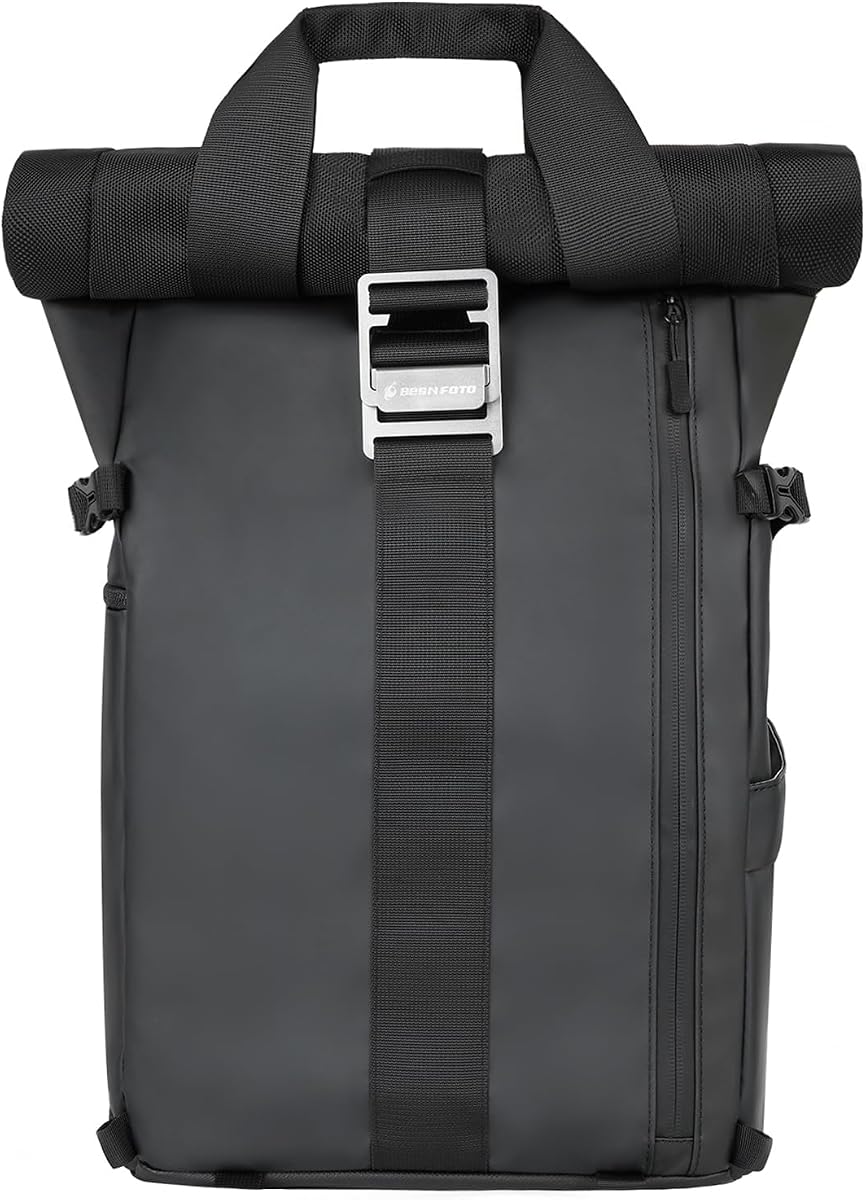
The Besnfoto Camera Backpack is the most expedition-oriented option in this group, combining a 4.6 rating with an expandable roll-top opening, a roll-top closure, quick side access, and an included rain cover. It is built for photographers who may carry two cameras, several lenses, and additional outdoor equipment.
We may earn a commission when you buy through this link, at no additional cost to you.
Water-repellent TPU nylon is described as soft, smooth, durable, scratch-resistant, and easy to clean with a damp towel. The main camera compartment measures 11.4 by 5.5 by 11.4 inches, and seven removable dividers allow the interior to be adjusted. The roll top can hold a sweater, jacket, books, or small devices, while a 16-inch laptop compartment supports substantial travel storage.
For hiking, the included waist strap, wide adjustable shoulder straps, breathable padded back, side tripod holder, front accessory straps, and internal mesh pockets create a feature-rich carrying system. These same features make the bag larger and more complex than minimal alternatives. A photographer traveling with a small kit may find the roll top excessive, and its expanded shape can be less convenient on narrow trails.
Choose the Besnfoto when equipment capacity, weather protection, and expandable trail storage outweigh compactness. It is a strong fit for multi-day outings, scenic backpacking routes, and photographers carrying a larger camera system or drone alongside personal outdoor gear.
The roll-top opening allows the upper section to expand beyond its normal shape. This is useful when a hike requires clothing, food, books, or other gear beyond the camera kit without adding a separate pack.
A waist strap, broad padded shoulder straps, and an ergonomic breathable back help stabilize the load. The included rain cover and water-repellent shell further support use in exposed outdoor conditions.
We may earn a commission when you buy through this link, at no additional cost to you.
The BAGSMART 2 in 1 Camera Backpack is a flexible choice for hikers who want a camera bag that can shift between cross-body, backpack, and hand-carried use. It has a 4.5 rating, 14.17 by 10.24 by 6.30 inch dimensions, and a two-in-one shoulder strap designed for different carrying preferences.
We may earn a commission when you buy through this link, at no additional cost to you.
The exterior uses waterproof, scratch-resistant polyester, while reinforced padding and removable dividers protect the main equipment area. A dedicated compartment holds a tablet up to 12.9 inches. Side openings improve access to the camera, and L-shaped front pockets provide storage for daily essentials. When the dividers are removed, the bag can function as a general travel or daily pack.
Its strongest travel feature is the back sleeve for a rolling suitcase handle, allowing the camera bag to ride with luggage. The listed airline under-seat sizing is another useful travel consideration, although actual airline policies should be checked. The dedicated tablet space means buyers wanting a conventional laptop compartment should verify whether their device and desired orientation will work before purchasing.
This backpack is a good match for photographers who want flexibility between a sling-style cross-body carry and two-shoulder backpack use. It is well suited to city-to-trail outings, day excursions, and travel days where a compact camera kit and tablet need organized transport.
The two-in-one strap can be worn cross-body or used as a backpack, and the bag can also be hand-carried. This makes it adaptable to crowded trails, transit platforms, and changing photo locations.
Removable dividers protect a camera kit during shoots but can be removed when the pack is used for general travel. Side access and dedicated front pockets keep essentials available without opening the main compartment.
We may earn a commission when you buy through this link, at no additional cost to you.
The RAINSMORE Tactical Camera Backpack is a rugged, highly configurable option for photographers who want extensive organization on demanding hikes. Its 4.6 rating is paired with 900D Oxford fabric, dual-cushion shock absorption, a bonus rain cover, and an interior designed for one or two camera bodies and three to five lenses.
We may earn a commission when you buy through this link, at no additional cost to you.
Six thick padded dividers and three elastic security straps allow the main compartment to be configured for a camera kit alone or for a camera and drone with accessories. Additional storage includes a padded 15.6-inch laptop compartment, two internal mesh pockets, a detachable keychain, two front zipper pockets, a hidden anti-theft back pocket, and a side elastic pocket.
The side quick-access opening includes dedicated SD card slots and an anti-slip battery pouch. MOLLE webbing and a patch panel offer external customization, while bottom straps and a side pocket provide two ways to carry a tripod. Thick memory foam shoulder straps, an adjustable chest buckle, and a breathable mesh back panel with airflow channels focus on sustained carrying comfort.
The design is best for photographers carrying a moderate or large kit and valuing rugged materials, modular access, and weather readiness. Its feature-heavy design may be unnecessary for a single compact camera, and owners should check whether the large internal structure and external attachment system remain practical for their preferred trail style.
Six padded dividers and three elastic security straps allow a large camera-and-lens setup to be split into stable zones. Removing or repositioning sections can create a dedicated area for a drone and its accessories.
Memory foam straps, an adjustable chest buckle, and a ventilated back panel help distribute weight and reduce heat buildup. These details become especially valuable during long trail days or extended shooting assignments.
We may earn a commission when you buy through this link, at no additional cost to you.
The right DSLR hiking bag depends on the size of your camera kit, expected weather, trail duration, preferred access pattern, and tolerance for pack weight. Use the following factors to narrow the options before checking the current listing.
Begin with the dimensions and configuration of the camera body, attached lens, additional lenses, flash, batteries, and drone. Some packs are designed for one body and several lenses, while others explicitly accommodate two bodies, larger accessory collections, or a laptop. Removable dividers add flexibility, but advertised capacity does not guarantee that every lens and body will fit in the same arrangement.
Prioritize the stated internal dimensions and compare them with your actual gear. Pay special attention to depth when a lens remains mounted, and leave enough room for dividers to sit between components without compressing them. Always select a model based on the complete kit rather than the camera body alone.
Hiking exposes a camera bag to rain, splashing water, mud, dust, and sudden temperature changes. Waterproof or water-repellent outer fabric helps, while an included full-coverage rain cover provides an additional barrier during sustained rain or when the bag is set on wet ground. Seam construction, zipper exposure, fabric seams, and opening design also influence real-world protection.
A weather-resistant bag should still be treated as protective equipment rather than waterproof storage. Pack the camera in a dry protective sleeve when severe rain is forecast, keep the rain cover accessible, and avoid leaving the bag open on the trail. Choose a full cover if you regularly hike in wet or changeable conditions.
Camera bags are carried alongside water, clothing, navigation tools, food, and other trail necessities. A lower bag weight leaves more carrying capacity for the rest of the hike, while padded shoulder straps, a breathable back panel, a sternum strap, or a waist belt make a larger load more manageable. A sling may feel lighter at first but can become tiring when it carries a substantial kit.
For a long hike, favor balanced two-shoulder carries or waist support. For a short outing with minimal equipment, a lightweight sling may be easier to manage. The weight of the bag itself is useful information, but the total load includes every lens, accessory, and trail necessity.
Front-opening camera compartments offer rapid access and make it easier to change lenses without placing the entire bag on the ground. Side-access designs can work while walking, while top-opening backpacks are often easier to organize but require the pack to come off for a full view of the equipment. Slings rotate toward the front and provide very quick access to one primary camera.
Consider how often you expect to change lenses and whether you need to reach memory cards or batteries while the bag is worn. A quick-access opening should still include a zipper or closure that prevents accidental movement. The best access system is one that protects the gear while matching the pace of the hike.
Adjustable padded dividers protect individual pieces of equipment and make the camera area adaptable. Elastic loops, mesh pockets, front zipper compartments, and dedicated card or battery holders are useful for small items that can shift or disappear inside a larger compartment. Some bags also convert into conventional travel packs by removing the dividers, which adds value when the bag will be used away from the trail.
Match the level of organization to the number of small accessories. A simple photographer carrying one body and one lens may prefer fewer features, while a working photographer carrying batteries, cables, filters, a controller, and a laptop benefits from dedicated locations. Avoid paying attention only to the number of pockets; their placement and easy reach matter more.
A padded laptop compartment can be valuable when moving between a trailhead and an accommodation, office, or vehicle. Check the listed size carefully because a compartment advertised for 16 inches may have a narrow opening or limited padding depth. Some products instead provide a tablet compartment, and actual device fit should be confirmed before purchase.
A luggage pass-through strap, trolley belt, or suitcase sleeve makes transportation easier by allowing the camera bag to ride on rolling luggage. If the bag will be used as carry-on luggage, compare its dimensions with current airline rules rather than relying solely on a general under-seat claim.
Tripod holders, trekking pole positions, bottle pockets, front straps, and MOLLE-style webbing determine whether outdoor equipment can remain attached to the bag. A tripod holder is convenient for a compact support, but long poles may interfere with the wearer or snag on vegetation. A bottle pocket is useful, though its location and size determine whether it is easy to reach while walking.
External modular systems provide more attachment choices but add complexity and visual bulk. A straightforward bag with a tripod holder, bottle pocket, and a few front pouches may serve most hikers better than a heavily equipped tactical design. Choose extra attachment features only when the associated gear will regularly be carried.
Scratch-resistant fabric, reinforced bottoms, quality zippers, anti-theft back pockets, and secure camera closures help protect equipment in busy outdoor environments. A hidden rear pocket is useful for a phone, wallet, passport, or keys, but it should never be the only place for irreplaceable travel documents. Anti-theft zippers are most useful in crowded areas and around other people.
Inspect seams, closures, strap connections, and padding before a long trip. Materials that resist scratches and tears are valuable on rough trails, while a rain cover improves weather readiness. Durability should be balanced against weight, because the most reinforced construction is not automatically the most comfortable choice.
Configure the padded dividers before every major outing, arranging them around the camera body, attached lens, and accessories. Keep memory cards and batteries in dedicated secure areas, distribute heavier items close to the center of the bag, and avoid overfilling the dividers. Leave enough space for the gear to remain cushioned rather than pressed tightly against the outer shell.
On the trail, use the quick-access opening only when the camera compartment can remain properly closed. Secure zippers, safety buckles, tripod straps, bottle pockets, and external attachments before moving. If the bag is set down, choose a stable surface and keep the camera compartment closed when it is not in use to reduce the risk of accidental exposure or impact.
Allow the bag to dry before storing it, especially after rain or mud. Wipe the outer material with a damp cloth, remove loose dirt carefully, and let moisture dissipate in a ventilated location. Do not wash a camera bag unless the manufacturer specifically permits it, and avoid submerging padded compartments, electronics, or coated surfaces.
The best size depends on the number of bodies, lenses, and accessories you carry, as well as the duration of the hike. A compact sling works well for one body and a minimal lens kit, while a backpack is generally more comfortable for a larger kit, water, clothing, and food. Compare internal dimensions with your actual equipment before ordering.
A rain cover is strongly useful in areas with frequent or prolonged rain, and it can also protect the bag from splashing water and dust during a hike. Waterproof or water-repellent fabric is an added advantage, but it should not replace careful packing. Keep the cover accessible and use a dry camera sleeve when conditions are severe.
A sling can be comfortable for short walks and minimal camera kits because it places the bag close to the body and offers rapid access. However, a single shoulder strap may become tiring when the bag carries multiple lenses or remains on one side for hours. For a long or technical trail, a balanced backpack with a chest or waist support is usually more comfortable.
Several models can be converted by removing the internal dividers, while others provide separate clothing compartments or roll-top storage. This makes them useful for travel days that combine photography with personal belongings. Confirm the laptop or tablet fit, total dimensions, and airline requirements before treating it as carry-on luggage.
A one-body and one-lens setup is easiest to carry, while a capacity for one body and three to five lenses suits photographers who want more shooting options. Larger capacities can accommodate two bodies or a drone, but they add weight and volume. Confirm the actual space needed rather than selecting a model solely by the advertised lens count.
Useful priorities include durable outer fabric, well-positioned padding, secure closures, a comfortable back and shoulder system, a tripod holder, and protection from water and dirt. Quick access matters when the camera is used often, while a rain cover becomes more important in wet climates. The best feature set reflects the kit, route, and expected weather.
A laptop compartment is useful for photographers who need to review or transfer images between a trail and a hotel, office, or vehicle. Check the stated maximum device size and compare it with the actual computer. If you only carry a tablet, choose a bag with a dedicated tablet space rather than assuming every laptop compartment will fit.
Adjust the padded dividers so each component remains separated without excessive compression, and use elastic straps or secure pockets for batteries, memory cards, cables, and smaller accessories. Keep the heaviest items close to the center and avoid overpacking the main compartment. Recheck the arrangement after walking a short distance and before beginning a longer hike.
The K&F CONCEPT Camera Backpack is the most balanced lightweight option, while the RAINSMORE Camera Backpack stands out for all-weather protection and rapid access. The Besnfoto Camera Backpack offers the strongest expandable expedition format, and the CADeN Camera Backpack provides a well-protected value choice for a standard camera kit.
Prioritize the fit of your actual gear, the expected weather, and the way you will carry the bag. A compact sling suits minimal kits and short outings, whereas a full backpack with chest or waist support is better for long hikes and heavier equipment. Confirm device dimensions, attachment positions, and included rain protection before making a final choice.
Ratings, configurations, and current prices can change over time, so check the latest product listing before purchasing. Compare the present camera bag with the equipment you will actually carry, then select the model that protects that kit without adding more complexity or bulk than your hike requires.