
ASUS Dual GeForce RTX 5060 Ti 16GB
4.7Editor score
16GB GDDR7 memory
767 AI TOPS
Compact 2.5-slot design
Our graphics cards for ray tracing guide compares 10 options for gaming, cooling, memory, power needs, and build fit, helping you choose in 2026.
Graphics cards for ray tracing must balance realistic lighting, frame rates, memory capacity, cooling, and power efficiency. Hardware ray tracing adds striking reflections, shadows, and global illumination, but it also increases rendering demands. The right card depends on your display resolution, preferred games, and the size of your computer.
This guide compares ten current options from NVIDIA and AMD, with particular attention to architecture, video memory, cooling design, clock speeds, physical dimensions, and required power connections. It covers premium, high-performance, midrange, and more compact choices, allowing you to compare capability without overlooking practical installation concerns.
Each numbered review explains the card's strongest traits, notable limitations, and ideal buyer. The top selections highlight a high-end RTX 5080, a versatile RTX 5060 Ti, and an established RTX 4070 Super. Product details and retailer availability can change, so confirm the latest specifications and system requirements before purchasing.
4.7Editor score

4.6Editor score

4.8Editor score
The comparison below places all ten cards side by side, emphasizing the factors that most directly affect ray-traced gaming: processor architecture, graphics memory, cooling, clock behavior, and chassis compatibility.




The GIGABYTE GeForce RTX 5080 Gaming OC 16G is the strongest all-around recommendation for shoppers who want uncompromising ray-traced gaming. It carries a 4.6 rating and combines NVIDIA's Blackwell architecture with 16GB of GDDR7 memory on a wide 256-bit interface. That combination gives it the headroom expected of a high-end graphics card.
We may earn a commission when you buy through this link, at no additional cost to you.
Its headline strengths are memory bandwidth, modern graphics features, and support for DLSS 4. The 16GB capacity is especially useful for high-resolution textures, ray-traced effects, content creation, and demanding modern games. A PCIe 5.0 interface also places the card on the newest platform generation, while the WINDFORCE cooling system is intended to manage sustained performance during demanding workloads.
The main compromise is system demand. A card at this performance tier can place substantial load on the processor, memory, and power supply, making a balanced system more desirable. The supplied specifications also do not list exact physical dimensions or power requirements, so buyers should verify those details and the case's available space before finalizing the installation.
Choose this model if your priority is a high-end ray-tracing experience and your system can support it. It is particularly suitable for demanding games at high resolutions, high-refresh displays, and users interested in a GPU that can also serve visualization or creative workloads. For most shoppers, the RTX 5080 represents the most confident high-performance recommendation in this guide.
The 16GB GDDR7 configuration and 256-bit bus give this GPU meaningful headroom for ray-traced games, high-resolution texture packs, and content-creation software. That capacity also reduces the pressure associated with relying on aggressive memory-management techniques in demanding modern titles.
DLSS 4 support is a major attraction for owners of a capable monitor. It can improve the practical value of the hardware by generating additional frames and applying AI-enhanced upscaling, although the benefits depend on the game, display, and system configuration.
We may earn a commission when you buy through this link, at no additional cost to you.
The GIGABYTE Radeon RX 9070 XT Gaming OC 16G is a compelling high-performance alternative for gamers who want substantial memory without moving into the most demanding hardware tier. Its 4.7 rating reflects strong customer satisfaction, while 16GB of GDDR6 provides ample room for modern games, detailed textures, and ray-traced effects.
We may earn a commission when you buy through this link, at no additional cost to you.
The card uses the Radeon RX 9070 XT processor, a PCIe 5.0 interface, and GIGABYTE's WINDFORCE Cooling System. Server-grade thermal conductive gel and the Hawk fan design indicate that cooling is a deliberate focus. RGB lighting adds visual appeal for builds with a visible side panel, although lighting should never be the primary reason to select a GPU.
Buyers should account for the nature of ray tracing across the games in their library. While hardware acceleration can improve lighting and reflections, feature support and performance can differ between titles and graphics APIs. The 16GB allocation is especially attractive for users who want to avoid memory constraints while playing at high settings or creating graphics-intensive content.
This is a persuasive choice for an enthusiast who values memory capacity, modern platform support, and AMD's broader GPU ecosystem. It may also appeal to buyers who want strong general performance without selecting NVIDIA's top-end model. Confirm the game's recommended graphics API, your power supply, and the card's exact dimensions before making the final decision.
A 16GB allocation is increasingly valuable in modern gaming. It provides room for high-resolution assets, ray-tracing buffers, expansive texture packs, and content creation, making this card more adaptable than options restricted to smaller memory configurations.
The WINDFORCE system, Hawk fan, and server-grade thermal conductive gel form a practical cooling package. These features are particularly relevant for ray tracing because heavier rendering loads can sustain heat over extended play sessions rather than only brief bursts.
We may earn a commission when you buy through this link, at no additional cost to you.
The ASUS Prime Radeon RX 9070 XT 16GB GDDR6 OC Edition pairs a high-performance AMD GPU with a cooler designed to balance thermal performance and build compatibility. Its 4.6 rating is strong, and the 2.5-slot format makes it a more practical option for many installations than bulkier enthusiast designs.
We may earn a commission when you buy through this link, at no additional cost to you.
The axial-tech fans use smaller hubs and longer blades to improve downward airflow, while a barrier ring contributes to the stated pressure improvement. A phase-change GPU thermal pad supports heat transfer, and dual-ball fan bearings are specified to last up to twice as long as conventional sleeve-bearing designs. The card also supports 0dB operation for lighter workloads.
Its dual BIOS switch provides a clear practical advantage. One profile can be used for quiet behavior, while the other is available when stronger performance is desired. GPU Tweak III adds performance tuning, thermal controls, and monitoring, although overclocking should be approached carefully and only when system cooling and power delivery are adequate.
This model suits gamers who want an RX 9070 XT with a relatively restrained cooler and flexible acoustic profiles. It is especially useful for a gaming system that must also fit larger CPU coolers or occupy constrained chassis space. Verify game-specific ray-tracing support and exact card dimensions, but the overall feature set is well balanced.
The dual BIOS switch makes it easy to move between a quiet-oriented setup and a performance-oriented profile. This is useful for desktop use, where the card may sit near a microphone, and for systems where a more aggressive fan curve is acceptable during gaming.
Dual-ball fan bearings and a phase-change thermal pad are meaningful durability features. They do not eliminate the need for sensible airflow, but they can make the card better suited to sustained workloads than a design relying on less durable bearing and thermal-material choices.
We may earn a commission when you buy through this link, at no additional cost to you.
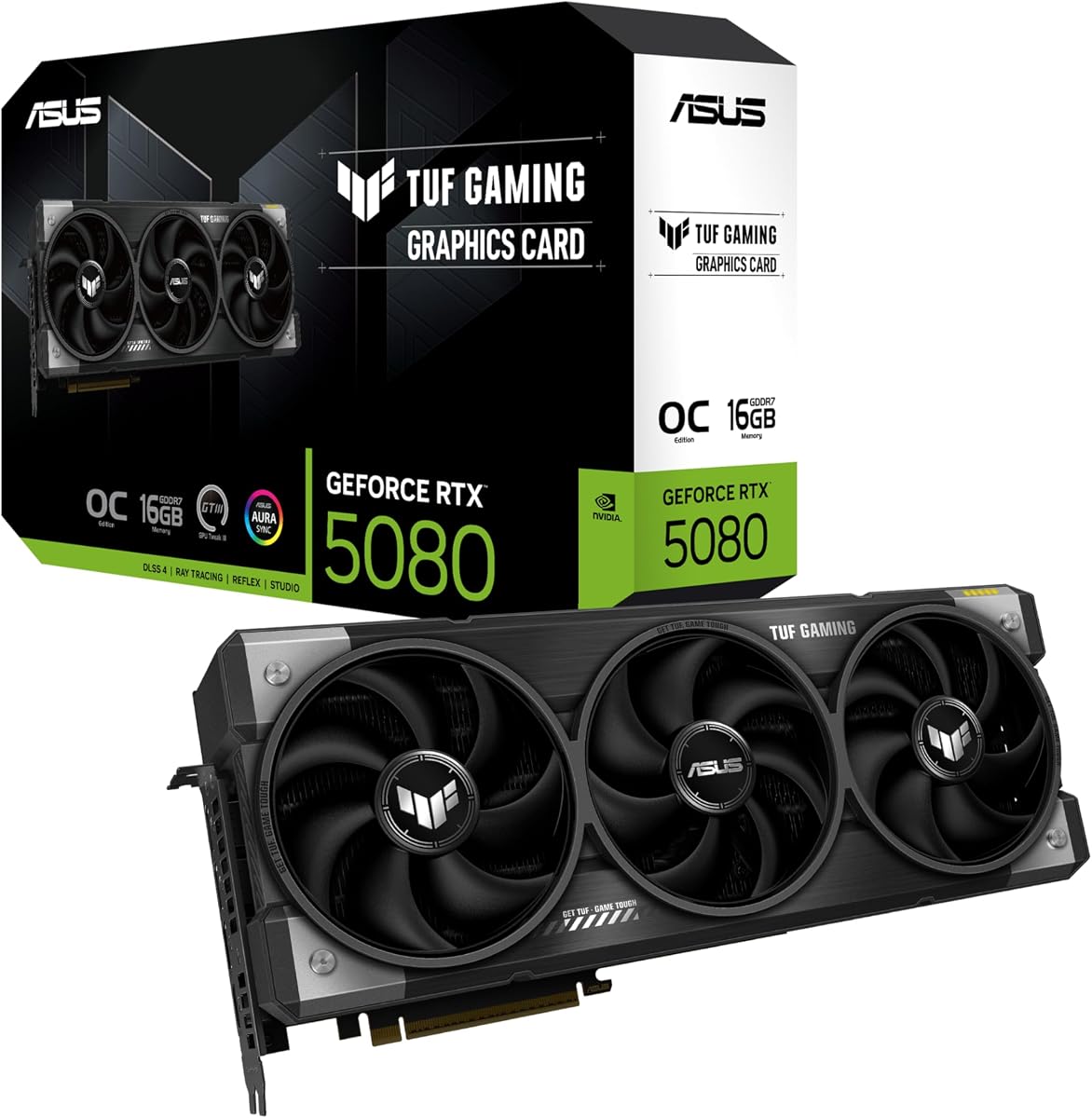
The ASUS TUF Gaming GeForce RTX 5080 OC is built for buyers who want the RTX 5080's high-end capabilities with a visibly substantial cooling and construction package. It holds a 4.6 rating and includes 16GB of GDDR7 memory, a massive fin array, and three Axial-tech fans for airflow through its 3.6-slot design.
We may earn a commission when you buy through this link, at no additional cost to you.
Military-grade components, a protective PCB coating, and a phase-change thermal pad reinforce the card's durability positioning. The included GPU bracket and ASUS GPU Guard support more secure installation, while GPU Tweak III provides tuning, thermal management, and system monitoring. The listed boost clock reaches 2730MHz in OC mode.
Physical scale is the critical compromise. The card measures 348mm long and occupies 3.6 slots, so it can crowd a compact case or interfere with CPU coolers and other expansion cards. The stated system requirement calls for a minimum 850W power supply with a 16-pin 12V-2×6 connector, and buyers should also use the appropriate cable arrangement.
Choose this card if you are building a high-performance system with a spacious chassis, quality power supply, and room for large graphics hardware. It is a fitting option for enthusiasts who value robust construction, extensive cooling, and monitoring tools as much as raw ray-traced performance. Less demanding builds may find a smaller RTX model more practical.
The three-fan, massive-fin-array configuration is intended to move substantial air through a high-end processor. That makes it a sensible match for prolonged ray-traced sessions, where sustained temperatures and consistent performance matter more than a brief burst of speed.
At 348mm long and 3.6 slots wide, this is one of the guide's most physically demanding models. Measure from the rear slot to the front drive cage, account for the power connector's bend, and check whether adjacent hardware can occupy the neighboring slots.
We may earn a commission when you buy through this link, at no additional cost to you.
The ASUS Dual GeForce RTX 5060 Ti 16GB OC Edition is the most compelling balanced pick in this guide. It delivers a 16GB memory configuration, Blackwell architecture, and DLSS 4 support in a 2.5-slot dual-fan design. Its 4.7 rating and 767 AI TOPS make it especially interesting for value-focused ray-tracing builds.
We may earn a commission when you buy through this link, at no additional cost to you.
The smaller axial-tech fan design supports downward airflow, while the two-slot-plus cooler improves compatibility without sacrificing the stated cooling approach. A dual BIOS lets users toggle between Quiet and Performance profiles, and 0dB technology can keep the fans stopped during light activity. Dual-ball fan bearings are specified to last up to twice as long as sleeve-bearing designs.
The trade-off is positioning. This is not the card to choose when top-tier 4K performance is the only goal. Its more modest hardware tier will be constrained by the processor and cooling configuration compared with larger RTX models. Even so, the 16GB allocation and compact cooler create an attractive package for 1440p gaming, especially when ray-traced effects are enabled selectively.
This is the ideal choice for a builder who wants modern NVIDIA features and ample video memory without committing to a massive flagship card. It should appeal to owners of midrange CPUs and to anyone assembling a smaller system. Confirm the game's recommended settings and make sure the included card dimensions suit the case.
A 16GB graphics-memory allocation is unusually valuable at this hardware tier. It can accommodate modern textures and ray-tracing workloads more comfortably than many similarly positioned cards, while also leaving useful memory for background applications.
The 2.5-slot design makes this ASUS Dual card easier to accommodate than a large three-fan model. It is a practical choice for builders who want modern graphics performance while preserving room for a substantial CPU cooler or other expansion cards.
We may earn a commission when you buy through this link, at no additional cost to you.
The ASUS TUF Gaming GeForce RTX 5070 OC is a durable middle ground for gamers seeking Blackwell architecture and DLSS 4 without moving to a 16GB flagship configuration. Its 4.7 rating indicates strong satisfaction, and the listed 2640MHz OC boost clock sits comfortably within a modern gaming hierarchy.
We may earn a commission when you buy through this link, at no additional cost to you.
Cooling is handled by three Axial-tech fans and a massive fin array in a 3.125-slot design. Military-grade components, protective PCB coating, and a phase-change thermal pad target reliability, while the ASUS GPU Guard and included bracket improve mounting security. GPU Tweak III supports performance adjustment, thermal control, and monitoring.
The central limitation is 12GB of video memory. That remains useful for many games, but high-resolution texture packs, ray-traced effects, content creation, and future titles can make memory capacity more consequential. The card's physical footprint also deserves attention because a three-slot-plus cooler can restrict access to nearby expansion slots.
Buy this model if you want a capable RTX 5070 in a TUF-style chassis with strong cooling and durability features. It is a sound option for high-refresh 1440p gaming and for users who value monitoring and profile control. If memory capacity is a priority or a 16GB option fits your budget, that may offer a more comfortable upgrade path.
Protective PCB coating, military-grade components, and a phase-change thermal pad are all useful for a card expected to operate for years. These details complement the cooling system and can improve confidence in sustained use, provided the surrounding case has adequate airflow.
Twelve gigabytes remains functional for many gaming scenarios, but the amount can become restrictive in the most demanding texture-heavy experiences. Review your favorite games' asset requirements and consider a 16GB model if memory headroom is a priority.
We may earn a commission when you buy through this link, at no additional cost to you.
The ASUS Dual Radeon RX 9060 XT 16GB offers an approachable way to enter hardware-accelerated ray tracing while retaining a useful 16GB memory allocation. Its 4.7 rating is among the strongest in the guide, and the 2.5-slot dual-fan design should be easier to install than oversized three-fan alternatives.
We may earn a commission when you buy through this link, at no additional cost to you.
Its cooling system uses axial-tech fans with longer blades and a barrier ring intended to improve downward air pressure. Dual-ball fan bearings offer improved expected longevity, while 0dB operation helps keep the card silent during light use. A dual BIOS switch separates quiet and performance profiles, and GPU Tweak III supplies clock, thermal, and monitoring controls.
This is an entry-level card, so expectations should be realistic. It is better suited to 1080p and selected 1440p scenarios than to uncompromised high-end 4K play, and individual games vary in the quality and performance of their ray-tracing options. The impressive memory capacity does not by itself translate into flagship frame rates.
Choose it for a budget-conscious gaming build, an upgrade from integrated graphics, or a compact PC that needs more memory than a typical entry card. It is particularly attractive when a 16GB configuration is hard to find at this tier. The dual BIOS and quiet fan behavior also make it pleasant for mixed gaming and general-use systems.
The 16GB configuration gives this entry-level model more breathing room than many cards in its class. That can help when loading detailed environments or combining a game with background applications, even though the GPU itself remains below the guide's high-performance models.
The 2.5-slot design and dual-fan cooler reduce installation pressure. They make the card an attractive candidate for compact builds where a three-fan card would be difficult to position or where preserving neighboring expansion-slot clearance matters.
We may earn a commission when you buy through this link, at no additional cost to you.
The ASUS TUF Gaming GeForce RTX 5070 Ti OC combines a high 4.8 rating with 16GB of GDDR7 memory and modern Blackwell features. It sits below the RTX 5080 in this guide but offers a potentially more balanced path for gamers who want flagship-class memory and substantial ray-tracing capability.
We may earn a commission when you buy through this link, at no additional cost to you.
The card's cooling system uses three Axial-tech fans and a massive fin array within a 3.125-slot chassis. Military-grade components, a protective PCB coating, and a phase-change thermal pad support durability, while Auto-Extreme manufacturing and GPU Tweak III add reliability and control. Its listed boost clock reaches 2610MHz in OC mode.
Installation requires planning. ASUS states a minimum 850W power supply with a 16-pin 12V-2×6 connector, making PSU capacity and cable compatibility important. The three-slot-plus design also needs adequate case clearance. While it avoids the extreme width of some larger cards, it remains far from a compact two-slot solution.
This RTX 5070 Ti is a strong recommendation for a high-end system that wants DLSS 4 and 16GB without stepping up to the RTX 5080. It is suitable for demanding games, high-refresh displays, and creators who value memory capacity. Buyers with compact cases should compare dimensions carefully, while others can focus on its strong thermal and durability package.
The 16GB GDDR7 allocation is a major strength because it supports demanding textures and ray-tracing workloads without moving into the absolute flagship category. It also gives the card more flexibility for mixed gaming and content-creation workloads.
The stated 850W minimum recommendation should be treated as a baseline, not a target. A quality power supply with ample headroom, correct connectors, and unobstructed cable routing creates the safest foundation for a high-end graphics card.
We may earn a commission when you buy through this link, at no additional cost to you.
The GIGABYTE GeForce RTX 5070 Gaming OC 12G is a straightforward midrange recommendation built around Blackwell architecture and DLSS 4. Its 4.8 rating is tied for the highest customer score in the guide, providing a strong signal that owners are satisfied with the card's overall package.
We may earn a commission when you buy through this link, at no additional cost to you.
The RTX 5070 processor is paired with 12GB of GDDR7 memory on a 192-bit interface, along with PCIe 5.0 support and the WINDFORCE Cooling System. This combination is aimed at smooth modern gaming and ray-traced effects that can benefit from AI-assisted rendering features such as DLSS.
The 12GB capacity and 192-bit bus are the main considerations for long-term buyers. They should be adequate for many current games, but heavy texture packs, high-resolution rendering, and advanced content creation can expose the limits of a smaller memory configuration. Exact physical and power specifications are not included in the supplied data and should be verified.
Choose this card when you want a capable NVIDIA GPU without the size, power demands, and expense of a flagship alternative. It is a good fit for high-refresh 1440p gaming and systems that value DLSS 4. If your workload regularly exceeds 12GB, choose a 16GB option instead; otherwise, this model delivers a clean and capable package.
Blackwell architecture, DLSS 4, PCIe 5.0, and GDDR7 memory form a modern foundation for ray-traced gaming. The card avoids unnecessary complexity while retaining the features most likely to influence everyday gaming performance.
A 12GB pool is relevant for your target games and resolution. If you routinely use extensive texture mods, work with high-resolution 3D scenes, or keep demanding applications open, a 16GB card offers a safer margin for future use.
We may earn a commission when you buy through this link, at no additional cost to you.
The ZOTAC Gaming GeForce RTX 4070 Super Twin Edge is a well-regarded, established choice for hardware ray tracing. It carries a 4.8 rating and combines the Ada Lovelace architecture with full ray tracing, DLSS 3, 12GB of GDDR6X memory, and a compact dual-fan cooler.
We may earn a commission when you buy through this link, at no additional cost to you.
Its memory runs at 21Gbps across a 192-bit interface, while the listed boost clock reaches 2475MHz. The IceStorm 2.0 cooling system uses two 90mm fans, a metal backplate, and a FREEZE Fan Stop feature for quieter idle behavior. SPECTRA RGB lighting adds a visual element without interfering with the core cooling design.
Display and API support make this card particularly well rounded. It includes three DisplayPort 1.4a connections and one HDMI 2.1a connection, along with 8K and four-display readiness. DirectX 12 Ultimate, Vulkan RT API, Vulkan 1.3, and OpenGL 4.6 support cover modern games and relevant ray-tracing workflows.
This is a strong choice for a high-end 1440p gaming system or a compact build that needs a capable card without a massive three-fan cooler. Its main technical drawback is that DLSS 3 is an older generation than DLSS 4 on the newest NVIDIA models, and 12GB can limit the heaviest workloads. Even so, the combination of strong rating, cooling, connectivity, and compactness makes it a premium all-rounder.
Two 90mm fans and a metal backplate create a restrained but purposeful thermal design. The backplate can help protect the card and provide structural rigidity, while the two-fan layout is generally easier to accommodate than a three-slot-plus alternative.
The mix of three DisplayPort 1.4a and one HDMI 2.1a connection provides flexibility for high-refresh monitors, ultrawide displays, and multi-screen arrangements. The included 8K-ready and VR-ready feature support also makes this card relevant to specialized display setups.
We may earn a commission when you buy through this link, at no additional cost to you.
Ray-traced gaming depends on more than a headline processor name. Video memory, thermal capacity, power requirements, software features, and physical fit all influence whether a card can deliver the experience you want.
Start by confirming that the graphics processor supports the ray-tracing features used by your games. NVIDIA's listed RTX models include hardware ray-tracing capabilities, while the AMD Radeon RX models in this guide support modern graphics APIs, but feature naming and performance vary by title. A modern API, such as DirectX 12 Ultimate or a supported Vulkan RT path, provides the appropriate framework for many ray-tracing effects. DLSS can improve performance and image output on supported NVIDIA systems, while AMD offers its own upscaling technologies in eligible games. Review the specific options available in your most-played titles rather than assuming every ray-tracing setting is equivalent.
Video memory determines how much texture data, geometry, frame data, and ray-tracing buffers a GPU can handle simultaneously. Models with 16GB provide the most comfortable margin in this list, particularly for high-resolution textures, 4K output, content creation, and multitasking. Cards with 12GB can still perform well in many games, but they may be more exposed to memory pressure in the most demanding releases or enhanced asset packs. Memory capacity is not the same as raw speed, yet it remains an important practical limit. Choose based on your target resolution and the games or applications you expect to run now and over the next several years.
Ray tracing can create a steadier and heavier workload than some traditional graphics settings, making cooling quality important during long sessions. Pay attention to the number and size of fans, the heatsink design, thermal materials, fan-bearing type, and acoustic features such as 0dB operation. A phase-change thermal pad can support sustained heat transfer, while three-fan coolers generally provide more thermal headroom than compact dual-fan designs. None of these features can compensate for inadequate case airflow. A card should receive air from the intake side and have enough clearance to exhaust warm air, especially when paired with a large CPU cooler or a tightly packed system.
A capable graphics card should be paired with a power supply that has adequate wattage and compatible connectors. The ASUS TUF RTX 5080 and RTX 5070 Ti explicitly list a minimum 850W power supply with a 16-pin 12V-2×6 connection. Other models also require careful cable selection, so their complete system requirements should be checked directly. Use the power cable supplied or approved for the exact graphics card and avoid sharply bending connectors near the plug. A power supply with reasonable headroom can improve efficiency and reduce strain, but oversizing alone does not compensate for poor-quality components. Your processor and the rest of the system also influence the appropriate power-supply capacity.
Length, height, thickness, and connector clearance can determine whether a card physically fits. The ASUS TUF RTX 5080 is listed at 348mm long and 3.6 slots, while several Dual and Prime models use a 2.5-slot design. Measure the usable distance from the rear expansion bracket to the front of the case, then leave room for the power connector and its bend radius. Check whether the card blocks access to nearby slots, CPU cooler fins, or front fans. If a compact case is part of your plan, prioritize a shorter dual-fan design and confirm both the board's slot layout and the chassis manufacturer's supported GPU dimensions.
The ideal GPU depends heavily on the display you own. High-refresh 1440p monitors benefit from a capable midrange or high-end card, while 4K gaming places greater demand on both rasterization and ray-traced rendering. DLSS and other upscaling technologies can make high-end ray tracing more attainable by improving image output and performance, but support varies by game and settings. On a 1080p display, frame rates are easier to achieve, and a lower-tier card may be sufficient. On a 4K television or monitor, prioritize raw performance, 16GB memory, and effective cooling. Match the card to the resolution and refresh rate you actually use instead of selecting for a scenario you do not plan to play.
Factory boost clocks provide a useful reference, but sustained performance also depends on cooling, power limits, and workload. Cards with dual BIOS profiles offer a convenient way to switch between quieter everyday behavior and more aggressive gaming settings. ASUS GPU Tweak III adds fan controls, monitoring, performance adjustments, and thermal management. Higher clocks are not automatically better if the card cannot maintain them, so cooling capacity matters. Users can still avoid manual tuning and leave the card on its default profile, but having reliable monitoring and profile options is useful when temperatures, fan noise, or workload behavior need adjustment. Avoid assuming an advertised overclock mode should be used constantly.
Ray-tracing performance depends on the title, scene complexity, resolution, engine, and selected effects. A game with inexpensive ray-traced reflections may run much differently from one using path tracing or numerous dynamic shadow effects. Before buying, check the game's recommended graphics settings, known API requirements, and community guidance for the specific card. Also verify that your desired resolution, refresh rate, and multi-monitor arrangement are supported. This research prevents a mismatch between a technically powerful card and a game that scales poorly on that hardware. The same caution applies to creative tools: some workflows benefit more from memory capacity, while others prioritize compute throughput or a particular software ecosystem.
Install the card into a compatible PCIe x16 slot with the system powered off and disconnected. Follow the motherboard and graphics-card manuals, confirm the power-supply wattage and required connector, and install the I/O bracket if it is not already attached. Connect the graphics power cable without sharply bending it at the plug. Secure the card with the appropriate retention hardware, connect the display cables, and verify that the card is fully seated before powering on.
After installation, update the operating system and graphics driver, then confirm that the card is recognized in the system's hardware-monitoring software. Start with the manufacturer's recommended settings and use a short test session to check temperatures, fan behavior, and stability. Introduce ray tracing gradually in games, beginning with the quality level you are comfortable with, and use in-game frame-time displays to evaluate performance. Upscaling options can improve image output, but the best setting depends on the monitor and title.
Keep the intake and exhaust paths clear of dust, cable obstructions, and decorative covers. Periodic cleaning with compressed air and a soft brush can maintain airflow, but power down the system and avoid touching electrical components. Monitor for unexpected throttling, artifacts, crashes, or sustained fan noise. Keep the graphics driver and any performance utilities reasonably current, and do not apply aggressive tuning settings until the default configuration has proven stable.
Sixteen gigabytes is not required for every ray-traced game, but it provides a safer margin for high-resolution textures, extensive texture packs, 4K output, and content creation. A 12GB card can deliver good results in many titles, especially at 1080p or 1440p. The best choice depends on the games you play, the settings you want, and how long you expect to keep the card.
Modern Radeon RX graphics processors support hardware-accelerated ray tracing through supported graphics APIs. The exact effects and performance vary by game because developers can offer different levels of ray-traced shadows, reflections, lighting, and path tracing. Check each title's supported APIs and recommended settings, and read current benchmarks for the specific card before setting expectations.
DLSS can make ray tracing more practical by improving image output and, on supported configurations, increasing frame rates through AI-assisted rendering. It does not replace hardware ray tracing or change the underlying lighting model, but it can help users retain effects that would otherwise reduce performance too severely. The best DLSS mode depends on your display, game, and preference for sharpening or latency.
The ASUS TUF RTX 5080 and RTX 5070 Ti in this guide specify a minimum 850W power supply with a 16-pin 12V-2×6 connector. Other cards have their own requirements, which should be checked before purchase. Your processor, memory, and other components also affect power demand, so select a quality unit with enough headroom and use the correct cable.
Only if the card's length, thickness, and power connector fit the available space. Measure from the expansion slot to the front of the chassis and check the CPU cooler, drive cage, and neighboring expansion slots. Compact dual-fan cards are generally easier to accommodate, but the manufacturer's exact clearance guidance should always take precedence.
No. Boost clock is only one component of performance. Memory capacity and speed, architecture, cache behavior, cooling, power limits, game engine, and the selected ray-tracing effects all influence results. A card that maintains its boost clock within a well-cooled system may deliver more consistency than one with a higher brief peak but weaker thermal margins.
Not necessarily. Each effect can carry a different performance cost, and games often allow them to be adjusted independently. A useful approach is to enable the effects that create the largest visual improvement for your display, then increase quality gradually while watching frame times. A stable frame rate is generally more important than enabling every effect at maximum settings.
Start by confirming that the case has adequate intake and exhaust airflow, the card is installed with sufficient clearance, and the correct power cable is connected. Use current monitoring software to check temperatures and fan behavior during a sustained game. Keep dust away from the fans, avoid blocking vents, and leave the default performance profile until cooling behavior has been evaluated.
The GIGABYTE GeForce RTX 5080 Gaming OC 16G is the leading high-performance recommendation, offering Blackwell architecture, a 16GB 256-bit GDDR7 configuration, DLSS 4, and PCIe 5.0 support. The ASUS Dual RTX 5060 Ti 16GB is the balanced value choice for builders who want generous memory and a more compact cooler, while the ZOTAC RTX 4070 Super Twin Edge is a proven premium pick with a restrained design, strong display connectivity, and full ray-tracing support.
Prioritize the GPU tier that matches your monitor, the amount of memory your games need, and the physical and electrical limits of your system. A 16GB card provides the safest long-term margin, but ray-traced gaming also benefits from capable cooling, modern upscaling support, and a balanced processor. Verify game compatibility, chassis clearance, and power requirements before checkout rather than comparing graphics processors in isolation.
Finally, recheck current retailer listings, warranty details, and system requirements before purchasing. Product configurations and bundle contents can change, and compatibility is as important as raw performance. Once the card matches your resolution, power supply, case, and favorite games, the right ray-tracing upgrade becomes much easier to choose with confidence.

