
GOCHIFIX 3-in-1 Handheld
4.2Editor score
12 MHz signal bandwidth
50 MSa/s sampling rate
Integrated waveform generator
Field-ready diagnostic design
An oscilloscope for car audio reveals what a multimeter cannot: the shape, timing, distortion, and behavior of voltage signals throughout a vehicle. The right instrument helps diagnose speakers, amplifiers, head units, crossovers, signal wiring, sensors, and power systems while reducing guesswork during installation or repair.
The products in this guide span handheld test tools, portable USB models, compact DIY kits, and professional benchtop scopes. We compared bandwidth, sampling performance, channel count, waveform controls, signal-generation features, measurement functions, display characteristics, connectivity, portability, and relevance to common automotive diagnostics.
Each review explains where the model fits best, highlights practical strengths, and identifies limitations. The first three products are the overall selections, while the remaining entries provide alternatives for different budgets, workspaces, and technical requirements. Product listings and prices can change, so confirm current specifications and availability before purchasing.
4.2Editor score
4.8Editor score

4.7Editor score
As an Amazon Associate we earn from qualifying purchases.
This side-by-side comparison organizes all ten options by signal bandwidth, sampling rate, channel access, portability, and diagnostic functions, helping car-audio installers match an instrument to their workflow.


The FNIRSI DST-210 combines a handheld oscilloscope, a 19,999-count digital multimeter, and a DDS signal generator in one compact instrument. It has no published rating in the supplied product data, so its evaluation rests on its stated capabilities rather than customer feedback. Its 10 MHz bandwidth and 48 MSa/s sampling rate make it suitable for many low-to-moderate-frequency diagnostic tasks.
We may earn a commission when you buy through this link, at no additional cost to you.
For car-audio work, the oscilloscope section can help inspect amplifier input and output signals, crossover behavior, periodic control voltages, and selected automotive pulses. The multimeter adds valuable measurements for resistance, capacitance, frequency, diode testing, temperature, continuity, and live or neutral detection. Meanwhile, the DDS generator provides 13 waveforms up to 50 KHz for simulation and signal-response testing.
The main limitation is that a single-channel view provides less insight into phase, timing, and inter-channel relationships than a multi-channel bench scope. The 10 MHz bandwidth also places the instrument well below the performance of higher-bandwidth models when investigating fast edges or high-frequency detail. Nevertheless, the combination of tools creates considerable utility in a single package.
This is a compelling choice for a mobile installer, electronics technician, or serious do-it-yourself user who wants more than a basic pocket scope. It is especially useful when diagnosing cables, amplifiers, crossovers, and slow automotive signals in the field. For professional work requiring several simultaneous waveforms, one of the multi-channel Siglent models will be the better fit.
The integrated multimeter reduces the number of tools required for basic troubleshooting. The scope, signal generator, and conventional electrical measurements work together in a single enclosure suited to mobile diagnosis.
Live and neutral detection, temperature measurement, capacitance testing, and frequency readings help broaden the instrument beyond audio-only troubleshooting. These functions are particularly handy when checking vehicle wiring and connected components.
We may earn a commission when you buy through this link, at no additional cost to you.
The FNIRSI DST-201 is a handheld 3-in-1 instrument combining a 19,999 TRMS multimeter, a 1 MHz oscilloscope, and a DDS signal generator. It has no published customer rating in the supplied information. Its strongest attraction is the breadth of measurement functions rather than high-performance waveform capture, with curve mode, maximum and minimum tracking, and data logging for ten points.
We may earn a commission when you buy through this link, at no additional cost to you.
The oscilloscope uses a 5 MSa/s sampling rate and offers vertical sensitivity from 10 mV per division to 10 V per division. Those characteristics suit low-frequency investigation rather than demanding audio or pulse analysis. The meter measures AC and DC voltage and current, resistance, capacitance, frequency, diodes, temperature, continuity, and live or neutral status, all within an auto-ranging format.
Its 1 MHz bandwidth is the most significant compromise in this list. A car-audio installer can still observe slower signals and use the meter for much of the associated installation work, but fast transients and higher-frequency distortion will not be resolved as well as they would be on a broader-band instrument. The signal generator is similarly limited to 10 KHz, with 13 available waveforms and adjustable amplitude.
Buy the DST-201 when portability, electrical measurement, and basic waveform visualization matter more than laboratory-grade bandwidth. It is a practical entry for diagnosing speaker wiring, amplifier inputs, continuity problems, and slow control signals. Users who need to study detailed audio waveforms, compare channels, or examine fast switching should save up for a higher-bandwidth scope.
True RMS readings and automatic ranging reduce manual setup during installation checks. The wide selection of electrical tests helps it serve as both an oscilloscope and a general vehicle diagnostic instrument.
The 1 MHz oscilloscope bandwidth is adequate for many slow signals but cannot provide the detail of faster models. Match the tool to the signal types and fault conditions you expect to investigate.
We may earn a commission when you buy through this link, at no additional cost to you.
The Korg Nu:Tekt NTS-2 is a build-your-own oscilloscope kit designed to make signal exploration approachable for musicians, creators, and beginners. It carries a 4.4 rating in the supplied data. Rather than competing directly with automotive bench scopes, it provides a tactile, educational way to visualize control voltages and audio signals.
We may earn a commission when you buy through this link, at no additional cost to you.
The kit requires assembly but explicitly avoids soldering, reducing the barrier to entry. Once built, it offers four-channel monitoring, a flexible waveform generator, a spectrum analyzer, and a tuner. Dual stereo inputs, dual stereo throughput or output connections, and two separate outputs provide flexible routing for comparing source signals and observing processed audio.
Its primary strength is accessibility. The straightforward interface and palm-sized construction make it suitable for learning how gain staging, filtering, phase, frequency content, and signal flow affect audio. However, it is not described as rugged automotive equipment and lacks the broad voltage categories, protective probing, and waveform specifications found in diagnostic-focused oscilloscopes.
The NTS-2 is best for car-audio enthusiasts who want to understand the signals in their own systems, experiment with filters and crossovers, and build a practical audio measurement foundation. It also makes sense for students and creators seeking a hands-on kit. For diagnosing intermittent vehicle wiring or automotive sensors, a dedicated handheld or bench model would be more appropriate.
Seeing control voltages and audio signals helps users connect abstract concepts with real behavior. The four-channel layout supports comparisons that are difficult to perform with a basic single-channel toy scope.
Dual stereo inputs and separate outputs suit signal-flow experiments involving crossovers, processors, and other audio components. The spectrum analyzer and tuner add perspectives beyond time-domain viewing.
We may earn a commission when you buy through this link, at no additional cost to you.
The Siglent SDS1202X-E is a 200 MHz, two-channel digital oscilloscope with a 4.7 rating. Its combination of bandwidth, real-time sampling, and record depth makes it a strong choice for installers and technicians who need more detailed signal analysis than compact handheld models can provide.
We may earn a commission when you buy through this link, at no additional cost to you.
The scope can sample at up to 1 GSa/s and store up to 14 million points. That capacity supports longer observations and more detailed analysis of periodic and aperiodic behavior. Its standard trigger and decoding features cover IIC, SPI, UART, RS-232, CAN, and LIN, adding value when a car audio system intersects with digital vehicle networks.
Two channels are enough for comparing an input with an output or evaluating signal changes through a processing chain. They do not offer the flexibility of four analog channels for complex vehicle systems, and the bench form factor is less convenient for mobile callouts. Its 200 MHz bandwidth also exceeds what routine audio tracing usually demands, but that margin supports fast edges, switching noise, and detailed transient investigation.
Choose the SDS1202X-E for a professional or advanced workshop that needs dependable bandwidth, deep records, and protocol decoding without moving to a four-channel mixed-signal platform. It is a particularly balanced choice for diagnosing amplifier behavior, intermittent digital connections, and control signals. It is less suitable for users needing a pocketable unit or extensive automotive bus analysis.
The wide bandwidth and fast sampling help preserve information in fast transitions. This is valuable when hunting for switching noise, clipping artifacts, or instability that a lower-bandwidth scope may conceal.
CAN and LIN decoding support makes the instrument relevant beyond ordinary audio troubleshooting. These protocols can help an installer understand whether a head unit, amplifier, or interface is communicating correctly with the vehicle.
We may earn a commission when you buy through this link, at no additional cost to you.
The GOCHIFIX 3-in-1 Handheld Oscilloscope Multimeter combines a 12 MHz oscilloscope, a 6000-count graphical multimeter, and a dedicated waveform generator. It has a 4.2 rating and stands out as a field-oriented instrument for technicians who need more capability than a basic pocket scope.
We may earn a commission when you buy through this link, at no additional cost to you.
A 50 MSa/s real-time sampling rate provides a better sampling foundation than many similarly portable competitors. Auto, normal, and single trigger modes support different capture needs, while a one-touch auto setup reduces configuration time in the field. The built-in generator produces sine, triangle, and square waves with adjustable amplitude and duty cycle for simulating sensors and checking circuit responses.
The product data specifically identifies crankshaft and camshaft sensors, throttle-position sensors, injectors, and PWM signals as suitable automotive test targets. It also warns that high-voltage ignition testing requires a standard 20:1 external attenuator probe. That safety-related limitation is important because standard automotive electrical environments can exceed the instrument's direct measurement envelope.
This is the best budget-oriented option here for mobile troubleshooting because it balances bandwidth, multimeter functions, signal generation, internal storage, and battery portability. It is well suited to testing amplifier inputs, sensor patterns, and intermittent electrical behavior. For rigorous multi-channel comparison, detailed high-frequency work, or frequent protected vehicle probing, a professional bench scope remains preferable.
A replaceable rechargeable battery, automatic sleep function, USB charging, and stored measurements support work away from a bench. The compact, drop-resistant design is practical for vehicle diagnostics and mobile installation calls.
The generator can imitate common waveforms and test how a circuit responds. That combination supports both fault isolation and controlled bench experiments without requiring a separate signal source.
We may earn a commission when you buy through this link, at no additional cost to you.
The NooElec DSO150 is a fully assembled portable digital storage oscilloscope supplied with an enclosure and a 1x/10x BNC probe. Its 3.8 rating reflects a more modest capability set, but it remains a straightforward tool for learning basic waveform inspection and carrying out light signal checks.
We may earn a commission when you buy through this link, at no additional cost to you.
The 2.4-inch color TFT display gives the scope a clear, compact presentation, while the included probe and enclosure make it easier to use without assembly. It is powered by a 9-volt supply and must not receive more than 10 volts. The mainboard accepts a standard 5.5 mm by 2.1 mm DC plug, and an alternative two-pin connector offers additional power-source flexibility.
Compared with the newer handhelds in this roundup, the DSO150 lacks an integrated meter, signal generator, rechargeable battery, and extensive data storage. It also offers fewer documented analysis and triggering features. Those limitations make it less useful for advanced vehicle diagnosis or comprehensive installation verification.
The DSO150 makes the most sense for a beginner who wants a ready-to-use scope for understanding audio waveforms, checking basic signal presence, or learning on a low-complexity system. It can also serve as a lightweight backup instrument. Buyers needing automotive sensor analysis, multiple measurement functions, or modern data handling should choose one of the multi-function handheld models.
The fully assembled enclosure and included BNC probe remove the setup friction associated with DIY kits. A user can add power and begin making basic measurements.
The color TFT gives waveforms a readable visual presentation despite the compact body. It is a practical way to build familiarity with signal shape, amplitude, and periodicity.
We may earn a commission when you buy through this link, at no additional cost to you.
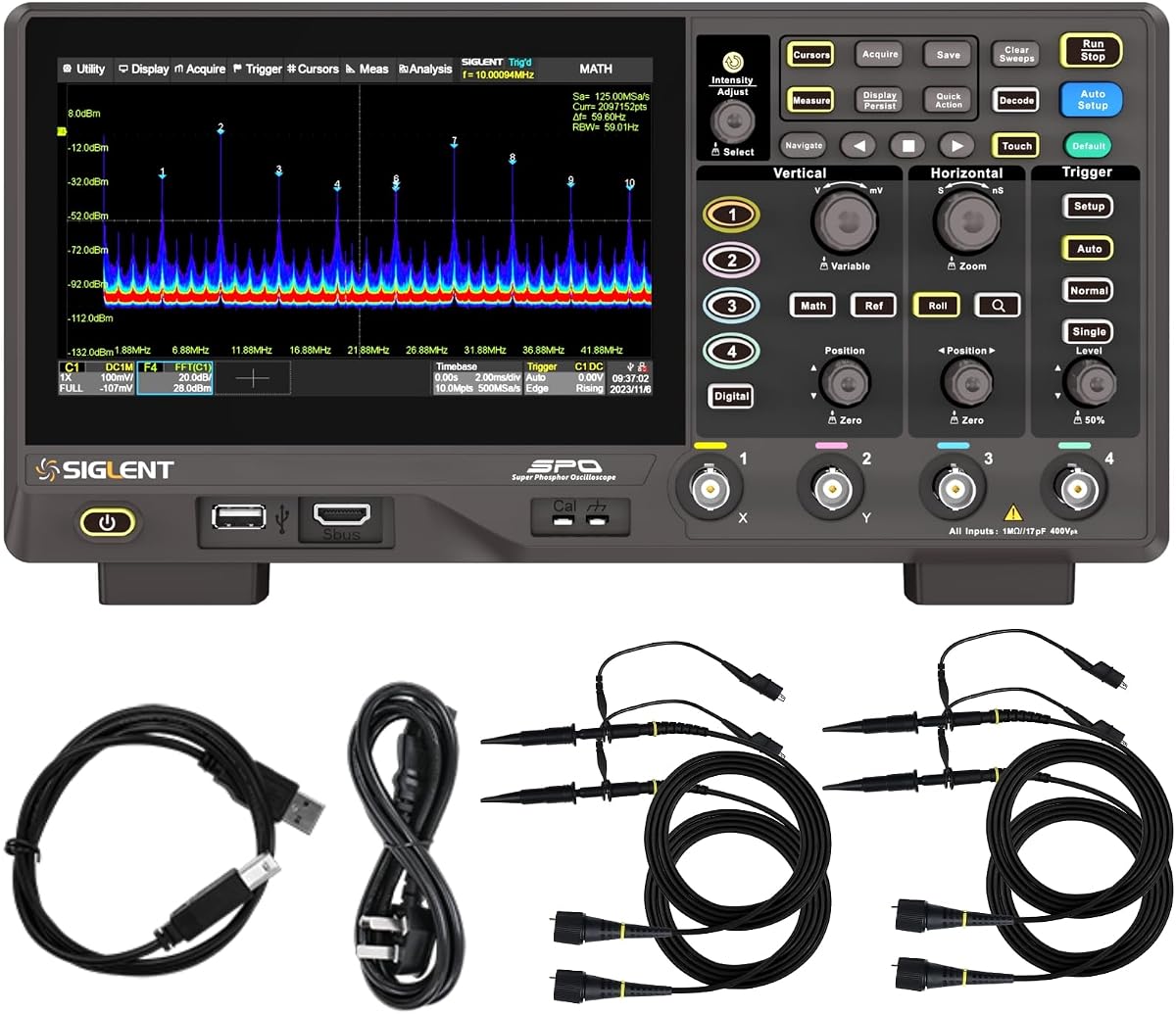
The Siglent SDS814X HD is a 100 MHz, four-channel mixed-signal oscilloscope with a 4.8 rating. It offers the most balanced combination of channels, resolution, sampling speed, memory depth, and display size in the group, making it the strongest overall recommendation for serious car-audio diagnosis.
We may earn a commission when you buy through this link, at no additional cost to you.
Its 2 GSa/s sampling rate and 50 Mpts memory depth give it enough performance for detailed investigation of audio, control, and mixed vehicle signals. The 12-bit analog and digital converter improves vertical resolution compared with conventional lower-bit scopes. Four analog channels allow direct comparison of source, left and right outputs, amplifier outputs, crossovers, and reference signals without rotating through multiple connections.
The seven-inch touch screen provides room to inspect multiple traces and settings at once. Waveform capture can reach 80,000 waveforms per second in normal mode and 500,000 in sequence mode, improving the odds of catching brief anomalies. Sixteen digital channels are possible, but they require the separately sold SDS800XHD-16LA option and SLA1016 logic probe.
This is the ideal model for an installer or serious enthusiast who routinely compares several signal paths and wants room to grow into mixed-signal troubleshooting. The four analog inputs are especially valuable for phase, gain, crossover, and timing work. Its size and price position it as a workshop instrument rather than a throwaway field tool, but it offers the most versatile core platform here.
Simultaneous inputs make it possible to compare an amplifier's input and output or monitor both sides of a stereo system. This visibility is more useful than repeatedly changing a single connection when hunting for phase or gain errors.
The 12-bit converter captures finer vertical detail than standard low-resolution scopes. That helps reveal small changes in level, noise, and waveform shape that can matter during careful audio-system setup.
We may earn a commission when you buy through this link, at no additional cost to you.
The Siglent SDS1104X-E is a 100 MHz, four-channel digital oscilloscope with a 4.8 rating. It is a well-rounded workshop scope for car-audio installers who need several analog inputs plus quick access to common automotive communication protocols.
We may earn a commission when you buy through this link, at no additional cost to you.
The standard decoder covers IIC, SPI, UART or RS-232, CAN, and LIN. That protocol support can help validate communication between aftermarket head units, vehicle interfaces, amplifiers, processors, and control modules. Four analog channels support the kind of side-by-side comparison that is central to diagnosing gain staging, phase, filtering, and stereo balance.
Optional 16 digital channels are available only on the four-channel series and require additional accessories. A USB arbitrary waveform generator is also optional. These expansions increase versatility, but the core instrument already includes the analog channels and decoders most likely to serve routine car-audio and vehicle troubleshooting.
Compared with the SDS814X HD, this model offers a similar four-channel layout and 100 MHz bandwidth but does not list the newer scope's 12-bit resolution, 2 GSa/s sampling, 50 Mpts depth, or touch display. It is still a strong all-rounder, especially for users who prioritize decoders and the possibility of adding logic channels. The best choice depends on whether high resolution and touch operation outweigh the newer platform's expanded specifications.
CAN and LIN support adds immediate value when a car-audio installation interacts with the vehicle's electronics. UART, IIC, and SPI decoding broaden the instrument's usefulness beyond conventional analog audio troubleshooting.
Optional digital channels and a USB waveform module can extend the platform as needs grow. The standard four analog channels remain the core benefit for direct audio signal comparison.
We may earn a commission when you buy through this link, at no additional cost to you.
The Owon VDS1022I is a USB-connected PC oscilloscope with a 4.1 rating. Its appeal lies in combining a portable measurement device with a computer interface, making it attractive to users who already prefer software-driven analysis, screen capture, and flexible workflows.
We may earn a commission when you buy through this link, at no additional cost to you.
The listed capabilities include up to 100 MHz bandwidth, a maximum real-time sample rate of 1 GS/s, and a 10 Mpts record length. The friendly interface can display FFT, X-Y, and two waveform views simultaneously. Trigger choices include edge, video, slope, pulse, and alternate modes, giving more flexibility than a minimal pocket scope.
USB isolation is especially noteworthy because it helps reduce signal interference and adds protection for the connected computer. Bus-powered operation and optional LAN remote control also support flexible placement around a vehicle or workbench. The ultra-thin body is easy to carry, although the dependence on a computer makes it less convenient for quick standalone field checks.
There is also a specification inconsistency in the supplied product listing: the title identifies a 25 MHz model, while the stated features mention up to 100 MHz. Buyers should confirm the exact bandwidth and configuration shown in the current listing. If the 25 MHz version is received, it remains a useful low-to-moderate-frequency tool, but the advertised feature set should be verified before relying on higher-frequency performance.
FFT, X-Y, and dual-waveform views move the instrument beyond a simple trace display. These modes are useful for examining frequency content, phase relationships, and signal transitions in a larger software workspace.
USB isolation helps protect the computer and reduces the chance that ground relationships will interfere with a measurement. The slim, bus-powered enclosure can be positioned close to the circuit under examination.
We may earn a commission when you buy through this link, at no additional cost to you.
The OWON HDS320S is a handheld oscilloscope, multimeter, and signal generator with a 5.0 rating, the highest numerical customer rating in the supplied data. It combines a 3.5-inch TFT display, a stated 200 MHz bandwidth, and a 1 GSa/s sampling rate in a portable three-pound package.
We may earn a commission when you buy through this link, at no additional cost to you.
Multiple acquisition modes—including normal, average, peak detect, and single sequence—give users different ways to examine changing signals. Average mode can stabilize repetitive displays, peak detect can expose short excursions, and single sequence supports isolated events. The display resolution of 320 by 240 pixels is modest but adequate for portable waveform observation.
Connectivity includes USB Host, USB Device, and Pass/Fail output interfaces, making data transfer and automated testing more convenient. The integrated meter and generator increase versatility, although the listing does not provide enough detail to evaluate every measurement range, protection rating, channel count, or trigger feature.
The product title also contains conflicting bandwidth references, showing 200 MHz while mentioning a maximum of 30 MHz, and gives only limited information about the meter's 4.5-digit specification. Buyers should verify the actual configuration and contents before purchase. Despite that ambiguity, the HDS320S could be a strong mobile choice for routine audio and electrical testing if the stated 200 MHz mode is confirmed.
Average, peak-detect, and single-sequence modes help expose different signal characteristics. Together they support both stable repetitive waveforms and brief events that a basic display mode might miss.
Combining the scope, meter, and generator reduces equipment carried to a vehicle. The light 3.5-inch display and three-pound body preserve mobility, while USB and pass/fail interfaces aid data handling and repeat testing.
We may earn a commission when you buy through this link, at no additional cost to you.
Choosing an oscilloscope for car audio means balancing bandwidth, channel access, measurement safety, portability, and the kinds of signals you need to inspect. The right instrument should fit both your diagnostic methods and the environment in which you work.
Bandwidth determines the range of signal frequencies an oscilloscope can display with useful fidelity, while sampling rate affects how accurately rapid changes and periodic waveforms are reconstructed. Basic car-audio troubleshooting often centers on audio-range signals, filters, control voltages, and relatively slow switching behavior. However, modern vehicle electronics, data lines, and switching power devices can introduce much faster edges and noise. A broader-band model gives you more confidence when the suspected problem is not purely an audio-frequency issue.
Choose a scope with enough bandwidth for the fastest signal you expect to investigate, rather than selecting by headline sampling rate alone. The GOCHIFIX offers 12 MHz, the Siglent bench models provide 100 or 200 MHz, and the FNIRSI products fall between 1 and 10 MHz. Verify the individual model specifications before ordering.
Channel count determines how many signals can be observed at the same time. That matters for gain comparison, phase checks, stereo balance tests, and tracing a signal through an amplifier or crossover. A single channel can show the shape of a signal, but it cannot directly display its relationship to another reference trace. Two channels cover many basic comparisons, while four channels make complex vehicle and audio setups much easier to understand.
For advanced car-audio work, four channels are worth prioritizing. The SDS814X HD and SDS1104X-E offer four analog inputs, while the Korg NTS-2 provides a four-channel audio-oriented experience. Choose fewer channels only when portability, simplicity, or budget matters more than simultaneous measurement.
Car-audio troubleshooting often intersects with vehicle electronics. Head units may communicate over buses such as CAN or LIN, while processors, interface modules, amplifiers, and sensors can create signals outside the basic audio range. Protocol decoding can make those communications visible and help determine whether a fault lies in configuration, wiring, or the audio path itself. The Siglent SDS1202X-E and SDS1104X-E include CAN and LIN decoders.
Look for decoders and triggering options relevant to the equipment you service. Also consider sensor patterns, PWM signals, injector behavior, and control voltages. Never assume a general-purpose scope is safe for every automotive circuit, especially ignition or other high-voltage systems.
An integrated multimeter reduces the need to carry separate tools for resistance, continuity, voltage, capacitance, frequency, and current. This is especially convenient for installation work, where checking wiring and grounding is just as important as viewing waveforms. The FNIRSI DST-210 and DST-201, GOCHIFIX, and OWON HDS320S combine multiple functions, although their capabilities and accuracy should be compared against your usual requirements.
A built-in generator is also useful. It can create sine, square, and triangle waves for simulating sensors, testing circuit responses, and confirming a signal path. Treat this feature as a productivity aid rather than proof that the scope is suitable for every high-frequency task.
Vehicle installation and repair happen away from a workbench, so portability can be as important as laboratory performance. A handheld scope with a rechargeable battery, auto-sleep function, compact enclosure, and removable probes can move quickly between diagnosis and testing. The GOCHIFIX is explicitly designed around automotive field diagnostics, while the FNIRSI models also combine several tools in handheld formats. A USB scope may be thin and easy to position, but it still depends on a computer for display and controls.
Consider how often you work on the road, how much equipment you carry, and whether standalone operation matters. Portability should not be purchased at the expense of safe voltage limits, adequate bandwidth, or display readability.
A large display makes it easier to read several traces, trigger controls, and measurement labels without constant zooming. The Siglent SDS814X HD uses a seven-inch touch screen, while the HDS320S provides a 3.5-inch TFT and the FNIRSI DST-210 uses a 2.8-inch display with 320 by 240 resolution. Screen size should be balanced against portability, and touch operation is not automatically better for every workflow.
Waveform storage, image export, and protocol decoding can make findings easier to document or share. The DST-210 supports waveform image saving, the GOCHIFIX stores 100 data sets and 10 waveforms, and the Siglent models provide deep record memory. Consider how you document faults before deciding which workflow fits you.
A low voltage rating does not mean every probe or connection is safe for a vehicle battery or charging system. Check maximum input voltage, probe attenuation, grounding, transient exposure, and the intended measurement environment. The GOCHIFIX listing explicitly states that high-voltage ignition testing requires a standard 20:1 external attenuator probe. Such warnings are important because a scope's nominal voltage rating alone does not guarantee suitability for every automotive node.
Make sure the supplied probe supports the bandwidth and voltage range you need. Consider external attenuators, insulated leads, ground references, and appropriate interface cables. A safe measurement setup is more valuable than a small increase in display size or waveform rate.
Begin by identifying the circuit and deciding what the waveform should prove. Connect the instrument correctly, select an appropriate time scale and vertical range, and use a known-good reference point such as a headphone output, test tone, or specified control signal. This turns the display into a diagnostic comparison rather than simply a collection of changing traces. For vehicle work, verify voltage limits and use the correct attenuation before touching a high-energy circuit.
Use triggering to stabilize repetitive signals and single-shot mode to catch brief events. Average mode can reduce random noise on stable waveforms, while peak detect can expose short excursions. When comparing two channels, use the same time base, coupling, and vertical scale so phase, gain, clipping, and filtering differences are easier to recognize. Save screenshots or exported images before changing the setup if the fault may be intermittent.
Protect and maintain the instrument according to its documentation. Use a padded case, keep probes from tangling, and avoid leaving the screen or controls exposed to excessive heat, moisture, or impact. Replace batteries as directed, clean connectors carefully, and do not exceed stated input limits. Periodic comparison against a known signal source can reveal drift, damaged probes, or calibration issues before a diagnostic task begins.
A scope with at least 12 MHz is useful for routine signal and sensor work, while 100 to 200 MHz models provide more detail for fast edges, switching noise, and vehicle electronics. The actual requirement depends on the signals you need to inspect. If you mainly troubleshoot audio, control voltages, and slow automotive signals, a wider-band model may still add confidence and future flexibility.
A signal generator is helpful when you need to simulate a sensor, inject a controlled tone, or check how a circuit responds. The GOCHIFIX, FNIRSI models, and OWON HDS320S include generation functions. It is not essential for every installation, but it can reduce the need to trace a fault using another piece of test equipment.
Four channels let you compare several related signals at once, such as a source input, left and right outputs, and an amplifier output. This makes gain differences, phase errors, clipping, and crossover behavior easier to identify. A two-channel scope remains capable, but you will need to change connections more often when investigating multi-stage signal paths.
A handheld model is often better for mobile work because it combines portability, battery operation, and meter functions. A bench scope usually offers more channels, deeper memory, larger displays, and broader protocol support. The best choice depends on whether you diagnose primarily at installed vehicles or in a dedicated workshop.
Not every budget scope is safe for every vehicle circuit. Verify its maximum input voltage, probe rating, attenuation, grounding, and whether the manufacturer calls out high-voltage limitations. Ignition circuits and other high-energy nodes may require suitable external attenuation and careful measurement procedures.
Apply a controlled test signal to the amplifier input and compare it with the output while monitoring for clipping, distortion, unwanted oscillation, and unstable behavior. Use a suitable probe, begin with conservative vertical settings, and ensure the amplifier is properly powered and grounded. A zero-crossing or tone-based measurement can help document whether output follows input cleanly.
Continuity and resistance checks can reveal opens, shorts, and out-of-range voice-coil resistance, while an oscilloscope can show AC or transient activity reaching the speaker terminals. The scope should not be used indiscriminately on a connected amplifier because its output circuitry can influence readings. Disconnect the speaker when appropriate and follow safe measurement procedures.
A USB scope is convenient when you want PC-based analysis, large-screen flexibility, easy file handling, and a thin measurement device. A standalone scope is generally simpler for quick field checks because it does not depend on a computer. Confirm that the software supports your operating system and that required cables or accessories are included before choosing a USB model.
The Siglent SDS814X HD is the strongest overall selection because four analog channels, 12-bit resolution, 2 GSa/s sampling, deep memory, and a large touch display support comprehensive audio and vehicle-signal comparison. The GOCHIFIX 3-in-1 Handheld is the best budget pick for mobile diagnostics, while the Siglent SDS1202X-E provides a premium path through high bandwidth, deep records, and useful protocol decoding.
Prioritize the features your work actually requires. Choose multiple channels for comparing signal paths, high bandwidth for fast transients, battery operation for field service, protocol decoders for modern vehicle integration, and integrated meters for installation checks. Compact and beginner-oriented options can be valuable for learning or light troubleshooting, but they should not be expected to match a four-channel workshop scope in analytical flexibility.
Before ordering, review the current listing, confirm the exact model configuration, check included accessories and probe ratings, and verify input safety for the circuits you intend to test. Product specifications, ratings, availability, and prices can change, so use the current seller information to make the final purchasing decision.