
Upgraded High Power Inverter
5.0Editor score
Pure sine wave output
Selectable 12V input
LCD operating display
10000W Inverter guide compares ten high-power models, highlighting output type, battery voltage, surge capacity, charging features, and installation fit.
A 10000W inverter can transform battery power into household AC power, but the most useful model depends on your battery voltage, load type, and installation environment. Continuous output, surge behavior, wave quality, cooling, protection, and monitoring all influence whether a large inverter suits a vehicle, RV, workshop, or solar system.
This guide compares ten products with 10000W power ratings, including modified sine wave, pure sine wave, portable, and grid-tied hybrid designs. We evaluated their stated continuous capacity, surge output, voltage configuration, outlets, battery charging, solar MPPT support, controls, safety features, and intended applications.
Each review identifies the strongest reason to consider a particular inverter, along with the compromises or installation requirements that shoppers should understand. Ratings and specifications can change, and current prices, availability, and seller details should be checked on Amazon before making a final purchase decision.
5.0Editor score
5.0Editor score

4.5Editor score
The comparison below highlights each inverter's core architecture, power behavior, installation context, and standout features, making it easier to identify the right 10000W unit for mobile, residential, solar, or backup-power use.



The Wagan EL3748 is a 12V modified sine wave inverter rated at 10,000W continuous with a 20,000W surge peak. Its 4.2 rating reflects a capable, established design aimed at demanding mobile and off-grid applications rather than sensitive electronics. Four household outlets and a high-output terminal block give users several ways to connect equipment.
We may earn a commission when you buy through this link, at no additional cost to you.
Its strongest qualities are the combination of true continuous power, generous surge headroom, and extensive safety functions. Overload, overvoltage, overheat, short-circuit, reverse-polarity, and low-battery protections are supported. Input and output LEDs, cooling vents, a power switch, integrated mounting points, and an included remote improve control and installation flexibility.
The main compromise is waveform quality. Modified sine wave output is generally most appropriate for resistive loads, many tools, pumps, and selected appliances, while sensitive or specialized equipment may perform better with pure sine wave power. The 12V architecture also means the battery bank must deliver unusually high current, making cable size, fusing, ventilation, and battery capacity essential installation concerns.
This is a practical recommendation for an RV, van, mobile workshop, or emergency setup that needs substantial continuous and startup power and can accommodate modified sine wave output. Buyers should calculate inrush carefully, connect through properly protected heavy-gauge cables, and reserve pure sine wave models for electronics with strict power-quality needs.
With 10,000W of stated continuous power, the EL3748 is suited to operating multiple high-draw appliances or larger tools from a robust 12V battery system. The 20,000W surge rating provides additional starting headroom for motor-driven equipment, provided the battery and cable installation can safely support that demand.
The included remote lets operators turn the unit on without walking to the inverter, which is particularly useful in an RV or vehicle installation. Four AC outlets plus a terminal block offer convenient household connections and a direct route for higher-current loads.
We may earn a commission when you buy through this link, at no additional cost to you.
This upgraded high-power inverter is a 10,000W pure sine wave model with a 12V-to-220V configuration. It carries a 5.0 rating, the highest score in this group, and presents a compelling balance of waveform quality, monitoring, efficiency, and protection. The title offers multiple capacity options, but this selected configuration is the 10,000W version.
We may earn a commission when you buy through this link, at no additional cost to you.
A major strength is the information presented by the LCD screen. It can display battery power, input voltage, AC output voltage, output power, operating state, and warnings for conditions such as overvoltage, undervoltage, overload, and short circuit. The stated 95% conversion efficiency also makes it appealing for users seeking useful output from a sizable battery bank.
Buyers should not mistake the advertised family of 12V, 24V, and 48V options for one universal inverter; the reviewed product is specifically configured for 12V input and 220V output. A 12V source at this power level requires a high-current battery, short appropriately protected cable runs, and very careful ventilation. The 220V output also makes this more suitable for specialized equipment and fixed installations than ordinary North American RV use.
It is a strong choice for a 12V solar, emergency, or regional 220V installation where pure sine wave quality is desired without moving to a complex hybrid inverter. The detailed display, soft-start behavior, and broad protection suite make it easier to manage, provided the electrical system is engineered around its specific voltage configuration.
Pure sine wave output is the defining attraction here. It is generally a more suitable match for computers, media equipment, variable-speed drivers, and other electronics that may behave unpredictably with a stepped waveform.
The LCD places input and output voltage, battery condition, power draw, and fault warnings in one convenient view. This visibility helps distinguish a low-battery event from an overload, overheat, or wiring-related shutdown without relying only on external meters.
We may earn a commission when you buy through this link, at no additional cost to you.
The SUNGOLDPOWER SPH10048P is a 10,000W, 48V all-in-one solar inverter with two MPPT controllers and battery charging up to 200A. Its 4.5 rating reflects a feature-rich premium design for serious off-grid or backup installations. It provides 20,000W peak power and supports selectable 120V/240V split-phase or 120V single-phase output.
We may earn a commission when you buy through this link, at no additional cost to you.
The strongest feature is integration. Solar tracking, battery charging, pure sine wave inversion, utility input, and flexible operating modes are combined in one enclosure. Two MPPTs can manage separate array orientations, while four charging modes and four output modes let installers prioritize utility power, solar generation, or stored energy according to the installation's priorities.
Time-slot charging and discharging adds advanced energy management, allowing schedules to be established around different periods of grid activity. The unit supports AGM, sealed, gel, flooded, and lithium batteries, as well as a user mode and battery-free operation. CAN, USB, and RS485 communication improves integration with compatible SUNGOLDPOWER batteries, although configuration is more involved than a simple portable inverter setup.
This inverter is best for a permanently installed home, cabin, or workshop solar system that needs substantial output, 48V battery architecture, grid interaction, and sophisticated operating controls. Buyers should confirm utility interconnection requirements, local electrical rules, battery communications, and the exact wiring configuration before installation.
The two MPPT inputs allow solar arrays to be tracked independently, which is useful when panels face different directions or experience unequal shading. This can improve operating flexibility compared with a single solar controller handling both arrays.
Hybrid, utility-priority, solar-priority, and solar-only charging modes make the SPH10048P adaptable to changing power conditions. The time-slot function adds another layer of control for users who want to schedule charging and battery discharge more deliberately.
We may earn a commission when you buy through this link, at no additional cost to you.
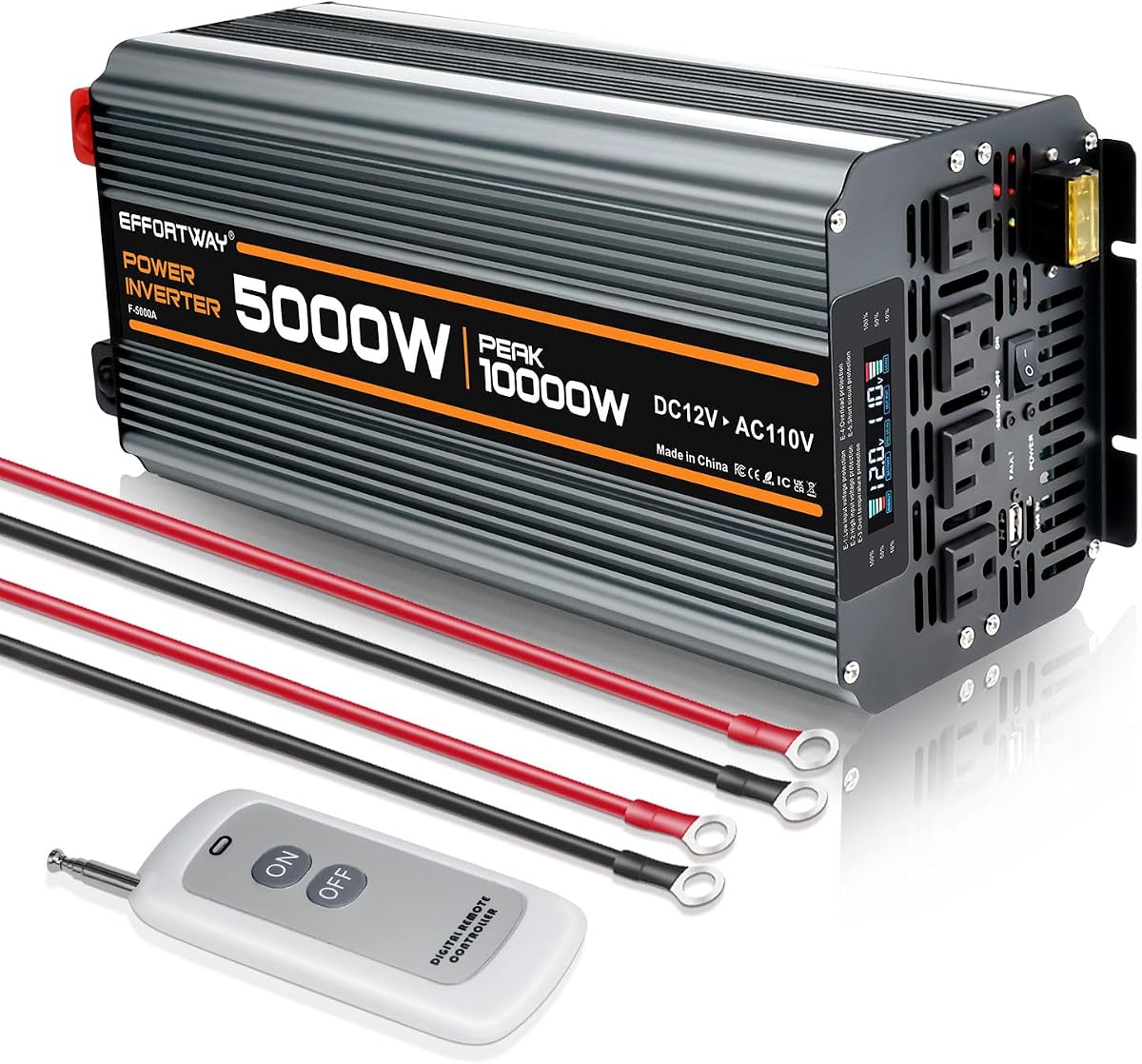
This inverter provides 5000W of continuous 12V-to-110V/120V output with a 10,000W peak rating, making it a useful alternative when shopping for a 10000W surge capability rather than a true 10,000W continuous unit. Its 4.4 rating and combination of remote control, LCD monitoring, and four AC outlets make it approachable for RV and mobile use.
We may earn a commission when you buy through this link, at no additional cost to you.
The LCD displays input and output voltage, battery capacity, load capacity, and error codes. A wireless controller reaches up to 150 feet, allowing convenient remote startup from outside a vehicle or near an RV. The inverter also includes a manual and two pairs of battery cables, while cooling fans, LED indicators, and built-in fuses support dependable operation.
Its major limitation is that continuous capacity is 5000W rather than 10,000W. That matters for heating elements, large appliances, and sustained tool loads. Its stated conversion efficiency exceeds 90%, but a 12V system still has to move considerable current to deliver 5000W continuously, and the included protection circuitry will shut down if voltage or temperature conditions become unsuitable.
Choose it when the important requirement is handling 10,000W startup peaks, or when 5000W steady output is enough. The remote is especially useful for mobile installations, while the display helps users monitor load and battery status without direct access to the unit. Turn the inverter off before using the remote to start it, as specified in the product guidance.
A 150-foot wireless controller adds convenience in RVs, trucks, and camper layouts where the inverter may be mounted away from living space. The display also shows fault codes that help identify common low-battery, overvoltage, overheating, overload, and short-circuit conditions.
The stated error-code guide translates common shutdowns into basic corrective actions. It does not replace professional diagnosis, but it gives users a practical starting point for checking battery level, cable connections, charging sources, ventilation, and connected loads.
We may earn a commission when you buy through this link, at no additional cost to you.
This SUNGOLDPOWER SPH model combines a 10,000W pure sine wave inverter, two MPPT solar controllers, and up to 200A battery charging in a 48V system. It earns a 4.5 rating and stands out for installers who may eventually expand beyond a single unit. Up to six units can reportedly operate in parallel.
We may earn a commission when you buy through this link, at no additional cost to you.
The inverter supports 20,000W peak output, 6HP motor loads, 500VDC maximum open-circuit PV voltage, and selectable 120V/240V split-phase or 120V single-phase output. Protection includes PV, AC input, battery overvoltage, and overload handling, while several charging and output modes allow utility, solar, and battery priorities to be adjusted.
This is clearly a permanent-system product rather than a simple plug-in appliance. Parallel operation requires compatible equipment, careful communication and phase matching, and adequate battery infrastructure. The time-slot charging and discharging function, broad battery-type support, and CAN, USB, and RS485 options are valuable for advanced installations but increase the planning burden.
It is a strong candidate for a growing off-grid home, commercial workshop, or solar installation where 48V is the preferred battery architecture and future parallel capacity matters. The recommendation depends on professional planning, correct protection, ventilation, and a clear understanding of the selected operating mode rather than treating expansion as a casual plug-in upgrade.
Parallel support for up to six units provides a clear path for increasing system capacity over time. Because expansion changes current draw and coordination requirements, the battery bank, cables, protection, and commissioning plan should be reviewed before adding units.
Combining pure sine inversion, dual MPPT tracking, grid input, and high-current battery charging reduces the number of separate major components. It also centralizes operating modes and status information in a system designed for high-capacity energy management.
We may earn a commission when you buy through this link, at no additional cost to you.
The AIMS 10000W inverter is a 12V modified sine wave unit delivering a stated 10,000W continuous and 20,000W surge. Its 4.0 rating is the lowest among the reviewed products, but the straightforward high-capacity design remains relevant for off-grid power, professional tools, pumps, motors, and essential appliances.
We may earn a commission when you buy through this link, at no additional cost to you.
Four 120V AC outlets and a terminal block provide flexible output options. Front-panel voltage and amperage meters make it easier to monitor battery condition and real-time consumption, while PWM soft start and phase correction are intended to improve compatibility with motor-driven loads. Its 30 years of stated power-engineering experience adds brand context.
The product data explicitly says it is not intended for standard vehicle use and requires a robust battery configuration to support 10,000W continuous output. That warning is important: a 12V battery system must be sized to supply extraordinary current without excessive voltage drop or overheating. Modified sine wave output also places limits on the range and type of compatible electronics.
This inverter makes sense for a fixed mobile installation, workshop, emergency power hub, or off-grid residence equipped with a serious battery bank. It is less suitable for ordinary car use, sensitive electronics, or a small battery setup. Buyers should prioritize proper bus sizing, fusing, ventilation, and grounding over convenience.
Built-in voltage and amperage meters provide immediate information about battery condition and consumption. This is useful in fixed installations where checking the battery directly would otherwise require additional access or separate instrumentation.
PWM soft start and a 20,000W surge capability are intended to ease startup demand from motors, pumps, and tools. The battery bank, cables, and protection system still need to be properly engineered to support those transient loads.
We may earn a commission when you buy through this link, at no additional cost to you.
The OLTEANP listing combines a 3000W continuous rating with a 10,000W startup surge, even though its title presents the product as 5000W. It carries a 4.6 rating, making it one of the stronger customer-rated entries, but careful shoppers should base load planning on the detailed 3000W continuous specification rather than the headline number.
We may earn a commission when you buy through this link, at no additional cost to you.
Its connection options are extensive for a portable unit: four AC outlets, one hardwired AC terminal, a 5V/3.1A USB port, and a 30W Type-C PD port. Dual LCD displays on the inverter and remote controller display input and output voltage, battery status, and fault alerts. Compatibility extends across LiFePO4, AGM, gel, and lead-acid 12V batteries.
The wave quality is a major strength because pure sine output is generally more suitable for sensitive equipment. Five-layer protection covers undervoltage, overvoltage, overload, overheating, and short circuits, with built-in fuses. The trade-off is capacity: 3000W continuous output limits simultaneous high-draw appliances, even though the 10,000W surge can help during startup.
Choose this model for an RV, van, boat, truck, or emergency kit where pure sine output, USB-C charging, remote monitoring, and several outlets matter more than full 10,000W continuous capacity. It is an attractive compact-feature package, but users should never size continuous household loads from the 10,000W surge figure.
The inclusion of a 30W Type-C port and a USB-A port adds convenient charging options alongside household outlets. The hardwired terminal provides a dedicated route for higher-current tools or appliances when a portable receptacle connection is unsuitable.
Pure sine output helps position the inverter for computers, routers, media devices, and other electronics that may be sensitive to waveform quality. Real-world runtime still depends on battery capacity, cable losses, and the inverter being operated within its continuous rating.
We may earn a commission when you buy through this link, at no additional cost to you.
The TOPBULL inverter supplies 5000W continuous and 10,000W peak power from a 12V source, with a 4.6 rating that places it among the best-rated products here. It is designed for vehicles, camping, mobile offices, emergency use, and off-grid solar, but it should be treated as a 5000W continuous model with 10000W surge capability.
We may earn a commission when you buy through this link, at no additional cost to you.
Four 20A AC receptacles, two USB fast-charging ports, a 30W Type-C port, and three AC terminal blocks offer a generous range of connections. A color display presents voltage, power, and operating status, while a 200-foot remote allows convenient switching. The stated metal housing, cooling system, and high-frequency transformer design emphasize durability and thermal management.
Its standout strength is the stated ten-part protection suite, covering low and high voltage, overload, short circuit, overheating, reverse polarity, grounding, overcurrent, leakage, and battery protection. Those features are valuable in a vehicle environment, although correct installation remains essential. Running a 5000W load from 12V creates substantial current, so the battery, cables, fuse, and ventilation must all be appropriately specified.
This inverter is a good fit for RV travelers, tradespeople, and mobile-office users who want 10,000W startup headroom and many output options. It may serve sensitive electronics better than a modified sine model if its output is pure sine as stated, but buyers should verify the final listing configuration and avoid confusing peak capacity with continuous output.
Reverse-polarity, short-circuit, overload, and battery protections are especially relevant when connecting an inverter to a vehicle battery. These safeguards support safer use, but they do not excuse the need for correct polarity, secure connections, and properly rated fusing.
A 200-foot wireless remote makes the inverter easier to operate from a cab, living area, or nearby campsite. The color display provides real-time voltage, power, and status information, reducing the need to open the installation area for routine checks.
We may earn a commission when you buy through this link, at no additional cost to you.
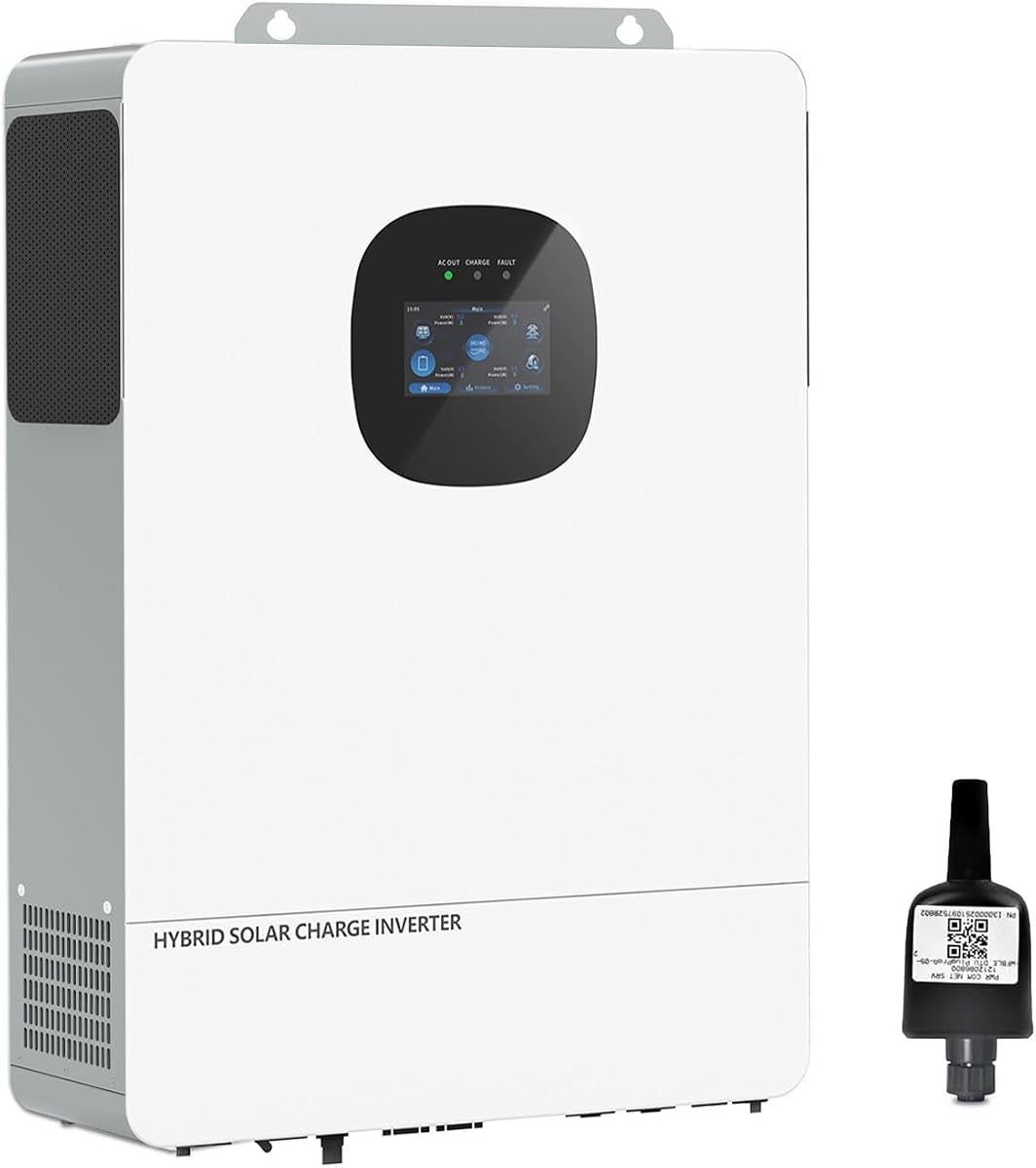
The POWLAND is a 10,000W grid-tied hybrid inverter designed around 48V solar and battery systems. It holds a 5.0 rating and distinguishes itself through a battery-free design, built-in 250A MPPT, and selectable 120V/240V split-phase output. The stated use cases include large homes, RV parks, and installations combining utility, solar, and optional battery support.
We may earn a commission when you buy through this link, at no additional cost to you.
A standout feature is the ability to use excess solar energy directly by the home and grid when an optional current transformer is used. The MPPT accepts 90–485VDC solar input at up to 250A, and the product claims 99.9% tracking efficiency along with improved low-light capture. This makes the inverter especially relevant to substantial rooftop arrays.
The inverter also includes overload, short-circuit, reverse-polarity, and over- or undervoltage protection, along with an IP65-rated case for dust and rain exposure. An LCD, LEDs, ECO mode, and dual-fan cooling improve operation. However, grid-tied installation is not a casual DIY task: utility interconnection, anti-backflow configuration, wiring, and local approval must be handled correctly.
This is the most flexible choice for a homeowner or installer seeking one device to handle grid power, solar generation, and optional batteries. It works with 48V LiFePO4 and lead-acid batteries, but battery-free operation provides another path for users who do not want to begin with a large battery bank. Its 10,000W output and expandable system design make it the standout editorial selection.
The battery-free design allows a system to operate from grid and solar power without requiring a battery bank from the start. That can simplify early deployment and offer a path toward adding compatible 48V storage later.
A 250A MPPT controller and broad 90–485VDC input range are designed for high-capacity solar collection. Dual-array optimization and low-light performance claims add appeal, while actual yield depends on panel layout, shading, orientation, and local conditions.
We may earn a commission when you buy through this link, at no additional cost to you.
The HumsiENK is a 48V hybrid inverter with 10,000W continuous pure sine wave output, 12,000W surge, and native 120/240V split-phase support. Its 4.7 rating is the highest among the non-grid-tied solar hybrid models, and its most distinctive feature is a stated UPS transfer time of 10 milliseconds or less.
We may earn a commission when you buy through this link, at no additional cost to you.
The unit integrates a 10,000W inverter, 12000W MPPT solar charger, and 220A battery charger. Two independent MPPT channels can manage separate solar arrays, while four charging modes and time-of-use scheduling give users detailed control over where energy comes from and when batteries charge or discharge. It can also operate without batteries when solar and grid power are available.
Fast transfer is valuable for computers, routers, and other sensitive electronics because it minimizes interruption during outages. The inverter also supports gel, flooded, lithium, and NCM batteries, plus Wi-Fi, Bluetooth, USB, RS485, and CAN communication. It can reportedly expand to six parallel units for a 60kW system, making it suitable for professionally planned residential or commercial power upgrades.
This model is ideal for whole-home backup, off-grid living, and workshops with 240V equipment. Its installation demands appropriate battery capacity, protected DC wiring, correct panel integration, and local electrical compliance. It earns a strong recommendation for buyers who prioritize fast switchover, split-phase capability, sophisticated solar control, and future expansion.
The stated transfer time of 10 milliseconds or less is designed to keep sensitive electronics running through brief grid interruptions. Actual continuity also depends on battery condition, load size, wiring, and system configuration, but the target is well suited to backup-power applications.
Wi-Fi and Bluetooth app access provide remote monitoring and local setup, while USB, RS485, and CAN ports support deeper integrations. Time-of-use scheduling and fault alerts make the inverter more useful for managed energy systems than for simple emergency use.
We may earn a commission when you buy through this link, at no additional cost to you.
Choosing a 10000W inverter requires matching its electrical architecture to the intended loads, battery system, and installation site while distinguishing continuous output from short-term surge capability.
A 10,000W headline rating can refer to continuous output, peak output, or a family of selectable inverter sizes. Some products genuinely sustain 10,000W, while others provide 5000W continuously and 10,000W only during startup. Continuous power is the figure that matters for running heaters, kettles, air conditioners, workshop machinery, and other sustained loads. Surge ratings help with motors, compressors, and pumps that draw extra current when starting.
Choose by sustained load, not startup headline. If several high-draw appliances may run at once, add their running requirements and leave sensible headroom for future equipment.
A 12V inverter is convenient for vehicles and modest mobile systems, but the current required to produce 10,000W is extremely high. At 48V, the same power requires roughly one-quarter of the current, making heavy cables, switches, fuses, and battery banks more practical. The battery chemistry also matters: common systems use flooded, gel, AGM, or lithium batteries, and hybrid inverters may support a user-defined battery profile.
Confirm that the battery system can support both running and surge current. Proper bus sizing, terminal quality, ventilation, and protection are as important as the inverter itself.
Pure sine wave output closely resembles utility power and is generally the safer choice for computers, audio equipment, variable-speed motors, medical devices, and other sensitive electronics. Modified sine wave models are usually less expensive and can work well with resistive loads, basic tools, and some motors, but they may cause noise, heat, or improper behavior in sensitive products.
Choose pure sine wave when equipment quality matters. Choose modified sine wave only after confirming that every important load is compatible and affordable to replace if it behaves poorly.
Most vehicle and RV users need 120V single-phase output, while whole-home systems may require 120V/240V split phase. The reviewed selection includes 110V, 120V, 220V, and split-phase options. This is not a minor specification: the output voltage must match the appliances, outlets, transfer switches, and distribution panel in the installation.
Use matching appliances or qualified transformers, but avoid adding unnecessary transformation when the inverter can provide the correct output directly. Confirm the required frequency and phase arrangement before purchase.
A basic inverter converts stored DC power into AC but does not necessarily harvest solar energy or coordinate grid input. Hybrid models can add MPPT solar tracking, high-current battery charging, utility backup, anti-backflow behavior, and programmable charging priorities. Models with two MPPTs can optimize arrays that face different directions or experience different shading conditions.
Prioritize these features if solar is central to the project. For a basic emergency or RV installation, simpler monitoring and remote control may be sufficient.
A useful display should reveal input voltage, output voltage, load percentage, battery state, operating mode, and fault codes. Physical controls remain necessary when remote communication fails, while wireless remotes make a unit mounted near a battery more convenient. Advanced systems may add app control, Wi-Fi, Bluetooth, USB, RS485, or CAN communication for integration with compatible battery management systems.
Match monitoring to the installation. A remote display and simple LED codes suit an RV, while a full protocol and application interface make sense for a managed home-energy system.
Look for protection against overload, short circuit, overvoltage, undervoltage, overheating, reverse polarity, and battery faults where available. Cooling is especially important because dense power conversion creates heat. Durable aluminum housings, temperature-controlled fans, grounding provisions, and clearly placed terminals support safer operation, but no internal protection can compensate for undersized wires or a weak battery.
Plan ventilation, fusing, grounding, cable routing, and mounting clearance before installation. Permanent and grid-connected systems should be reviewed by a qualified electrician familiar with local requirements.
Before connecting anything, identify the inverter's input voltage, continuous output, surge capability, output waveform, and AC configuration. Compare those figures with the battery bank and every intended load. Ensure the inverter is switched off while wiring, use correctly rated battery cables, install appropriate circuit protection, and confirm that ventilation openings remain unobstructed.
Start with the display or indicator lights and verify battery voltage and output settings before switching on. Connect loads gradually rather than energizing the entire system at once. Keep total running demand within the continuous rating and leave room for startup surges. Use the remote or monitoring interface only as directed, and never exceed the stated battery input, temperature, ventilation, or wiring limits.
For long-term care, keep the enclosure dry and dust-free, inspect terminals for corrosion or looseness, and check cables for heat, abrasion, or damaged insulation. Clean cooling vents regularly and ensure the unit has unobstructed airflow. Battery condition directly affects inverter performance, so inspect terminals, test battery health, and verify that charging equipment operates correctly.
No. An inverter converts stored DC battery power into usable AC power; it does not create energy by itself. The inverter's 10000W label describes its output capability, while runtime depends on battery capacity, efficiency, cable losses, and the load. A 10000W inverter can run many large appliances, but a modest battery bank may still be depleted quickly.
A 12V system is convenient for vehicles but requires very high current to deliver 10,000W, resulting in heavy cables and a large battery bank. A 48V system uses substantially less current for the same output and is often more practical for a permanent home or workshop installation. Choose the voltage that your battery bank already uses or that your installation can safely support.
Continuous power is the level the inverter can maintain as ordinary running demand. Surge power is a short-term allowance for startup events, commonly associated with motors, compressors, and pumps. Products described as 5000W with 10000W peak should not be treated as 10,000W continuous inverters. Size the unit from sustained loads, then verify that surge capacity covers startup behavior.
Pure sine wave output is usually preferable for sensitive electronics, variable-speed motors, medical equipment, and appliances that may produce noise or malfunction with a stepped waveform. Modified sine wave output may still suit simple resistive loads and tools. The additional value depends on the equipment being powered, but pure sine wave is the safer general-purpose choice when the budget permits.
It may run a central air conditioner if its running demand fits within the inverter's continuous rating and its startup surge fits the surge specification. A 5000W-continuous alternative with 10000W surge may handle startup but cannot sustain the full air conditioner's running load. Check the compressor data, account for other household loads, and use a properly sized 48V battery system for stationary operation.
Those features are essential for a standalone solar system, but not for every inverter installation. A basic unit can provide AC from a battery charged by a separate alternator or solar controller. A hybrid inverter is more convenient when you want one enclosure to track solar panels, charge batteries, provide backup power, and coordinate grid use.
Battery capacity depends on desired runtime, load level, inverter efficiency, and the battery's usable depth of discharge. Calculate expected watt-hours, divide by usable battery energy, and account for conversion losses and temperature effects. More important than nominal capacity alone is whether the battery bank can safely deliver the inverter's very high continuous and surge current.
Professional installation is strongly advisable because grid-tied equipment can interact with utility wiring and requires correct protection, grounding, disconnects, and anti-backflow configuration. Local rules may require inspection or approval. Even for an off-grid system, a 10,000W installation involves high-current DC wiring and safety considerations that favor guidance from a qualified installer.
The best choice depends on whether sustained output, surge handling, solar integration, or grid backup is the priority. The upgraded pure sine model and POWLAND hybrid both hold 5.0 ratings, while the SUNGOLDPOWER SPH10048P stands out as a premium 48V solar system with dual MPPT control and substantial battery charging capability.
Prioritize exact continuous capacity, battery voltage, waveform quality, and output configuration before considering secondary features. A true 10,000W continuous model is appropriate for major simultaneous loads, while a 5000W model with 10,000W peak is better viewed as a surge-focused or lighter-duty option. Always engineer the battery bank, cables, protection, cooling, and grounding around the inverter.
Finally, check current prices, availability, ratings, and the exact selected configuration on Amazon before purchasing. Product variants and seller listings can change, and a model with a 10000W surge rating is not necessarily equivalent to one with 10000W continuous output. Confirm the final electrical specifications against your planned equipment before placing an order.