
FSP Hydro Ti Pro 1000W
4.6Editor score
Dual Titanium certifications
ATX 3.1 and PCIe 5.1
Fully modular 1000W design
Our 80 Plus Titanium Power Supply guide compares ten efficient units for gaming and workstation builds, covering wattage, connectors, noise, modularity, and
An 80 Plus Titanium power supply is designed to convert wall power into usable system power with exceptional efficiency, helping reduce waste heat and fan noise while supporting demanding graphics cards and processors. The right model also needs adequate wattage, current-generation connectors, reliable protections, and a modular design suited to your case.
This guide compares ten power supplies using the supplied efficiency certifications, power ratings, connector details, cooling features, warranty terms, and other documented specifications. It covers compact 850-watt models, high-capacity 1000- and 1300-watt units, and extreme 1600-watt options for advanced gaming and workstation systems.
The selections show which models stand out for everyday value, outright performance, premium features, quiet operation, and future-facing power delivery. Product details and prices can change over time, so readers should verify the current listing, connector layout, and system requirements before making a final purchase.
4.6Editor score

4.7Editor score

5.0Editor score
The comparison below places each unit’s capacity, efficiency, connector support, cooling approach, and practical differentiators side by side, with one Gold-certified compact model included as a useful efficiency-tier alternative.




The FSP Hydro Ti Pro 1000W is a 1000-watt power supply that combines 80 Plus and Cybenetics Titanium efficiency with a rating of 4.6. Its standout qualities are a compact chassis, modern ATX 3.1 and PCIe 5.1 support, a fully modular cable system, and unusually broad environmental protection.
We may earn a commission when you buy through this link, at no additional cost to you.
Efficiency is documented at more than 94 percent under typical loads, which should limit waste heat and help the internal fan remain inactive during lighter workloads. The 135mm fluid dynamic bearing fan has a Zero-RPM mode, while the conformal coating is documented as protecting against moisture, dust, and staining. Its 150mm length also makes it more manageable than many other high-wattage units.
The main compromise is scale. Although 1000 watts is ample for many high-end gaming configurations, it leaves less headroom than the 1300-, 1600-, and 1200-watt alternatives in this guide. Buyers who routinely combine an exceptionally powerful processor and graphics card should calculate their expected draw and allow room for power excursions before choosing it. The size of the fan may also require attention when planning airflow.
This is a strong recommendation for a builder who wants Titanium efficiency without moving into the footprint and cost of the most extreme workstation-oriented units. It is especially attractive when a native 12V-2×6 connection, modular cabling, compact dimensions, and a ten-year warranty matter more than having the largest possible power rating.
The 150 by 150 by 86mm enclosure separates this model from many similarly powerful units that use a longer 170mm chassis. That shorter body can make it easier to route cables and maintain case airflow, especially when the power bay is crowded.
A 12V-2×6 connector and five PCIe 6+2-pin connectors provide flexible support for current and demanding graphics hardware. ATX 3.1 and PCIe 5.1 readiness also make this a practical foundation for future high-performance upgrades.
We may earn a commission when you buy through this link, at no additional cost to you.
The Seasonic Prime TX-1600 Noctua Edition is a 1600-watt power supply rated 4.7 and built for high-performance workstations and gaming systems. It combines huge power capacity with an emphasis on very low noise, using a renowned Noctua NF-A12x25 fan and a custom fan grille.
We may earn a commission when you buy through this link, at no additional cost to you.
Its most significant feature is the cooling strategy. The product is documented as approximately 8 to 10dB(A) quieter than the regular Seasonic Prime TX-1600, and it carries Cybenetics Lambda A++ certification. Semi-passive operation keeps the fan off until the unit reaches 50 percent load at an ambient temperature of up to 25°C, then ramps it gradually as demand rises.
Electrical performance remains focused on demanding modern hardware. The unit is 80 Plus and Cybenetics ETA Titanium certified at 94 percent efficiency at 50 percent load. It supports ATX 3.1 and PCIe 5.1, includes a 12V-2×6 connector, and is backward compatible with ATX 3.0 and PCIe 5.0. Backward compatibility is useful for builds that may not yet have native high-end graphics cards.
This is the recommendation for builders who want the quietest premium option in the group without surrendering a 1600-watt ceiling. Its capacity is excessive for many mainstream systems, but it offers a logical option for extreme components, extensive expansion, and quiet workstations where acoustic quality is a priority.
The Noctua fan and semi-passive control are the defining features here. A system that spends considerable time below the stated fan activation threshold can remain exceptionally quiet while still gaining a large thermal reserve for sustained high-load work.
With 1600 watts and 94 percent efficiency at a 50 percent load, the unit combines substantial headroom with reduced waste heat. That balance can help preserve quieter cooling in a workstation that also contains high-output processors and graphics cards.
We may earn a commission when you buy through this link, at no additional cost to you.
The MSI MPG Ai1300TS PCIE5 is a 1300-watt, fully modular gaming power supply with a 5.0 rating. It stands out through its GPU Safeguard+ monitoring, server-grade silicon carbide MOSFETs, dual native 12V-2×6 connections, and a twelve-year warranty.
We may earn a commission when you buy through this link, at no additional cost to you.
GPU Safeguard+ is the most distinctive feature. It provides real-time current protection and an early alert when the 12V-2×6 current enters an abnormal state, allowing the user to address the problem while maintaining system functionality. The dual native cables can each deliver up to 600 watts, providing direct support for PCIe 5.1 graphics hardware without requiring an adapter.
Thermal design is supported by a 135mm fluid dynamic bearing fan and server-grade SiC materials in the interleaved PFC MOSFETs, which are intended to improve efficiency and keep temperatures low. The included cable inventory is also extensive: motherboard, CPU, two 12V-2×6, five PCIe, a PCIe-to-dual-PCIe adapter, SATA, and peripheral leads.
MSI recommends the product for high-end GPUs and CPUs, and its 1300-watt rating offers enough capacity for many demanding builds without reaching the footprint demands of a 1600-watt model. It is best suited to enthusiasts who value early connector warnings, modern cable support, and a long warranty over a more conventional or compact design.
Real-time monitoring distinguishes the Ai1300TS from ordinary high-wattage power supplies. Catching an abnormal connector condition early can help users correct cable routing, seating, or compatibility issues before the situation becomes more serious.
The use of server-grade SiC MOSFETs in the interleaved PFC stage is intended to support efficiency and lower operating temperatures. A fluid dynamic bearing fan adds durability to the cooling system, while the twelve-year warranty provides a lengthy ownership commitment.
We may earn a commission when you buy through this link, at no additional cost to you.
The ASUS ROG Thor 1600W Titanium III is a 1600-watt enthusiast power supply with a 4.3 rating. It is the most feature-oriented model in the group, combining GaN MOSFET technology, GPU-first voltage detection, a magnetic OLED display, a Turbo mode, and extensive thermal design.
We may earn a commission when you buy through this link, at no additional cost to you.
Its most visible feature is the magnetic OLED display, which shows real-time power consumption and can be placed on either side of the unit. That flexibility allows a side-mounted display in a conventional installation or a different orientation when the power supply is installed with or without its fan. The screen makes power monitoring more immediate than relying only on software reporting.
Electrical technology is similarly advanced. The GaN MOSFET is documented as offering up to 30 percent higher energy efficiency than standard MOSFETs, while the patented GPU-First intelligent voltage stabilizer is said to improve delivered graphics-card voltage by as much as 45 percent. ROG heatsinks, aluminum housing, a double ball bearing fan, and a tuned ventilation curve support sustained operation and extended power excursions.
The Thor 1600W III is a compelling choice for showcase systems and advanced builders who value real-time information and specialized GPU voltage management. It also carries both Cybenetics Lambda A+ and 80 Plus Titanium certification, with a ten-year warranty. The trade-off is that its visual complexity and large capacity are unnecessary for a modest or entry-level PC.
The magnetic OLED screen gives the power supply a role beyond electrical conversion. Seeing power consumption directly can be useful when tuning a high-output system or checking behavior while different components become active.
GPU-First voltage detection and the intelligent stabilizer focus attention on the graphics card connection. ATX 3.1 support, 1600 watts of capacity, and a Turbo mode make the unit especially relevant to advanced gaming and enthusiast configurations.
We may earn a commission when you buy through this link, at no additional cost to you.
The be quiet! Dark Power 13 850W is an 80 Plus Titanium power supply rated 4.1. It targets high-end systems that need efficient 850-watt capacity without moving to a much larger chassis, and its stated efficiency reaches as high as 95.4 percent.
We may earn a commission when you buy through this link, at no additional cost to you.
Efficiency can translate into a cooler and quieter system because less energy is lost as heat. The product supports ATX 3.0 and PCIe 5.0, includes a native 12VHPWR connection for newer graphics cards, and retains PCIe 6+2-pin connectors for existing GPU configurations. That combination gives users more installation options than a design built around only the newest standard.
The power delivery specification is designed around four independent 12V rails and 850 watts of continuous power. The supplied information also states that the unit can handle short-term graphics-card power excursions up to double its rated power. This makes it relevant for hardware with demanding transient behavior, although buyers should still confirm that their individual components remain within the manufacturer's limits.
The Dark Power 13 is a sensible choice for a powerful but manageable workstation or gaming PC. It does not use the latest ATX 3.1 label, and its 4.1 rating is the lowest among the featured units. Even so, it offers a compelling combination of 850-watt capacity, very high stated efficiency, modern and legacy GPU connectors, and excursion handling for a comparatively compact build.
A documented efficiency of up to 95.4 percent is among the strongest figures in the guide. Lower waste heat can assist fan control and may contribute to a quieter system when the power supply is installed in a well-ventilated case.
Native 12VHPWR is paired with PCIe 6+2-pin connections, giving builders a modern route for supported graphics cards while retaining familiar options for other equipment. ATX 3.0 and PCIe 5.0 readiness align it with high-end platforms.
We may earn a commission when you buy through this link, at no additional cost to you.
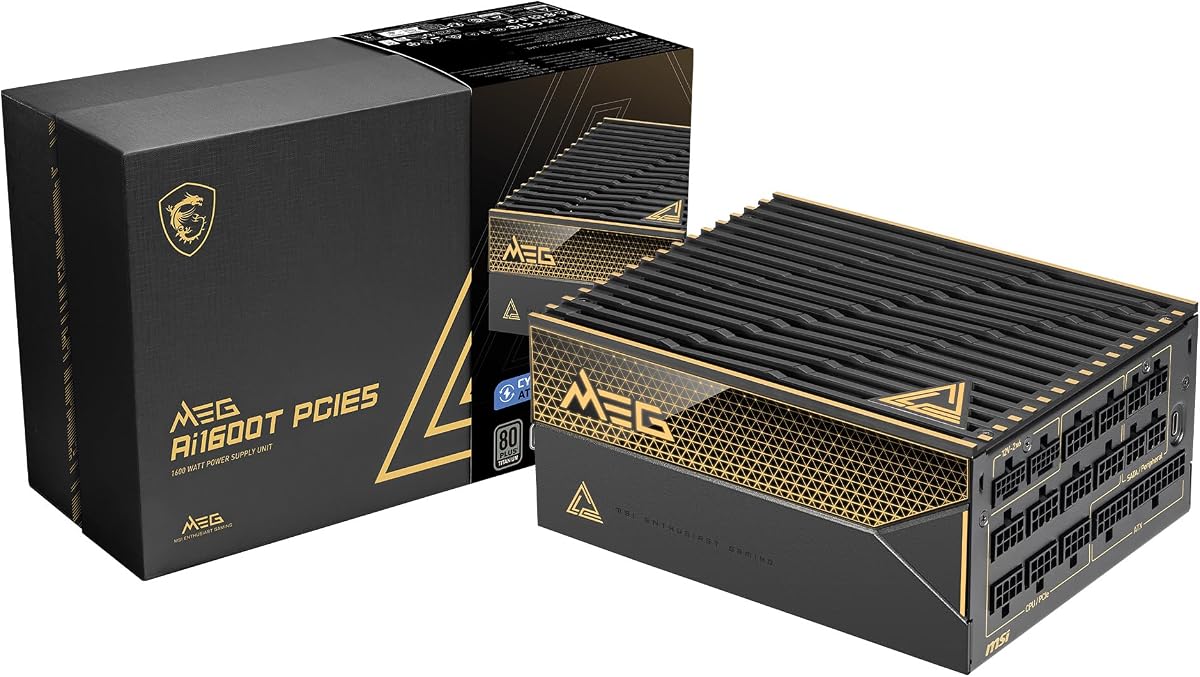
The MSI MEG Ai1600T PCIE5 is a 1600-watt gaming power supply with a 4.5 rating. Its defining strength is certification breadth: it is listed as 80 Plus, Cybenetics, and PPLP Titanium certified, alongside ATX 3.1 and PCIe 5.1 readiness.
We may earn a commission when you buy through this link, at no additional cost to you.
The unit includes two native 12V-2×6 connectors, allowing direct power delivery to compatible high-end graphics cards. A fully modular design, braided cabling, and a low-noise orientation make it visually appropriate for a gaming system, while the massive 1600-watt capacity provides considerable room for high-end processors, graphics cards, and expansion hardware.
MSI emphasizes a 100 percent Japanese 105°C capacitor configuration and an extensive industrial protection suite. The listed safeguards include OCP, OTP, OPP, SCP, OVP, UVP, SIP, and NLO. Together with the twelve-year warranty, these details position the model as a long-term high-output option rather than a basic gaming power supply.
The MEG Ai1600T is best for builders who are assembling an exceptionally powerful system and want more documented protections and certifications than a standard model provides. The trade-off is that many consumer PCs will never require 1600 watts, and buyers may have to ensure their case can accommodate the unit and route several thick modular cables without restricting airflow.
Being listed as 80 Plus, Cybenetics, and PPLP Titanium certified gives this model a stronger documented efficiency foundation than many alternatives. Certification across these programs can help buyers compare performance under more than one testing framework.
The broad protection list includes overcurrent, over-temperature, over-power, short-circuit, overvoltage, undervoltage, surge, and no-load protections. Combined with native high-current GPU connectors and a twelve-year warranty, it targets demanding, long-term installations.
We may earn a commission when you buy through this link, at no additional cost to you.
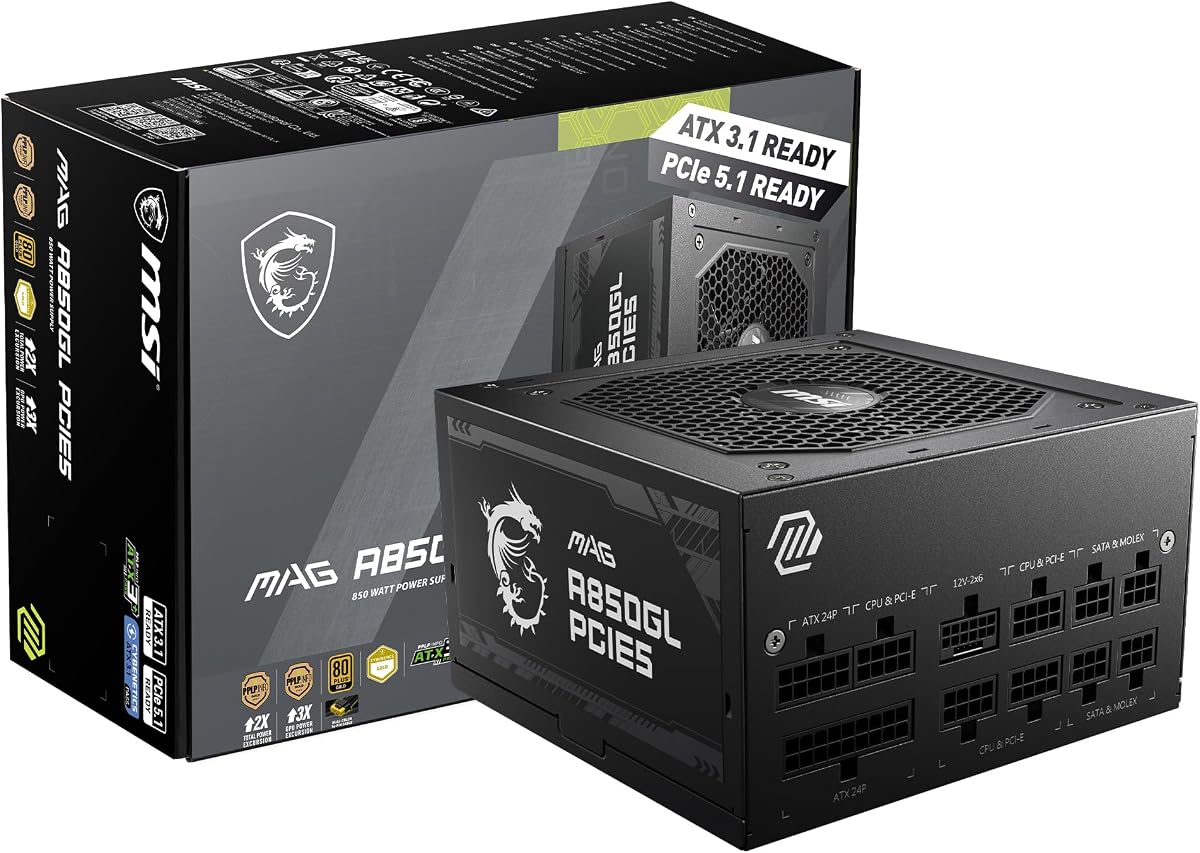
The MSI MAG A850GL PCIE5 is a compact, fully modular 850-watt gaming power supply with a 4.5 rating. It is included in this comparison as an efficiency-tier alternative because it carries 80 Plus Gold rather than Titanium certification.
We may earn a commission when you buy through this link, at no additional cost to you.
Its modern platform support is still impressive. ATX 3.1 and PCIe 5.1 readiness make it compatible with the latest high-power interface expectations, and the native dual-color 12V-2×6 cable provides a direct connection option for compatible graphics hardware. Full modularity allows unused leads to remain out of the case.
The principal distinction from the true Titanium models is efficiency certification. Gold represents a different efficiency tier, so buyers prioritizing the lowest waste heat and a documented Titanium rating should focus on the other entries. For systems that do not require the absolute highest efficiency, however, the MAG A850GL can still provide a practical combination of modern connectivity, compact 850-watt capacity, and a ten-year limited warranty.
This recommendation makes the most sense for a high-end gaming PC with a modest power budget or a builder seeking a less expensive route to ATX 3.1 and PCIe 5.1. It is not the strongest literal match for a buyer searching strictly for 80 Plus Titanium, but it serves as a credible modern alternative for a compact build.
ATX 3.1 and PCIe 5.1 support do not require an oversized unit. The A850GL brings current connector expectations and native 12V-2×6 support into a more moderate 850-watt category.
The product is 80 Plus Gold certified, not Titanium. Buyers should treat it as a value-oriented alternative within the comparison rather than treating its certification level as equivalent to the certified Titanium models.
We may earn a commission when you buy through this link, at no additional cost to you.
The Corsair AX850 is an 850-watt, fully modular 80 Plus Titanium power supply with a 4.7 rating. It offers an established combination of high efficiency, quiet operation, stable voltage regulation, and customizable exterior styling.
We may earn a commission when you buy through this link, at no additional cost to you.
The zero-RPM fan mode is central to the quiet-operation proposition. At low and medium loads, the 135mm true fluid dynamic bearing fan can remain stopped, reducing acoustic output when the system does not need active cooling. When demand rises, the bearing design is intended to maintain low noise while providing the required cooling.
Electrical performance is another major strength. Corsair describes the AX850 as offering stable voltages and ultra-low ripple noise, while its modular design helps reduce case clutter. Three-color customizable magnetic side labels let the exterior match different build themes without altering the unit's core hardware.
The principal limitation is its product generation. The supplied specifications do not identify ATX 3.1 or PCIe 5.1 support, and it predates the newest connector standards represented in several other picks. It remains a compelling 850-watt Titanium option for compatible hardware, especially when quiet operation and strong customer feedback are priorities. For the newest graphics cards, confirm cable and connector requirements before ordering.
A zero-RPM mode is especially useful for browsing, office work, media consumption, and other situations where the processor and graphics card do not create sustained heat. The fan can remain inactive until the unit's cooling demand increases.
The AX850 delivers an 850-watt rating with 80 Plus Titanium certification. That makes it a practical tier for many performance systems that need more capacity than a basic unit but do not require 1200 watts or more.
We may earn a commission when you buy through this link, at no additional cost to you.
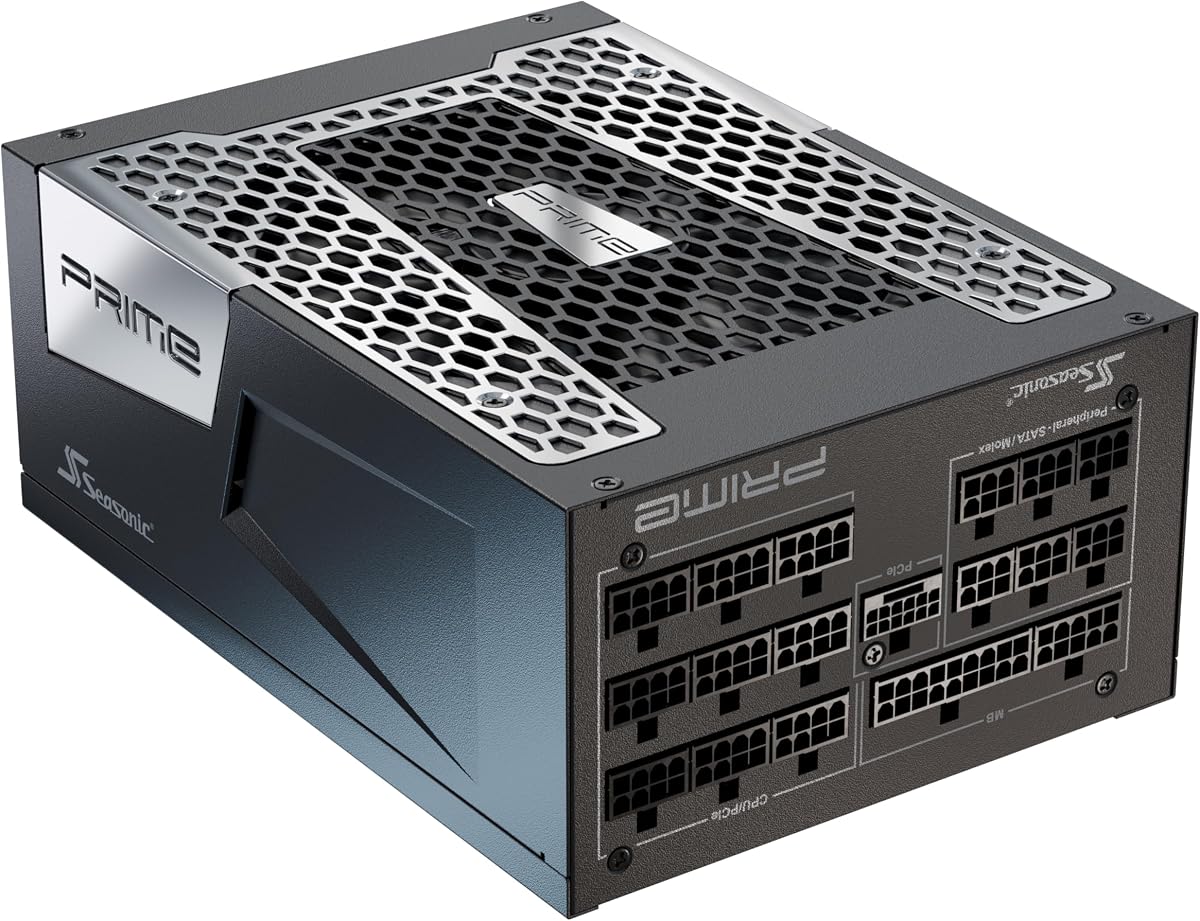
The Seasonic Prime TX-1300 is a fully modular 1300-watt power supply with an 80 Plus Titanium certification and a 4.5 rating. It balances substantial capacity with the established Prime Series focus on electrical performance, modular construction, and reliable components.
We may earn a commission when you buy through this link, at no additional cost to you.
One of its most precise advertised specifications is Micro Tolerance Load Regulation at 0.5 percent. This indicates close control of output voltage as the load changes, a useful characteristic for systems with demanding processors and graphics cards. A 135mm fluid dynamic bearing fan provides cooling, while the fully modular PVC-embossed cable design keeps unused connectors out of the chassis.
The unit is ready for ATX 3.0 and PCIe 5.0 platforms and is listed as compatible with Nvidia RTX 30 and 40 Super graphics cards as well as AMD GPUs. It also uses premium Japanese capacitors, supporting the model's emphasis on long-term component quality. The 1300-watt rating is large enough for many high-end configurations while remaining below the footprint demands of some 1600-watt choices.
This is a strong all-rounder for builders seeking high efficiency and abundant power without paying for the most extreme capacity. Its main caveat is that it uses an older interface generation than the ATX 3.1 options. Buyers with a native 12V-2×6 requirement should check the included cable set and manufacturer guidance before committing.
The documented 0.5 percent Micro Tolerance Load Regulation is the standout specification. It indicates that the output voltage is closely regulated as demand changes, which can benefit high-performance components in rapidly changing workloads.
ATX 3.0 and PCIe 5.0 readiness, a 135mm fluid dynamic bearing fan, and premium Japanese capacitors make this a well-rounded option for compatible modern systems. Fully modular cabling improves installation neatness and airflow.
We may earn a commission when you buy through this link, at no additional cost to you.
The be quiet! Dark Power 14 1200W is a high-efficiency power supply with a 4.9 rating. It combines 80 Plus and Cybenetics Titanium certification, up to 95.42 percent stated efficiency, ATX 3.1 support, and a generous 1200-watt capacity for demanding systems.
We may earn a commission when you buy through this link, at no additional cost to you.
Cooling can be handled in two ways. Active mode runs the Silent Wings fan continuously, while semi-passive mode stops and starts it as cooling demand changes. A re-ventilation process is documented to keep the fan running for two to five minutes after the load falls, helping prevent frequent starting and stopping and the associated noise.
The unit also gives overclockers a manual multi-rail or single-rail choice. In single-rail mode, the output is consolidated onto a massive 12V rail, while the standard configuration offers four separate 12V rails. An active rectifier, full-bridge LC technology, Japanese capacitors rated for operation up to 105°C, and long modular cables reinforce its high-end positioning.
The Dark Power 14 is an excellent recommendation for a modern enthusiast system that needs more than 1000 watts but may not need the full 1600-watt capacity of the largest units. Its 4.9 rating is particularly strong. The trade-off is the need to understand the rear-panel controls and confirm that the selected cooling and rail modes align with the builder's preferences.
A rear-panel button lets the owner choose continuous active cooling or semi-passive operation. The documented re-ventilation cycle reduces rapid fan cycling, making semi-passive mode more practical for systems that alternate between lighter and heavier workloads.
The manual switch between four independent 12V rails and a single-rail configuration gives builders direct control over power distribution. This is particularly relevant to overclockers who want to manage multiple high-current devices.
We may earn a commission when you buy through this link, at no additional cost to you.
A good selection depends on more than the certification badge. Capacity, transient behavior, connector standards, acoustic design, cable layout, protections, physical clearance, and warranty should all be matched to the components and operating conditions of the intended system.
Begin by estimating the combined power demands of the processor, graphics card, memory, drives, fans, expansion cards, and accessories. Do not rely only on the sum of a graphics card's recommended supply and a processor's labeled power. Peak demand, efficiency losses, power excursions, and possible future upgrades can all increase the appropriate target. High-end systems often benefit from 1000 watts or more, while 1300- and 1600-watt models provide substantially more room for extreme processors, multiple demanding GPUs, and sustained workstation workloads.
Choose a rated capacity that comfortably exceeds realistic peak demand without making the unit unnecessarily large or expensive.
80 Plus Titanium indicates that a power supply converts AC power to DC power efficiently across defined load ranges. The listed models also receive Cybenetics certification in several cases, while the MSI MEG Ai1600T carries 80 Plus, Cybenetics, and PPLP Titanium certification. Comparing both programs can provide a more complete view because their testing methodologies and labels are not necessarily identical. A higher efficiency rating reduces waste heat, potentially lowers fan activity, and improves the thermal environment around the unit.
Prioritize a genuine Titanium certification when efficiency is central to the selection, and compare the certified load ranges rather than looking only at a single headline percentage.
Modern graphics cards may require a native 12V-2×6 or 12VHPWR connection, while older and smaller cards often use PCIe 6+2-pin leads. A PSU can be wattage-sufficient and still be unsuitable if its cable set cannot safely connect to the intended hardware. Check ATX and PCIe generation labels as well: ATX 3.0, ATX 3.1, PCIe 5.0, and PCIe 5.1 are not interchangeable statements, and some products support more than one generation.
Verify every required connector, adapter, and cable specification before ordering, and prefer native connections when the manufacturer supports them.
Modern processors and graphics cards can change their power demand rapidly, making transient response and excursion support increasingly important. ATX 3.x readiness is one useful indicator, while some products add dedicated GPU monitoring or explicit excursion-handling claims. The MSI MPG Ai1300TS includes real-time 12V-2×6 current alerts, and the be quiet! Dark Power 13 is documented to handle short-term excursions up to twice its rated power. These claims should complement, rather than replace, careful system planning.
Choose a model with current-generation transient support and verify that every high-power component falls within the power supply's documented operating envelope.
Efficiency helps reduce the amount of heat that must be removed, but the fan and airflow design still influence noise. Semi-passive modes keep the fan stopped at suitable loads, while specialized fans such as the Noctua NF-A12x25 and be quiet! Silent Wings focus on low acoustic output. Some products also include re-ventilation behavior that prevents rapid fan cycling. Evaluate noise not only at idle but also during sustained loads, where every additional watt of heat becomes fan noise.
For a quiet workstation or gaming system, favor a well-reviewed fan, a proven semi-passive mode, and enough thermal capacity to avoid constant high-speed operation.
A fully modular design lets builders use only the cables they need, improving case appearance and potentially reducing airflow restrictions. Cable length matters just as much as modularity, especially in large cases or when the power supply is mounted away from the motherboard. The FSP Hydro Ti Pro is notably compact at 150mm long, while the Seasonic TX-1600 Noctua Edition includes long modular cabling for flexible placement. Measure the power bay, account for cable bend radius, and confirm that every plug can reach without being sharply bent.
Prioritize a chassis that fits comfortably and a cable set long enough for the planned layout, while leaving room for service access and proper airflow.
A quality power supply should include safeguards against abnormal electrical conditions. Protection coverage varies across the group, with the MSI MEG Ai1600T listing a broad suite that includes OCP, OTP, OPP, SCP, OVP, UVP, SIP, and NLO. Component quality is another differentiator: the Seasonic Prime TX-1300 and be quiet! Dark Power 14 highlight Japanese capacitors, while the FSP Hydro Ti Pro uses conformal coating for environmental resilience. Warranty terms range from ten years on several models to twelve years on the featured MSI units.
Favor meaningful protection coverage, reputable component specifications, and a long warranty that matches the expected service life of the computer.
Some buyers value a magnetic OLED power display, manual fan modes, single-rail overclocking controls, real-time GPU current alerts, or detailed monitoring above the price of a simpler unit. These features can be genuinely useful, but they should not displace a sound fit, adequate capacity, proper connectors, and reliable protection. The most valuable purchase is not necessarily the one with the longest feature list; it is the one whose strengths align with the actual system and the buyer's priorities.
Pay for documented features that solve a real need, and treat unneeded displays, controls, or extraordinary capacity as optional rather than essential.
Install the power supply in a clean, well-ventilated area of the case and use the modular cables supplied with that exact model. Connect the motherboard, processor, graphics card, storage, and peripheral leads while the system is powered off and disconnected from wall power. Never combine modular cables from different power-supply models, even when the connectors appear identical, because internal pin assignments may differ.
Inspect the system before energizing it. Confirm that every connector is fully seated, that no cable is pinched or sharply bent, and that the installed graphics-card power plug is connected correctly. Route the cables away from fans and intake vents, and check the case clearance around the power supply. If the unit has a fan orientation option, a semi-passive switch, or a rail-mode button, set it according to the manufacturer's instructions and your chosen configuration.
For routine care, keep the intake and exhaust paths clear of dust and maintain adequate clearance around the chassis. Do not open the power supply, because its internal capacitors may retain dangerous voltage after shutdown. If you hear unusual buzzing, notice a burning odor, detect unexpectedly hot cables, or experience repeated system resets, disconnect the system from the wall outlet and have the unit or the connected hardware inspected. Periodic software monitoring can help identify unusual power behavior, but it should not replace physical checks or manufacturer guidance.
It can be worthwhile in a gaming PC because high efficiency reduces waste heat and may help the power supply remain quieter under moderate load. The benefit grows when the system draws substantial power for long periods. For a modest computer, the savings may be less noticeable, so capacity, connectors, protections, and build quality should still drive the decision.
Not necessarily. The correct wattage depends on the specific graphics card, processor, memory, expansion, and expected upgrades, rather than GPU model alone. A demanding single-GPU system may perform well with 1000 watts, while an extreme processor-and-GPU combination may benefit from 1300 or 1600 watts. Include transient behavior and future expansion in the calculation.
Both are high-current graphics-card power interfaces, but they are distinct connectors with different specifications. A power supply must explicitly support the connector required by the graphics card, and an adapter should never be assumed to provide the same capabilities as a native cable. Check the PSU and GPU documentation, use the correct supplied cable, and ensure the plug is fully seated.
No. The mode only stops the internal fan while load and temperature remain within the manufacturer's stated range. The fan will start when additional cooling is needed, and other components such as CPU and GPU fans can still produce sound. Semi-passive control is best viewed as one tool for reducing noise rather than a guarantee of total silence.
Fully modular models allow unused cables to remain stored away from the system, which can make installations cleaner and easier to manage. They do not inherently guarantee better electrical performance, however. The more important considerations are efficiency, voltage regulation, protections, compatibility, and reliability, regardless of whether the cables are fixed or removable.
It reduces the amount of energy lost as heat while the supply converts AC power to DC power, so the system uses less wall power for the same useful output. The amount depends on the load level and the unit's efficiency curve. Lower waste heat may also reduce fan activity, although total system acoustics still depend on every cooling device in the case.
It may be possible if the wattage, ATX format, PCIe generation, and physical connectors are suitable. However, older models may not provide the native high-current connection or documented transient support expected by a current graphics card. Verify the GPU manufacturer's power requirements and the PSU specifications before purchasing or assembling the system.
Install it in a case with clean filtered intake airflow and keep the vents unobstructed. Avoid placing it on a damp surface and minimize exposure to accidental spills. Models with conformal-coated internals, such as the FSP Hydro Ti Pro, provide additional documented environmental resistance, but good installation and regular cleaning remain essential.
The FSP Hydro Ti Pro 1000W is a balanced recommendation for buyers who want dual Titanium certification, a compact chassis, modern ATX 3.1 support, and a native 12V-2×6 connection. The Seasonic Prime TX-1600 Noctua Edition stands out for extraordinary quiet cooling and enormous power capacity, while the MSI MPG Ai1300TS PCIE5 delivers advanced GPU monitoring and premium SiC-based components.
Prioritize the fit between the unit and the machine rather than treating wattage as the only metric. Confirm connector standards, transient support, physical clearance, modular cable length, protections, and acoustic behavior. Efficiency matters, but a Titanium-certified supply only benefits the build when it has enough capacity and every cable is compatible with the installed hardware.
Finally, check the current product listing and price before purchasing. Ratings, bundles, cable configurations, firmware or component details, and availability can change over time. Comparing the latest listing against the documented specifications in this guide is the safest way to make an informed final decision.