
Renogy 800W N-Type Panels
4.3Editor score
Two 400W bifacial panels
N-Type 16BB cells
Dual-module shade design
Up to 25% efficiency
Our 800W Solar Panel guide compares ten high-output solar panel sets for RV, marine, off-grid, portable, rooftop, and residential installations by design.
An 800W solar panel system can deliver meaningful charging capacity for an RV, boat, cabin, backup power setup, or other off-grid installation. The best choice depends on panel construction, voltage, mounting requirements, charge-controller compatibility, weight, and how easily the system can be deployed.
We compared ten 800W solar panel products using the supplied specifications, including power configuration, cell technology, environmental features, wiring, mounting options, and intended applications. The list covers rigid, flexible, bifacial, and portable designs, with two-panel sets distinguished from kits that include a controller.
Each review identifies the product's strongest traits and practical limitations. Ratings reflect the supplied customer feedback, while technical claims come from the product information. Availability, package contents, and configurations may change, so buyers should verify current specifications before purchasing.
4.3Editor score

4.5Editor score
5.0Editor score
This side-by-side comparison shows how the ten 800W solar panel sets differ in construction, power configuration, mounting style, weather resistance, and system integration.
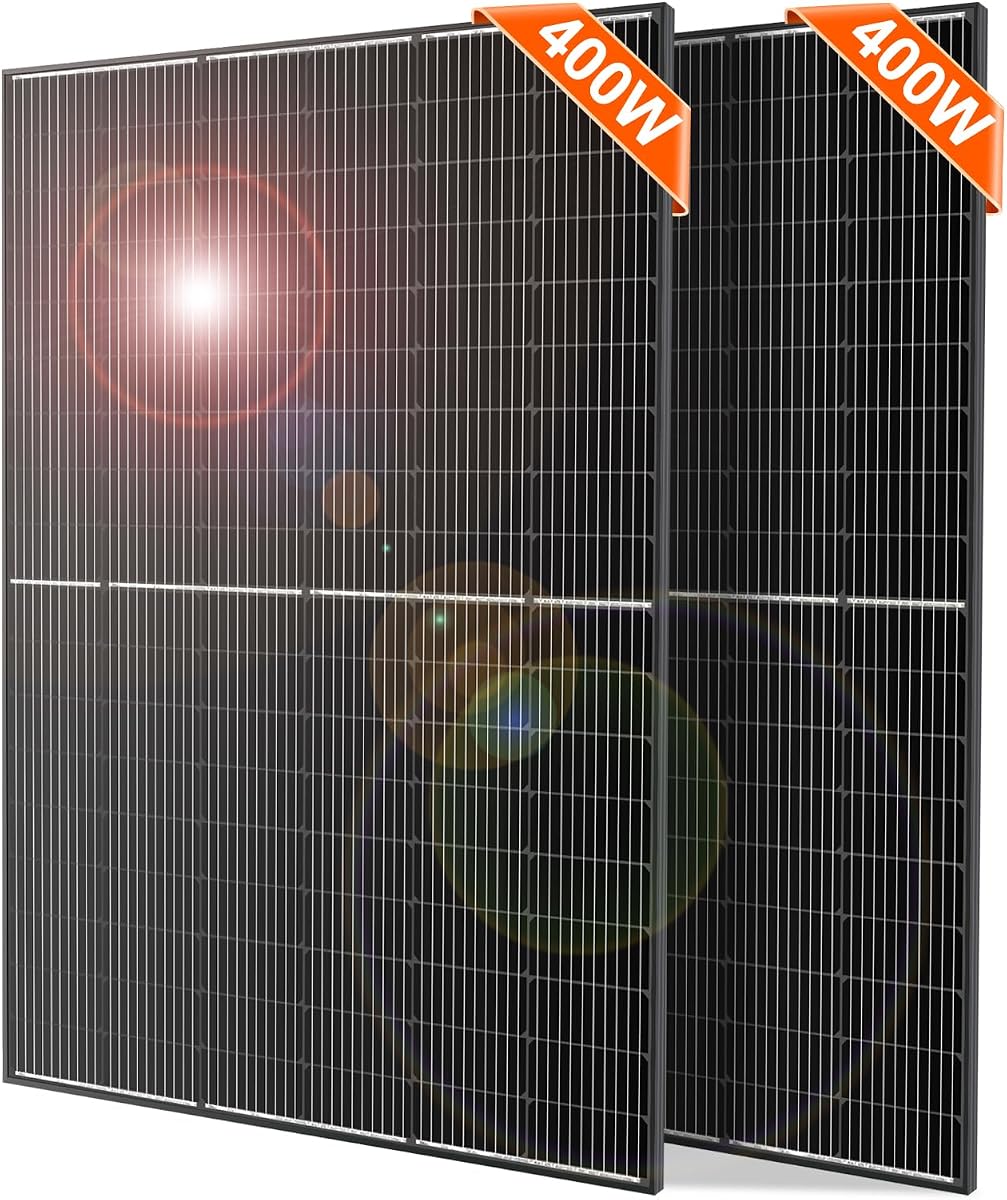


This DOKIO set combines two 400W rigid panels into an 800W system and carries a 4.1 customer rating. Its tempered-glass faces, aluminum frames, and sealed junction boxes make it a practical choice for permanent outdoor installations where a conventional framed panel is easier to mount than a flexible sheet.
We may earn a commission when you buy through this link, at no additional cost to you.
A major advantage is the reduced wiring complexity relative to an eight-panel, 100W-per-panel arrangement. Each module includes 9.84-foot MC4 leads, giving installers more reach between the panels and a combiner or controller. The set supports 12V and 24V AGM, gel, and LiFePO4 systems through compatible PWM or MPPT equipment.
The product guidance recommends parallel wiring first on a 12V bank, with series configurations used only when the controller can safely accommodate the higher voltage. Because two 400W modules can deliver substantial current, selecting a compatible controller and inverter is as important as selecting the panels themselves.
This is a sensible recommendation for installers who want high nameplate capacity, a conventional aluminum frame, and fewer inter-panel connections than a many-small-panel array. It is less suitable for travelers who need a compact, foldable system or for roofs where only a thin flexible panel will fit.
Two large modules can replace a much larger group of smaller panels while reducing branch connectors and joints. That can simplify routing and reduce potential connection points, although the installer still needs to follow the controller's voltage and current limits.
The approximately three-meter leads attached to each panel help span larger gaps to a combiner or controller. They can also eliminate the immediate need for extension cables, but final cable length should be planned before mounting.
We may earn a commission when you buy through this link, at no additional cost to you.
This second DOKIO option also uses two 400W panels and has a 4.1 rating. It is presented primarily for 24V off-grid systems, giving it a slightly more defined system focus than the general-purpose 12V/24V version listed above.
We may earn a commission when you buy through this link, at no additional cost to you.
Its 800W nameplate capacity is paired with tempered glass, an aluminum frame, and sealed junction boxes for permanent outdoor use. Three-meter MC4 leads on both modules support longer cable runs, while the two-panel layout reduces the number of connectors and branch points associated with a larger collection of smaller modules.
Parallel wiring is the recommended starting point for a 12V installation. Series wiring should only be considered when the charge controller supports the resulting input voltage. The panels do not include a controller or inverter, so buyers must size those components for the combined current and the battery bank's voltage.
Choose this set when reducing installation hardware is important and the system will remain mounted outdoors. It offers less flexibility than a foldable camping array and does not provide the turnkey convenience of a kit with a charge controller included.
The 31V panel rating makes this pair more naturally suited to a 24V battery architecture when configured appropriately. Exact series and parallel arrangements should always be confirmed against the controller's input specifications.
Using two high-output modules limits the number of physical panels and branch connections needed for an 800W target. This can make roof or ground-mount layouts look less crowded and easier to service.
We may earn a commission when you buy through this link, at no additional cost to you.
The Renogy set combines two 400W bifacial panels and earns a 4.3 rating. It stands out for N-Type 16BB cells, claimed efficiency of up to 25%, and the ability to collect sunlight from both the front and reflective rear surfaces.
We may earn a commission when you buy through this link, at no additional cost to you.
The bifacial design is especially relevant where the rear can receive reflected light, including snow, sand, concrete, white gravel, and light-colored roofs. The dual-module arrangement also provides two independently operating power zones, allowing one section to continue producing when leaves, branches, vents, or chimneys shade another section.
Its premium position comes from advanced cell construction rather than a larger cable bundle or included controller. Rear-side output depends on mounting height, surface reflectivity, tilt, and surrounding obstructions, so buyers should not assume the advertised bifacial gain will occur in every location.
This is a strong recommendation for rooftop, RV, and off-grid projects where space, efficiency, and shade tolerance are priorities. It is less relevant for a portable camping setup that needs folding construction, and its listed tax-credit statement depends on eligibility and installation rules.
A rear-facing surface exposed to reflected light can add energy beyond the front-side result. The benefit varies with the mounting environment, so pale roofs and open reflective ground generally offer more opportunity than shaded locations.
The two independently operating zones can preserve output when one part of the array is obstructed. They do not make the panels immune to shade, but the architecture can be more forgiving than a comparable design without independent sections.
We may earn a commission when you buy through this link, at no additional cost to you.
This flexible RV-oriented set is rated 5.0 by customers and combines two 400W monocrystalline panels for 800W total output. Its ETFE surface, low weight, and ability to conform to curved roofs make it a distinctive choice for mobile installations where drilling may be undesirable.
We may earn a commission when you buy through this link, at no additional cost to you.
Each panel weighs 4.4 pounds and is described as 0.1 inch thin, with a stated 70% weight advantage over rigid alternatives. The ETFE coating offers UV resistance and better light transmission than PET, while the panels have an IP68 waterproof rating and salt-spray corrosion protection.
The panels can bend to a 30-degree curvature and carry a stated thermal tolerance of 248°F. Pre-drilled holes are described as hole-free, and installation without mounting frames is possible. These features improve weight distribution and roof compatibility, although adhesive bonds require careful surface preparation and curing.
This set is well matched to RVs, vans, boats, cabins, and remote work sites where low weight and a thin profile matter. It is less suitable for users who want a removable portable array or prefer the long service expectations commonly associated with rigid framed modules.
A flexible profile spreads across a curved roof or deck more readily than a rigid framed module. That makes the set useful on boats, camper vans, trailers, and other surfaces where maintaining continuous contact is important.
At 4.4 pounds per panel, the listed construction places less weight on mounting surfaces than a traditional glass-and-aluminum panel. The reduced load is particularly helpful for mobile applications where roof weight and attachment points are important constraints.
We may earn a commission when you buy through this link, at no additional cost to you.
This portable set pairs two 400W folding panels for 800W total capacity and carries a 4.2 rating. It is designed for campsites, RV travel, and off-grid charging rather than permanent roof mounting, with a foldable format and an overall stated weight of 20 pounds.
We may earn a commission when you buy through this link, at no additional cost to you.
The panels use Sunpower solar cells with a claimed efficiency of 23%. Adjustable kickstands provide four positions—30, 40, 50, and 80 degrees—allowing the user to change the panel angle as the sun moves. An ETFE-coated surface adds impact resistance and durability for outdoor travel.
A 39V panel voltage is important when selecting a compatible power station, controller, or inverter. This higher-voltage configuration should not be connected directly to a 12V or 24V battery without appropriate charge control and configuration. The folding design also creates more surface area to protect than a single rigid panel.
This is the most mobile option in the guide and is recommended for campers who want high output without fixed installation. It is less attractive for a fixed cabin or rooftop array, where rigid panels and dedicated mounting hardware may be easier to maintain.
Four kickstand positions let users respond to changing sun direction throughout the day. Adjusting the array can improve the angle of incidence, although output still depends on local conditions and the panels receiving unobstructed sunlight.
The folding construction allows the array to be deployed at a campsite and packed away afterward. That flexibility makes it better suited to temporary use than roof-mounted alternatives designed for long-term fixed brackets.
We may earn a commission when you buy through this link, at no additional cost to you.
This bundle includes two 400W panels, a 30A MPPT charge controller, and an inverter for a 12-volt system, making it more turnkey than a panel-only set. Its supplied customer rating is 1.0, a notably weaker result than the other rated products in this guide.
We may earn a commission when you buy through this link, at no additional cost to you.
The panel information cites 10BB cells, up to 25% efficiency, and n-type monocrystalline technology. Built-in MC4 connectors, pre-drilled holes, and a supplied controller can reduce the number of separate components a beginner needs to source for a basic installation.
Despite the package's convenience, the supplied rating makes it difficult to recommend without caution. The listing also describes many intended uses, including RVs, campers, yachts, residential storage, and commercial installations, so buyers should confirm that the included inverter and controller match their specific loads and battery arrangement.
This kit is most relevant to someone seeking an integrated 12V package rather than a bare 800W panel array. Those comfortable selecting their own controller and inverter may prefer a panel-only product with stronger customer feedback and clearer installation guidance.
Including a 30A MPPT controller makes this package more accessible for a new system builder. The controller still needs to be matched correctly to panel voltage, battery chemistry, and load requirements.
The broad list of applications suggests flexibility, but it also highlights why detailed system matching matters. A package can include several components without guaranteeing that each one is appropriate for every installation.
We may earn a commission when you buy through this link, at no additional cost to you.
This two-panel set combines 400W modules with a 4.4 customer rating, placing it among the strongest-rated products in the guide. It uses advanced N-Type monocrystalline cells and 16BB half-cell technology intended to improve light utilization and reduce internal power loss.
We may earn a commission when you buy through this link, at no additional cost to you.
Construction includes tempered glass, a corrosion-resistant aluminum frame, and IP68-rated connectors. The listed 2400Pa wind-load and 5400Pa snow-load ratings indicate a focus on demanding outdoor installations. Pre-installed MC4 connectors, bypass diodes, and approximately 3.6-foot cables support straightforward integration with controllers and other modules.
One trade-off is the relatively short included cable length compared with the DOKIO sets. Installers may need additional appropriately rated cable depending on the distance to the controller. The product information mentions compatibility with Z-brackets, side mounts, grounding mounts, and tilt brackets, but mounting hardware is not described as part of the package.
This is an excellent fixed-array choice for RVs, boats, homes, cabins, and off-grid systems when rugged construction and N-Type cell technology are priorities. It is less convenient for portable use because it lacks folding construction and adjustable stands.
N-Type cells are described as having lower recombination losses and improved conversion behavior compared with traditional PERC cells. The stated low-light response also makes the modules relevant to systems that need useful output during mornings, evenings, or cloudy periods.
Pre-drilled holes make the panels adaptable to common Z-bracket, side-mount, ground-mount, and tilt-bracket arrangements. Choosing the correct bracket and attachment method remains important for long-term performance and weather resistance.
We may earn a commission when you buy through this link, at no additional cost to you.
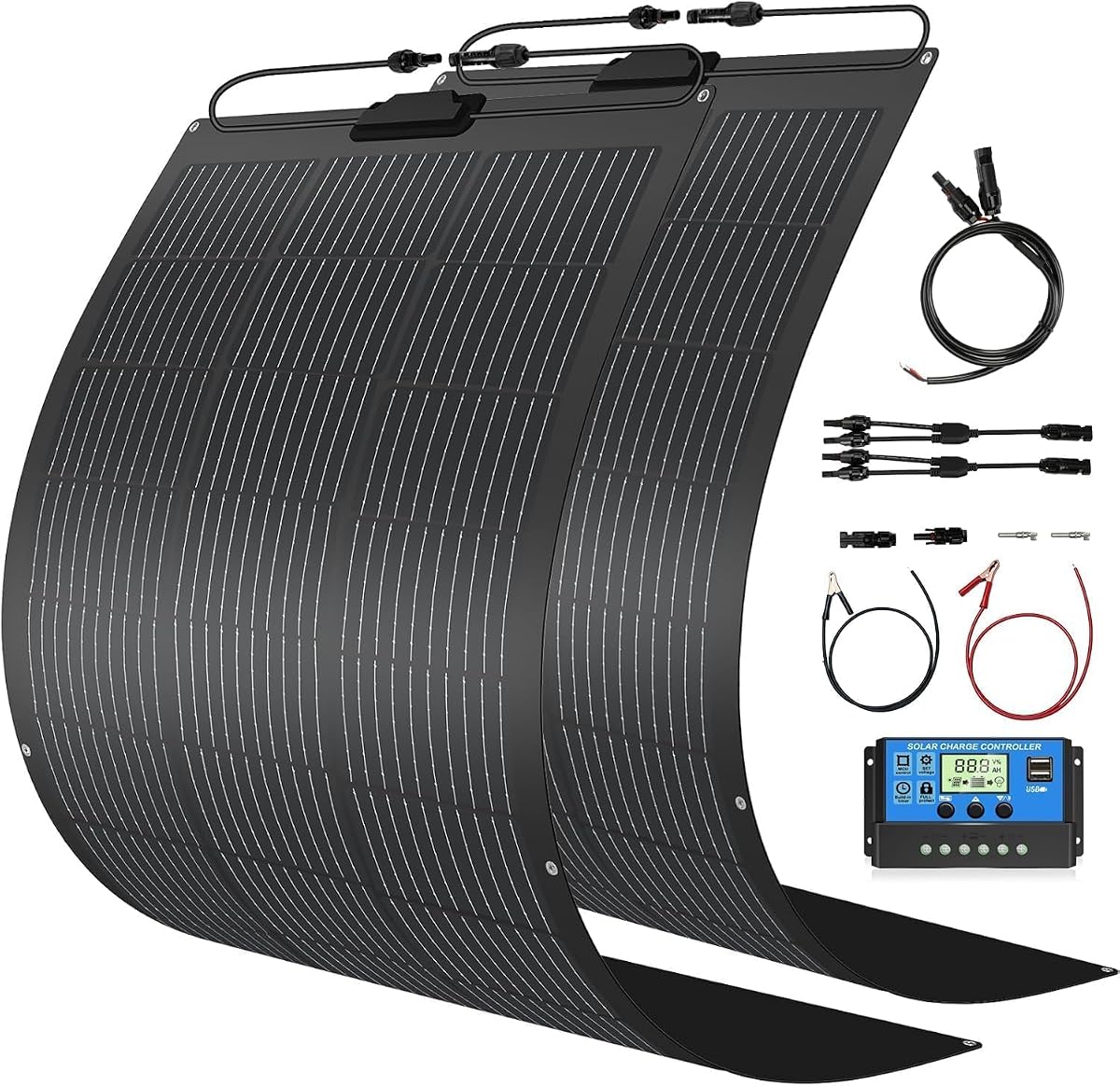
This kit combines two 400W flexible monocrystalline panels with a 40A solar charge controller. It targets camping, off-grid battery charging, boats, RVs, trailers, and other locations where a rigid panel might not conform to the available surface.
We may earn a commission when you buy through this link, at no additional cost to you.
The flexible construction is intended for curved or irregular applications such as boat decks, truck roofs, car roofs, coaches, cabins, tents, trailers, and golf carts. A sealed, waterproof junction box supports outdoor use, while six grommet holes allow attachment with fasteners, silicone, or adhesive tape.
No customer rating is supplied, so there is no visible user-feedback score to support the decision. The controller's precise electrical compatibility is also not detailed in the provided information. Buyers should confirm panel voltage, open-circuit specifications, battery voltage, and controller limits before connecting the components.
This kit is a practical candidate for mobile users who want a more complete package than a panel-only flexible set. It is less suitable for buyers who require detailed technical ratings, rigid mounting strength, or an established customer-rating history.
Flexible modules can follow a boat hull curve, camper roof, or another irregular surface more closely than a rigid framed panel. This can improve the available mounting area and reduce the need for custom brackets.
Six grommet holes provide options for mechanical fasteners, silicone, or adhesive tape. The attachment system must be suitable for the surface and wind conditions because the thin flexible format has different load characteristics than a framed panel.
We may earn a commission when you buy through this link, at no additional cost to you.
This flexible 800W kit offers two 400W monocrystalline panels and a 40A solar charge controller in one package. Like the preceding flexible set, it is aimed at camping, battery charging, marine use, and off-grid locations that can benefit from a thin, conformable panel.
We may earn a commission when you buy through this link, at no additional cost to you.
The junction box is sealed and the panels are described as water resistant and more durable than traditional glass-and-aluminum modules in this application. Six mounting grommets allow the installer to use fasteners, silicone, or adhesive tape, adding flexibility when conventional brackets are impractical.
There is no customer rating supplied for this product, which makes direct comparison with well-reviewed options more difficult. The provided information also gives fewer detailed electrical specifications than the strongest rigid-panel listings. Buyers should therefore confirm the exact voltage, current, and charge-controller requirements before installation.
This kit is best considered when a ready-made panel-and-controller package and flexible mounting are the main priorities. It may be suitable for a mobile setup, but buyers seeking extensive environmental ratings, long warranty information, or established customer feedback should examine other options closely.
Bundling the flexible panels with a controller reduces the need to source core charging components separately. It is a convenient starting point for mobile projects, provided the included controller is electrically compatible with the chosen battery system.
The six grommets support several attachment approaches, allowing the installer to adapt the panels to a boat, RV, trailer, tent, vehicle, or irregular surface. The chosen sealant or fastener should be rated for the installation environment.
We may earn a commission when you buy through this link, at no additional cost to you.
The EPOCH set is the highest-capacity option in the guide, combining two 430W panels for 860W and earning a 4.5 customer rating. It uses grade A+ monocrystalline cells, 16BB half-cut cell construction, bypass diodes, and a stated conversion efficiency of up to 25%.
We may earn a commission when you buy through this link, at no additional cost to you.
Both sides of the panels can capture light, allowing reflected energy to contribute to production. The product information cites transparency of up to 91.5%, while the rugged design handles snow loads up to 5400Pa and wind loads up to 2400Pa. Its IP68 junction box and IP67 MC4 connectors provide environmental sealing.
Each panel receives 100% electroluminescence testing for microcracks, and the manufacturer provides a 12-year quality warranty and a 25-year linear power-output warranty. The panels also support common ground mounts, Z-brackets, corner brackets, pole mounts, and tilt mounts, with pre-drilled holes for mounting.
This is a compelling fixed-installation recommendation for users who want more nameplate capacity than the other 800W sets and can provide a reflective rear environment. The additional capacity does not guarantee additional real-world output unless mounting, orientation, shading, and temperature conditions are favorable.
At 430W per panel, the pair provides 30W more rated capacity than a standard two-by-400W arrangement. That makes it attractive when maximum panel output is a priority and the roof or ground area can support the mounting arrangement.
The stated electroluminescence testing checks for subtle microcracks before the panel leaves the manufacturer, and the warranty combines quality coverage with long-term linear output protection. Buyers should retain the serial information and follow the manufacturer's installation requirements.
We may earn a commission when you buy through this link, at no additional cost to you.
Choosing an 800W solar panel set requires matching power output to the installation site, battery architecture, mounting method, controller, inverter, and expected travel or maintenance needs.
The correct voltage configuration is more important than the headline wattage. A 31V or 39V panel set may suit a 24V battery bank or a suitable power station, but it cannot automatically be connected to a 12V battery. A properly selected charge controller is essential for regulating power and preventing unsafe battery charging.
For a 12V system, the DOKIO listings specifically recommend parallel wiring first because it keeps the operating voltage within the expected range. Series wiring should only be used with a controller that supports the higher input voltage. Verify open-circuit voltage, current, and controller limits before connecting any panels.
Rigid glass-and-aluminum panels generally suit permanent rooftop, ground-mount, RV, and marine brackets, while flexible panels can conform to curved surfaces and reduce mounting weight. N-Type monocrystalline cells and half-cut designs are emphasized in several of the leading products, with claimed efficiency reaching up to 25% under favorable conditions.
Choose construction based on the surface and service requirements rather than efficiency alone. A rigid panel is easier to mount on conventional brackets, while a flexible panel may be the only practical option for a curved roof. Actual output varies with sunlight, temperature, orientation, and shading.
Bifacial panels collect sunlight from the front and can also generate from light reflected onto the rear. The Renogy and EPOCH sets use this approach, which may be beneficial over pale roofs, concrete, sand, gravel, or snow. The additional contribution is site-dependent and should not be treated as guaranteed production.
Partial shade is a separate issue. The Renogy set uses two independently operating power zones, allowing one section to continue producing if another is obstructed. For any array, mounting away from chimneys, vents, trees, and other obstructions remains the most reliable way to limit shade losses.
An 800W panel set can produce enough current to exceed the limits of an undersized controller or inverter. The controller should support the panel configuration's voltage and current, as well as the connected battery chemistry. The listed 30A and 40A kits include controllers, while panel-only options require separate purchases.
Also consider whether the inverter is included. One listing bundles a controller and inverter for a 12V system, whereas most products provide only panels and wiring. Confirm battery voltage, load requirements, connector type, and the inverter's continuous and surge capacity before completing an off-grid system.
Portable users benefit from foldable panels, integrated kickstands, and a manageable packed weight. The portable set provides four angle settings and weighs 20 pounds for the two-panel package. Permanent installations are better served by rigid panels with pre-drilled holes and standard bracket compatibility.
Flexible panels occupy a middle ground. They are thin, light, and useful on curved RV, trailer, and boat surfaces, but their attachment method must withstand travel and wind. The grommet kits permit fasteners, silicone, or adhesive tape, whereas the ETFE RV set is designed for installation without drilling.
Environmental claims should be matched to the location. Several products use sealed junction boxes, IP-rated connectors, corrosion-resistant frames, or waterproof flexible surfaces. The N-Type 16BB set lists a 2400Pa wind load and 5400Pa snow load, while the EPOCH set also cites 5400Pa snow-load tolerance and 2400Pa negative wind load.
A waterproof rating does not eliminate the need for sensible mounting, secure connectors, and routine inspection. Salt spray, accumulated debris, UV exposure, and repeated physical contact can affect any outdoor system. Marine installations should pay particular attention to corrosion resistance and sealed cable entries.
Cable planning affects both installation convenience and electrical quality. The DOKIO sets provide approximately three-meter MC4 leads, while the N-Type 16BB set lists roughly 3.6-foot cables. Longer leads can reduce the need for extensions, but cables should be sized for the actual voltage drop and run distance.
Using fewer large panels also reduces the number of branch connectors compared with an eight-by-100W layout. That can make the array visually cleaner and limit potential connection points. All connectors must remain fully seated and protected from moisture and direct strain.
Customer ratings provide useful context, but they are only one part of a purchase decision. The EPOCH set lists a 4.5 rating with a 12-year quality warranty and 25-year linear output warranty, while the flexible RV set has a 5.0 rating and two-year materials coverage with a stated 25-year output claim.
Review the specific warranty terms, coverage exclusions, installation requirements, and the availability of replacement parts. Products without a supplied rating can still be technically suitable, but they offer less visible evidence about long-term customer experiences. Compare documentation and system compatibility as carefully as the panel headline.
Before installation, identify the battery voltage, controller limits, inverter requirements, panel voltage, and total current. Plan the series or parallel arrangement on paper, then verify the final operating and open-circuit voltage. For 12V banks, parallel-first guidance is appropriate unless the controller explicitly supports a different arrangement.
Mount the panels using brackets, fasteners, straps, silicone, or adhesive appropriate to the construction and surface. Rigid panels need secure, even support, while flexible panels require continuous contact and carefully prepared bonding areas. Connect MC4 leads with the power source isolated, and follow the controller manufacturer's connection sequence.
For ongoing care, clean the surface with a soft cloth and nonabrasive cleaner, keep connectors dry, and inspect mounting points for looseness, corrosion, cracks, or cable strain. Check the controller and battery condition periodically. Portable panels should be folded only when dry and stored away from sharp objects that could puncture the solar cells.
An 800W solar panel should not be connected directly to a battery without appropriate charge control. The controller must match the panel voltage, array current, battery voltage, and battery chemistry. A 12V or 24V battery bank normally requires a controller designed for that bank voltage, while a 31V or 39V panel configuration may suit a higher-voltage power station or properly arranged 24V system.
Two high-output panels can reach the same rated capacity with fewer modules, branch connectors, and physical mounting points. That may simplify cable routing and reduce potential connection issues. The trade-off is that each panel is heavier, requires adequate support, and may be harder to position for partial shade, so the installation surface must be suitable.
Bifacial panels can collect light on the front and use reflected light on the rear. The extra contribution is generally strongest over light-colored roofs, concrete, sand, gravel, or snow. It still depends on mounting height, tilt, reflectivity, and surrounding obstructions, so buyers should not assume a fixed production increase in every environment.
Flexible panels can be a good option for RV roofs because they are thin, light, and able to conform to curved surfaces. They may reduce roof load and eliminate drilling when properly bonded. Installation quality remains critical because the adhesive or sealant must hold under heat, vibration, weather, and wind, and flexible panels generally need more careful surface preparation.
The correct controller depends on panel configuration, battery-bank voltage, and expected current rather than only the 800W headline. Two 400W panels can exceed the current rating of an undersized controller, especially in strong sunlight. MPPT is recommended in several listings, but its input voltage and current ratings must exceed the array's operating values.
It depends on the power station's input voltage, current limit, connector type, and internal charge controller. A 39V folding set may suit a high-voltage input, while a 31V rigid set may require a different arrangement. Never connect a panel to a power station until the voltage range and maximum input current have been confirmed in its documentation.
The power difference is not determined by flexibility alone. Cell efficiency, irradiance, temperature, orientation, shading, and system losses all affect output. Flexible panels can be especially practical where rigid panels cannot be mounted, so the best choice depends on whether surface fit and weight are more important than maximizing output from a fixed open area.
Clean the panel faces with a soft cloth and a nonabrasive cleaner, especially after dust, salt, bird droppings, or sap accumulate. Inspect brackets, adhesive bonds, cable insulation, and MC4 connectors, and ensure the controller and battery remain in proper operating condition. Always isolate the panel or switch off the controller before making wiring changes.
The EPOCH 860W bifacial set leads for users seeking the highest listed capacity, durable mounting provisions, extensive testing, and long warranty coverage. The Renogy N-Type set is another premium option with bifacial cells and two independently operating sections, while the flexible ETFE RV set stands out for its 5.0 rating, low weight, and curved-surface installation.
For portable power, the foldable 39V set provides adjustable positioning and a familiar travel-oriented format. For fixed systems, choose between fewer large rigid panels, flexible modules, bifacial construction, and packages with a controller based on the battery voltage, mounting surface, shade pattern, and electrical equipment. Correct system matching matters more than the 800W label alone.
Before purchasing, verify the latest package contents, electrical specifications, controller compatibility, warranty terms, and available configuration. Product listings and availability can change, so reviewing the current seller information helps ensure that the selected 800W solar panel set still fits the intended RV, marine, off-grid, portable, or residential installation.