JadeAudio/FiiO JM21
4.0Editor score
Android 13 streaming flexibility
Dual CS43198 DAC chips
Balanced 700mW output
Compact 156g design
Discover the 10 best Android DAP options, comparing audio hardware, streaming, storage, outputs, battery life, portability, and everyday usability for
An Android DAP combines the focused experience of a dedicated portable music player with the flexibility of a smartphone. A strong model should deliver reliable wired headphone output, convenient streaming, broad file support, practical battery life, and controls that remain comfortable on the move. The right choice depends heavily on your headphones and listening habits.
We compared all ten featured players across DAC and amplifier design, operating system, supported apps, wireless codecs, storage, outputs, portability, display, and power-related features. The list includes compact Android 12 models, slim Android 13 players, more powerful desktop-capable devices, and a Sony Walkman designed around high-resolution local playback.
Each review identifies the hardware that stands out, the compromises worth considering, and the listener most likely to benefit. Product details and availability can change, so verify the current specifications and listing before buying. The selections reveal useful choices for different priorities, from streaming convenience and balanced output to powerful amplification and broad wired connectivity.
4.0Editor score

4.0Editor score

4.0Editor score
The table below places every featured Android DAP side by side, focusing on the processor and OS, DAC configuration, wired outputs, and major connectivity features that most affect daily use.


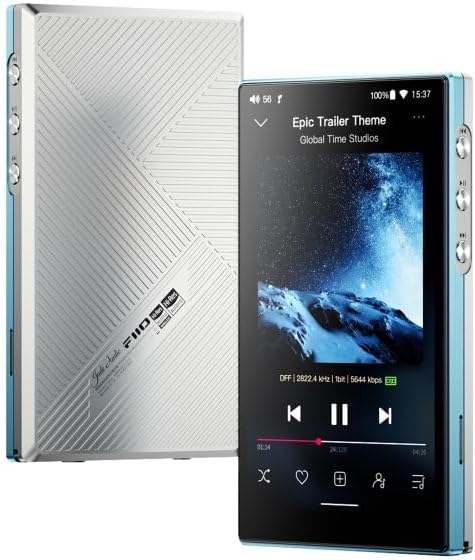
The JadeAudio/FiiO JM21 in black combines a dedicated hi-fi architecture with the flexibility of a customized Android 13 system. It carries a 4.0 rating, and its most compelling qualities are the pair of Cirrus Logic CS43198 DACs, fully balanced output stage, and useful power for larger headphones. At only 156g and 13mm thick, it also stands out as one of the more travel-friendly players in this group.
We may earn a commission when you buy through this link, at no additional cost to you.
Its Qualcomm Snapdragon 680 uses a 6nm process and an eight-core Kryo 265 design clocked up to 2.4GHz. The customized Android system supports installation of services such as Spotify and Apple Music, while the DAPS digital audio purification system works with a fifth-generation FPGA and dual femtosecond crystal oscillators. The result is a player intended to preserve source quality across local files, third-party apps, and USB DAC output rather than treating Android playback as an afterthought.
The dual-DAC design is paired with SGM8262 operational amplifiers, and the balanced output reaches up to 700mW plus 700mW. That is meaningful capability for a compact device and makes it better suited to demanding over-ear headphones than many basic portable players. The trade-offs are equally clear: the base configuration offers 3GB of RAM and 32GB of storage, and it lacks the FiiO M21's dedicated desktop mode and larger four-DAC matrix.
This is a strong recommendation for a listener who wants balanced output, familiar streaming apps, and a compact body without stepping up to a larger desktop-oriented model. Sensitive in-ear monitors, portable use, and moderately demanding headphones should all sit comfortably within its intended range. If maximum internal storage or desktop-style operation is essential, the 4GB+64GB JM21 or FiiO M21 may be more appropriate.
The JM21's fully balanced architecture and 700mW-plus-700mW capability give it enough output for larger headphones without requiring a bulky desktop-style chassis. Its 13mm profile and 156g weight also make it easier to carry than many high-power Android players.
The customized Android 13 platform permits familiar streaming applications, while DAPS is designed to retain the original sampling rate during compatible third-party app playback. USB DAC use adds another route for listeners who already own a separate DAC.
We may earn a commission when you buy through this link, at no additional cost to you.
The sky-blue JadeAudio/FiiO JM21 offers the same core hardware proposition as the black version, including a 4.0 rating, dual CS43198 DACs, and a balanced amplification section capable of up to 700mW plus 700mW. It is a particularly appealing option for listeners who want serious portable audio hardware in a conspicuous, contemporary color rather than the restrained look associated with many professional DAPs.
We may earn a commission when you buy through this link, at no additional cost to you.
The Snapdragon 680 is built on a 6nm process and provides an eight-core Kryo 265 layout with speeds reaching 2.4GHz. A customized Android 13 operating system adds access to streaming services and media applications, while the DAPS system, fifth-generation FPGA, and custom dual femtosecond oscillators focus on maintaining source sampling rates. The player can also serve as a USB DAC, extending its usefulness beyond direct headphone listening.
Its main limitation is storage. The 3GB RAM and 32GB internal memory configuration is adequate for a curated local collection and downloaded content, but it leaves less room for large lossless libraries or extensive offline streaming archives. The absence of a desktop mode also means it is less obviously designed to serve as a permanently connected source for a full-size headphone setup.
Choose this JM21 if color, portability, balanced power, and streaming convenience are your priorities. It is well suited to commuting, travel, and daily use with in-ear monitors or headphones whose requirements fall within the stated output capability. Listeners needing more internal capacity should consider the 4GB+64GB JM21, while those prioritizing maximum desktop flexibility should look toward the FiiO M21.
The sky-blue finish gives the JM21 a more expressive identity while the hardware remains focused on high-resolution playback. Dual flagship DACs and a balanced output stage make the design more than a cosmetic alternative to conventional compact Android devices.
A 13mm thickness, 156g weight, and stated 12.5-hour playback figure suit mobile listening. Bluetooth and WiFi support also make it convenient when moving between wired hi-fi listening and everyday wireless use.
We may earn a commission when you buy through this link, at no additional cost to you.
The HiBy R4 earns a 4.1 rating and differentiates itself with a deliberately elaborate four-way audio architecture. It uses four DAC chips, two dedicated low-phase-noise crystals, 28 high-precision tantalum capacitors, and an integrated Class A headphone amplifier. For a listener who wants visible hardware sophistication and broad file support, the R4 makes a strong case even without moving to the more powerful R6III 2025.
We may earn a commission when you buy through this link, at no additional cost to you.
Its SD665 octa-core processor and Android 12 operating system support streaming services such as Spotify, Pandora, and Tidal, along with MP4 content from services including YouTube and Twitter. System-wide SRC bypass is designed to preserve original audio quality, and the hardware supports DSD256 native, PCM768kHz/32-bit, and MQA 16X unfolding. Separate PCM and DSD circuitry allows the DACs, filters, and power supplies to operate independently for the two formats.
Connectivity is another strength. Bluetooth 5.0 supports UAT, LDAC, aptX, aptX HD, AAC, and SBC, while dual-band WiFi supports app downloading. DLNA, AirPlay, and WiFi song transfer broaden its network role. For physical listening, it includes both 3.5mm single-ended and 4.4mm balanced outputs, plus physical function keys for tasks such as locking controls and rotating the screen.
The R4 is best for users who value codec breadth, expandable storage, a sizable 4.7-inch LCD, and separate wired output choices. Its 4500mAh battery and media capabilities make it a well-rounded portable system. The compromises are the older Android 12 platform and a larger, more feature-dense footprint than the slim JM21, but those are reasonable trade-offs for this level of functionality.
The R4's independently operating PCM and DSD circuitry allows its filters and power supplies to adapt to each format. Support for DSD256 native, PCM768kHz/32-bit, and MQA 16X unfolding makes it suitable for listeners with large high-resolution libraries.
Dual-band WiFi, Bluetooth 5.0, LDAC, aptX HD, DLNA, AirPlay, and WiFi transfer cover an unusually broad set of listening routes. Its 4.7-inch display and physical function keys also suit browsing larger libraries away from a desktop.
We may earn a commission when you buy through this link, at no additional cost to you.
The HiBy R6III 2025 represents the most technically expansive premium selection here. It has a 4.0 rating, four Cirrus Logic CS43198 flagship DACs, and an eight-channel monoblock output architecture. The inclusion of both Class A and Class AB headphone amplifiers gives it flexibility for large headphones and high-impedance in-ear monitors while retaining the character associated with those amplifier types.
We may earn a commission when you buy through this link, at no additional cost to you.
Playback specifications extend to DSD512 native, PCM768kHz, and MQA 16X. Its Qualcomm Snapdragon 665 is paired with Android 12, 4GB of RAM, 64GB of internal storage, and expansion up to 2TB. The operating system permits downloading and installing third-party applications, which makes the R6III 2025 useful for both local libraries and streaming services.
Wired connectivity is unusually comprehensive. There are dedicated 3.5mm and 4.4mm headphone outputs, line outputs, USB digital audio input and output, coaxial digital output, and analog line output. This makes the device easier to integrate into a home system even when wireless playback is not the main goal. Bluetooth 5.0 includes LDAC, aptX, aptX HD, SBC, and AAC, while dual-band WiFi is specified at rates up to 433Mbps.
This premium player is recommended for audiophiles who want the strongest analog hardware and digital connectivity in the guide. It is particularly compelling when using demanding full-size headphones, high-impedance IEMs, or an external system that can benefit from digital input and multiple output options. The Android 12 version and substantial feature set add complexity, but they do not undermine its core appeal to a high-end listener.
Class A and Class AB amplification can serve different preferences and headphone demands. The stated robust driving capability is especially relevant for large over-ear models, while high-impedance IEM users also have a useful amplifier platform available.
USB digital input and output, coaxial digital output, analog line output, and dedicated headphone connections create more ways to integrate the player. It can function as a local source, a streamer, and a digital component rather than remaining an isolated portable device.
We may earn a commission when you buy through this link, at no additional cost to you.
This alternate HiBy R4 listing presents the same 4.1-rated feature set in a distinct product entry. Its core appeal lies in four DAC chips, two low-phase-noise crystals, 28 high-precision tantalum capacitors, and an integrated Class A headphone amplifier. That hardware supports a listener who wants a portable device with high-resolution capability, balanced connectivity, and more storage flexibility than a basic Android player.
We may earn a commission when you buy through this link, at no additional cost to you.
The SD665 octa-core processor runs Android 12 with system-wide SRC bypass designed to maintain original audio quality. Streaming applications including Spotify, Pandora, and Tidal are supported, as are media uses through YouTube and Twitter. For local files, the player reaches DSD256 native, PCM768kHz/32-bit, and MQA 16X unfolding. Its separate PCM and DSD circuitry uses independent DAC, low-pass filter, and power supply paths.
The R4 includes a 4.7-inch LCD and a 4500mAh battery. Bluetooth 5.0 supports UAT, LDAC, aptX, aptX HD, AAC, and SBC, while 2.4GHz and 5GHz WiFi enables downloads, streaming, DLNA, AirPlay, and WiFi song transfer. Both 3.5mm single-ended and 4.4mm balanced headphone connections are present, and the physical FN keys provide quick access to functions such as key lock and screen rotation.
Listeners comparing listings should verify which color or presentation they prefer, but the underlying R4 specifications are the deciding factor. It is a good all-around pick for local high-resolution playback, streaming, and wireless flexibility. Those seeking a more premium Android 13 experience with higher output can consider the FiiO M21, while the most compact option remains the JM21.
The R4 combines 32GB of internal storage with expansion up to 2TB. That flexibility is valuable for listeners maintaining lossless collections, downloading media for travel, or keeping multiple streaming libraries available offline.
Support for Spotify, Pandora, Tidal, DLNA, AirPlay, and WiFi transfer gives the player several paths to familiar music. Bluetooth codec support extends that flexibility to compatible headphones and speakers.
We may earn a commission when you buy through this link, at no additional cost to you.
The Sony NW-A306 is the most traditionally focused Walkman in this collection. It carries a 3.6 rating, the lowest among the ten featured models, but it remains a refined option for listeners who prioritize Sony's portable engineering, local high-resolution music, compact construction, and long battery life over a broad open-Android feature set.
We may earn a commission when you buy through this link, at no additional cost to you.
Sony builds the device around a rigid aluminum frame with gold solder in a precisely engineered chassis. Its NW-A300-series high-quality PCM conversion supports the company's approach to digital processing, while DSD formats up to 11.2MHz broaden local hi-res compatibility. The player also supports 360 Reality Audio, giving compatible listeners access to Sony's spatial audio content within the device's ecosystem.
Battery life is a major attraction, with up to 36 hours of 44.1kHz FLAC playback stated. The lightweight chassis is designed for pockets, and connecting to a PC provides access to a personal music collection. WiFi compatibility allows direct downloads and streaming, while Android support adds a more familiar software foundation than a closed-purpose media player would provide.
The NW-A306 makes sense for listeners who want a portable music experience centered on high-resolution local files and Sony's established tuning and construction. It is less compelling for someone seeking unrestricted app installation, extensive digital outputs, or a heavily specified multi-DAC architecture. Its 32GB capacity also requires thoughtful file management for larger collections. Within that focused use case, it remains a credible specialist choice.
The NW-A306 emphasizes PCM conversion and DSD support up to 11.2MHz, with PC access for managing a personal collection. This makes it most compelling for listeners who regularly use high-resolution files rather than relying entirely on streaming.
A rigid aluminum frame, gold solder, lightweight construction, and stated FLAC battery life show the emphasis on durable daily portability. The form is intended to fit comfortably in a pocket and operate away from a charging cable.
We may earn a commission when you buy through this link, at no additional cost to you.
The FiiO M21 combines the portability of an Android music player with enough output capability to function as a serious desktop source. Its 4.0 rating is supported by four CS43198 DAC chips, a fully balanced four-channel and eight-path design, and a two-stage headphone amplifier. The standout feature is Desktop Mode, which allows the player to operate on external power without the internal battery charging or discharging.
We may earn a commission when you buy through this link, at no additional cost to you.
The Qualcomm Snapdragon 680 is manufactured on a 6nm process and paired with Android 13, 4GB of RAM, and 64GB of storage. Its quad-DAC matrix supports hi-res audio and DSD, while the fully differential output architecture emphasizes dynamic range and noise immunity. Splitting the amplifier into voltage-amplification and current-boosting stages allows the design to drive a broad range of headphones more effectively than a simple integrated stage.
Output flexibility is extensive. Dual 3.5mm and 4.4mm headphone or line outputs have independent line-amplification circuitry, and the player also supports SPDIF and USB Audio output. The stated SPDIF performance is designed to reduce jitter by 70%, making the M21 useful as a digital transport as well as a conventional wired player. Its stated 950mW high-power output further separates it from compact alternatives.
This is the best all-round recommendation for a listener who wants a current Android platform, premium DAC hardware, strong balanced amplification, and desktop versatility in one device. It is especially appropriate for difficult headphones or users who want to connect the player to an existing system. The trade-off is bulk and complexity, but the feature set makes the M21 especially compelling for listeners who want more than a pocket companion.
When Desktop Mode is active, the M21 runs on external power while leaving the built-in battery neither charging nor discharging. This reduces battery cycling for stationary use and allows the player to act as a more permanent source for a home system.
Four CS43198 chips feed a four-channel, eight-path fully differential design. Combined with separate voltage and current amplification stages, the architecture is intended to improve dynamic range, noise immunity, and compatibility with demanding headphones.
We may earn a commission when you buy through this link, at no additional cost to you.
The Surfans F20 Pro combines a 4.1 rating with dual ESS9018K2M DAC chips, DSD512 support, and a 500mW balanced output. Those specifications make it a noteworthy high-resolution Android DAP, particularly for listeners who want flexible storage, streaming applications, and enough balanced power for larger headphones without moving to the premium tier.
We may earn a commission when you buy through this link, at no additional cost to you.
Its octa-core Android 12 platform is equipped with 3GB of RAM and 32GB of internal storage. Software downloads and upgrades are supported, allowing access to Spotify, Apple Music, Tidal, and YouTube. Audio is handled by dual ESS9018K2M converters and dual OPA1612 operational amplifiers. The listed distortion figure of 0.0008% is paired with low-phase-noise oscillators in a design intended to preserve detail and dynamic range.
The F20 Pro supports DSD512 and 192kHz/24-bit playback. Its 3.5mm single-ended output is specified at 125mW into 32 ohms, while the 4.4mm balanced output reaches 500mW into 32 ohms. Bluetooth 5.0 with LDAC and dual-band WiFi support wireless use, and the aluminum CNC body houses a 2.7-inch touchscreen and tactile ALPS volume wheel.
This is a compelling recommendation for a budget-conscious listener who prioritizes the DAC specification, balanced output, and storage expansion. The included 32GB card and support for up to 1TB via microSD make library management flexible. The smaller touchscreen may feel less spacious than the HiBy R4's 4.7-inch LCD, but the F20 Pro prioritizes portable high-resolution playback and tactile adjustment.
DSD512 and 192kHz/24-bit support provide ample format headroom, while dual ESS9018K2M DACs and OPA1612 amplifiers form the core of the signal path. The 500mW balanced output is especially relevant for headphones that need more current than a basic phone output can supply.
Built-in 32GB storage, an included 32GB card, and microSD expansion up to 1TB accommodate both curated albums and large offline libraries. Android app support allows the same device to handle Spotify, Tidal, Apple Music, and video content.
We may earn a commission when you buy through this link, at no additional cost to you.
The 4GB+64GB JadeAudio/FiiO JM21 has a 4.3 rating, the highest in this guide, and improves on the basic 3GB+32GB JM21 configurations by adding memory and internal storage. It retains the same Snapdragon 680, Android 13, dual CS43198 DACs, and balanced 700mW-plus-700mW output, making it an appealing balance of portability, capability, and practical capacity.
We may earn a commission when you buy through this link, at no additional cost to you.
The processor uses a 6nm process and an eight-core Kryo 265 architecture with clock speeds up to 2.4GHz. A deeply customized Android 13 system supports installation of streaming applications such as Spotify and Apple Music. DAPS, a fifth-generation FPGA, and custom dual femtosecond crystal oscillators work together to preserve original sampling rates during compatible local files, third-party app playback, and external USB DAC use.
The dual DACs feed SGM8262 operational amplifiers within a fully balanced architecture. This allows the JM21 to offer 700mW plus 700mW of balanced power, useful for larger over-ear models while retaining a compact body. At 13mm thick and 156g, it is easy to carry, and the stated 12.5-hour battery life supports extended mobile listening.
This JM21 is best recommended to listeners who love the compact JM21 format but want additional storage for downloaded tracks and albums. It is particularly useful for anyone balancing streaming libraries with local hi-res files while still traveling light. It lacks the M21's desktop mode and quad-DAC matrix, but for portable Android listening, its memory configuration is a meaningful upgrade.
The move from 32GB to 64GB gives the JM21 more internal space for downloaded music, cached streaming content, and local lossless files. The 4GB of RAM also complements the Snapdragon 680 when running Android applications.
Despite its compact 156g body, the balanced section reaches up to 700mW plus 700mW. That makes it practical for more demanding headphones without giving up the thin, travel-friendly form.
We may earn a commission when you buy through this link, at no additional cost to you.
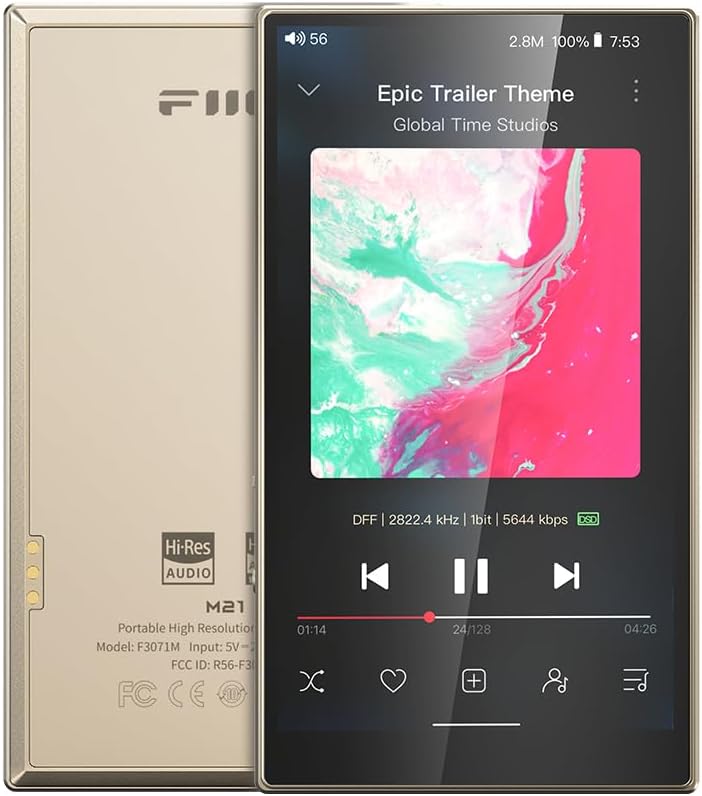
The titanium-gold FiiO M21 is the same core platform as the blue-black edition, with a 4.0 rating, Snapdragon 680 processor, Android 13 software, and four CS43198 DACs. Its distinguishing feature is the finish, which gives buyers a more formal appearance for a DAP likely to be seen outside the home as well as used near a desktop system.
We may earn a commission when you buy through this link, at no additional cost to you.
The four DACs are arranged in a fully balanced four-channel, eight-path matrix with a two-stage headphone amplifier. The first stage handles voltage amplification and the second boosts current, a design intended to improve dynamic range and noise immunity while supporting a wider variety of headphones. Desktop Mode provides up to 950mW of high-power output while operating on external power without charging or discharging the internal battery.
The M21 provides both 3.5mm and 4.4mm headphone or line outputs, each with independent line amplification circuitry. SPDIF and USB Audio output broaden its digital transport role, with the stated SPDIF implementation reducing jitter by 70%. Android 13, 4GB of RAM, and 64GB of storage allow streaming applications and local media to coexist comfortably.
Choose the titanium-gold version for listeners who want the M21's high-power, desktop-capable performance in a polished finish. It is particularly appealing for demanding headphones, high-impedance IEMs, and users who will connect the player to a larger system. The titanium-gold styling is subjective, of course, and the hardware itself is more important. Compared with the slim JM21, the M21 offers more power, more DACs, and more ports in a less compact package.
The titanium-gold finish gives the M21 a premium appearance that complements its desktop-oriented capabilities. Beneath the styling, the quad-DAC and two-stage amplifier architecture provides the technical substance expected from a serious Android hi-fi player.
USB Audio and SPDIF output let the M21 feed compatible external hardware, while the 3.5mm and 4.4mm outputs handle conventional listening. Desktop Mode further supports extended stationary use without unnecessary battery cycling.
We may earn a commission when you buy through this link, at no additional cost to you.
The right Android DAP depends on how you listen, which headphones you use, and how much you value portability versus desktop capability. Processor speed alone does not determine sound quality, so the most important checks are DAC performance, amplifier power, output configuration, app compatibility, storage, and battery behavior.
A DAP's digital-to-analog converters determine how source files are decoded, while the surrounding clocking and filtering design affects signal discipline. Look at the number and model of DACs, supported PCM and DSD formats, and whether the player uses separate PCM and DSD pathways. The HiBy R4 supports DSD256 native and PCM768kHz/32-bit, while the R6III 2025 reaches DSD512 native and PCM768kHz. The JM21 and M21 use CS43198 devices, with the M21 taking a four-chip matrix approach. More chips are not automatically better, but a more elaborate architecture can provide the headroom needed for demanding source material.
DAC resolution cannot create the voltage or current required by every pair of headphones. Balanced high-impedance in-ear monitors may need voltage headroom, while large over-ear headphones often benefit from substantial current capability. The JM21's balanced output is stated at up to 700mW plus 700mW, the Surfans F20 Pro reaches 500mW into 32 ohms on its 4.4mm output, and the FiiO M21 offers up to 950mW in Desktop Mode. These numbers are not direct guarantees of subjective quality, but they help identify whether a player has meaningful power for difficult loads.
A modern DAP may function as more than a headphone player. The JM21 offers 3.5mm and 4.4mm connections plus USB DAC use, while the M21 adds line outputs and SPDIF. The R6III 2025 goes further with USB digital input and output, coaxial digital output, and analog line output. Bluetooth codecs, WiFi bands, AirPlay, DLNA, and WiFi transfer can also determine whether the device integrates cleanly with speakers, computers, and network music systems. Check every port rather than assuming two headphone sockets indicate equivalent flexibility.
Android support should be judged by both version and implementation. The JM21 and M21 use Android 13, while the HiBy R4, R6III 2025, Surfans F20 Pro, and Sony NW-A306 are described as Android-supported or Android 12 devices. Installation support can be valuable for Spotify, Apple Music, Tidal, YouTube, and other services, but app behavior also depends on available processing power and system resources. Check whether the manufacturer supports firmware updates, app downloads, and the exact streaming services you use. A dedicated local player can be more focused, while a customizable Android platform is generally more versatile.
Storage capacity depends on whether you rely on streaming, downloaded files, local hi-res collections, or some combination. The base JM21 offers 32GB, while the 4GB+64GB JM21 and M21 double internal storage to 64GB. The HiBy R4 supports expansion up to 2TB, the R6III 2025 also supports up to 2TB, and the Surfans F20 Pro supports up to 1TB via microSD and includes a 32GB card. The Sony NW-A306 provides 32GB internal storage. A larger card can hold more music, but it may also reduce the need to carry every file on the player itself.
Battery specifications can differ by format, settings, display use, and wireless activity, so compare real use rather than treating every stated figure as identical. The JM21 lists up to 12.5 hours of playback, while the Sony NW-A306 states up to 36 hours for 44.1kHz FLAC. The FiiO M21's Desktop Mode is notable because external power is used without the internal battery charging or discharging, making it easier to keep the unit at a desk for long sessions. Frequent streaming or high-power amplification can increase consumption, so a long stated runtime is especially useful when paired with efficient settings.
A DAP must be comfortable to carry if it is meant to accompany you. The JM21 is only 13mm thick and weighs 156g, making it exceptionally compact. The Surfans F20 Pro combines a 2.7-inch touchscreen with an ALPS volume wheel and CNC metal body, while the HiBy R4 uses a larger 4.7-inch LCD that helps with browsing but adds bulk. The FiiO M21 and HiBy R6III 2025 prioritize high power and extensive connections, which naturally make them heavier desktop-leaning options. Consider screen size, physical controls, grip, and weight together.
Wireless support matters most if you listen through Bluetooth speakers or compatible headphones. The HiBy R4 supports UAT, LDAC, aptX, aptX HD, AAC, and SBC, plus DLNA, AirPlay, and WiFi transfer. The M21 and JM21 highlight Bluetooth, WiFi, and LDAC support, while the Surfans F20 Pro combines Bluetooth 5.0, LDAC, and dual-band WiFi. High-resolution codecs can reduce compression artifacts, but they also require compatible hardware. It is just as important to verify the WiFi bands and network transfer functions you actually intend to use.
Before adding music, check the manufacturer's quick-start instructions, update the operating system and firmware where applicable, and review the output configuration. Connect headphones or a line-level destination while the volume is low, then confirm whether you want a 3.5mm single-ended connection or a 4.4mm balanced one. Install only the streaming and media applications you need, and sign in before travel. For local playback, copy files into the correct folder structure and avoid interrupting the transfer before the device confirms completion.
Choose output settings that match your source and hardware. Enable high-resolution or bit-perfect playback only when the music service, file format, and output path support it, because forcing an incompatible setting can introduce unnecessary resampling. When using Bluetooth, verify that both devices are using a codec you want and maintain a stable connection. For the M21 or R6III 2025, test the digital outputs and line outputs with the rest of your system, and use Desktop Mode only in a suitably ventilated, stable setup.
Care for the player by keeping the headphone and charging ports clear, using a suitable protective case during travel, and avoiding moisture, excessive heat, and unstable storage. Check firmware notices periodically, particularly after installing major Android updates, and keep some free internal storage available for stable operation. Store removable cards safely when changing devices, back up important music libraries, and clean the screen with a soft dry cloth rather than aggressive solvents. Periodic careful use of the volume control helps preserve comfortable listening levels and protects sensitive headphones.
An Android DAP can be better when priority sound quality, wired headphone power, local high-resolution files, and distraction-free playback matter most. A smartphone is often more convenient for calls, messaging, cameras, and always-connected apps. The right choice depends on how you listen and whether you are willing to carry a dedicated device with its own storage and charging routine.
Many Android DAPs support downloadable streaming applications, including Spotify, Apple Music, or Tidal, depending on the model and system version. Compatibility does not guarantee that every playback setting remains untouched, so users interested in high-resolution streaming should investigate the manufacturer's source-bypass and sampling-rate claims. App availability and behavior can also change with software updates.
A balanced output can be beneficial when your headphones or earphones provide matching balanced cables and the player's implementation suits them. It can offer additional output headroom and lower channel interference compared with a single-ended connection. If your accessories are only 3.5mm, however, a balanced jack will not magically create balanced operation, so cable compatibility comes first.
Power requirements vary with headphone impedance, sensitivity, impedance frequency response, and volume demands. High-impedance in-ear monitors may require voltage headroom, while large low-impedance over-ear headphones often need considerable current. The JM21, F20 Pro, and M21 provide increasingly substantial stated balanced output, making them more versatile for demanding headphones than basic players.
It depends on the formats and library size in your possession. Lossless and high-resolution files consume substantially more space than compressed streaming downloads, and installed apps and the operating system also occupy internal storage. The 64GB JM21 and M21 provide more room than 32GB models, while the R4 and Surfans F20 Pro support removable-card expansion.
They matter if your library contains those formats and you can hear a meaningful benefit in your system. The HiBy R4 supports DSD256 native, the R6III 2025 supports DSD512 native, and the Surfans F20 Pro supports DSD512. The FiiO models also advertise DSD support. Format capability is useful, but DAC quality, filtering, amplifier design, and file quality also deserve attention.
It is not automatically equivalent. Modern codecs such as LDAC can transmit very high-quality audio, but compression, wireless conditions, codec implementation, and the receiving device all affect the result. Wired output from a DAP remains the most direct route for users with compatible headphones and should be preferred when maximum fidelity and predictable channel behavior are priorities.
It can for many portable and near-desktop use cases, particularly if the player offers sufficiently powerful balanced output, line outputs, and digital connections. The FiiO M21 and HiBy R6III 2025 are especially relevant because they include high-power amplification and broader output options. Specialized desktop equipment may still offer superior connectivity, cooling, channel controls, or sustained capability.
The JadeAudio/FiiO JM21 is the most straightforward value choice for portable balanced listening, while the 4GB+64GB version is preferable when storage matters. The FiiO M21 stands out as the best-balanced recommendation because it combines Android 13, a quad-DAC matrix, very strong output, desktop mode, and extensive wired connections. For high-end listeners, the HiBy R6III 2025 adds Class A and Class AB amplification plus an even broader selection of digital and analog outputs.
Prioritize the features that affect your daily system rather than choosing only by processor generation or DAC count. Headphone impedance, balanced-cable availability, streaming-service requirements, local storage, battery life, and intended portability should guide the decision. The HiBy R4 is especially well rounded for media and codec flexibility, the Surfans F20 Pro offers capable balanced hardware with expansion, and the Sony NW-A306 remains a focused choice for local high-resolution listening.
Specifications, app compatibility, firmware behavior, and product availability can change over time, so check the current listing and manufacturer information before purchasing. Comparing the final wired output, controls, and supported apps with your own equipment will produce the most satisfying Android DAP choice.