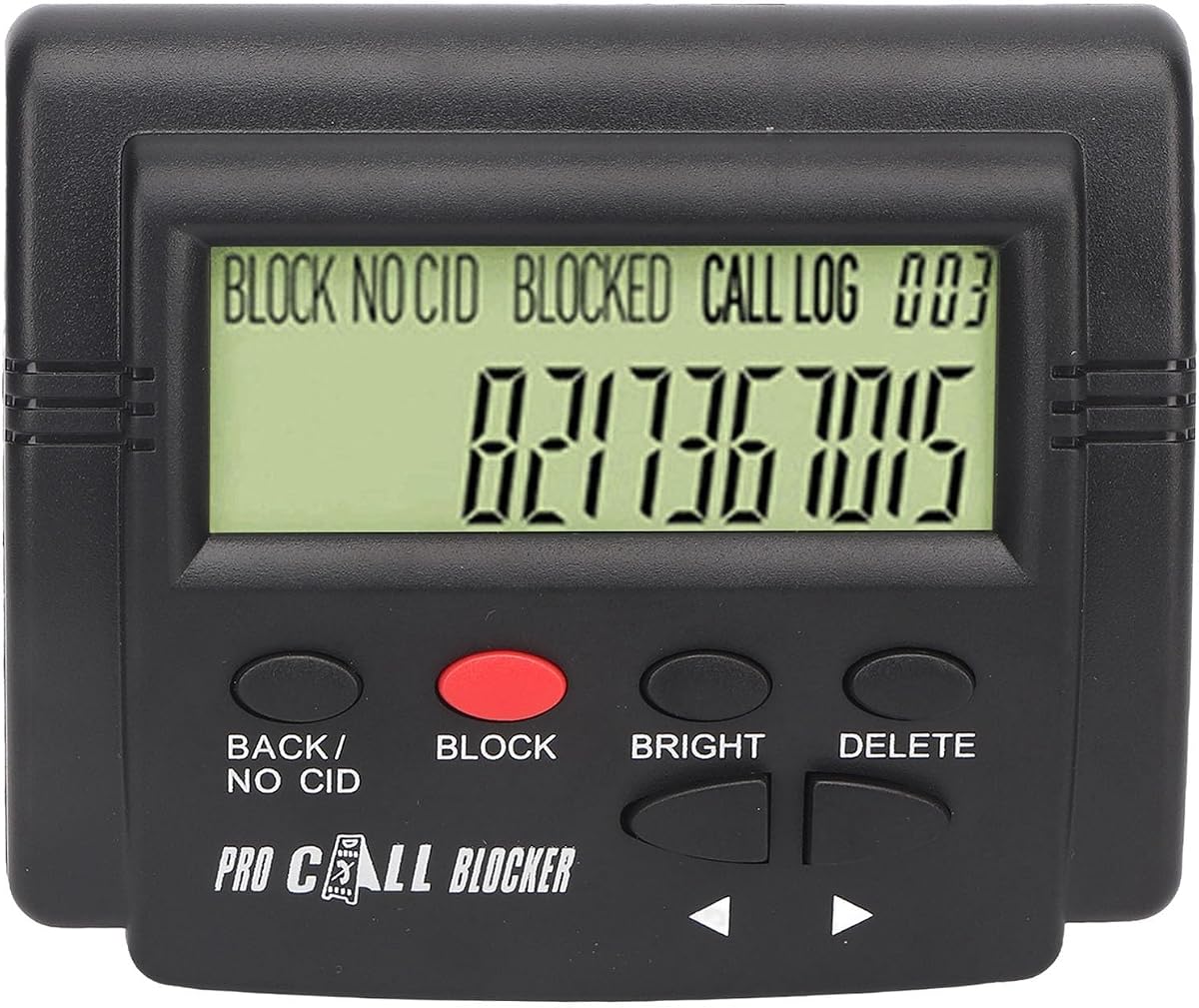
HEITIGN Landline Call Blocker
4.0Editor score
4000-number blacklist capacity
One-touch call blocking
Five-level LCD brightness
Dual-plug installation
Best call blockers for landline phones compared for call filtering, capacity, ease of use, compatibility, and features to find the right option for your home.
Call blockers for landline phones can make a fixed-line home or office far more peaceful by filtering robocalls, telemarketers, spoofed numbers, and other unwanted interruptions. A useful model should work with your telephone service, require little setup, make blocked calls easy to manage, and remain understandable for every household member.
We compared ten products using the information supplied for each one, focusing on blocking methods, blacklist and whitelist capacity, caller information, installation, line compatibility, accessibility, and the degree of manual intervention required. The list includes basic one-touch blockers, database-assisted models, senior-friendly designs, and a more advanced two-line system.
Each review explains the strongest reason to consider a model, along with its important limitations and compatibility considerations. Ratings reflect the supplied customer feedback, while prices and product availability can change, so shoppers should verify the current listing and confirm their telephone service before buying.
4.0Editor score

4.2Editor score

4.2Editor score
The comparison below highlights the key differences among ten call blockers, including database size, manual capacity, filtering modes, display features, line support, and installation requirements. Compatibility deserves special attention because several products are designed specifically for traditional analog landline service.


The CPR V5000 combines an approachable physical design with a substantial starting database. Its supplied 4.2 rating reflects generally favorable customer feedback, while the oversized red block button, clear display, and audible click make the device especially understandable for users who do not want to manage a complicated telephone application.
We may earn a commission when you buy through this link, at no additional cost to you.
Its main advantage is the combination of 5,000 preloaded known nuisance numbers and room for 1,500 manually added entries. That means the unit can provide useful filtering before the owner has built a personal database, while the one-touch control makes it quick to stop a new or spoofed number after it rings. The device needs no app, account, subscription, or mains power, reducing both cost complexity and setup friction.
The important limitation is line compatibility. CPR specifically requires a traditional analog line with Caller ID service, and its compatibility information excludes internet-based and digital services such as Vonage, Ooma, Xfinity Voice, and Quantum Fiber. It is also honest to recognize that no standalone blocker can stop every spam call because fraudulent callers frequently change numbers. The V5000 reduces interruptions and makes repeat offenders easy to suppress, but it cannot guarantee that unwanted calls will never ring.
This is a strong recommendation for a household with analog service that wants substantial preloaded protection and a physical, senior-friendly way to block calls. It is especially appealing to anyone who values simplicity over app-based features. Buyers using a digital or internet-based telephone service should look elsewhere unless they can confirm that the product's compatibility claims apply to their exact setup.
The 5,000-number starting database offers immediate assistance, while the additional 1,500-entry capacity lets users build a personal list of repeat offenders. Combining automatic filtering with fast manual blocking is a balanced approach because it covers both known spam patterns and newly spoofed numbers.
The large red button, clear screen, and loud click reduce the need to memorize menu steps. No app, subscription, or mains power is required, making this a straightforward choice for users who prefer a dedicated telephone accessory over a smartphone-based solution.
We may earn a commission when you buy through this link, at no additional cost to you.
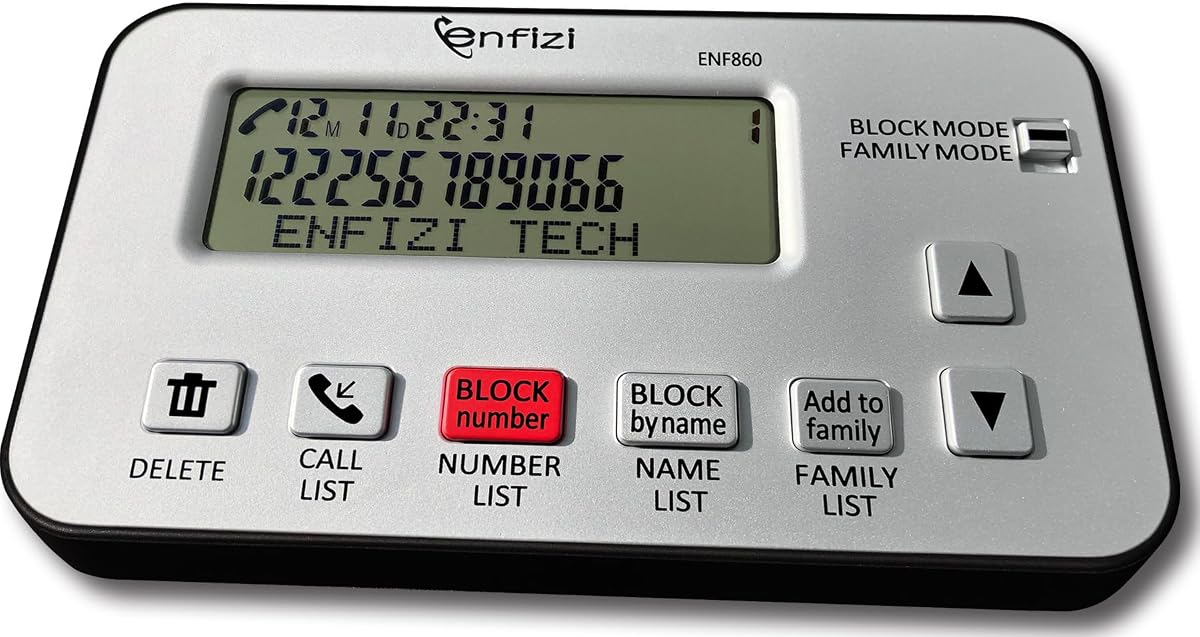
The Enf860 is built around two operating modes: BLOCK mode for actively rejecting unwanted callers and FAMILY mode for allowing only listed contacts. It has a 4.1 rating and stands out for combining number filtering, name filtering, and a large 4,000-plus-number manual blacklist with a whitelist-oriented alternative.
We may earn a commission when you buy through this link, at no additional cost to you.
Its filtering depth is a major selling point. Users can add more than 4,000 numbers, store as many as 256 names, and reject international, private or withheld, and out-of-area calls. It also supports blocking an entire area code or number prefixes beginning with selected digits. The ability to switch between BLOCK and FAMILY modes without losing stored data gives households a more structured approach than a simple one-touch blacklist.
The Enf860 is not an automatic guarantee against every nuisance call. The supplied information explicitly warns that new number variants can still bypass the database, requiring manual configuration or a switch to FAMILY mode. It is also a call blocker only: no telephone or answering machine is included. Analog service and Caller ID are required, so buyers with internet-based or digital lines should verify compatibility before purchase.
The Enf860 is best for users who want control over both known and unknown callers. It suits a household willing to maintain a list or adopt an allow-only approach when repeated calls become troublesome. Its flexible modes make it particularly useful for people who have both trusted contacts and a strong need to silence unfamiliar numbers.
BLOCK mode gives users room to create a large personal blacklist, while FAMILY mode permits only numbers placed on the family list. Switching between them without losing stored information makes it possible to tighten protection during periods of heavy unwanted calling.
The ability to block by caller name, area code, and numeric prefix provides several ways to interrupt repeat patterns. These controls are useful when many unwanted calls share a familiar regional code or begin with the same digits.
We may earn a commission when you buy through this link, at no additional cost to you.
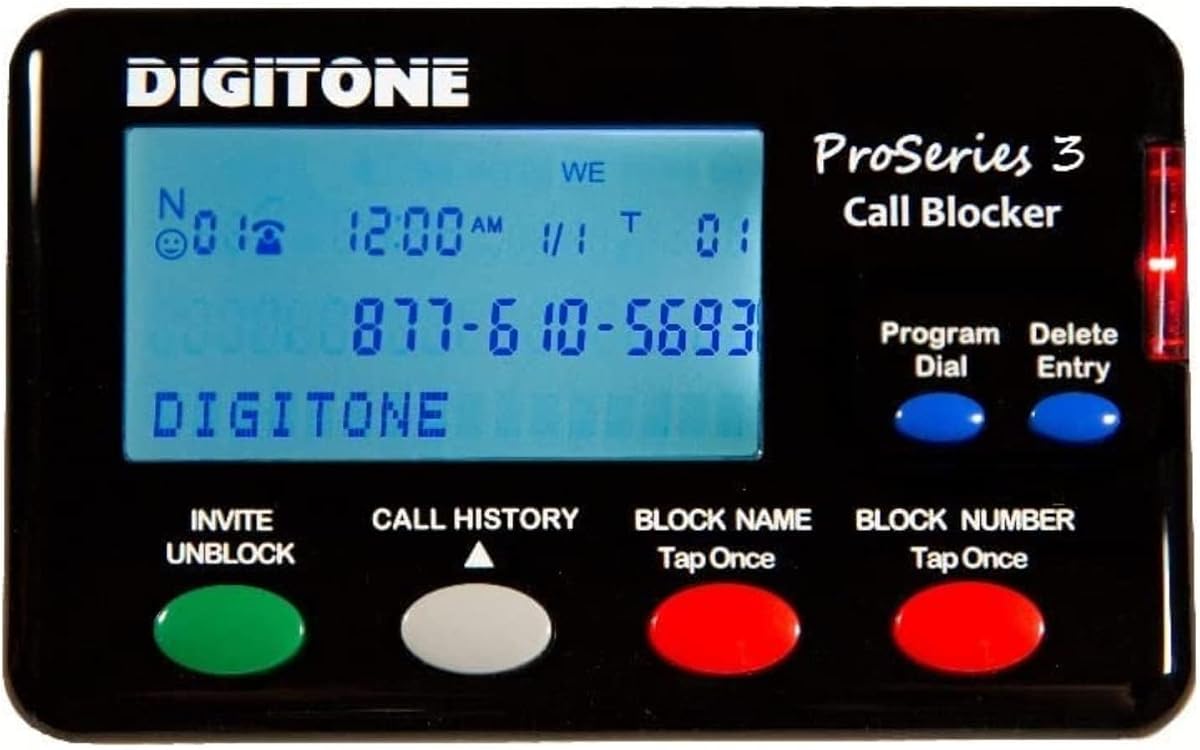
The Digitone ProSeries 3 offers one of the broadest feature sets in this roundup. It automatically identifies and blocks several categories of unwanted calls, including known spam, out-of-area, private, anonymous, 800-service, and unusual call patterns. Its 3.8 rating is lower than those of the leading models, but the supplied capabilities make it a credible option for users who want more than a basic blacklist.
We may earn a commission when you buy through this link, at no additional cost to you.
Dual block buttons allow a caller to be blocked by displayed name or number, and call history can be used to select a previous caller. A green Invite button lets blocked contacts ring through, with a double tap adding a preferred caller from the call history. A remote sequence, stated as dialing * 2 # through the handset, can also block a call. The large backlit display keeps caller information and operating prompts easy to see.
There are trade-offs. The number of controls may feel more complex than a one-button unit, especially for someone less comfortable with telephone menu systems. Caller ID name and number service is required for the model to work automatically. The supplied compatibility description also combines references to traditional service and digital or VoIP providers, so customers should confirm whether their precise line and equipment are covered rather than assuming all services behave identically.
The ProSeries 3 is a good match for a busy household that wants automatic filtering but still needs ways to admit trusted contacts. It is particularly appealing when callers may be recognized by name rather than only by number. Buyers should balance its wider feature set against a rating that is lower than the top three, and read the manual before installation.
The device handles recognizable spam patterns automatically while still providing buttons for name, number, and call-history blocking. This balance is useful when the automated database cannot identify a caller that the household knows is unwanted.
The Invite function allows selected callers through even if they have been blocked previously. That makes the ProSeries 3 useful for households where a strict blacklist could accidentally keep important people from reaching the home.
We may earn a commission when you buy through this link, at no additional cost to you.
The HEITIGN Landline Call Blocker focuses on the fundamentals: a 4,000-number blacklist, a dedicated one-touch block button, and a clear LCD display. Its 4.0 rating places it in the middle of the field, but the uncomplicated layout and adjustable brightness make it a practical choice for a home or office that wants a straightforward filtering accessory.
We may earn a commission when you buy through this link, at no additional cost to you.
Installation is designed around dual phone plugs, allowing the unit to connect with compatible landline equipment without complicated configuration. The display has five brightness levels, which is a thoughtful detail for use in bedrooms, offices, or rooms with different lighting. Users can quickly add nuisance callers to the blacklist and have those numbers filtered on future incoming calls.
The device is limited to fixed-line and landline telephones with Caller ID service enabled, so compatibility should be checked before purchase. The supplied information does not describe a preloaded nuisance-number database, family whitelist, name-based filtering, or advanced automatic screening. Consequently, it is best understood as a generous manual blacklist rather than a fully automated filtering platform.
This model is well suited to buyers who want an uncomplicated box that does the expected job without a subscription, app, or complicated operating process. It also works well for a small office with a conventional fixed line. The recommendation depends on having Caller ID and a compatible analog setup, as well as being willing to block repeat offenders manually when they first ring.
Five brightness levels make the LCD easier to read under different indoor conditions. This is especially useful for a device that may sit beside a phone throughout the day rather than be used only occasionally.
A 4,000-number blacklist is ample for many households that repeatedly encounter the same unwanted callers. The dedicated block control keeps the process direct and avoids unnecessary setup steps.
We may earn a commission when you buy through this link, at no additional cost to you.
The Enf510 combines a preloaded set of more than 4,000 frequently complained-of caller numbers with a separate manual capacity of more than 3,000 entries. Its 3.8 rating is midrange, but the variety of filtering controls makes it a capable option for users who understand that robocallers can change numbers frequently.
We may earn a commission when you buy through this link, at no additional cost to you.
Users can block a number by pressing the physical block button or by entering the stated sequence on the telephone. The device can also reject an entire area code or numbers sharing a fixed prefix, including the kinds of prefixes associated with international or service-related calls. International, private or withheld, VoIP, and out-of-area categories can be blocked as well. It operates from the telephone line without requiring mains power.
The Enf510 displays numbers rather than caller names, which may make it harder to recognize a familiar contact during a fast incoming call. It is compatible with analog telephones but explicitly does not support digital and internet phones. New number variants can still bypass the database, so users must manually add them for the best results. It also requires Caller ID service.
This model suits an analog household with corded, cordless, or answering-machine equipment that wants a large database and flexible prefix rules. It is a solid alternative to simpler one-button units, particularly for people willing to spend a little time adding repeat offenders. Users who depend on caller names or have an internet-based line should consider a different product.
Area-code and prefix filtering can stop broad categories of unwanted calls instead of requiring each variation to be added separately. This is useful when repeated spam calls share a recognizable numeric pattern.
The combination of more than 4,000 preloaded numbers and more than 3,000 manual entries gives users both an initial filter and room to build a personal database. It is designed for people willing to maintain that list as new calls arrive.
We may earn a commission when you buy through this link, at no additional cost to you.
The Generic 2000-Group Call Blocker provides a conventional combination of caller display, manual blacklist controls, and area-code filtering. Its 3.4 rating is the lowest supplied among the ten products, so it should be considered a basic option rather than the most complete solution for a demanding household.
We may earn a commission when you buy through this link, at no additional cost to you.
The device can store 2,000 groups of blocked numbers, and users may add individual numbers or configure an area code to reject a broader group. A dedicated LCD provides the operating information, while the simple button layout and dual-plug connection make installation relatively direct. The core anti-harassment function is to stop repeated unwanted calls without requiring the user to replace an existing landline telephone.
Its limitations are significant for shoppers seeking advanced protection. The product information mentions no preloaded database, friendly list, automatic spam classification, name-based blocking, bilingual announcements, or multi-line handling. Caller ID must be enabled on the telephone service, and the fixed-line restriction means it is intended for conventional landlines rather than a broader selection of internet-based devices.
This model is most appropriate for someone who primarily wants a simple, expandable manual blacklist and already owns a compatible landline. It can help with telemarketing, harassment, and repeated nuisance calls, but buyers should not expect it to independently identify every type of spam. Comparing it with a database-assisted model is advisable if new and changing caller numbers are a persistent problem.
The LCD and dedicated block button keep routine call management understandable. A household can add repeat offenders without learning a complex menu structure or setting up a separate application.
Blocking an entire area code can be effective when many unwanted calls share the same region. It broadens the device's usefulness beyond isolated, manually recorded numbers.
We may earn a commission when you buy through this link, at no additional cost to you.
The 4000-Capacity Call Blocker is a straightforward device for users who want control over a large personal list. It carries a 3.9 rating and can hold up to 4,000 individual numbers, incoming and outgoing entries, prefixes, and area codes. Its strongest distinguishing feature is that the blacklist remains stored even when power is off or the telephone line is unplugged.
We may earn a commission when you buy through this link, at no additional cost to you.
A one-touch Block control makes it easy to locate a displayed number and add it to the list. The device is line powered and battery free, reducing the need for routine maintenance. The preferred setup is in series between the telephone and the PSTN line, although parallel installation is possible; the supplied information warns that parallel use may not work with every phone system.
This is primarily a manual filtering tool rather than an advanced automatic screening platform. The stated features do not include a preloaded database, family whitelist, remote verification, name-based rules, or a display for extensive caller information. Users must also review the blacklist if a legitimate call is blocked, since broad area-code or prefix entries can sometimes catch more numbers than intended.
The device is a reasonable choice for a traditional single-line household that wants dependable storage and broad numeric blocking without batteries. Its persistent list is convenient for users who do not want to rebuild their preferences after a power interruption. People with complex phone systems should confirm connection compatibility before installation.
The stored list remains intact even if the device loses power or is disconnected from the telephone line. That makes maintenance less repetitive and helps preserve a carefully built set of exclusions.
Users can block individual numbers, prefixes, and area codes. This flexibility is useful for recurring patterns, although broad rules should be reviewed carefully to avoid blocking a legitimate caller.
We may earn a commission when you buy through this link, at no additional cost to you.
The Panasonic KX-TGA710B is the most feature-rich traditional cordless-oriented blocker in the group. Its 4.2 rating, large preloaded database, contact-recognition system, bilingual talking Caller ID, and physical block button justify considering it when the goal is a polished, self-contained telephone accessory.
We may earn a commission when you buy through this link, at no additional cost to you.
The unit includes a database of 14,000 robocaller and telemarketer numbers and can accept 2,000 manual entries. It can block unknown international calls, numbers beginning with 00, and other unwanted callers. A separate friendly database stores up to 100 contacts, with a green indicator showing when one of those people is calling and a red indicator signaling an unknown call. English or Spanish talking Caller ID can announce the caller's name or number, while a backlit LCD and large red button make operation visible and tactile.
The friendly-list maximum of 100 is modest compared with the much larger blocked-number database, so a very large social circle or busy office may need another approach. The device is designed to connect with landline cordless phones, and buyers should confirm that its connection method suits the rest of their telephone arrangement. It also does not address the fact that a determined scammer can generate a new number outside any database.
The Panasonic is a strong all-around choice for households seeking automatic protection, useful spoken caller information, and a trusted-contact system. It is particularly appropriate for users who benefit from hearing who is calling or who want more confidence when deciding whether to answer. The premium feature set distinguishes it from simpler manual blockers.
With 14,000 preloaded robocaller and telemarketer numbers, the Panasonic can begin filtering familiar spam categories without a long initial setup period. Manual capacity adds a personal layer for repeat offenders.
The friendly-contact system and bilingual announcements make it easier to distinguish an expected person from an unknown caller. Color-coded indicators and spoken information are particularly useful for users who prefer not to depend on a small display.
We may earn a commission when you buy through this link, at no additional cost to you.
The Senior Landline Blocker is designed around visibility, accessibility, and straightforward connection. It can block up to 2,000 calls, provides a bright LCD for viewing incoming numbers, and uses large buttons with one-touch blacklist control. No customer rating was supplied, so the product's available feedback is less clear than that of the ranked models.
We may earn a commission when you buy through this link, at no additional cost to you.
Its senior-oriented design is evident in the physical layout rather than a complicated mobile interface. Users can screen an incoming number on the digital display and reject it with a dedicated control. The package includes the call blocker, a modular in-line coupler, a 25-foot curly handset cord, and a cord detangler, giving users more of the hardware needed to create a tidy connection.
The 2,000-call capacity is smaller than the manual or preloaded capacities of several competing models. The supplied details do not identify a preloaded nuisance database, a trusted-contact list, automatic name recognition, advanced area-code rules, or multi-line support. It is a single-purpose accessory designed for direct connection to a home telephone line, and buyers should ensure that their existing equipment and service are compatible before purchasing.
This is a sensible option for a household seeking large controls and a clear screen, particularly when an older adult will be the primary user. It simplifies the act of rejecting a caller and includes useful connection accessories. However, shoppers wanting a developed friendly list, sophisticated automatic database, or extensive customer rating should examine one of the better-established alternatives.
Large buttons, one-touch blocking, and a bright LCD reduce the need for close visual inspection or complicated navigation. The design is well suited to users who may find small menu-driven controls inconvenient.
The modular coupler, long handset cord, and detangler make it easier to arrange the telephone and blocker neatly. Including these components gives the user more control over the final installation.
We may earn a commission when you buy through this link, at no additional cost to you.
The TB208 is the most specialized product in the roundup, designed for two-line homes and small offices rather than a single ordinary landline. It uses a whitelist-only operating model, automatic robocall handling, manual blacklist capacity, and call routing across multiple extension telephones. No customer rating was supplied, so its appeal is best judged by its extensive feature set.
We may earn a commission when you buy through this link, at no additional cost to you.
The device automatically blocks robocalls and calls without a caller ID number. For a caller outside the whitelist, it can automatically answer without ringing the extension telephone and play a verification prompt; a caller who does not enter the correct code is disconnected. The supplied description states that this method can block 95% of spam calls. Up to 1,000 groups of numbers, area codes, or prefixes can be manually blocked, while 500 groups can be placed on the whitelist.
Important constraints make TB208 less suitable for ordinary households. It has no display, so it cannot show caller ID or report what it has blocked. There is no physical BLOCK or ALLOW button; users must operate the associated extension telephone. It passes only the caller's number, not the caller's name. The extensions also cannot dial * or #, meaning voicemail access through the extension is not available as it normally would be.
TB208 is a sophisticated choice for a two-line household or small office that wants strict whitelist control, automated verification, and direct routing of trusted contacts. Its metal case, eight extension jacks, and wall-mounted or desktop design support more complex installations. Users who need a simple one-button blocker or full telephone functionality should choose a different model.
The automatic prompt gives unknown callers a way to prove that they are not automated robocallers. Calls that do not provide the requested verification code are ended before the extension telephone rings.
Two central-office line jacks and eight extension jacks make TB208 suitable for a more structured home or office network. Trusted calls can be routed to the appropriate extension, and answered calls can then be transferred.
We may earn a commission when you buy through this link, at no additional cost to you.
The right landline call blocker depends less on raw capacity and more on your telephone service, the types of calls you receive, and how much control you want to manage. Compatibility, filtering logic, accessible controls, and reliable storage should be considered together.
This is the most important check because several products work only with a traditional analog telephone line and Caller ID service. The CPR V5000, Enf860, and Enf510 are explicitly limited to analog service, while some products state that internet-based lines are unsupported. The TB208 is designed differently and includes a power supply, two line jacks, and multiple extension connections. Before buying, identify whether your service is traditional analog, cable-provided digital, fiber-based, or delivered through a voice-over-internet adapter, and review the listing's exact compatibility language. A device that works with a standard handset is not automatically compatible with every modern telephone system.
A large blacklist is useful when you are willing to add unwanted callers manually, while a substantial preloaded database can provide immediate value with less initial effort. The Panasonic includes 14,000 preloaded numbers and room for 2,000 manual entries. The CPR V5000 starts with 5,000 known nuisance numbers and can store 1,500 additional entries. The Enf510 combines more than 4,000 preloaded numbers with more than 3,000 manual slots. Capacity alone does not guarantee effectiveness, however, because new and spoofed numbers can still reach the phone.
A blacklist rejects selected callers while allowing everyone else through. A whitelist works in the opposite direction, allowing only approved contacts and making it useful when the household wants strict control. The Enf860 offers both BLOCK and FAMILY modes, the Digitone ProSeries 3 includes an allowed-family concept and invite controls, and the Panasonic maintains a friendly-contact list. The TB208 operates in a whitelist-only mode and uses a verification prompt for unlisted callers. A whitelist can be more comprehensive than a blacklist, but it takes more initial effort to populate correctly.
Manual blockers rely on the household to add a number after the first unwanted call. This is simple and predictable, but it cannot prevent that initial interruption. Database-assisted models can stop many known calls before they ring, and the Digitone and TB208 go further by automatically identifying or verifying suspicious calls. Automatic filtering is convenient, while manual controls remain valuable for newly spoofed numbers. The best balance often combines a preloaded or automatic layer with a physical way to block a caller immediately.
A clear display helps users identify who is calling before deciding whether to answer. The Digitone ProSeries 3 features a large backlit screen, while the HEITIGN offers five brightness levels. The Panasonic adds bilingual talking Caller ID, allowing the name or number to be announced in English or Spanish. The generic 2000-group model includes an LCD, whereas the TB208 has no display at all and passes only the number to the extension telephone. If household members include someone with limited vision, hearing the caller information may be more useful than relying on a small screen.
A dedicated block button, clear feedback, and understandable controls can make a device usable by seniors and other less technical household members. The CPR V5000 emphasizes a large red button and loud click, while the Senior Landline Blocker provides large buttons, one-touch control, and a bright LCD. More advanced models can offer more features but also require users to learn additional settings, such as the Digitone's dual buttons and remote command or the TB208's extension-based controls. Accessibility should be judged by how comfortably an intended user can perform the routine task of rejecting a call.
Most single-line blockers use dual plugs and connect between the wall line and existing telephone. The 4000-Capacity model notes that series installation is preferable and warns that parallel setup may not work with every phone system. The TB208 is a larger installed system that uses an AC supply, two line jacks, and eight extension jacks. Some units also work alongside answering machines, fax machines, and cordless handsets, but the supplied descriptions are not universal. Review the included cables, existing telephone arrangement, and manual before installation to avoid an incompatible setup.
Your preferred exclusions should remain in place without being rebuilt after a power interruption or line disconnection. The 4000-Capacity model explicitly retains its blacklist even when power is off or the line is unplugged. Other line-powered units require no batteries or mains power, which can simplify maintenance, while the TB208 requires an AC supply. Whitelist systems require occasional review to add new trusted contacts. Blacklist systems require occasional review to remove outdated rules and add new variants. Whichever operating style you choose, allow time to check the list after the first few days of use.
Begin by confirming that your telephone line and existing phone equipment are compatible with the blocker. Connect the unit in the arrangement recommended by its manual, usually between the wall line and telephone, and make sure Caller ID is active. For the TB208, install the supplied power supply, connect the intended line and extension jacks, and review the device's operating instructions before adding contacts.
Test the basic workflow with a call from a trusted person and, if appropriate, a number you do not want to reach the phone. Add important contacts to a whitelist or friendly list first. When an unwanted caller appears, use the physical block button or the stated telephone command, then confirm that the number was stored. Use broad area-code or prefix rules only when the pattern is reliable, since a broad rule may affect legitimate callers.
Review the list after the first week and periodically thereafter. Add repeat offenders, remove entries that are no longer needed, and update the whitelist as trusted contacts or numbers change. Do not open the unit or alter the wiring; if a connection fails, review the plugs and compatibility requirements first, then contact the manufacturer or appropriate telephone service provider. Keeping the device dry, placed securely, and away from unnecessary cord strain will help maintain reliable operation.
Most models in this guide require Caller ID because they use the incoming number or name to decide whether to allow or reject a call. Some require both Caller ID name and number service for automatic functions. If your service does not provide Caller ID, check the product listing carefully because manual and automatic blocking may not operate as intended.
No. Fraudsters and telemarketers frequently change numbers, so a device may not recognize a newly generated or spoofed number. Database-assisted models reduce many known calls, while a manual block button lets you stop a new offender after it rings. A strict whitelist can further reduce exposure by allowing only approved contacts.
It depends on the product and the way your service delivers voice. Several models are explicitly restricted to traditional analog lines, while others mention compatibility with digital services, cable modems, DSL, fiber, or VoIP adapters. Because support varies widely, verify the exact service type and telephone adapter with the manufacturer before buying.
Usually, a conventional blocker sits between the wall connection and the existing phone rather than replacing it. The Enf860 explicitly includes no telephone or answering machine. Products designed for multiple extensions, such as the TB208, are closer to a small phone system and require compatible corded or cordless handsets and extension wiring.
A blacklist blocks selected numbers while allowing other callers to ring through. A whitelist does the opposite: it permits approved contacts and rejects or verifies everyone else. Blacklist mode is usually easier to begin, while whitelist mode provides stricter protection but requires accurate contact management.
Several models support area-code and numeric-prefix filtering. The Enf860, Enf510, generic 2000-group model, and 4000-Capacity model all describe this type of control. Use broad rules carefully because they can catch legitimate callers, and review the list if an expected person is unexpectedly blocked.
They can be when the interface is accessible. The CPR V5000 and Senior Landline Blocker emphasize large buttons, clear displays, and one-touch operation, while the Panasonic offers spoken caller information in English or Spanish. The best choice is the model whose routine controls the intended user can read and operate comfortably.
Most of the traditional single-line models are line powered, need no batteries, and do not require an application or subscription. The TB208 is different because it uses an AC power supply and supports a multi-extension installation. Check the product details to confirm the power and maintenance requirements of the model you choose.
The CPR V5000 is the most straightforward all-around recommendation because it combines 5,000 preloaded nuisance numbers, 1,500 additional entries, and a highly accessible one-touch design. The HEITIGN provides a simpler manual alternative with 4,000 blacklist entries and an adjustable LCD, while the Panasonic KX-TGA710B stands out for its larger preloaded database, friendly-contact recognition, and bilingual talking Caller ID.
Before choosing, prioritize compatibility over every other feature. Confirm that the product supports your exact analog, digital, fiber, or VoIP telephone service and requires only the caller information you actually have. Then decide whether you want a straightforward manual blacklist, a database-assisted system, a strict whitelist, or the verification and multi-extension features of the TB208. The right device should make routine call screening feel effortless rather than introduce another complicated system.
Ratings, promotions, product listings, and prices can change, so check the current product page before making a final purchase. Also review the supplied instructions, included accessories, warranty information, and return terms. With service compatibility confirmed, the right call blocker can turn a traditional landline into a quieter and more manageable communication point.