
2.4G Wireless Saxophone Microphone System
3.6Editor score
12 ms wireless latency
15-hour rechargeable battery
Automatic wireless pairing
Adjustable metal gooseneck
This guide compares the best clip on saxophone microphones, covering sound quality, wireless range, battery life, clip design, and key features.
A clip on saxophone microphone can transform rehearsal, teaching, streaming, and live performance by capturing the instrument without a cumbersome stand. The right model should combine balanced tone, a secure and gentle clip, useful controls, and a connection method suited to your equipment.
The products in this guide span wired condenser systems, UHF and 2.4 GHz wireless kits, and a dedicated microphone clip. We compared the supplied specifications, focusing on pickup design, transmission range, power options, mounting hardware, compatibility, and practical features for musicians.
Each review highlights the strongest reasons to consider a model and the compromises worth understanding. The recommendations range from premium studio-oriented microphones to compact wireless systems for lessons and small stages, while current prices and availability can change at any time.
3.6Editor score

4.7Editor score
4.6Editor score
This side-by-side comparison shows the principal differences among wired and wireless clip on saxophone microphones, including pickup style, transmission range, battery life, mounting approach, and output options.




The SGPRO TR15 is a wireless clip-on microphone system rated 4.3 out of 5, with a particularly broad set of performance and control features for a compact package. It is designed to work with soprano, alto, tenor, and baritone saxophones, as well as trumpet, French horn, tuba, and trombone.
We may earn a commission when you buy through this link, at no additional cost to you.
Its standout features include a stated transmission range of up to 196 feet, 20 preset UHF channels, adjustable EQ and echo settings, and an LCD that displays volume, signal strength, channel, sensitivity, echo, and battery status. The padded clip avoids the kind of instrument finish concerns associated with screw-on mounts, while the bronze gooseneck is designed to remain stable after adjustment.
The main limitation is the stated battery life of up to four and a half hours, which may be less convenient for an all-day event. Buyers should also note that upgraded TR15 packages have a fixed gooseneck microphone and transmitter, while earlier regional packages may have a detachable gooseneck and a bonus mini microphone.
This is a compelling option for a saxophonist who needs broad instrument compatibility, wireless freedom, and detailed signal controls. It works particularly well for rehearsals, lessons, mobile performances, and small stages where a long operating range and compact storage matter more than extended all-day battery life.
Virgin rubber padding helps the clip hold the instrument firmly while avoiding finish damage. The adjustable bronze gooseneck provides a practical way to establish a consistent pickup position and reduces the need to reposition the microphone repeatedly.
Separate echo and EQ levels, along with an information-rich LCD, make the TR15 more configurable than many simple wireless kits. Those controls are useful when moving between different rooms, teaching applications, and performance environments.
We may earn a commission when you buy through this link, at no additional cost to you.
This 2.4G wireless saxophone microphone system is rated 3.6 out of 5 and focuses on approachable operation, long battery life, and quick setup. It is aimed at students, teachers, and performers who want to move around during practice, lessons, rehearsals, busking, or small gigs.
We may earn a commission when you buy through this link, at no additional cost to you.
The 2.4 GHz system has a stated latency of only 12 milliseconds and uses automatic frequency hopping for stronger interference resistance. It can also operate multiple sets simultaneously, making it more relevant to group instruction than a single hardwired microphone. A reinforced flexible metal gooseneck offers 360-degree positioning, while the rechargeable battery is specified for up to 15 hours of continuous use.
Its lower rating reflects a less proven feature set than the higher-rated condenser microphones in the list, even though the stated specifications are attractive. The system also provides less visible channel and signal information than models with detailed LCD screens, so troubleshooting a crowded wireless environment may require more trial and adjustment.
Choose this model when setup simplicity, mobility, and long battery life are the priorities. It is particularly suitable for students and instructors who want an easy introduction to wireless instrument amplification without paying for a more elaborate studio or touring system.
The advertised 15-hour runtime is the defining practical advantage of this system. An included Type-C dual charging cable powers both transmitter and receiver, while LEDs provide basic battery monitoring.
Automatic connection removes the manual frequency-matching process often associated with wireless microphones. The result is a setup that can be especially approachable for beginners, teachers, and performers working under time pressure.
We may earn a commission when you buy through this link, at no additional cost to you.
The Audio-Technica PRO 35 is the highest-rated product in this guide at 4.7 out of 5. It is a wired cardioid condenser microphone designed for musicians who value consistent tone capture, accurate placement, and straightforward operation over wireless freedom.
We may earn a commission when you buy through this link, at no additional cost to you.
The UniMount clip allows the microphone to be positioned precisely on a saxophone or other supported instrument. Its cardioid polar pattern reduces pickup from the sides and rear, improving isolation of the desired source, while the extended frequency response is intended to capture subtle performance details.
Because the microphone includes a permanently attached six-foot cable, it cannot offer the mobility of a wireless system. The fixed length can also make placement more restrictive in large stages or unusual performance positions. On the positive side, there are no batteries to charge and no radio channels to configure.
The PRO 35 is an excellent recommendation for rehearsals, lessons, recording, controlled live performance, and musicians who prefer a dependable wired signal. Its combination of isolation, precise positioning, and detailed frequency response makes it the most balanced general-purpose choice in the guide.
The cardioid pattern emphasizes sound from the front while reducing unwanted pickup from the sides and rear. This focused response is valuable in practice rooms, classrooms, stages, and recording spaces where unrelated sounds could otherwise enter the signal.
The UniMount is intended to resist shock and protect the microphone element while allowing accurate positioning. A stable mount helps the capsule maintain the same relationship to the instrument, producing more repeatable results during rehearsals and performances.
We may earn a commission when you buy through this link, at no additional cost to you.
The HHLPRO wireless saxophone microphone system is rated 4.3 out of 5 and is built for performers who need detailed control over a wireless instrument signal. It combines a detachable microphone and transmitter arrangement, UHF transmission, automatic channel scanning, and support for numerous simultaneous systems.
We may earn a commission when you buy through this link, at no additional cost to you.
The system claims a transmission range of up to 260 feet and latency below 5 milliseconds. Its 360-degree adjustable cardioid condenser microphone includes vibration dampening, while the silicone-sleeved transmitter can attach to a strap or waist to reduce the load carried by the saxophone. A Shure-compatible XLR adapter broadens compatibility with audio equipment.
Thirty-two built-in channels and one-to-many receiver matching make this a strong candidate for sax orchestras, community bands, group rehearsals, and other settings with several wireless players. The trade-off is complexity, and the five-to-eight-hour battery life is less generous than that of the 2.4G system.
Choose the HHLPRO when multi-user operation, low latency, flexible mounting, and broad output compatibility are the leading priorities. It is especially well suited to organized ensembles and technically confident musicians who will benefit from automatic scanning and one-button pairing.
Automatic scanning identifies available channels, while one-button pairing simplifies setup after the system is configured. The ability to match one transmitter with multiple receivers can also help a conductor or instructor monitor several performers.
Separating the microphone from the transmitter lets the player keep the sax lighter and preserve a more natural posture. The silicone-sleeved transmitter can sit at the waist or on a strap rather than adding all of its weight at the instrument.
We may earn a commission when you buy through this link, at no additional cost to you.
The UHF 164ft clip-on saxophone microphone system has a 4.6 out of 5 rating and emphasizes a short path from unpacking to playing. Its plug-and-play design avoids software, drivers, and a complicated initial configuration process.
We may earn a commission when you buy through this link, at no additional cost to you.
The included transmitter and receiver provide a stated operating range of up to 164 feet. A lightweight adjustable gooseneck microphone clips to the bell area and is intended for saxophone, French horn, trumpet, and trombone. The compact bodypack transmitter is designed to remain discreet during live use.
One limitation is that the supplied information does not state the system's battery duration, which makes it harder to compare directly with models that publish detailed runtime figures. It also offers less information about channel scanning, display readouts, and multi-system operation.
This system is best for musicians who want a uncomplicated wireless setup for rehearsals, church services, outdoor events, small gigs, or studio work. It is a practical choice when reliable range, clear wireless transmission, and fast connection matter more than extensive controls.
The receiver connects to the user's sound system, and both units can be powered on without specialized software. This keeps the workflow approachable for students and performers who may not want to manage complex digital menus.
A 164-foot stated range gives the player ample room to move compared with a cable-mounted microphone. The wireless format also avoids stands and instrument cables that could interfere with movement or restrict the performance area.
We may earn a commission when you buy through this link, at no additional cost to you.
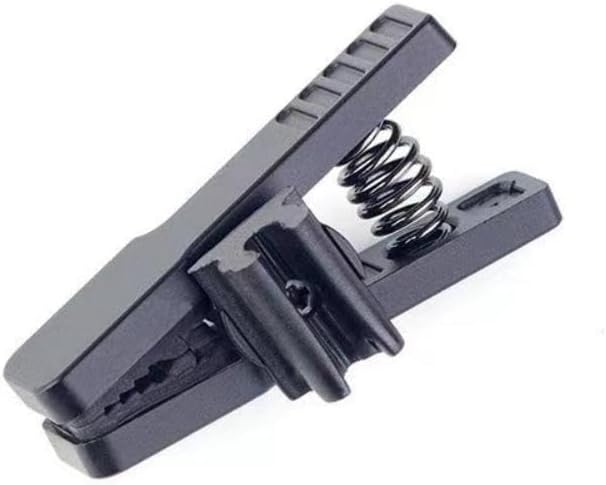
The Instrument Microphone Clip Mic Stand is a saxophone-specific mounting accessory rated 4.5 out of 5. Unlike the other products in this guide, it is not a complete microphone system and does not include a microphone, transmitter, receiver, or cable.
We may earn a commission when you buy through this link, at no additional cost to you.
Its value lies in providing a dedicated clip for saxophone players who already own a compatible microphone and want a simpler mounting solution. That makes it potentially useful for building a custom rig, replacing a damaged clip, or avoiding a complete system upgrade when only the mount is missing.
The limited product information is important. The supplied description does not state the microphone thread, included adapters, dimensions, materials, or exact instruments beyond its saxophone designation. Buyers should therefore verify those details and compatibility before ordering.
This clip is best for a musician who needs a replacement or dedicated saxophone mount rather than an all-in-one capture system. It should not be considered a standalone microphone, and it is most valuable when paired with equipment whose mounting requirements are known to be compatible.
A dedicated clip can be useful when combining a preferred microphone capsule with a particular stand, cable, or wireless transmitter. This modular approach gives experienced users more control than purchasing a fixed system.
Because the supplied data contains limited mechanical details, musicians should inspect the attachment design and confirm the required thread or adapter. Compatibility with both the instrument and the chosen microphone is essential.
We may earn a commission when you buy through this link, at no additional cost to you.
The UHF Horn Sax System is a 4.0-rated wireless clip microphone package for saxophone, horn, trumpet, cello, and other instrument applications. It combines a clip-on pickup, wireless transmitter, receiver, charging cable, and protective storage box in one coordinated set.
We may earn a commission when you buy through this link, at no additional cost to you.
Its UHF transmission supports a stated range of up to 131 feet, and the product description says multiple devices can operate at the same time without interference. A 360-degree silicone shock-proof clip and steel collar provide a flexible, secure attachment, while the receiver includes both 1/8-inch and 1/4-inch plugs for different audio equipment.
The approximately four-hour battery life is modest for lengthy rehearsals or multi-set events. Although the system offers automatic connection, the instructions describe a manual re-pairing sequence that may be necessary if the units do not connect or produce sound.
This is a sensible option for mobile musicians who want one package to cover several instruments and common connection formats. It is especially useful for amplification, broadcasts, outdoor performances, and casual recording where cordless operation and broad instrument support are the main priorities.
The rotatable silicone clip and steel collar allow the microphone to be positioned around different instruments while helping reduce vibration. Its treated surface is designed to resist corrosion during regular handling and transport.
Including both 3.5 mm and 6.35 mm receiver plugs improves the chance of compatibility with mixers, amplifiers, speakers, and portable audio devices. The receiver still needs to be connected to an appropriate audio input for sound to be monitored or recorded.
We may earn a commission when you buy through this link, at no additional cost to you.
The YXG M-03 wireless saxophone microphone system carries a 4.3 out of 5 rating and offers a balanced combination of informative controls, wireless range, and battery life. It is marketed for saxophone and trumpet use and provides 20 preset UHF channels within the 550–573 MHz range.
We may earn a commission when you buy through this link, at no additional cost to you.
Its LCD displays volume, RF and AF signal strength, channel, echo, sensitivity, and battery information, allowing users to check operating conditions without relying on separate indicators. The clip uses virgin rubber padding to avoid finish damage, and the bronze gooseneck is engineered to resist annoying rebound after being adjusted.
The stated 100-foot range is shorter than that of most other wireless options in the guide, which may matter in large stages and outdoor spaces. The information also focuses more specifically on saxophone and trumpet rather than listing the broad brass compatibility claimed by several other models.
The M-03 is a strong match for performers who value clear status displays and straightforward tone controls. It suits rehearsals, lessons, smaller performances, and practice sessions where an eight-hour rechargeable battery and a range of 100 feet provide sufficient mobility.
The LCD is one of the system's most useful features because it centralizes signal, channel, volume, and battery information. This makes channel adjustments and troubleshooting more direct than on systems that expose only small LEDs.
Rubber padding helps the clip avoid marking the instrument while maintaining a firm hold. The bronze gooseneck is designed to settle into a chosen position, which supports repeatable microphone placement between rehearsals and performances.
We may earn a commission when you buy through this link, at no additional cost to you.
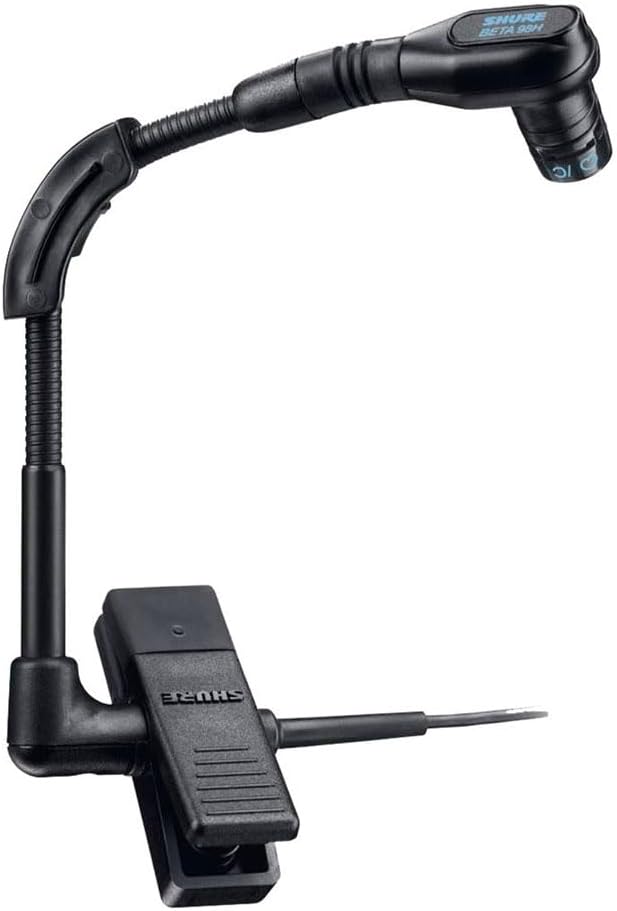
The Shure BETA 98H/C is a premium wired miniature instrument microphone rated 4.6 out of 5. It is designed for saxophone, brass, and percussion applications, offering a tailored frequency response, cardioid pickup, and a clip-on gooseneck that can be fixed in a precise position.
We may earn a commission when you buy through this link, at no additional cost to you.
Its transformerless preamplifier circuitry is intended to improve linearity across the frequency range, while the cardioid pattern provides high gain before feedback and rejects unwanted noise. A high maximum SPL makes the microphone suitable for demanding brass and woodwind sources, and the three-meter high-flex cable terminates in an attached XLR preamplifier.
The wired design is the principal trade-off. Players must remain within the cable's reach, and the XLR connection requires compatible preamplification or recording equipment. Although the compact construction provides low visibility, a fixed cable can also be less convenient than a wireless system for large stages.
This microphone is the strongest premium recommendation for serious players, educators, and recording engineers who prioritize natural reproduction, feedback resistance, and repeatable positioning. It is especially appropriate in controlled rehearsal spaces, studios, and professional amplified environments where signal quality matters most.
The tailored frequency response is designed to reproduce the instrument with an open, natural character. Combined with the cardioid pattern and transformerless circuitry, it supports clear capture while reducing unrelated environmental sound.
A gooseneck, ratcheting swivel joint, and angle brace allow the microphone to be placed accurately and then held in position. This is important during demanding performances when instrument vibration and frequent movement could otherwise disturb the capsule.
We may earn a commission when you buy through this link, at no additional cost to you.
The UHF 196ft Wireless Saxophone Instrument Microphone System is rated 4.0 out of 5 and combines long-range wireless operation with extensive channel selection. It supports saxophone, trumpet, French horn, tuba, trombone, and other brass instruments, with a clip opening specified at 0.4 inch.
We may earn a commission when you buy through this link, at no additional cost to you.
Its highly sensitive cardioid condenser pickup is specified for a 24-bit, 48 kHz sample rate and a frequency response from 30 Hz to 20 kHz. UHF digital transmission provides a stated open-area range of up to 196 feet, while infrared automatic pairing simplifies connection and an LED screen shows frequency, battery power, and volume.
The rechargeable system provides approximately six hours of use after a two-to-three-hour charge. The receiver offers both 1/4-inch and 1/8-inch plugs, but it must still connect to a suitable amplifier, speaker, interface, or other audio device to deliver sound.
This system is well suited to players who want extensive channel flexibility for busy wireless environments or multi-instrument performances. Its 200 adjustable channels are especially relevant to ensembles, while the 196-foot range provides considerable freedom for outdoor and stage movement.
With 200 adjustable channels across the stated UHF band, the system offers a large selection when several performers need to operate in the same location. This channel flexibility is more valuable than maximum range alone in crowded performance environments.
The LED digital display keeps frequency, battery power, and volume visible during setup and performance. Infrared automatic pairing reduces the effort required to establish the connection between transmitter and receiver.
We may earn a commission when you buy through this link, at no additional cost to you.
Choosing a clip on saxophone microphone means balancing capture quality, mobility, instrument handling, power requirements, and compatibility with your existing audio equipment. The most important distinction is whether a permanent wired signal or a wireless system best fits the environment.
A wired microphone provides a direct, predictable signal and eliminates radio pairing, channel interference, and battery management. It is an attractive option for rehearsals, lessons, recording sessions, and fixed positions in a studio or small performance area. The main limitation is cable length, which can restrict movement and create a trip or snag risk on a busy stage.
A wireless system offers greater freedom of movement and removes the need to route a cable from the instrument. It is better suited to stages, outdoor events, mobile performances, and group instruction, although users must consider frequency selection, charging, latency, and possible interference. Choose the format that matches how and where you perform rather than treating one as universally superior.
A cardioid pickup pattern concentrates sensitivity toward the front of the microphone while reducing sound from the sides and rear. This directionality can improve isolation in a room containing instruments, voices, stage equipment, or audience noise. Extended or tailored frequency response can help reveal subtle tonal details, but the actual result also depends on placement, instrument, room, and preamplification.
Look for pickup and response specifications that describe the intended instrument source rather than vague claims about clarity. For practice and teaching, a controlled cardioid response is often more useful than a highly sensitive pickup that captures excessive surrounding noise. For high-level brass performance, ensure the microphone can handle the source without becoming distorted.
A stable clip should hold the microphone at a consistent angle without scratching the instrument or interfering with keys, keys guards, and hand position. Rubber padding, shock absorption, and an adjustable gooseneck can all help. Some designs place the microphone at the bell, while others use a detachable arrangement that places the transmitter on a strap or waist.
Pay attention to the stated instrument compatibility and any clip-opening dimensions. A model that appears universal may still fit certain bell shapes more securely than others. If you switch between saxophones or other brass instruments, test the mounting geometry whenever possible and avoid tightening the clip beyond what the finish can comfortably tolerate.
Latency is the delay between playing a note and hearing it through the wireless system. Very low latency is especially helpful during teaching, interactive practice, monitoring, and live performance because it makes the amplified sound feel connected to the instrument. Systems in this guide range from a stated 12 milliseconds to less than 5 milliseconds, while several products provide no detailed latency figure.
Range alone does not guarantee a reliable signal. Look for UHF or 2.4 GHz systems with frequency hopping, automatic scanning, status displays, and multiple channel options when many wireless devices operate nearby. Remember that the stated maximum range generally represents an open-area condition and may be reduced by walls, crowds, other radio equipment, and competing wireless systems.
Battery runtime determines whether a wireless system can cover a full rehearsal, lesson, or performance without interruption. The featured systems advertise runtimes ranging from approximately four hours to 15 hours, with several offering rechargeable batteries and a cable that charges both transmitter and receiver. Dual charging is convenient, but users should also consider whether the system can operate while charging.
For regular gigging, longer runtime and a clear battery indicator should be priorities. For occasional use, a shorter runtime may still be practical if the components recharge between sessions. USB Type-C charging is convenient, but the cable and any required wall adapter should be checked against the musician's existing accessories and travel routine.
The receiver must connect to equipment capable of accepting its output. Some systems use a 3.5 mm plug, some provide 6.35 mm plugs, and others use an XLR adapter or a wired XLR microphone with an attached preamplifier. The destination may be a mixer, amplifier, interface, recorder, PA system, speaker, or another active input.
Consider the signal requirements of that destination as well as the physical connector. A microphone-level output may require gain control, while a line-level connection may behave differently. For the Shure BETA 98H/C, the attached preamplifier and XLR connection make it particularly suitable for professional-style audio inputs. Confirm the entire signal chain before purchasing to avoid needing unlisted adapters.
Players who perform on more than one saxophone or brass instrument benefit from explicit compatibility lists. Systems marketed for saxophones, trumpets, French horns, tubas, trombones, and related instruments can simplify equipment planning. However, a stated compatibility claim does not guarantee that every model fits every instrument equally well, so the clip geometry still deserves attention.
Teachers, band directors, and ensemble leaders should look for automatic scanning, one-button pairing, and support for multiple simultaneous systems. The HHLPRO offers 32 channels and one-to-many receiver matching, while the 196-foot system provides 200 adjustable channels. These features can matter more in an ensemble than a longer individual range or a more elaborate onboard display.
Clear controls can make a microphone much easier to use under pressure. Volume, EQ, echo, sensitivity, channel, and signal-strength displays provide useful visibility, while quick-access receiver controls allow adjustments without navigating complicated menus. The balance depends on whether the player wants a streamlined system or direct access to more parameters.
Portability is also worth evaluating. Compact transmitters, light clips, and included cases simplify transport between rehearsal, lessons, and gigs. A travel case is beneficial for a wireless kit containing several small components, but it should not substitute for a durable clip and a sound connection method suited to the intended environment.
Begin by confirming that the microphone and receiver are compatible with your instrument, sound system, and chosen connection method. Charge the transmitter and receiver fully if the system is wireless, and pair or connect the units before placing the microphone on the saxophone. For a wired model, route the attached cable with enough slack to allow comfortable movement without pulling on the instrument.
Attach the clip gently and position the microphone using the gooseneck, swivel, or angle adjustment provided by the design. Keep the capsule at a consistent distance and angle from the appropriate part of the instrument, tightening only enough to maintain a secure hold. Turn the system on, set a moderate input level, and raise the output gradually while checking for distortion, unwanted feedback, and excessive room noise.
After each session, switch off the equipment and disconnect any cables. Wipe the microphone and clip with a dry, soft cloth, remove visible dust without forcing it into openings, and inspect the padding and gooseneck for looseness. Store wireless components in their case, recharge them according to the manufacturer's instructions, and avoid moisture, extreme heat, and cables stored under sharp bends.
Yes, provided the model is mounted securely and paired with an appropriate amplifier, mixer, interface, or PA system. Wireless systems are especially convenient for stages because they remove instrument cables and allow the player to move. Their range and latency claims should still be evaluated against the size of the venue and the density of other wireless equipment.
A wired model sends the microphone signal through a physical cable, offering a direct connection without charging or radio pairing. A wireless system uses a transmitter, receiver, and radio frequency, providing more movement but requiring battery management and channel configuration. Wired systems often suit controlled rehearsals and studios, while wireless systems favor mobile and amplified performance.
A properly designed clip should use padding and enough tension to remain secure without marking the finish. The SGPRO TR15, YXG M-03, and 196-foot system are specifically described as using virgin rubber padding, while the HHLPRO includes a vibration-dampening design. Even with padding, avoid overtightening the clip and inspect the instrument after mounting it.
The required distance depends on the performance area, movement patterns, obstacles, and competing radio systems. A range of 100 to 196 feet may be sufficient for many classrooms, rehearsal rooms, and stages, but walls and crowds can reduce effective performance. Systems with automatic frequency scanning and many selectable channels are valuable in busy venues.
Yes, provided the output can connect to a recorder or audio interface with suitable gain. The Audio-Technica PRO 35 and Shure BETA 98H/C are wired condenser options well suited to controlled capture, while wireless systems are useful for recording performances in larger or less controlled spaces. Test the level and placement before recording an important session.
Very low latency is helpful because it minimizes the delay between the player's action and the sound heard through the system. It is especially important in teaching, practice, and live monitoring situations. The featured 2.4G model specifies 12 milliseconds, and the HHLPRO specifies less than 5 milliseconds, both of which are intended to preserve a responsive feel.
Many models are designed for saxophone, trumpet, French horn, tuba, and trombone, but the attachment still needs to fit the instrument securely. The listed compatibility can vary by product, and the HHLPRO also mentions clarinet and percussion applications. Players who use many instruments should consider an adjustable gooseneck and a clip sized for the intended bells and fittings.
Keep the microphone and clip dry, clean them with a soft dry cloth, and inspect the padding and joints for looseness. Route wireless cables carefully when present, store small components in a protective case, and recharge batteries according to the manufacturer's instructions. Avoid pulling on the attached cable or microphone because strain can damage the connection or positioning.
The Audio-Technica PRO 35 stands out as the most balanced overall option because its cardioid condenser design, shock-resistant mount, and detailed frequency response serve rehearsals, lessons, recording, and controlled performance. The Shure BETA 98H/C is the premium choice for musicians who prioritize tailored response, feedback resistance, and secure positioning.
For players who need wireless freedom without a complex feature set, the 2.4G system stands out with automatic pairing, 12-millisecond latency, and a 15-hour battery. Larger wireless systems offer more range, more channels, and greater control, so prioritize operating range, status visibility, battery runtime, and output compatibility according to the environments where you perform.
Before ordering, confirm that the microphone fits the saxophone, the output works with your audio equipment, and the power requirements match your routine. Current prices, promotions, availability, and package contents can change, so check the listing and included accessories before making a final purchase.