
8BitDo All-Button Arcade Controller
4.6Editor score
All-button quad-movement layout
Hot-swappable mechanical switches
Xbox and Windows wireless support
Compact 1.6-centimeter design
Our D Pad for Fighting Games guide compares ten controllers on button layout, input options, compatibility, customization, and build quality for play.
A D Pad for fighting games should make directional inputs readable, dependable, and comfortable through long practice sessions. The best options combine an appropriate control layout with responsive face buttons, useful stick behavior, dependable connectivity, and software customization for the games you play.
This guide compares ten fighting-game controllers spanning traditional gamepads, six-button pads, leverless arcade-style layouts, and a dedicated keypad. We evaluated each product using its supplied specifications, covering compatibility, button arrangements, D-pad or directional behavior, programmability, connectivity, and intended gaming style.
The list highlights the strongest option for different needs, including a premium modular controller, a compact all-button pad, and a value-focused six-button wireless model. Product ratings and availability can change over time, so readers should confirm current specifications, system support, and prices before purchasing.
4.6Editor score

4.2Editor score

4.0Editor score
The comparison below organizes all ten controllers by control style, directional options, platform support, customization, and connectivity, making it easier to identify the model that fits a particular fighting-game routine.




The HORI Fighting Commander OCTA is a tournament-oriented fightpad for PlayStation 5, PlayStation 4, and PC. Its 4.1 rating reflects a solid overall proposition, and the standout feature is a control layout built around six face buttons, an adjustable D-pad, and a short-throw analog stick designed for accurate, rapid execution.
We may earn a commission when you buy through this link, at no additional cost to you.
Micro Switch buttons are central to the pad's appeal for fighting-game players who want a clear mechanical action and durable tactile response. The stick uses an eight-way gate, which helps direct movement toward cardinal and diagonal positions while limiting accidental intermediate readings. Adjustable D-pad sensitivity provides useful flexibility for games that emphasize clean directional inputs.
The controller also supports headset input, onboard audio controls, and customization through its companion app. Those extras make it more versatile than a bare arcade stick, although the fixed button configuration gives it less freedom than modular alternatives. Its wired connection also means it will appeal to players who prefer a consistent cable-based setup.
This is our best overall recommendation for a player who wants a recognizable six-button layout without moving to a full leverless controller. It is particularly suitable for PlayStation owners, PC players seeking a dedicated fightpad, and anyone who values an adjustable D-pad and short-throw stick over wireless convenience or extensive physical modularity.
The adjustable D-pad allows players to tune directional behavior to their preferences, while the short-throw stick and eight-way gate support deliberate movement. Together, these features make the OCTA a practical choice for games that demand clean diagonals, quick movement, and repeatable command execution.
Micro Switch face buttons and a six-button arrangement provide a more fighting-focused foundation than a standard console controller. The companion app adds profile and configuration options without changing the core physical layout.
We may earn a commission when you buy through this link, at no additional cost to you.
The Victrix Pro BFG is the most adaptable controller in this guide, combining a standard PlayStation-style body with a swappable six-button fightpad module. Its 4.2 rating and extensive interchange system make it a strong premium pick for players who want to experiment with sticks, D-pads, and gates rather than settle for a fixed layout.
We may earn a commission when you buy through this link, at no additional cost to you.
The controller includes a reversible left module, a standard right module, a six-button fightpad module, four interchangeable sticks, three different D-pads, and four gates. That selection gives players meaningful control over directional feel, travel, and resistance. Four mappable back buttons and three profile slots also support games that benefit from additional actions.
Audio is another strength. The Pro BFG supports Sony 3D audio on PS5, low-latency audio, and selectable EQ profiles. It is officially licensed by Bandai Namco Entertainment and is a PlayStation Official Licensed Product, which may appeal to players who value recognizable certification alongside customization.
The Pro BFG is best for enthusiasts who want one controller to cover several fighting styles. It is less compelling for someone seeking the smallest possible setup, but for players who rotate between Tekken, button-oriented fighters, and other genres, the interchangeable system makes the premium proposition especially compelling.
Swappable sticks, D-pads, gates, and left modules allow the controller to be adjusted as different games or personal habits change. This makes the Pro BFG more versatile than a controller with one permanently installed control configuration.
Four mappable back buttons can be assigned to useful actions, while the profile button stores three distinct configurations. Players can move between fighting games, action titles, and other genres without relying on the same layout every time.
We may earn a commission when you buy through this link, at no additional cost to you.
The VILCORN Wireless Fighting Game Controller is a value-focused traditional pad with a six-action-button arrangement, an eight-way directional disc, and a Hall Effect joystick. Its 4.0 rating is not the highest in the list, but the feature set gives it a compelling case for players who want familiar arcade-style controls across several systems.
We may earn a commission when you buy through this link, at no additional cost to you.
The adjustable keycap height on the Hall Effect stick is a thoughtful ergonomic feature. It can accommodate different thumb lengths and grip styles, while magnetic sensing is intended to provide precise, drift-free movement. Mechanical shoulder buttons offer a light touch and quick rebound, which can be useful for actions that require immediate actuation.
For PC, the included 8K USB receiver supports a polling rate of 6000Hz+, and the controller also supports Bluetooth across Nintendo Switch, PS3, PS4, Windows, Android, and iOS. Turbo and programmable macro back buttons add useful functionality, though players should use macros only where permitted by the games they play.
This is the best budget recommendation for someone who wants more than a standard console gamepad without moving to a full arcade stick. It is a strong match for retro collections, mixed-platform libraries, and players who prefer a six-button layout, an 8-way D-pad, and wireless flexibility.
The six-button arrangement closely resembles classic arcade controls, while the disc D-pad supports clear diagonal and cardinal directions. Hall Effect sensing, adjustable keycap height, turbo, and macros bring modern conveniences without changing the familiar shape.
Bluetooth compatibility spans Nintendo Switch, older PlayStation systems, Windows, Android, and iOS. The high-frequency receiver gives PC players a dedicated connection option when their supported game and setup can use it.
We may earn a commission when you buy through this link, at no additional cost to you.
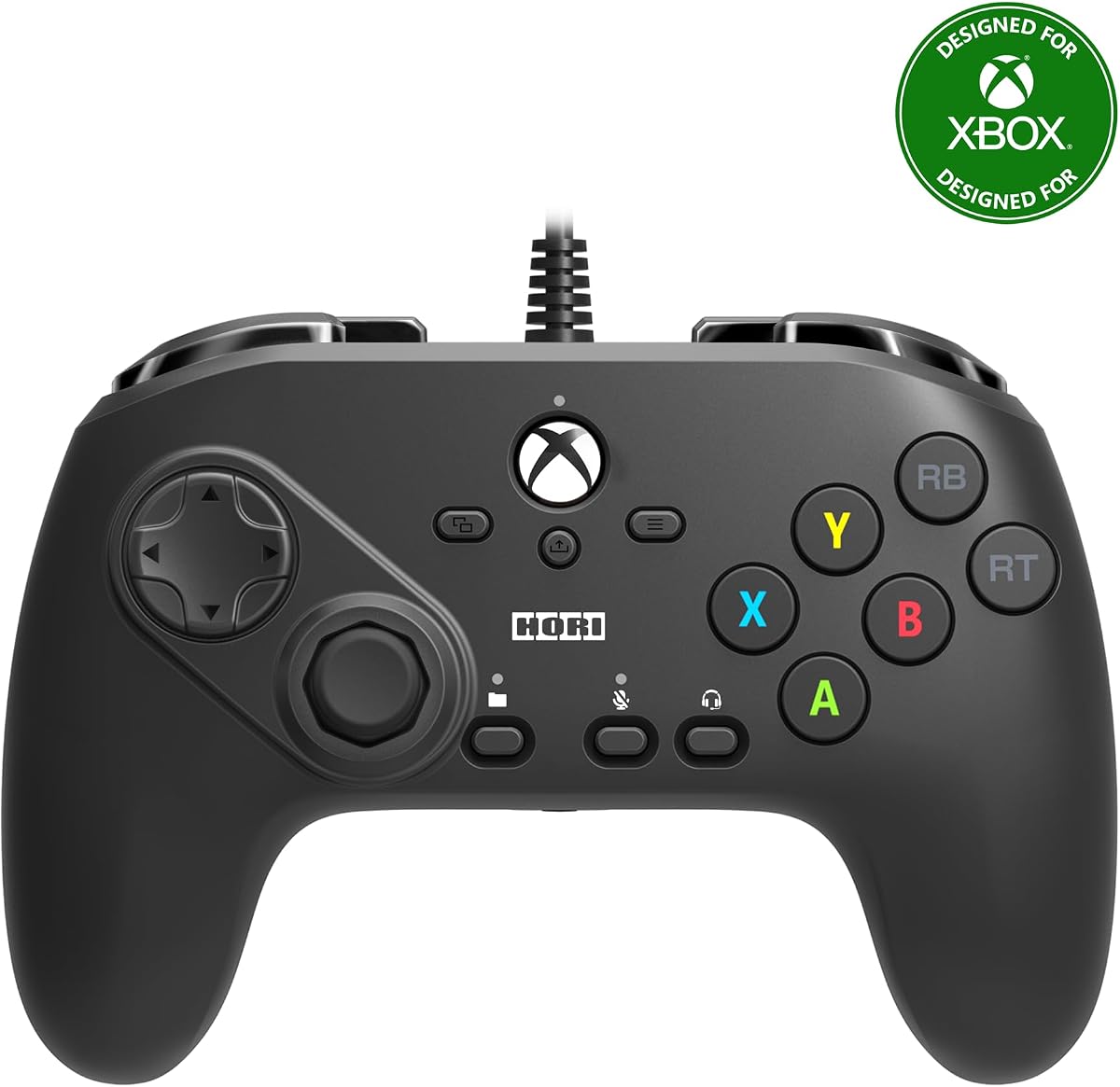
The HORI Fighting Commander Octa brings a dedicated six-button layout to Xbox Series X|S, Xbox One, and Windows 10. Its 3.5 rating is the lowest among the listed products, but the supplied specifications show a focused design for players who want traditional fightpad controls on Microsoft systems.
We may earn a commission when you buy through this link, at no additional cost to you.
Micro Switch buttons, an adjustable D-pad, and a short-throw analog stick with an eight-way gate form the core control package. The D-pad can be tuned for directional sensitivity, and the short stick is designed to improve accuracy and execution speed for familiar arcade-style inputs.
The companion app can save up to four profiles, and a dedicated profile button allows fast switching between them. This is helpful for players who use different button arrangements, sensitivity preferences, or assignments across several fighting games.
The Octa is best viewed as a specialized Xbox fightpad rather than a universal controller. Its wired construction and focused layout will suit competitive players who prefer stable connectivity, while its platform limitation and modest user rating mean that buyers should compare it carefully with more highly rated Xbox alternatives.
A short-throw stick, eight-way gate, and adjustable D-pad give fighting-game players several ways to execute directions. The design is focused rather than general-purpose, which is appropriate for repeated movement and combo training.
The companion app can store as many as four profiles. A physical profile button then provides convenient access when a player needs to switch games or preferred configurations.
We may earn a commission when you buy through this link, at no additional cost to you.
The 8BitDo M30 combines a retro-inspired six-button layout with modern Xbox compatibility and a wired connection. Its 4.2 rating places it among the stronger-reviewed products here, while the USB-C design and support for 8BitDo Ultimate Software make it appealing to players who enjoy configurable retro-style controllers.
We may earn a commission when you buy through this link, at no additional cost to you.
The controller supports Xbox Series X|S, Xbox One, and Windows. Two bumpers, two triggers, and two button-layout switches form part of its control arrangement, and a custom profile button provides access to three profiles that can be changed during play.
A 3.5 mm audio jack and volume control are useful additions for players who use wired headsets or speakers. The USB-C connection is described as virtually lag-free, which helps maintain consistency during inputs and feedback.
The M30 is a good fit for Xbox owners who want a six-button aesthetic without moving to a larger arcade stick. It is less suitable for players seeking wireless freedom, extensive physical modularity, or a fully leverless layout, but its combination of familiar styling, profiles, and strong rating makes it an approachable contender.
The M30 preserves the visual language of an older-style six-button controller while adding contemporary system support, profiles, and software customization. That balance makes it useful for both retro collections and current Xbox fighting games.
USB-C connectivity keeps the setup simple and avoids the need to manage wireless pairing or charging during a match. The included audio controls also make it convenient to adjust headset volume without leaving the game.
We may earn a commission when you buy through this link, at no additional cost to you.
The 8BitDo All-Button Arcade Controller is a compact leverless pad built around an all-button quad-movement design. It carries a 4.6 rating, tied for the highest listed score, and its combination of wireless support, hot-swappable switches, and a thin housing makes it one of the most distinctive options in this guide.
We may earn a commission when you buy through this link, at no additional cost to you.
Instead of a conventional stick, the controller uses directional inputs arranged around the action buttons. This approach can appeal to leverless players who prefer separating movement and attacks spatially. Sixteen Kailh Wizard low-profile mechanical switches support the action layout, and a hot-swappable PCB allows compatible replacements.
The controller is nearly the size of an A4 sheet and only 1.6 centimeters thick. That compact profile makes it easier to store and transport than a full-size arcade cabinet. Two programmable buttons, replaceable lock caps, an independent control panel, and a built-in 3.5 mm audio jack with volume control cover essential customization and convenience needs.
This is the best pick for players who are already interested in leverless or all-button layouts and want a portable Microsoft-platform option. It may require an adjustment period for players accustomed to a stick, but the high rating, compact construction, and switch customization make it a particularly attractive premium choice.
The quad-movement layout places directional inputs directly around the action area, reducing the distance between movement and attacks. Its thin 1.6-centimeter body also makes the controller easier to carry and store than a traditional fightpad.
The hot-swappable PCB lets players exchange compatible low-profile mechanical switches without soldering. This gives the controller a tactile upgrade path and allows individual preferences to be explored over time.
We may earn a commission when you buy through this link, at no additional cost to you.
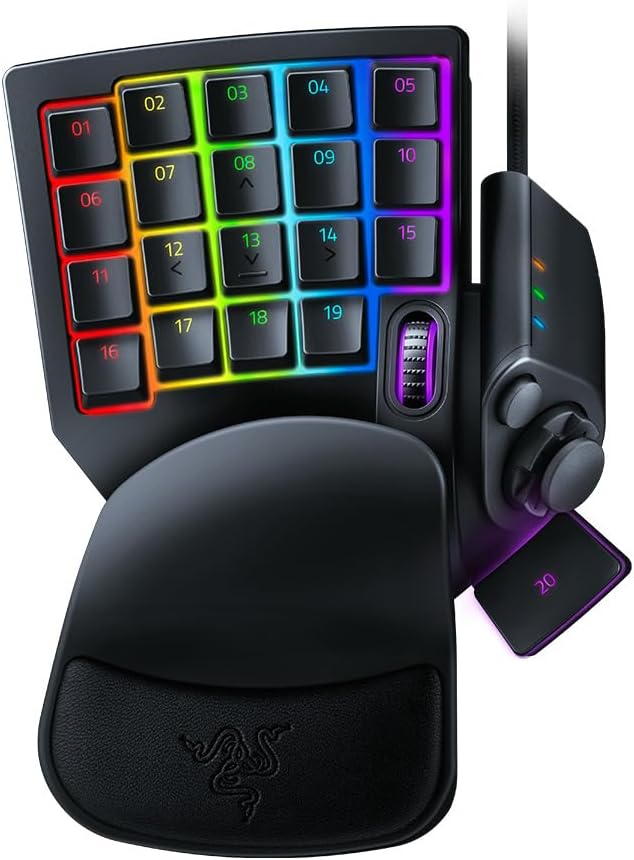
The Razer Tartarus Pro is a gaming keypad rather than a conventional controller, but its eight-way thumbpad and programmable key bank make it relevant to fighting-game players. Its 4.2 rating reflects a mature, feature-rich design built around analog-optical switches, rapid triggering, and extensive customization.
We may earn a commission when you buy through this link, at no additional cost to you.
Rapid Trigger allows a key to reset as soon as it rises by as little as 0.1 mm, enabling faster repeated inputs than a standard keyboard mechanism. Adjustable actuation spans 1.5 to 3.6 mm, allowing players to select how much travel is required before an input registers.
All 32 keys can be programmed, and Razer Hypershift supports remapping individual keys and key combinations. Those macro capabilities are extensive, although competitive rules may restrict certain automated or combined inputs. The eight-way directional thumbpad provides a more natural directional option for console-oriented players than a small cluster of keys.
The Tartarus Pro is best for PC players who want a dense set of programmable actions, comfortable directional movement, and a high degree of software control. It does not replace the ergonomics of a six-button gamepad or the spatial freedom of a leverless controller, but it offers a distinctive route to specialized fighting-game layouts.
The analog-optical system lets players choose activation depth between 1.5 and 3.6 mm. Shorter settings can support quick repeated actions, while longer settings may provide a more deliberate feel.
Thirty-two programmable keys and Razer Hypershift provide a large canvas for custom assignments and macros. Chroma RGB adds individually backlit-key effects that can synchronize with supported games and other compatible devices.
We may earn a commission when you buy through this link, at no additional cost to you.
The Haute42 R16 is a full-size leverless controller built for fighting games and other arcade-style genres. Its 4.5 rating reflects a strong overall feature set, with a thinner and lighter design than many conventional arcade sticks, a sixteen-button arrangement, and extensive configuration support.
We may earn a commission when you buy through this link, at no additional cost to you.
The controller uses a Raspberry Pi RP2020 chip and GP2040-CE firmware, supporting sub-1-millisecond latency according to the supplied information. It also offers web-based configuration after connecting to a PC, giving players access to firmware updates and detailed settings.
Hot-swappable switch sockets allow mechanical keys to be replaced without soldering. The package includes low-profile switches, a puller, button caps, and anti-slip pads. A rim around the controller supports the fighting-game focus, while the M2 button has been moved to the left pinky area for easier access during intense play.
The R16 is best for players who want a substantial leverless surface and broad system support without purchasing a full arcade cabinet. Compatibility includes Windows 10 or later, Steam Deck, PS3, PS4 with an adapter, and Nintendo Switch. Buyers should verify their exact platform and required accessories before ordering.
The RP2020 chip and GP2040-CE firmware are intended to minimize delay, with listed latency below 1 millisecond. The design also emphasizes low frame leakage for competitive play.
Players can connect to a PC and access the built-in configuration interface through a web browser. Hot-swappable sockets make it possible to change compatible mechanical switches without soldering.
We may earn a commission when you buy through this link, at no additional cost to you.
The 8BitDo Retro Wireless Arcade Fight Stick delivers a familiar arcade form factor with modern wireless flexibility. Its 4.5 rating places it among the top-reviewed products here, and support for Bluetooth, 2.4 GHz, and wired USB-C gives it several ways to connect to Nintendo Switch or Windows.
We may earn a commission when you buy through this link, at no additional cost to you.
The control platform is notably mod-friendly. Thirty-millimeter and 24-millimeter arcade buttons can be replaced, while a universal joystick mounting plate supports a broad range of arcade components, including Sanwa JLF sticks. This makes the fight stick attractive for players who already own preferred arcade parts.
8BitDo Ultimate Software supports button mapping, macros, controller profiles, and dedicated P1 and P2 macro buttons. A dynamic button-layout feature changes the visual arrangement when switching between Switch and PC X-Input modes, helping players keep their reference positions intuitive.
The fight stick is best for Nintendo Switch or Windows players who want a genuine arcade-style unit and enjoy modifying its controls. Its stated battery life is 40 hours on 2.4 GHz and 30 hours on Bluetooth, with a four-hour charging time, although users should factor that into long practice sessions.
Replaceable buttons and a universal mounting plate make it possible to personalize the stick with compatible arcade components. The support for Sanwa JLF devices is particularly relevant to players familiar with traditional Japanese arcade hardware.
Bluetooth, 2.4 GHz, and wired USB-C cover different preferences for mobility, dedicated wireless input, or a fixed connection. The 2.4 GHz receiver stores in a dedicated compartment in the controller.
We may earn a commission when you buy through this link, at no additional cost to you.
The Haute42 13-Key Leverless Arcade Controller is a compact RGB fighting stick with a transparent housing and a 4.6 rating. It ties for the highest rating in the list and offers a deliberately small design, measuring 11.65 by 7.71 inches with a thickness of 0.49 inches.
We may earn a commission when you buy through this link, at no additional cost to you.
Its thirteen keys use a hot-swappable mini-keyboard design, allowing compatible mechanical switches to be replaced without soldering. The transparent acrylic construction creates an RGB-lit appearance, and the housing can also be personalized with a custom skin for a more individualized look.
The controller lists a one-millisecond delay and supports firmware updates. Five operating modes include X-Input, Switch, PS3, D-Input, PS4, and keyboard functions, along with multiple SOCD cleaning modes, turbo, embedded web configuration, button-layout swapping, and customizable M1 and M2 keys.
The T13 is best for players who prioritize a compact, visually striking leverless setup with broad configuration options. The thirteen-key layout is smaller than a traditional six-button gamepad and may not suit games requiring a standard arrangement, but the compact profile, switch customization, and mode support make it a distinctive last-place recommendation.
At only 0.49 inches thick, the T13 offers a very slim leverless footprint. Its transparent housing and customizable skin support make the controller especially appealing to players who enjoy personalizing their setup.
Five controller modes, several SOCD cleaning options, turbo, layout swapping, and embedded web configuration provide broad control. Firmware updates can also help keep the device aligned with changing software needs.
We may earn a commission when you buy through this link, at no additional cost to you.
The right fighting-game controller depends on your platform, preferred input method, and willingness to customize. Layout, connectivity, switch feel, and software support matter more than decorative features or small differences in specification.
A traditional gamepad uses a directional stick or D-pad and separates attacks into a smaller set of face buttons. A leverless controller spreads movement and actions across a larger surface, which can make certain motions easier to perform but requires a different muscle-memory adjustment. Six-button pads sit between those formats and closely resemble classic arcade controls.
Choose the layout that complements games you actually play and the control style you already understand.
System support is a hard filter, not a minor preference. Xbox-oriented models in this list focus on Xbox Series X|S, Xbox One, and Windows, while PlayStation models cover PS4 and PS5. The VILCORN controller spans the widest set of listed platforms, and the 8BitDo fight stick supports Nintendo Switch and Windows.
Check the exact console revision, operating mode, and any required adapter before buying.
Directional execution depends on the stick gate, stick travel, D-pad design, or leverless arrangement. The HORI OCTA models use short-throw sticks with eight-way gates, while the Victrix Pro BFG lets players change sticks, D-pads, and gates. An eight-direction disc favors simple diagonals, whereas an all-button layout offers more spatial placement options.
Prioritize consistent, repeatable input over a directional design that merely looks different.
Mechanical switches can influence perceived speed, feedback, and sound. Hot-swappable sockets, as found on the 8BitDo All-Button Arcade Controller and both Haute42 models, allow compatible switches to be changed without soldering. Software remapping, button layouts, and dedicated profile controls add a different kind of customization.
Decide whether you want to alter physical parts, software assignments, or both.
Wired controllers provide a simple, consistent connection and avoid charging during matches. Wireless models offer convenience and portability but require attention to receiver range, battery life, and platform support. The Victrix Pro BFG, VILCORN, 8BitDo All-Button, and 8BitDo Retro Fight Stick support wireless operation, while the HORI OCTAs and 8BitDo M30 are wired.
For tournament stations, a dependable wired setup may be easier to standardize.
Profiles help players move between game-specific layouts without reconfiguring the controller repeatedly. The Victrix Pro BFG stores three mapping profiles, the HORI Xbox OCTA supports four, and the 8BitDo M30 provides three. Macro tools can accelerate training or automate actions, but competitive rules may restrict their use.
Use macros in practice or permitted scenarios and verify tournament policies before relying on them.
Full-size arcade sticks and leverless controllers generally offer a broad action area but require more desk space. Compact pads such as the 8BitDo All-Button Arcade Controller and Haute42 T13 are easier to store and carry. Traditional gamepads are the simplest option for players who also use a console for non-fighting games.
Measure your setup and consider where the controller will be stored between sessions.
Headset support and onboard audio controls can make a dedicated fightpad more comfortable for longer sessions. The Victrix Pro BFG includes premium audio features, while the 8BitDo M30 and All-Button Arcade Controller provide 3.5 mm audio connections and volume controls. A versatile controller can also serve other game genres without feeling purpose-built for one title.
Balance fighting-game specialization with the other games and entertainment you use.
Begin by connecting the controller using the method supported by your system and game. Wired models should be connected directly, while wireless controllers may require pairing through Bluetooth or the included 2.4 GHz receiver. Update the applicable companion software, create a profile for the game, and verify that every attack, directional command, and menu input is assigned correctly before training.
Spend time learning the physical layout rather than beginning with maximum difficulty. Practice short movement sequences first, then move into your game's essential attacks, cancels, and movement combinations. If a controller supports interchangeable sticks, gates, D-pads, or switches, change only one element at a time and allow enough practice to identify whether the new configuration feels clearer.
Keep the controller away from moisture, dust, and liquids, and avoid pulling on a cable while it is connected. Clean lightly with an appropriate soft, dry material, and periodically inspect buttons, stick gates, switch sockets, and anti-slip feet. Wireless models should be charged before important sessions, while leverless and arcade-style controllers should be stored flat to protect their keys and housings.
It depends on the game and the player. A D-pad can provide clear cardinal and diagonal input, while an analog stick may offer more nuanced directional positioning. Fighting-game players often prioritize a short-throw stick with an eight-way gate or a leverless directional system because those layouts can support deliberate, repeatable movement commands.
Leverless controllers can be excellent for players who want each direction and action to occupy a separate position. They can make some motions easier to perform and eliminate analog drift. However, players accustomed to a gamepad may need an adjustment period, so it is worth considering the control styles of the games in your library.
A wired connection can be preferable because it is simple, consistent, and requires no charging during a match. It also removes wireless pairing and receiver-placement concerns. Wireless controllers are more portable, so the better choice ultimately depends on your setup, platform support, and preferred routine.
A six-button layout provides separate inputs for attacks and special moves, often arranged in a familiar arcade-style pattern. This can make standard commands easier to execute by matching the controls to an arcade cabinet. The exact advantage depends on the game, because some titles use fewer meaningful attack inputs than others.
Macro rules vary by game and tournament. Some events permit macros for specific training or accessibility purposes, while others prohibit automated inputs that could produce an advantage. Players should check the current rules of the game, platform, and event before using programmable combinations in ranked or tournament play.
Look for a clear directional action, a layout that matches your favorite titles, responsive inputs, and stable construction. Platform support, wired or wireless connectivity, and software customization are also important. If you want frequent physical changes, prioritize hot-swappable switches and interchangeable sticks, gates, or D-pads.
Official licensing can provide reassurance about platform compatibility, firmware handling, and expected integration. It is not the only factor in controller quality, however. The more important questions are whether the control layout suits your games, the connection is reliable, and the buttons or switches feel consistent for your playstyle.
Update the firmware when the manufacturer recommends it, when compatibility changes, or when you encounter a configuration or input problem. Before updating, save or note custom profiles and read the manufacturer's instructions. For competition, perform updates and testing well before an important session rather than immediately beforehand.
The HORI Fighting Commander OCTA is the most balanced traditional fightpad, while the Victrix Pro BFG leads readers who want extensive physical and software customization. The 8BitDo All-Button Arcade Controller stands out for its compact all-button design, and the VILCORN wireless pad provides a traditional six-button experience with broad platform support.
Prioritize platform compatibility, the direction system used by your favorite games, and the kind of adjustment period you are comfortable making. Traditional pads suit many newcomers, leverless designs reward spatial learning, and modular systems are best for players who want to refine their setup over time rather than settle immediately.
Ratings, software behavior, accessory requirements, and prices can change, so check the current product listing before purchasing. The most suitable D Pad for fighting games is ultimately the one that supports your games, feels comfortable, and lets you practice the commands you need with confidence.