
PFSN 3000 Lumens Dive Light
4.4Editor score
3000-lumen maximum output
Lockable accidental activation control
Three practical lighting modes
Real-time battery indicator
Compare 10 Dive Light for Night Diving options by beam reach, waterproofing, lighting modes, controls, runtime, and suitability for caves, wrecks, and deep
A dive light for night diving must do more than illuminate a general area. It needs a focused or adaptable beam, dependable underwater controls, solid corrosion resistance, and enough output to reveal a wreck, cave wall, reef, or signaling target without making every dive feel like a search operation.
The products in this guide were compared using the supplied specifications, including maximum output, beam angle or reach, depth rating, lighting modes, battery behavior, switch design, mounting options, and intended underwater applications. The list covers compact backups, rechargeable primary lights, video lights, signaling torches, and premium zoomable models.
Each review explains what distinguishes the light, where it appears most practical, and which compromises deserve attention. Ratings reflect the available customer feedback, while technical claims come from the product information. Prices and availability can change, so compare the current listing and verify the complete package before buying.
4.4Editor score

4.7Editor score

4.8Editor score
This side-by-side comparison organizes the ten listings by the features that most affect night-dive visibility, control, endurance, and practical use, while clearly identifying the two entries with no supplied product details.




The ORCATORCH D530 combines a customer rating of 4.7 with a compact 1500-lumen design, making it one of the most convincing all-around choices in this guide. Its 6500K cold-white output and narrow seven-degree beam are designed to concentrate illumination into a concentrated target beam that can reach as far as 291 meters according to the supplied information.
We may earn a commission when you buy through this link, at no additional cost to you.
The main advantage is controlled, directional visibility. A tight beam is especially helpful when inspecting holes, cracks, cave formations, wreck details, or a partner at a distance without flooding the immediate surroundings with glare. Three lighting modes provide some flexibility, while the titanium alloy side switch should be easier to locate and operate when wearing neoprene gloves.
There are practical limitations to consider. No standalone lithium batteries are supplied, so buyers should verify whether their chosen configuration includes cells or whether the light requires a separate compatible battery solution. The product information also says it is not suitable for use on land because it can overheat and reduce light intensity. Its fixed seven-degree beam is excellent for reaching a target but less versatile than a zoomable design.
This is a strong recommendation for divers who want a focused primary light or compact backup with serious reach. It suits cave exploration, wreck diving, salvage work, and conventional recreational night diving, particularly when the priority is seeing into dark spaces rather than evenly lighting a wide area.
The seven-degree beam concentrates the D530's output into a narrow shaft, helping reveal cave cracks, wreck openings, and distant subjects. This makes it more purposeful than a broad general-purpose flashlight when visibility and pinpoint inspection are the main goals.
The side switch and five-second lock reduce the risk of accidental activation. A double-click unlocks the light, creating a straightforward control sequence that can be learned before entering the water.
We may earn a commission when you buy through this link, at no additional cost to you.
The PFSN 3000 Lumens Dive Light stands out with a 4.4 rating, a stated maximum output of 3000 lumens, and a claimed beam reach of 400 meters. Those headline figures make it look particularly capable for technical diving, cave exploration, snorkeling, spearfishing, and other activities where a diver wants strong illumination from a compact housing.
We may earn a commission when you buy through this link, at no additional cost to you.
Its practical controls deserve attention. A lockable switch helps prevent an accidental power-up from draining the battery during transport or storage. A real-time power indicator provides a quick battery check, while high, low, and emergency signal modes cover general illumination, reduced output, and an emergency signaling function.
The main compromise is battery serviceability. The supplied information describes the rechargeable battery pack as a permanent, sealed, non-removable component, and warns that forcibly removing it may damage the unit. The stated 20-hour runtime is also mode-dependent, so it should not be interpreted as a full-output duration. Beam range also varies with water clarity, beam angle, and environmental conditions.
For budget-conscious divers, the PFSN offers an unusually generous specification sheet and a useful safety-oriented control package. It is a compelling pick for divers who value output, lockout, and battery status more than the ability to replace a cell or carry a primary and backup light using identical battery formats.
The light allows divers to move between three modes and a real-time battery display, helping balance illumination against available runtime. Continuous high output will naturally consume the battery faster than the lower setting.
A lockable switch is particularly useful when the light is attached to equipment, carried through staging areas, or stored with other metal objects. It reduces the chance that movement will activate the lamp unnecessarily.
We may earn a commission when you buy through this link, at no additional cost to you.
The WINDFIRE TS08 is a focused dive light with a 4.4 rating, a 5500K white beam, and a stated reach of up to 150 meters. Its 12-degree beam is narrower than a typical wide-area light, helping restore underwater color and direct illumination toward a target when visibility is poor.
We may earn a commission when you buy through this link, at no additional cost to you.
Three modes—high, low, and SOS—provide a sensible mix of illumination and emergency signaling. The power indicator is unusually informative, using green above 30 percent, orange from 10 to 30 percent, and flashing red below 10 percent. This lets a diver check the battery state without relying only on a vague icon.
Runtime is the primary limitation. The supplied information lists up to two hours in high mode and four hours in low mode, considerably less than the maximum-runtime claims associated with some other rechargeable lights. The battery is built in and cannot be detached, and the stated IPX8 waterproof rating does not include a specific maximum depth.
The WINDFIRE is well suited to divers seeking a straightforward backup, emergency torch, or focused night-diving light without complicated controls. The included USB cable, adjustable lanyard, manual, and storage box also make it practical to keep organized, although serious expedition divers may want a model with a clearly stated depth rating and longer low-mode runtime.
Green, orange, and flashing red indicators make remaining power easier to interpret at a glance. This is useful for judging whether a light should be recharged before the next planned dive.
High, low, and SOS modes cover the most common needs. Divers can conserve power in low mode or use the emergency signal mode when the light is needed to attract attention rather than illuminate a route.
We may earn a commission when you buy through this link, at no additional cost to you.
The ORCATORCH ZD710 MK2 has the highest supplied rating at 4.8 and offers the most versatile beam adjustment in the guide. Its stepless 4-to-72-degree zoom shifts from a concentrated spotlight for night and cave diving to a broad flood suitable for underwater photography or close-range viewing.
We may earn a commission when you buy through this link, at no additional cost to you.
The stated output is 212,500 candela for a long-range spot beam, while the light offers Turbo, High, Medium, and Low modes at up to 1500, 880, 420, and 150 lumens respectively. A titanium alloy side switch is designed for reliable operation with thick gloves, and the five-second lock can be released with a double-click.
As a premium-style package, the ZD710 offers more than beam control. It supports a wrist strap for hands-free use and can be paired with a Goodman handle for controlled positioning during technical dives, wreck exploration, and cave travel. The trade-off is that a feature-rich, zoomable light is likely bulkier and more specialized than a simple narrow-beam backup.
This light is ideal for divers who move between long-range searching, close inspection, and photographic lighting without wanting to carry multiple fixtures. It also has the strongest supplied customer rating among the detailed entries, making it a particularly attractive choice for divers who value adjustability and mounting flexibility.
Stepless adjustment lets the diver narrow the beam for distant objects and widen it for nearby terrain. The four-to-72-degree range is one of the guide's most useful distinctions for adaptable night-dive visibility.
The wrist strap supports hands-free use, while compatibility with a Goodman handle gives divers a secure way to direct the beam. This flexibility is valuable in caves, wrecks, and currents.
We may earn a commission when you buy through this link, at no additional cost to you.
The Wurkkos DL08 is a multi-purpose underwater video light with a 4.4 rating and the broadest stated flood coverage in the guide. It reaches 3600 lumens across a 133-degree beam, while a separate spotlight mode provides up to 2000 lumens and a stated beam distance of 274 meters for cave and wreck exploration.
We may earn a commission when you buy through this link, at no additional cost to you.
Nine LEDs support four broad lighting categories: spotlight, floodlight, red light, and ultraviolet light. The middle button adjusts brightness and power, while a rotary switch selects the mode. Divers can move among four preset brightness levels or continuously dim from 10 to 3600 lumens, offering much more control than a simple two- or three-mode flashlight.
The 90 color-rendering index is intended to reproduce underwater colors and contours more faithfully, making the flood useful for photography and close observation. The thickened tempered glass, 6016 aluminum alloy body, and double-layer waterproof rubber ring support durability and saltwater resistance. On the other hand, continuous dimming and multiple controls add complexity, and very high output will place greater demand on the battery.
The DL08 makes the most sense for divers who need photography, biological observation, or broad scenic lighting in addition to conventional night-dive navigation. It is less compelling for someone wanting the simplest possible backup, but its broad feature set makes it a capable all-round underwater tool.
The 133-degree flood and 90 CRI are intended to illuminate subjects with a broad, color-conscious beam. That makes the DL08 especially relevant to underwater photography and close-range observation.
Continuous adjustment from 10 to 3600 lumens lets users match illumination to visibility, subject distance, and battery needs. Preset levels also provide quick access to common outputs.
We may earn a commission when you buy through this link, at no additional cost to you.
This entry corresponds to Amazon ASIN B07F8S81CX, but the supplied dataset contains no product title, rating, image, description, or technical specifications. As a result, it cannot be evaluated responsibly as a night-diving light based on the available information.
We may earn a commission when you buy through this link, at no additional cost to you.
A direct listing remains the only appropriate place to verify the current product identity and specifications. Buyers should look for an explicit lumen rating, beam angle, depth rating, battery arrangement, switch type, and lockout behavior. They should also confirm that any claimed water resistance applies to the intended diving depth.
The absence of data is itself a meaningful buying warning. A technical dive light that lacks a clear maximum-depth specification may be unsuitable for deeper dives, and a light without a documented beam pattern may offer far less useful visibility than its marketing implies. Battery details, charging method, and replacement options also matter for long-term planning.
This listing is not recommended without direct verification. The practical advice is to use the ASIN to inspect the present product page, compare the specifications with the established choices in this guide, and avoid relying on a bare listing title or an unverified waterproof claim.
Check the live listing for the exact model, output, beam angle, depth limit, and battery arrangement. Any discrepancy between the page and your intended use should be resolved before purchase.
For underwater use, a stated depth rating and sealed construction are more informative than generic brightness language. A light without clear safety information deserves extra caution.
We may earn a commission when you buy through this link, at no additional cost to you.
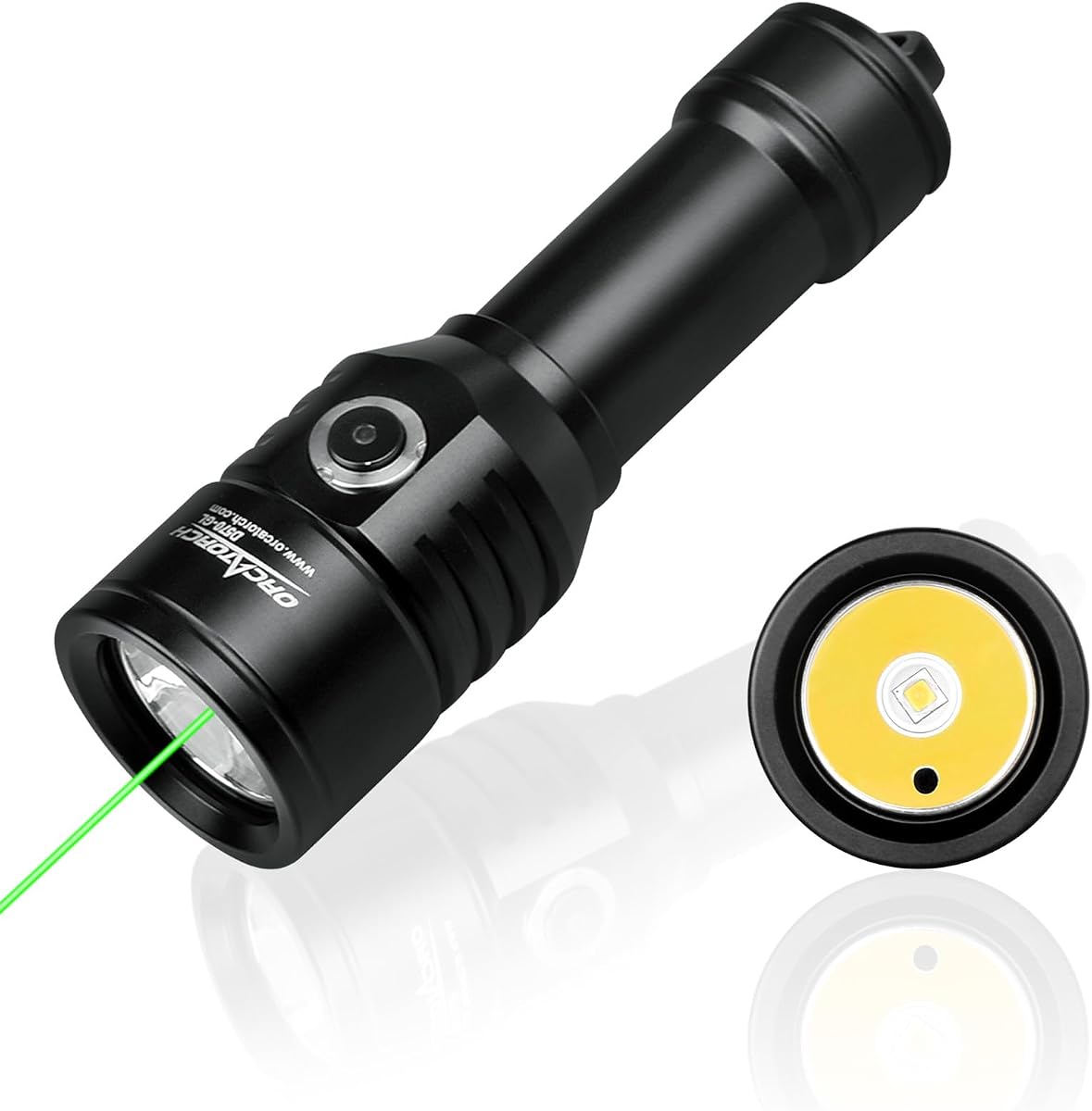
The ORCATORCH D570-GL 2.0 has a 4.6 rating and stands apart through its combination of 1500-lumen white illumination and a long-range green signal beam. Rather than functioning only as a conventional dive light, it is designed to illuminate targets while also helping guide teammates, identify locations, attract attention, or support underwater communication.
We may earn a commission when you buy through this link, at no additional cost to you.
The white beam has an eight-degree angle, keeping the illumination focused, while the green signaling beam is described as reaching 1000 meters. Its output is listed as Class IIIA and below 5mW. Independent controls allow a double-click for white light and a press-and-hold action for green, reducing the need to cycle repeatedly through a shared menu.
The aircraft-grade aluminum body is corrosion-resistant and rated to 150 meters. The main caveat is that the green beam is specialized: it is a communication and signaling tool rather than a substitute for broad white illumination. No standalone lithium batteries are included, so the purchased configuration should be checked carefully. The side switch also takes time to learn because each beam uses a different activation method.
This is a compelling recommendation for instructors, guides, technical divers, and buddy teams that need a visible way to communicate in dark water. It may be less attractive for a solo recreational diver who only wants a dependable white primary or backup light, but the added signaling function is unusually substantial.
The dedicated green beam is designed to guide divers and make a location more noticeable. It can complement a buddy system without requiring every team member to carry an additional signaling device.
Separate activation methods reduce accidental switching between white illumination and the green signal. Divers can select the required function quickly while wearing gloves.
We may earn a commission when you buy through this link, at no additional cost to you.
The supplied listing for ASIN B0GXTWHDTG contains no title, description, rating, image, or specifications. Because the product cannot be identified from the provided data, it would be misleading to invent a lumen rating, beam pattern, waterproof depth, or battery configuration.
We may earn a commission when you buy through this link, at no additional cost to you.
Potential buyers should open the listing and confirm whether it is genuinely a dive light rather than a general-purpose flashlight marketed for occasional underwater use. The relevant details include a stated depth rating, corrosion-resistant housing, covered controls, a secure attachment method, and an understandable beam pattern for the intended dive environment.
Battery details deserve equal attention. A built-in rechargeable cell, replaceable batteries, and a removable pack each have different implications for transport, charging, and long-term use. Divers should also inspect whether the stated maximum output comes with a realistic runtime at the lower modes they intend to use.
This entry cannot receive a positive recommendation without additional evidence. It is best treated as a listing to investigate, not a proven choice. If the live page fails to provide clear safety and performance information, choosing one of the models with documented beam, depth, mode, and control specifications would be the more responsible decision.
Start by confirming the model name and intended underwater application. A similarly positioned Amazon ASIN may change or redirect over time, so the present listing should be treated as the source of truth.
Look for a stated depth rating, appropriate beam, secure switch, and mounting option. Generic claims about water resistance do not establish suitability for night diving.
We may earn a commission when you buy through this link, at no additional cost to you.
The Wurkkos DL46 is built around very high output, reaching 20000 lumens with a stated illumination distance of 608 meters. Its 100 CRI is intended to reveal true underwater colors, while the 6061 aluminum body, anti-crash geometry, and IPX8 designation support its use in demanding environments, including the supplied information's stated 100-meter depth capability.
We may earn a commission when you buy through this link, at no additional cost to you.
Output is divided into three practical levels: 20000 lumens for high mode with a stated three-hour runtime, 5000 lumens for medium mode with five and a half hours, and 1000 lumens for low mode with 24 hours. A magnetic rotating ring changes power and mode, allowing relatively straightforward operation. A side color indicator communicates real-time battery status.
The obvious trade-off is energy consumption and potential glare. Maximum output may help reveal distant structure, but close-range use can wash out fine detail and shorten available operating time. A 24-hour low-mode figure makes the light far more practical for extended trips, although the full output specification is the feature likely to attract attention.
The DL46 is a good candidate for divers exploring caves, wrecks, or large underwater structures where serious output and long reach are priorities. It may be excessive for routine recreational diving or for situations where a compact, moderate-output backup would be easier to carry. The rotating control and dedicated handle also suit divers who prefer firm, immediate adjustment.
The three stated runtimes help match illumination to the dive. High mode prioritizes maximum visibility, medium balances output and duration, and low mode supports much longer exploration.
The magnetic rotating switch is intended for quick changes even under stressful conditions. Its simple sequence makes it easier to verify the selected mode before entering the water.
We may earn a commission when you buy through this link, at no additional cost to you.
The Underwater Kinetics C4 eLED is a more traditional dive light built around alkaline power, a rugged composite body, and a 575-lumen high setting. It carries a 4.4 rating and provides 200 lumens in low mode, where the stated runtime rises to 19 hours. That makes it a durable, endurance-oriented alternative to sealed rechargeable models.
We may earn a commission when you buy through this link, at no additional cost to you.
Its ergonomic pistol grip offers a secure and comfortable hold, which can be valuable for divers managing a regulator, a reel, or other equipment with one hand. A locking switch toggles between high and low output, reducing accidental changes during transport. HYDRALUM and engineering polymer components are described as capable of holding up for 20 years in seawater.
The main limitation is that 575 lumens is modest compared with the high-output lights in this guide, and the supplied information does not state a maximum operating depth. Divers must also plan for alkaline battery logistics rather than relying on a convenient built-in rechargeable cell. A fresh, matched set of alkaline batteries is important for predictable runtime.
The C4 is a sensible pick for divers who value established marine durability, simple controls, and long low-mode endurance over maximum brightness or modern charging convenience. It may also work well as a durable backup carried alongside a higher-output primary light, provided the depth rating and battery configuration are verified before the dive.
Nineteen hours of stated low-mode runtime provides a useful margin for longer trips. The low output is more appropriate for close-range orientation and conserving energy.
The pistol-grip design gives the light a natural place in the hand and can make it easier to aim while the other hand manages diving equipment. Its corrosion-resistant body is designed for prolonged seawater exposure.
We may earn a commission when you buy through this link, at no additional cost to you.
Choosing a night-diving light requires balancing beam reach, close-area coverage, underwater controls, depth resistance, battery strategy, and the specific environments you plan to enter. The most important rule is to evaluate the complete dive setup rather than selecting on brightness alone.
A narrow beam concentrates light into a bright target and is useful for examining distant wrecks, cave openings, cracks, and crevices. A wide flood illuminates a larger area close to the diver and can be more suitable for photography, reef observation, and navigating around structure. Some lights offer both through zoom, while others include separate spotlight and flood modes. Think about whether your priority is long-range penetration or broad, even coverage, and consider how a tight beam may behave in turbid water.
Choose a beam that matches the dive environment rather than selecting solely by the greatest stated distance.
Lumen ratings indicate total light output, but they do not fully describe beam quality, color rendering, runtime, or underwater usefulness. A very bright spotlight can reveal distant objects, while excessive output may create glare and rapidly consume the battery. Moderate outputs with several levels often prove more versatile because a diver can increase brightness only when distance or darkness requires it.
Prioritize usable output across multiple levels rather than treating the highest lumen figure as the only measure of quality.
A dive light should have a clearly stated maximum depth that covers the dive plan with an appropriate safety margin. IPX8 is a general water-resistance classification, but it does not communicate a precise operational depth in the same way as a stated 100- or 150-meter rating. Corrosion resistance, protected buttons, sealed battery compartments, and pressure-resistant construction also matter. A product described only as splash-proof or water-resistant is not automatically suitable for submerged recreational diving.
Check the stated depth and underwater rating, and never assume a general water-resistance label equals dive-depth protection.
A large, tactile switch is easier to find and operate with neoprene gloves. Some designs use a side button, others a rotating ring, and some provide separate actions for different functions. A lockout prevents accidental activation while the light is in a bag, attached to equipment, or carried through staging areas. Check whether locking requires a deliberate hold, how the lock is released, and whether the mechanism remains easy to operate underwater.
Select a control that is glove-friendly, easy to identify by touch, and protected against accidental activation.
Rechargeable lights offer convenience and are often paired with a status indicator, but a sealed battery pack cannot be replaced if it fails. Models using removable batteries may offer longer-term flexibility but require careful transport, matching, and inventory management. Compare runtime by mode, because headline figures usually refer to the lowest output. A night-diving light should ideally support enough duration in its useful lower mode to cover the planned dive plus reserve.
Choose a battery system that matches your charging access, travel rules, and need for a replaceable emergency reserve.
A secure wrist strap, clip, or lanyard can prevent a light from being lost, while a good handle allows precise beam positioning. Some dive lights are designed to attach to a Goodman handle for caves, wrecks, and technical dives. Consider whether the light will be carried in one hand, mounted on the wrist, or fixed to gear. Also account for bulk: a large high-output model may be less convenient on a recreational dive than a compact backup.
Evaluate how the light will be carried, secured, and aimed during the specific activities you expect to perform.
Useful lighting modes commonly include high, low, and an emergency signal, while more advanced products add continuous dimming, UV, red light, or a dedicated green signaling beam. Low mode preserves battery capacity, SOS supports emergency attention, and red light may offer a less conspicuous option for close observation. A zoomable beam can replace the need for both a spot and flood fixture, although it may add bulk and cost. Extra features should solve a real need rather than add avoidable complexity.
Favor modes and controls that improve safety, communication, or endurance without making routine operation unnecessarily complicated.
A high color-rendering index can make underwater subjects appear more natural, which is especially valuable for photography and biological observation. A balanced white beam helps reveal texture and shape. Accessories such as a storage case, USB cable, lanyard, manual, or mounting handle can improve organization and readiness, but the core light should still meet your depth, output, control, and runtime requirements. Check the included components because package contents can vary between listings.
Use beam quality and included accessories as finishing criteria after confirming that the light meets essential safety and performance needs.
Before the dive, read the current instructions, inspect the housing and controls, and confirm that the battery is charged or fresh. Test every mode on land, check the switch lock and release method, and make sure the beam is the correct orientation for your planned route. For a rechargeable model, charge the light fully before departure; for an alkaline model, carry the stated number of correctly matched cells and check the contacts.
Secure the light to your wrist, lanyard, or handle before entering the water, and confirm that it cannot snag on hoses, webbing, or cave formations. Begin with a lower setting when close visibility permits, then increase output for distant targets. Keep the beam moving rather than holding it directly in a teammate's eyes, and use the narrowest practical beam for distant objects. Preserve battery capacity by using the lowest mode that still provides a safe view of the exit, terrain, and equipment.
After the dive, switch the light off and engage any lockout before handling it with wet hands. Rinse the housing with fresh water, especially after use in salt water, and allow the seals and controls to dry before opening any compartment. Do not charge a rechargeable light while it is wet. Store it in a dry, protected place away from extreme heat, direct sunlight, and corrosive materials, and follow the manufacturer's battery, replacement, and maintenance instructions.
The required output depends more on beam concentration and dive conditions than on a single lumen threshold. A focused 575-lumen beam can be useful at close range, while thousands of lumens can help reveal distant wrecks or caves. For general night diving, a light with several output levels lets you use only as much brightness as the visibility requires. Consider beam angle, color quality, runtime, and water clarity alongside the lumen figure.
Carrying two independent lights is generally the safer approach for caves, wrecks, technical dives, and remote open-water dives. One should provide general or long-range illumination, while a compact backup remains accessible if the primary fails, becomes lost, or its battery is depleted. Each light should have an attachment method that prevents it from being dropped, and the backup should be checked before every dive.
A spot beam concentrates light into a narrow area and is designed to illuminate distant subjects or look into openings. A flood beam covers a wider area and is better for close-range orientation, photography, and viewing nearby surroundings. A zoomable model can shift between both, while multi-mode lights may provide separate spot and flood settings. The most useful choice depends on whether long reach or broad coverage is the priority.
IPX8 indicates strong water resistance, but it does not always provide a specific maximum depth. For diving, look for a stated underwater depth rating that covers your planned dive with an appropriate margin. Also confirm that the light is designed for underwater use rather than only accidental immersion. A clearly stated depth rating, sealed construction, and corrosion-resistant body provide more useful safety information than a generic waterproof claim.
Only use a light that is specifically designed and rated for underwater use. A regular flashlight may lack pressure resistance, corrosion protection, secure controls, and an appropriate switch design. It can also be difficult to turn on or operate with wet or gloved hands. A dive-rated model offers a stated depth limit and a body and battery arrangement intended for prolonged exposure to water and saltwater.
The useful duration should exceed the planned dive with a conservative reserve, especially in caves, wrecks, or remote locations. Runtime varies sharply by mode, so a quoted maximum generally refers to the lowest setting. Consider a light with a real-time battery indicator and use a moderate mode unless maximum reach is necessary. Divers should also carry a backup light with a separate, verified power source.
A lockout is useful because it prevents accidental activation during transport, staging, or storage. It can also preserve battery capacity when the light is not needed. Check how the lock is engaged and released, and ensure the mechanism can be operated with gloves. If a model lacks lockout, keep the light switched off and physically secure until it is ready for use.
A green signal beam can improve communication and help a team identify a location in dark water. It is especially useful for instructors, guides, and buddy teams that need to guide attention without continuously illuminating everything around them. It is a specialized function rather than a replacement for a good white beam, so divers should verify that the model provides both adequate illumination and straightforward controls.
The ORCATORCH D530 stands out as the most balanced focused-light choice, with 1500 lumens, a seven-degree beam, a 150-meter rating, and a 4.7 customer rating. The PFSN 3000 Lumens model is the practical budget selection for divers seeking high output, a lockable switch, and a battery indicator, while the ORCATORCH ZD710 MK2 is the premium option for exceptional beam flexibility.
Your priorities should guide the final decision. Choose a narrow beam for distant wrecks and cave openings, a broad flood for photography and close observation, and multiple modes for adaptable trips. Verify the stated depth rating, controls, battery arrangement, and runtime rather than relying on brightness alone. A backup light and a conservative power reserve remain sensible even when the primary fixture is powerful.
Finally, review the current Amazon listing before purchasing because product packages, availability, and pricing can change. Confirm that the listing matches the model discussed here and that the included battery, cable, lanyard, case, or mounting hardware is suitable for your dive plan.