
WVL 7400mWh Emergency Weather Radio
4.6Editor score
2000mAh phone charging capacity
Hand crank, solar, battery inputs
AM, FM, and NOAA reception
Flashlight and motion reading lamp
Discover the best hand crank radio cell phone chargers, comparing battery capacity, charging options, radio reception, lighting, size, and emergency features.
Hand crank radio cell phone chargers combine an emergency radio, portable power bank, flashlight, and weather receiver in one device. The strongest models offer useful battery capacity, dependable NOAA reception, multiple ways to recharge, and enough output to keep essential phones from going completely dark during outages.
This guide compares ten hand crank radio cell phone chargers using the specifications and feature descriptions supplied for each model. The comparison covers battery capacity, radio bands, charging methods, lighting, size, water resistance, display features, and emergency functions rather than relying on hands-on testing claims.
Each review explains where a particular radio excels and where buyers may need to compromise. The top picks highlight a budget model, a feature-rich overall choice, and a high-capacity premium option, while the complete list shows how smaller and larger emergency radios differ. Prices and availability can change.
4.6Editor score

4.7Editor score

4.7Editor score
The table below compares all ten radios by power capacity, charging flexibility, radio coverage, and physical scale, making it easier to identify the model that fits a compact kit, family emergency plan, or demanding outdoor use.



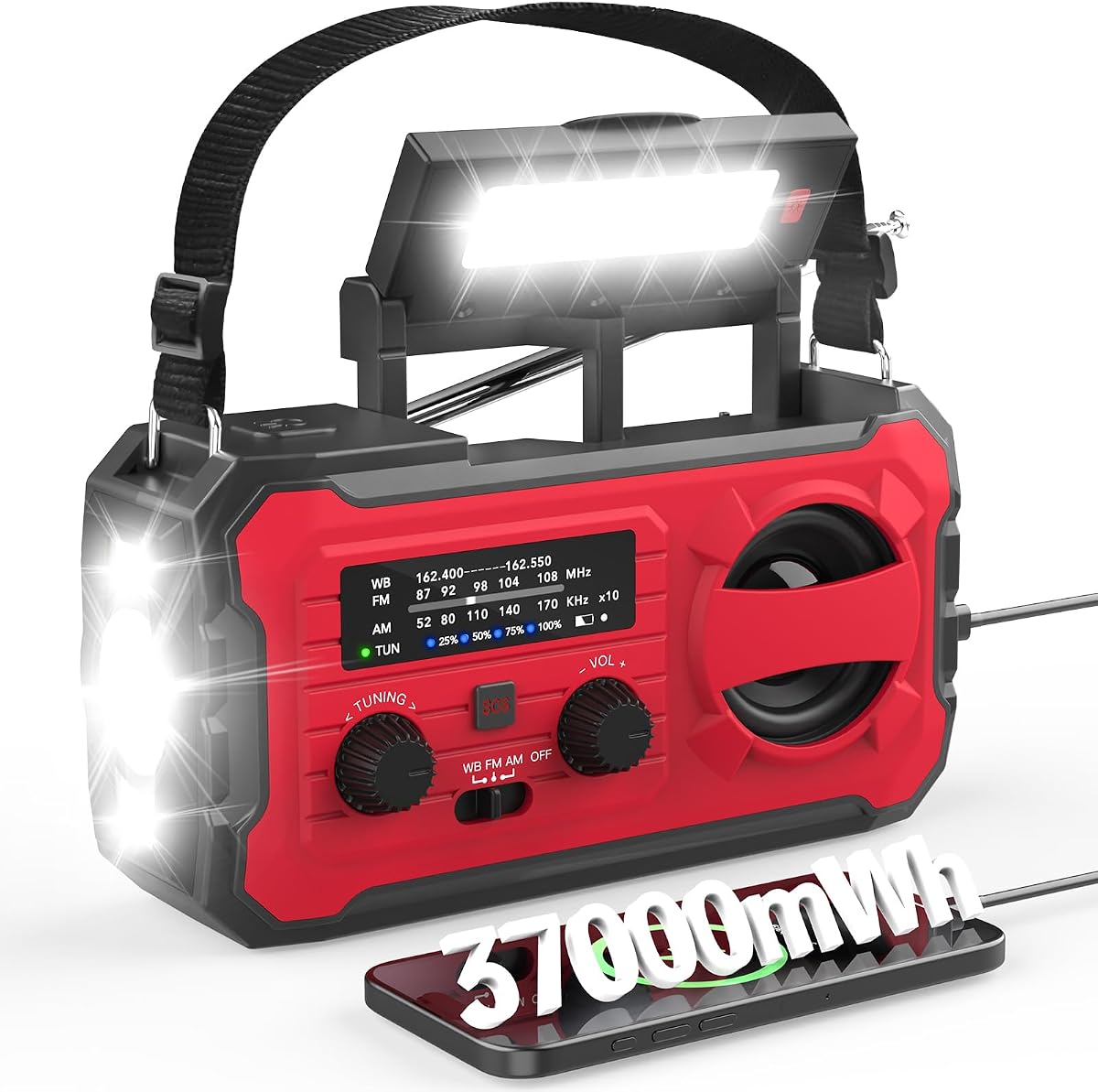

The WVL 7400mWh Emergency Radio combines a 2000mAh charging bank, AM/FM/NOAA receiver, hand-crank generator, solar panel, flashlight, reading lamp, and SOS siren in a housing measuring 130 by 50 by 60 millimeters. Its 4.6 rating reflects a balanced package for buyers who want more than a conventional power bank without carrying a large emergency unit.
We may earn a commission when you buy through this link, at no additional cost to you.
Its principal advantage is the combination of a 1.5-watt LED flashlight and motion-sensor reading lamp. The radio can be charged by hand crank, sunlight, or its built-in lithium-ion battery, reducing dependence on wall power when conditions become difficult. NOAA preset channels add practical storm coverage, while the SOS siren offers another way to attract attention.
The limitation is the comparatively small 2000mAh phone-charging capacity. It is best viewed as emergency support for essential communication rather than a substitute for a high-capacity power bank. The analog tuning system also lacks the frequency display and automatic scanning found on more sophisticated models.
This is a compelling choice for a go-bag, car kit, apartment emergency box, or compact hiking setup. Buyers who prioritize portability and broad utility should give it serious consideration, while households expecting to recharge several modern phones repeatedly may prefer a larger battery.
The radio packs several preparedness functions into a notably small and light enclosure. That makes it easier to keep accessible during a blackout instead of leaving it buried in a larger kit.
A bright spotlight handles urgent movement, while the motion-activated reading lamp provides convenient illumination without requiring someone to hold the radio.
We may earn a commission when you buy through this link, at no additional cost to you.
The Solar Radio Emergency Hand Crank 12000mAh is a strong all-around choice for buyers who need meaningful phone-charging capacity without moving to the largest emergency radios. Its 4.7 rating, 12000mAh battery, large solar panel, tuned crank, flashlight, reading lamp, and clear-signal radio design give it unusually broad utility.
We may earn a commission when you buy through this link, at no additional cost to you.
The 8500-square-millimeter monocrystalline solar panel is substantially larger than the decorative panels common in smaller products. An upgraded generator, reinforced magnet, larger copper coil, and extended crank arm are designed to make manual charging easier. The radio also uses a high-sensitivity signal chip, noise-reduction circuitry, and an extended antenna to improve reception.
Its 6.8 by 2.9 by 4.7-inch body and firm non-slip grip trade some pocketability for easier handling. The large tuning knob and clearly labeled buttons are beneficial in darkness or for older users. Flashlight and reading lamp brightness options add flexibility, although solar input speed still depends on sunlight and weather.
The radio is best suited to households, camping trips, and emergency kits where balanced capacity and operation matter more than minimum weight. It is our overall recommendation because it avoids the modest cell capacity of compact units while remaining less bulky than the largest 20000mAh designs.
A 12000mAh internal battery offers a more substantial reserve for phones and radio functions than entry-level 2000mAh models, making the unit more useful when an outage lasts beyond a brief emergency.
Noise reduction, a high-sensitivity chip, and an extended antenna support the radio's most important emergency function: delivering understandable weather and public-safety information when phone networks are unreliable.
We may earn a commission when you buy through this link, at no additional cost to you.
The Emergency Weather Radio with Large Solar Panel is another strong 12000mAh option, with an emphasis on outdoor durability and lighting. It holds a 4.7 rating and combines an 8500-square-millimeter monocrystalline panel, efficient hand-crank generator, NOAA alerts, phone charging, an SOS alarm, and IPX6 waterproof protection.
We may earn a commission when you buy through this link, at no additional cost to you.
Its 5-watt adjustable-beam flashlight is the standout lighting feature, while a soft 12-LED reading lamp covers lower-intensity tasks. The supplied information says the hand crank can support emergency calls, lighting, or news updates after one minute and that the radio offers five ways to charge, although the individual methods are not separately named in the description.
Buyers should note that water resistance does not make the radio suitable for immersion. The listing also uses broad language about charging performance, so checking the manual for compatible cables and exact output requirements before relying on it for a specific phone is advisable.
This model suits campers, hikers, boaters, and households wanting a durable radio with substantial capacity. It is particularly attractive when reliable lighting and resistance to rain splashes matter more than minimizing packed size.
An IPX6 rating adds useful confidence for camping and storm preparation because the radio is designed to tolerate heavier water exposure than basic splash-resistant models.
The adjustable-beam flashlight can illuminate a path or work area, while the separate reading lamp offers softer illumination for maps, documents, and close-range tasks.
We may earn a commission when you buy through this link, at no additional cost to you.
The Hand Crank Emergency Radio 7400mWh distinguishes itself with three integrated charging cables for Lightning, USB-C, and Micro USB devices. Its 4.6 rating and collection of NOAA reception, four charging options, three-mode flashlight, six-LED reading light, and SOS alarm make it a practical choice for mixed-device emergency kits.
We may earn a commission when you buy through this link, at no additional cost to you.
Keeping the cables attached solves a common practical problem: finding the right adapter during a blackout. The radio can be charged through USB-C, its hand crank, its solar panel, or AAA batteries, giving it multiple levels of resilience. An extended antenna and DSP chip support AM, FM, and weather-band broadcasts.
Its phone-charging capability is limited by the 2000mAh internal bank, although the radio's overall battery is advertised at 7400mWh. It is better for preserving a phone's remaining charge and making urgent calls than for replenishing several devices continuously.
This is a good match for households carrying several generations of devices or travelers who want cables already attached. It offers more charging flexibility than a basic compact radio, but buyers who anticipate frequent phone use may want a model with a larger power bank.
The permanently attached Lightning, USB-C, and Micro USB leads are unusually practical because the most frustrating part of emergency charging can be finding a compatible cable in darkness or disorder.
USB-C, hand crank, solar, and AAA battery inputs reduce the likelihood that one unavailable charging method will leave the radio completely useless.
We may earn a commission when you buy through this link, at no additional cost to you.
The Emgykit Hand Crank Radio prioritizes portability in a straightforward emergency package. It measures 5.1 by 2.1 by 2.4 inches, weighs 0.51 pounds, and carries a 4.6 rating. Its core functions include AM/FM/NOAA reception, a 2000mAh rechargeable battery, phone charging, a flashlight, and an SOS alarm.
We may earn a commission when you buy through this link, at no additional cost to you.
The upgraded three-LED flashlight produces 140 lumens, a meaningful improvement over many basic single-LED units. Its three charging methods—hand crank, solar panel, and Type-C input—give the radio useful redundancy, while the SOS siren exceeds 80 decibels according to the supplied feature description.
The main limitation is capacity. Its 2000mAh battery can help with essential phone use, but it cannot provide the reserve of a 10000mAh or 20000mAh model. It also lacks a digital screen, advanced weather scanning, and a high-capacity solar array.
This radio works well as a lightweight backup in a jacket pocket, desk drawer, office bag, or vehicle kit. It is best for buyers who prioritize radio, lighting, and alarms over extended phone-charging sessions.
The compact dimensions and listed weight make this model convenient for a personal emergency kit where every bit of space and carrying comfort matters.
A high-output flashlight and loud siren provide visible and audible signals that can help attract attention when someone is stranded or navigating darkness.
We may earn a commission when you buy through this link, at no additional cost to you.
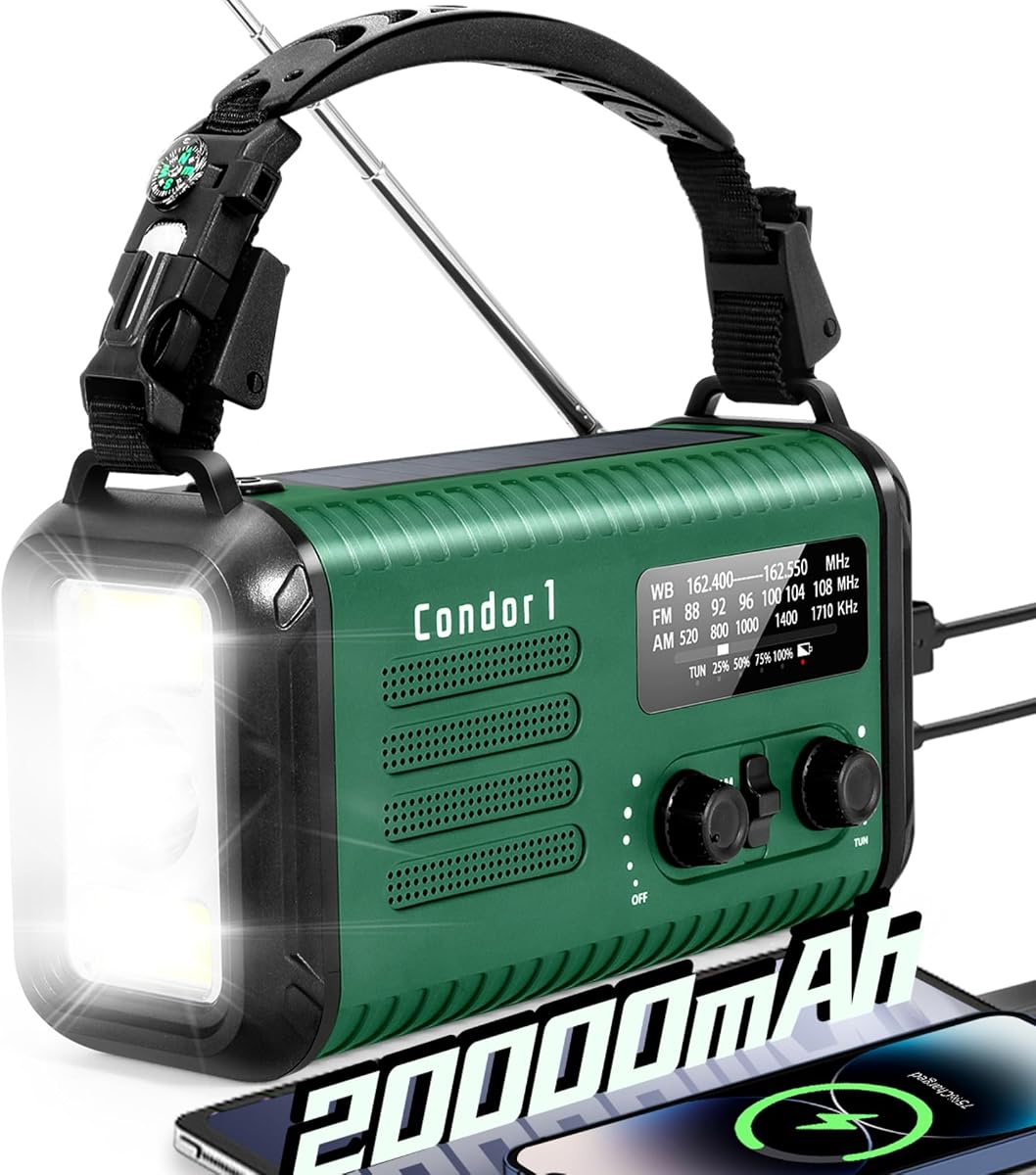
The iRonsnow Condor 1 is built for buyers who want the radio to function as a substantial emergency power source. Its 4.4 rating accompanies a 20000mAh rechargeable battery, support for charging two mobile devices at the same time, NOAA/AM/FM reception, a bidirectional USB-C interface, and multiple solar and crank functions.
We may earn a commission when you buy through this link, at no additional cost to you.
Its 74000mWh stated battery energy and ability to run the radio, lights, alarm, and devices make it a credible choice for family outages. The survival handle integrates a compass, cutter, whistle, and fire starter, while a 3.5-millimeter headphone jack supports quieter listening.
The trade-off is size and weight. At 1.8 pounds and 6.93 by 3.94 by 3 inches, it is bulkier than portable models. Its IPX3 rating also trails the stronger water-resistance claims of the IPX6 options. These details matter for rain-prone camping and storm-prone locations.
This radio is most suitable for a household command center, garage, cabin, or vehicle rather than a lightweight hiking kit. It is the option to consider when simultaneous device charging and a generous internal reserve outweigh portability.
The 20000mAh battery offers a larger safety margin than most competing radios, which can be valuable when a household needs multiple communications devices kept online.
Compass, cutter, whistle, and fire-starting functions make the carry handle more than a handle, although buyers should still maintain a separate comprehensive survival kit.
We may earn a commission when you buy through this link, at no additional cost to you.
The Raynic Emergency Radio combines a 5000mAh battery with a large HD LCD display, digital tuning, and automatic NOAA scanning. Its 4.5 rating reflects a feature-rich design that is particularly useful for users who want visible frequency and battery information rather than navigating an analog dial.
We may earn a commission when you buy through this link, at no additional cost to you.
Automatic scanning checks for emergency and weather alerts when the radio is switched on or placed in standby. The display shows battery level and tuning frequency, while AM/FM/SW/weather-band coverage expands entertainment and information options. The description lists six charging approaches, including the internal battery.
Phone output is respectable for emergency use but lower than that of the 12000mAh and 20000mAh models. The unit also weighs 1.2 pounds, so it is better suited to a home or campsite than an ultralight personal carry. Headphone support is helpful when shared spaces require quiet monitoring.
This model is a good choice for older users, families, and anyone who values a clear screen and automatic warnings. Buyers needing repeated high-volume phone charging should select a larger bank.
The screen makes the radio easier to monitor in low light and gives users a visible indication of the selected frequency and remaining battery level.
Automatic alert scanning can notify users of emergency broadcasts while the radio is in standby, reducing the need to listen continuously.
We may earn a commission when you buy through this link, at no additional cost to you.
The NITIGO Weather Radio offers a balanced alternative between compact 2000mAh radios and larger 20000mAh models. It has a 4.7 rating, a 10000mAh battery, NOAA and AM/FM reception, solar, hand-crank, and USB charging, phone output, an SOS alarm, and dual lighting functions.
We may earn a commission when you buy through this link, at no additional cost to you.
Its adjustable high-gain antenna is designed to improve reception across indoor, outdoor, and remote settings. A retractable 180-degree reading lamp provides flexible positioning, while an ultra-bright LED flashlight handles more demanding illumination. A flashing light accompanies the audible alarm for greater visibility.
The 10000mAh reserve is adequate for meaningful emergency phone support and operating the radio and lights, though it will not match a high-capacity unit during prolonged use. The listing also provides fewer details about solar-panel size and water resistance than some competing descriptions.
NITIGO is a solid middle-ground recommendation for campers, renters, and families seeking more capacity than a pocket radio without carrying the largest model. It should be fully charged and tested before it is placed in an emergency kit.
The 10000mAh battery creates a useful middle tier, giving buyers more reserve than compact models without moving directly to the largest emergency power banks.
The 180-degree rotating lamp can be aimed toward a book, work surface, or another person, making the radio more versatile than a fixed downward light.
We may earn a commission when you buy through this link, at no additional cost to you.
The 20000mAh Hand Crank Emergency Radio is the premium choice in this guide, combining a large battery with extended reception, sophisticated lighting, and strong portability credentials. Its 4.7 rating and feature set target campers, households, and remote travelers who want the radio to double as a substantial emergency power bank.
We may earn a commission when you buy through this link, at no additional cost to you.
The radio supports NOAA, AM, FM, and shortwave reception through a 20.5-inch telescopic antenna and noise-reduction chip. A digital display and four-level power indicator help manage energy, while a 3-watt spotlight and 96-LED low-blue reading lamp cover different lighting needs. The supplied description also notes a 120-decibel SOS siren and reflective rescue strap.
Its 20000mAh polymer battery is listed as capable of charging an iPhone 14 Pro up to five times, while five minutes of cranking is described as equivalent to 30 minutes of emergency calls. Actual output and conversion efficiency depend on the phone, cables, usage, and operating conditions, so those figures should be treated as product claims rather than guaranteed results.
At one pound with IPX6 protection and a detachable carabiner, this is a premium pick for serious backup power, outdoor trips, and communication during outages. The main caution is that fully replenishing such a large battery takes time, so it should remain topped up before an emergency.
The 20000mAh battery substantially increases the number of phone charges available compared with compact radios, making the device useful for more than one brief emergency call.
A long telescopic antenna and shortwave coverage give the radio more flexibility for outdoor locations and users who want access beyond standard AM, FM, and NOAA programming.
We may earn a commission when you buy through this link, at no additional cost to you.
The Kaito KA500 is a traditional multi-power emergency radio with a broad mix of reception options and charging methods. Its 4.5 rating reflects a capable design offering AM, FM, two-band shortwave, seven NOAA channels, phone charging, a flashlight, reading lamp, and red SOS beacon.
We may earn a commission when you buy through this link, at no additional cost to you.
Power can come from the hand crank, solar panel, three AA batteries, 5-volt USB input, 5-volt AC/DC input, or the built-in replaceable NiMH battery pack. The 14.5-inch telescopic antenna and signal-strength indicator support precise tuning, while the built-in speaker is designed for clear, loud output.
Its phone-charging function uses a standard 5-volt USB output, making it broadly useful with compatible cables. The replaceable NiMH pack is a notable advantage because it can be serviced, although the AA batteries and wall adapter are not included. Impact-resistant, water-resistant ABS supports indoor and outdoor use.
The KA500 suits buyers who value proven-style analog operation, broad radio bands, and flexible power inputs. It is less modern than models with digital screens and automatic alert scanning, but that straightforward design can be easier to operate during a stressful outage.
Six power configurations allow the radio to continue operating across several different failure scenarios, including loss of wall power, depleted internal energy, or limited sunlight.
The replaceable NiMH pack offers a practical alternative to radios with a permanently sealed battery, allowing owners to maintain or replace the energy source when needed.
We may earn a commission when you buy through this link, at no additional cost to you.
The right emergency radio depends on how much power you need, how quickly you can recharge it, where it will be used, and which communication functions matter most. Comparing these factors prevents a buyer from choosing a compact novelty radio when a serious outage kit demands greater resilience.
Battery capacity determines whether the radio is a light emergency supplement or a dependable multi-day power source. The listed models range from a 2000mAh phone-charging bank to 20000mAh internal batteries, with the WVL and Raynic also expressed in watt-hours. Higher capacity generally means more phone runtime, more radio and lighting use, and fewer charging interruptions, but it also tends to increase size, weight, and recharge time. Compare usable output carefully because battery energy, port output, conversion losses, and device requirements are related but not identical measurements.
Choose a smaller bank for a vehicle or personal backup and a larger capacity for households, cabins, camping, or extended outages.
A hand crank is valuable because it does not require electricity or sunlight, while solar supports unattended maintenance and USB or Type-C input allows normal charging before an emergency. Some models add replaceable AA batteries, another wall adapter, or additional input methods. A real emergency plan should not depend on one source, so radios with at least three paths are generally more resilient. Before relying on a unit, check whether the radio can be charged while it is simultaneously used to charge a phone.
Prioritize diverse inputs, then pre-charge the unit through the fastest dependable method.
NOAA weather reception is the defining feature of an emergency weather radio, while AM and FM add useful news, talk, sports, and entertainment. Shortwave can be valuable for travel and remote communication. Reception quality depends on the antenna, tuning system, signal chip, and noise-reduction circuitry as well as the user's location. Digital displays, automatic scanning, signal-strength indicators, and preset NOAA channels improve usability, but analog radios can be simpler to operate.
For warning readiness, look for NOAA coverage, an extended antenna, and automatic alert scanning when your situation values unattended warnings.
Emergency radio power banks usually use USB-A, USB-C, or proprietary integrated cables. A phone may charge slowly, partially, or not at all if the radio lacks the correct voltage and current output or the required cable. Built-in Lightning, USB-C, and Micro USB leads are particularly helpful because users will not have to search for an adapter during darkness. Always verify the output specifications, connector type, and charging protocol compatibility before an emergency.
Carry a known-compatible cable and confirm the phone accepts charging from the radio before relying on it.
A radio becomes more useful when it can illuminate a dark room, guide someone along a path, or display a map. Separate flashlight and reading lamps offer different brightness levels and beam patterns. Motion sensors, adjustable beams, rotating arms, and multiple brightness modes improve flexibility. An SOS alarm and flashing beacon add an audible and visual distress signal, which may be more noticeable than a flashlight alone. Check claimed lumen or wattage figures when available, but also consider beam reach and runtime.
Choose strong directional light for navigation, softer reading light for close tasks, and an SOS signal for attracting attention.
A large battery is not always more useful if the radio is too heavy to carry or awkward to store. Compact units weighing around half a pound suit pockets and personal kits, while radios above one pound are better suited to vehicles, homes, campsites, or carry handles. Water-resistance ratings also vary: IPX3 indicates splash protection, while IPX6 is designed for heavier rain exposure. Neither rating implies the radio should be submerged.
Match size to the location where it will actually live and choose water protection appropriate for exposure to rain.
Digital frequency displays, automatic scanning, large tuning knobs, illuminated buttons, and battery indicators can make a radio much easier to operate in darkness or stress. Analog models may cost less and reduce control complexity, but they require more attention while tuning. A large display is especially helpful for elderly users or anyone who may need to find a station quickly. Ensure labels are legible and controls can be distinguished by touch when necessary.
Choose digital alerts and displays for quick situational awareness or simple analog tuning for fewer controls.
Some emergency radios include survival handles with compasses, whistles, cutters, and fire starters, while others include headphone jacks, rescue straps, or carabiners. These additions can be convenient, but no single radio replaces a complete first-aid kit, water supply, food, light, and communication plan. Assess extras by reliability and portability rather than assuming every added tool will be useful. A dedicated survival item should still have an appropriate role in a broader emergency kit.
Treat extras as useful supplements, and prioritize radio reception, lighting, and charging reliability first.
Before an emergency, fully charge the radio through its fastest reliable charging input, then verify that its battery indicator, flashlight, radio tuning, SOS alarm, and device-output port all work. Test it again periodically because stored rechargeable batteries lose charge over time. Keep the radio accessible, identify the local NOAA channels, and make sure every family member knows how to switch it on and obtain a forecast.
During a power outage, use the radio for timely weather and public-safety information rather than relying on it as the only source of news. Conserve energy by limiting brightness and listening time, and switch the radio off when it is not needed. Use its USB output for essential phone communication, rotating between essential devices when capacity is limited. The hand crank should be treated as a reserve input because extended manual charging consumes effort.
Keep the device dry, clean, and away from extreme heat. After outdoor use, remove any visible moisture from the exterior before storing it, and do not charge a wet radio unless its instructions explicitly permit it. Inspect cables, ports, and the crank for damage, and follow the manufacturer's guidance for battery replacement and solar-panel care.
No. It depends on the radio's output voltage, current, port type, cable, and the phone's charging requirements. Some models include built-in cables for Lightning, USB-C, and Micro USB, while others require a compatible USB cable. Test the radio with your intended devices before an emergency and never assume every USB port supplies suitable power.
A 2000mAh bank is best treated as short-term communication backup, while 10000mAh to 12000mAh models offer a more practical reserve for several uses. A 20000mAh radio is better suited to households or prolonged outages. Actual phone gains vary because of conversion losses, phone size, and usage, so battery capacity should be considered alongside the number of devices involved.
Usually not when the device is needed quickly. Solar is excellent for gradual maintenance charging between emergencies, especially with a large high-efficiency panel. The hand crank provides a faster manual option, while USB or Type-C charging is generally the most practical way to fill the battery before an event. Keep at least two replenishment methods available.
NOAA weather reception, a clear loudspeaker, a long antenna, alert scanning, and a loud SOS siren are especially valuable. Battery capacity and phone output help maintain emergency communication, while flashlight and reading lamp functions provide light after power loss. Water-resistant construction also matters if the kit may be exposed to rain or flooding.
Most can charge one connected device at a time, although the iRonsnow Condor 1 is specifically described as supporting two devices simultaneously. Simultaneous charging can also consume the battery faster and may share available output. Confirm the number of output ports and total output rating before planning a multi-device charging strategy.
Yes. Cellular networks and phone power can fail during severe weather, while a dedicated NOAA radio can continue receiving local forecasts and hazard alerts. It can also provide information when mobile data is congested or users cannot charge their phones. A radio should supplement, not completely replace, emergency notifications and official instructions.
Check the battery and basic controls every few months and perform a fuller test before storms or travel. Confirm that the radio receives stations, the flashlight and reading lamp illuminate, the alarm sounds, and the phone output works with your actual cable. Recharge the unit promptly after testing so it remains ready for use.
It depends on where the radio will be used. A home or vehicle kit may be adequately served by a basic splash-resistant model, while camping, boating, or storm preparation benefits from an IPX6-rated unit. Even higher water-resistance ratings do not make a radio waterproof for immersion, so it should still be protected from submersion.
The WVL 7400mWh Emergency Radio stands out as the budget choice because it combines a compact body, 2000mAh phone output, three charging methods, NOAA reception, and useful lighting. The Solar Radio Emergency Hand Crank 12000mAh is the most balanced overall recommendation, while the 20000mAh Hand Crank Emergency Radio provides the strongest premium reserve and advanced outdoor features.
Prioritize the functions your family or trip actually needs. Compact buyers should focus on basic radio, light, and signaling capability; households should examine battery capacity and phone output; campers should consider water resistance, antenna length, and solar size. Buy the largest radio only when its weight and charging demands will not discourage you from maintaining it.
Current prices, availability, and product details can change, so check the current listing and manufacturer information before purchasing. Regardless of the model selected, charge it fully, test every function, learn how to tune NOAA channels, and keep it in a designated emergency kit rather than allowing it to gather dust.