
J-B Weld 50132 PlasticWeld
4.5Editor score
Five-minute set time
3900 PSI tensile strength
Syringe simplifies 1:1 mixing
Our hard plastic glue guide compares ten fast-setting, two-part, brush-applicator, and gap-filling adhesives for models, toys, household repairs, and DIY
Hard plastic glue can be difficult to choose because plastic surfaces vary widely in composition, texture, and resistance to solvents. A useful adhesive must provide enough working time for alignment, penetrate small joints, and form a durable bond without leaving an objectionable stain or brittle residue.
We compared the ten options in this guide by examining their stated adhesive chemistry, cure times, applicator design, material compatibility, gap-filling ability, and suitability for detailed or larger repairs. The list covers two-part epoxies, cyanoacrylates, brush-applicator formulas, and multifunctional hard plastic adhesives.
Each pick highlights the type of repair for which it appears best suited, along with important limitations from the available product information. Ratings and product details reflect the supplied listings, while availability and prices can change, so readers should confirm current details before purchasing.
4.5Editor score
4.6Editor score

4.2Editor score
The comparison below places all ten adhesives side by side, emphasizing adhesive type, working method, cure profile, and practical repair use. Because no two plastics or joint designs are identical, the best choice depends on surface compatibility, precision requirements, and how much handling strength the repair needs.


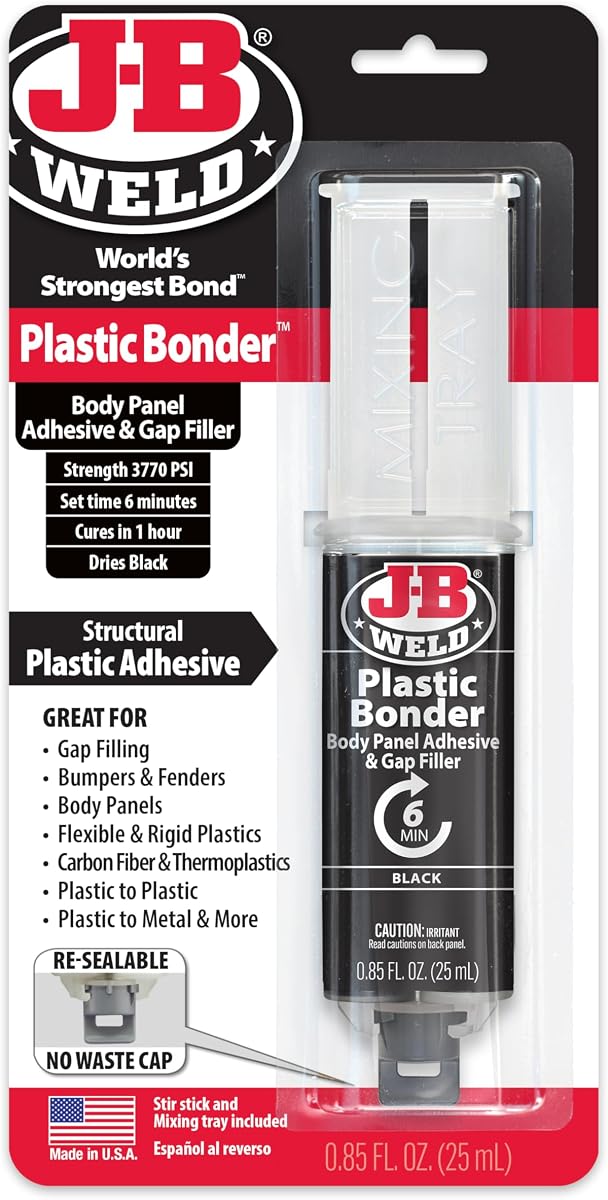
The J-B Weld 50139 Plastic Bonder is a two-part polyurethane adhesive and gap filler with a 4.6 rating. It stands out in this category because it is designed to create a strong, lasting repair while accommodating more than one type of plastic. Its stated applications include thermosets, carbon fiber composites, thermoplastics, coated metals, concrete, plastic, and PVC.
We may earn a commission when you buy through this link, at no additional cost to you.
The formula provides a more forgiving repair window than many cyanoacrylate products. It sets in 15 minutes, can be sanded after 30 minutes, and is advertised with a tensile strength of 3770 PSI. The black color may also be advantageous when filling visible dents or reconstructing a dark plastic body panel, although the repair area may remain noticeable on light-colored parts.
The main trade-off is the requirement to mix the two components accurately at a 1:1 ratio. A rushed or uneven mixture can produce inconsistent results, so careful measuring and thorough mixing are essential. The cure time is also much longer than that of instant adhesive products. Despite these requirements, the combination of gap filling, sanding, strength, and broad material compatibility makes this a compelling general-purpose option.
Choose the 50139 when the repair may involve a sizable plastic component, a small dent, or a joint that needs both adhesion and gap filling. It is less convenient for a model assembly that must be fixed within seconds, but it offers a more deliberate and structurally capable bonding process. For those needs, it is our most balanced overall selection.
The advertised 15-minute set time gives users more opportunity to position components than a typical instant adhesive. That extra time is useful when a joint needs careful alignment or when the repair involves more than one piece of plastic.
This product is more than a simple joint adhesive because it can fill dents and gaps while forming a hard bond. The black finish also makes it easier to see where material has been added, particularly on dark components.
We may earn a commission when you buy through this link, at no additional cost to you.
This Super Glue All-Purpose Liquid is a 50-gram cyanoacrylate adhesive with a 4.6 rating. Its most attractive feature is the combination of a substantial container and an instant repair profile. The listing positions it for everyday household work as well as heavy-duty industrial tasks, making it a versatile choice for users who expect to make repeated repairs.
We may earn a commission when you buy through this link, at no additional cost to you.
The formula reaches maximum handling durability in seconds and dries clear on most materials. That rapid cure can be a major advantage for small household objects, decorative pieces, and detailed crafts where waiting for a two-part epoxy would interrupt the work. An anti-clogging safety cap supports consistent dispensing and helps protect the remaining adhesive during storage.
Fast-setting chemistry also creates the main limitation. Cyanoacrylate leaves little time to reposition parts after application, and excess adhesive can be difficult to manage around visible surfaces. The product is presented as a liquid instant adhesive rather than a gap filler, so it is less suitable for rebuilding missing material. The large supply and low-viscosity convenience outweigh these constraints for quick, precise assembly tasks.
This adhesive makes sense for users who want a generous bottle of clear instant glue for many separate projects. It is especially attractive for decorative items, small components, and rapid household repairs where the joint is already well aligned. Buyers should prepare the surfaces and parts before opening the bottle.
The 50-gram capacity is larger than the tiny tubes commonly associated with instant adhesives. It is a practical format for workshops, craft areas, and households where a single repair is unlikely to be the only project.
A crystal-clear finish helps the repaired area blend into decorative and household objects. It is especially useful when appearance matters, although the user should still remove excess adhesive before it cures.
We may earn a commission when you buy through this link, at no additional cost to you.
The J-B Weld 50133 Plastic Bonder is a tan, two-part polyurethane adhesive and gap filler with a 4.6 rating. It offers a broad list of compatible surfaces, including thermosets, carbon fiber composites, thermoplastics, coated metals, plastic, PVC, concrete, ceramic, tile, fiberglass, and aluminum.
We may earn a commission when you buy through this link, at no additional cost to you.
Its syringe format makes the 1:1 mixing ratio easier to control, while the re-sealable cap helps prevent leaking and drying between uses. After mixing, the adhesive sets in 15 minutes and reaches full cure in 30 hours. The listed 3770 PSI tensile strength reinforces its positioning as a structural repair option rather than a temporary assembly adhesive.
The long full-cure period and tan color are the primary considerations. A repair should not be treated as fully finished immediately after the initial set, particularly if it will experience stress. Tan can blend well with natural, beige, or unfinished surfaces but may be more visible than the black version on dark components. For body-panel work, visible appearance, and mixed-material projects, however, the versatility is difficult to overlook.
This is a strong choice for DIY users repairing bumpers, filling dents, restoring plastic parts, or joining plastic to another listed substrate. It suits projects where strength and filling matter more than an immediate cure. Those willing to follow the mixing and cure schedule receive a dependable, multipurpose bonding system.
Dispensing equal amounts directly from a syringe simplifies the 1:1 mixing process. A re-sealable cap also makes the product more practical for multiple repair sessions than a disposable mixing tray alone.
The compatibility list extends beyond plastic into PVC, fiberglass, aluminum, ceramic, concrete, and coated metals. That makes it useful for mixed assemblies that would require several separate adhesives.
We may earn a commission when you buy through this link, at no additional cost to you.
The Loctite Super Glue Plastics Bonding System is a clear, two-part system comprising adhesive and activator. Its 4.2 rating is lower than those of the other products in the guide, but its specialized treatment of difficult plastics gives it a clear technical purpose. The listed compatible substrates include polyethylene, polypropylene, and PTFE.
We may earn a commission when you buy through this link, at no additional cost to you.
The activator primes the surfaces before the cyanoacrylate adhesive is applied. According to the product information, the system requires no mixing or clamping and dries transparent in seconds, which makes it particularly useful when a repair involves smooth, low-surface-energy plastic that can defeat ordinary instant glue.
Compared with conventional two-part epoxies, the system avoids manual proportioning and gives fast handling strength. The trade-off is the need to apply the activator correctly, and the package contains less adhesive than several larger options. Its transparent cure is discreet, while its stated resistance to water, most chemicals, and freezing temperatures supports use in demanding conditions.
This system is best for users who know they are working with PE, PP, PTFE, or another hard-to-bond plastic. It is less convenient than a single-bottle glue but more purposeful than buying a general adhesive and hoping it will wet the surface. Its activator-based approach earns it a place as the guide's premium specialty pick.
The activator treatment is designed for plastics that are notoriously difficult to bond. This makes the kit more suitable for selected PE, PP, and PTFE parts than a standard all-purpose cyanoacrylate.
The transparent adhesive sets in seconds and requires neither mixing nor clamping. It is a practical option for quick repairs where the bonded area should remain visually unobtrusive.
We may earn a commission when you buy through this link, at no additional cost to you.
The GH1200 Plastic Glue is a fast-setting cyanoacrylate with both a brush and nozzle, rated 4.5 by customers. Its defining feature is application control: the fine brush is designed for precise placement, while the nozzle can dispense more adhesive or cover a broader surface area.
We may earn a commission when you buy through this link, at no additional cost to you.
The product sets between 10 and 45 seconds, making it suitable for toys, ABS and PVC models, 3D-printed figures, and other detailed plastic work. It is also described as waterproof and temperature resistant, and its clear finish is intended to avoid obvious staining. The dual applicator design is particularly useful when a project includes both a small seam and a slightly larger joint.
The listing includes an important limitation: it does not work on hard plastics such as plastic bags or containers. In addition, although the bond gains handling strength rapidly, the recommendation is to allow 24 hours for a better final result. The brush also requires care to avoid fraying or picking up excess glue. These limitations narrow its use compared with a broad-purpose two-part system.
Buyers should choose this GH1200 for detailed plastic models, miniatures, toys, and manageable household plastic parts when the surfaces fit its stated compatibility. It is not the right pick for the toughest hard plastics, but its brush-and-nozzle design gives it excellent control for fine assembly work.
The built-in brush places a controlled amount of adhesive along a seam or into a small joint. That can reduce overflow when joining detailed model components compared with a free-flowing nozzle.
The precision nozzle is useful when more adhesive is needed or when the repair area is too broad for the brush. Having both options in one container simplifies changing application methods during a project.
We may earn a commission when you buy through this link, at no additional cost to you.
Gorilla Super Glue Gel XL is a 25-gram clear gel formulated for controlled applications. With a 4.6 rating, it offers the strong customer response associated with several leading choices in this guide, while its thicker consistency differentiates it from ordinary liquid super glue.
We may earn a commission when you buy through this link, at no additional cost to you.
The no-run gel is intended for precision repairs and vertical surfaces where a thin liquid adhesive may run out of place. It sets in 10 to 45 seconds, requires no clamping, and reaches full cure in 24 hours. The product also uses Impact Tough technology to increase impact resistance and strength, and it dries without the foaming or residue associated with some less controlled formulas.
Its stated material range includes glass, plastic, wood, metal, ceramic, rubber, leather, and paper, which makes it more broadly useful than a plastic-only formula. The gel consistency can be less effective than a thin adhesive in very narrow capillary joints, however, and the metal pin in the anti-clog cap should be kept clean. The 24-hour full-cure period also requires patience after initial handling strength develops.
This Gorilla gel is an excellent option when the joint is vertical, the repair area is visible, or a runny adhesive would be inconvenient. It is also useful for general household work involving several materials. For tiny, deeply mating model parts, a low-viscosity liquid may be easier to position, but for controlled everyday repairs this gel offers a persuasive combination of features.
The thicker gel stays closer to the application point instead of quickly running downward. That behavior makes it more suitable for hanging or upright plastic components than a thin liquid formula.
The anti-clog cap creates an airtight seal and includes a metal pin intended to keep the nozzle open. This design supports smoother, more consistent use across multiple repair sessions.
We may earn a commission when you buy through this link, at no additional cost to you.
The Plastic Super Glue Liquid is a clear, fast-drying cyanoacrylate developed for plastic repair and rated 4.5. Its specific applications include toys, models, ABS, acrylic, 3D-printed parts, and eyeglass frames, giving it a strong identity as a detail-oriented adhesive rather than a generic household glue.
We may earn a commission when you buy through this link, at no additional cost to you.
Precision tips help place a controlled amount of adhesive into tight spaces and intricate joints. The anti-clog cap is intended to preserve smooth flow between uses, and the product is also advertised for bonding plastic to ceramic, glass, wood, and metal. It can handle uneven, rough, or vertical surfaces, which broadens its use beyond perfectly flat model parts.
As with other instant cyanoacrylates, the fast setting creates a tradeoff: parts must be aligned before application, and the bond should be allowed to develop fully before stressing it. The product information describes professional-grade strength and durability, but it does not give a numerical cure time or tensile figure. The listed plastics are examples rather than a universal compatibility guarantee, so unknown surfaces should be checked carefully.
This liquid glue is a strong choice for model kits, miniatures, 3D-print corrections, toys, and detailed household projects where narrow, controlled application is valuable. It is less suitable when substantial repositioning is needed or when the joint requires gap filling. For precise visual work, however, the dedicated tips and clear finish make it particularly attractive.
Narrow tips are useful for fixing small details and feeding adhesive into joints that are difficult to reach with a standard nozzle. The clear formula also helps preserve the appearance of finished models.
The ability to join plastic with ceramic, glass, wood, and metal makes this useful for more than scale models. It is convenient for small craft and household assemblies that combine several materials.
We may earn a commission when you buy through this link, at no additional cost to you.
The GH1200 Brush Super Glue is a clear cyanoacrylate that combines a fine brush applicator with a nozzle and carries a 4.6 rating. It is designed as a general household adhesive for plastic, rubber, metal, ceramic, pottery, jewelry, toys, and other objects, making it broader in application than the plastic-focused GH1200 option.
We may earn a commission when you buy through this link, at no additional cost to you.
Its main advantage is the ability to choose between a brush for controlled placement and a nozzle for greater dispensing. The product is advertised as resistant to drying out and as capable of smooth, repeatable flow. It sets in 10 to 40 seconds, dries clear, and forms a permanent, weather-resistant bond according to the listing. These qualities make it appealing for visible household repairs and mixed-material projects.
The listing recommends allowing 24 hours for the cure to mature, so rapid handling strength should not be confused with full cure. Cyanoacrylate can become brittle when used incorrectly, and the fine brush may pick up residue if it is not cleaned after repeated applications. The weather-resistant description is useful but should not be interpreted as suitability for every chemical, load, or prolonged outdoor exposure.
This GH1200 is a versatile pick for someone who wants both detailed brush control and conventional nozzle dispensing. It works well for small household objects, toys, jewelry, and assorted materials where a clear finish is desirable. It is less suitable for load-heavy structural repairs than a two-part epoxy or polyurethane system, but it is a convenient everyday adhesive.
The brush is well suited to controlled repairs, while the nozzle can handle broader coverage. This flexibility is helpful when a household's projects range from tiny decorative pieces to larger plastic joints.
The listing emphasizes smooth flow and resistance to drying out. That focus makes the adhesive attractive for intermittent use rather than a single emergency repair.
We may earn a commission when you buy through this link, at no additional cost to you.
J-B Weld 50132 PlasticWeld is a quick-setting, two-part epoxy in a 25-milliliter syringe, with a 4.5 rating. It combines a five-minute set time with a stated tensile strength of 3900 PSI, the highest numerical tensile figure among the products in this guide. That balance makes it especially attractive for users who want more strength and working control than instant glue offers.
We may earn a commission when you buy through this link, at no additional cost to you.
The epoxy is listed for plastic, PVC, fiberglass, glass, ABS, composites, and vinyl. Mixing equal amounts in the syringe provides a 1:1 ratio, and the included tray and stir stick support straightforward preparation. It sets in five minutes and reaches full cure in one hour, which is longer than the set time but still much faster than the 30-hour cure listed for J-B Weld PlasticBonder.
As a two-part epoxy, it requires careful mixing and has a shorter working window than a slow-cure adhesive. The translucent yellow color may be conspicuous on clear or light-colored parts. It is also not presented as a gap filler, so missing material or distorted joints may need separate preparation. Even with these limitations, the quick set, high listed tensile strength, and broad compatible-material list make it a strong budget structural option.
Choose the 50132 for quick plastic, ABS, PVC, fiberglass, composite, vinyl, and glass repairs that benefit from a two-part epoxy bond. It is well suited to DIY users who can measure, mix, and align parts within a few minutes. The translucent color should be considered for visible assemblies, but the performance-oriented design makes this our budget pick.
The five-minute set time is short enough for quick assembly work, yet it provides a more deliberate working period than an instant cyanoacrylate. The advertised 3900 PSI tensile strength reinforces its structural positioning.
The syringe dispenses equal amounts directly, while the included tray and stir stick support mixing. A re-sealable cap helps prevent leakage and drying so unused material can be saved.
We may earn a commission when you buy through this link, at no additional cost to you.
LOCTITE 406 Super Glue is a low-viscosity cyanoacrylate in a 20-gram container. Its 4.7 rating is the highest among the ten products in the guide, and its formulation is specifically aimed at fast bonding of plastic and rubber where very quick fixturing is required.
We may earn a commission when you buy through this link, at no additional cost to you.
The exceptionally low viscosity makes the adhesive suitable for close-fitting components and assembly applications that demand rapid setting. It can also be combined with compatible LOCTITE primers for cyanoacrylates, which may improve performance on difficult-to-bond plastics. Rather than being marketed only as a household repair product, it is presented as a reliable professional and industrial bonding solution.
The primary trade-off is speed. Fixturing must occur quickly because cyanoacrylate adhesive does not offer a long alignment window. Low viscosity is beneficial for tight joints, but it can also spread beyond the intended area. Primers are not described as mandatory for every use, yet they are identified as a route to handling more difficult plastics, which is important for anyone seeking a dependable hard-plastic bond.
LOCTITE 406 is best for manufacturers, repair technicians, serious crafters, and experienced DIY users who value fast fixturing, a low-viscosity application, and professional-grade positioning. It is less forgiving than the two-part epoxies in this guide, but for compatible plastic and rubber assemblies that are properly prepared and aligned, it may be the most efficient option in the roundup.
The thin formula is well matched to small gaps and precise assembly work where a thicker gel would not flow into the joint. It also allows a minimal amount of adhesive to serve as the bond line.
Compatibility with LOCTITE primers gives users an additional surface-preparation option for plastics that are difficult to bond. This can be more reliable than applying an ordinary instant adhesive and hoping it will wet the substrate.
We may earn a commission when you buy through this link, at no additional cost to you.
The right hard plastic glue depends on the polymer, joint design, required cure time, and level of repair. Use the following factors to narrow the field before comparing applicators, adhesive chemistries, and compatibility claims.
Start by determining the type of plastic involved, because no adhesive behaves identically on every polymer. The products in this guide mention plastics such as ABS, PVC, thermoplastics, thermosets, polyethylene, polypropylene, PTFE, polycarbonate-style eyeglass frames, and 3D-printed materials. Surface identification matters because smooth PE and PP can be difficult to bond, while some PVC, ABS, and composite assemblies accept different adhesive families. The Loctite Plastics Bonding System specifically identifies PE, PP, and PTFE and uses an activator to prime those surfaces.
Two-part epoxies, polyurethane systems, and cyanoacrylates each offer a different balance of strength, cure time, and handling. Epoxy products such as J-B Weld 50132 and 50139 offer measured mixing and longer working opportunities, with advertised tensile strengths of 3900 and 3770 PSI respectively. Cyanoacrylates set much faster and dispense more simply, making them attractive for models, toys, and small assemblies. The choice should reflect whether the repair needs a carefully prepared structural bond or immediate fixture strength.
A fast initial set is not necessarily the same as a fully cured bond. The GH1200 options set in roughly 10 to 45 seconds but recommend allowing 24 hours for better results. Gorilla Super Glue Gel XL also gains handling strength in 10 to 45 seconds and reaches full cure in 24 hours. By comparison, J-B Weld 50132 sets in five minutes but cures in one hour, while 50133 and 50139 set in 15 minutes and require substantially longer before full cure. Match the adhesive to the urgency of the project and avoid stressing a joint before its stated cure period.
The applicator can determine whether a repair looks neat and whether too much adhesive reaches the joint. Brush applicators on the two GH1200 products offer controlled placement, while their nozzles add greater flow for broader areas. LOCTITE 406 is a low-viscosity liquid suited to close-fitting parts, and the model-focused Plastic Super Glue Liquid includes multiple precision tips. Gorilla's gel format is designed to resist running on vertical surfaces, while the large all-purpose Super Glue bottle uses a precision tip and an anti-clogging cap.
A joint between two accurately mating parts does not necessarily need a gap-filling adhesive. A thin, fast-setting cyanoacrylate can be more appropriate for that situation because it creates a compact bond line. By contrast, J-B Weld PlasticBonder 50139 and 50133 are explicitly described as gap-filling systems, with 50139 also positioned for body-panel work and dents. PlasticWeld 50132 is not presented as a gap filler. If the joint is distorted, has missing material, or must rebuild a damaged edge, select a product whose advertised gap-filling role matches the repair.
The cured color can influence whether a repair is noticeable. J-B Weld 50139 dries black, making it useful on dark parts and making filled areas easier to see. The tan 50133 may blend better with beige or unfinished surfaces but can stand out on dark components. PlasticWeld 50132 cures translucent yellow, which may reveal a repair on clear or pale objects. Several cyanoacrylates dry clear, including Loctite's bonding system, the large all-purpose Super Glue, Gorilla Gel XL, the model-focused liquid glue, and both GH1200 options.
A repair used indoors does not face the same demands as one exposed to water, temperature changes, or outdoor weather. The J-B Weld PlasticBonder products are described as suitable for indoor or outdoor use. Loctite's Plastics Bonding System resists water, most chemicals, and freezing temperatures. GH1200 2-in-1 and Gorilla Gel XL also make water, temperature, or weather-resistance claims, but none of these statements guarantees unlimited exposure to every solvent, load, or environment. Consider exposure conditions alongside the adhesive's main bonding performance.
Even a strong adhesive benefits from clean, appropriately prepared surfaces. Cyanoacrylates generally require careful alignment and benefit from clean bonding areas, while two-part systems require accurate proportioning and thorough mixing. The Loctite Plastics Bonding System adds an explicit activator step for difficult plastics, while LOCTITE 406 can be used with compatible primers. An anti-clog cap or metal pin helps maintain delivery, but applicators still need reasonable care. Account for preparation time, mixing tools, ventilation needs, and whether you can clamp or hold the joint during the initial set.
Begin by identifying the plastic and choosing the most compatible adhesive for the repair. Clean both bonding surfaces and remove loose dust, oil, or residue without spreading contamination onto adjacent areas. For a two-part epoxy or polyurethane, dispense the specified equal amounts, mix thoroughly, and apply a controlled amount. For cyanoacrylate, use the smallest quantity that can wet the joint, then position the parts immediately before the adhesive sets.
Use the applicator that matches the joint. Apply a thin line with a brush for detailed work, a precision tip for small seams, and a nozzle for broader coverage. A gel formula is useful on vertical surfaces because it is less likely to run. Avoid flooding a joint, since excess adhesive can squeeze beyond the edges, create a visible bead, or make two parts stick before they are correctly aligned.
Hold, clamp, or support the repair in the position required by the product's instructions, then allow the stated full-cure period before exposing the joint to heavy use. Store the container upright with its cap or pin properly secured, clean the nozzle or brush after use, and keep moisture or loose material away from the opening. Different chemistries have different storage needs, so follow the specific packaging instructions whenever they differ from these general practices.
Strength depends on the plastic, joint design, and service conditions, so no adhesive is ideal for every situation. J-B Weld PlasticWeld 50132 has the highest listed tensile strength at 3900 PSI, while the two PlasticBonder products list 3770 PSI. Instant adhesives can create excellent bonds on properly prepared and closely fitting parts, but their fast setting leaves less time for alignment.
No. Different polymers respond differently, and some low-surface-energy plastics are difficult to bond without special preparation. Loctite's Plastics Bonding System specifically addresses polyethylene, polypropylene, and PTFE with an activator, while other products list ABS, PVC, composites, thermoplastics, and thermosets. Always check the stated compatibility and test a small, inconspicuous area when the material is unknown.
A cyanoacrylate can make a strong bond when the joint is clean, close-fitting, properly aligned, and not exposed to excessive heat or impact. For a structural component or a joint that will carry substantial force, a two-part epoxy or polyurethane may offer more control and a longer working time. The repair's expected load should determine the adhesive choice.
Super glue is a fast-setting cyanoacrylate that generally needs no measuring and cures within seconds, making it convenient for small, precise repairs. Two-part plastic epoxy requires mixing equal amounts but provides a longer working period and develops a harder structural bond. The GH1200 brush glues blur this distinction because they combine fast cyanoacrylate curing with more controlled application.
The usual causes are inadequate surface cleaning, poor compatibility, too little adhesive, incorrect mixing, or stressing the repair before full cure. Cyanoacrylates can also struggle on smooth polyethylene or polypropylene unless the surface is primed. Clean the parts, confirm compatibility, use the recommended primer or activator when needed, and allow the stated cure time before testing the joint.
Low-viscosity instant glues are often well suited to close-fitting model parts because they can flow into fine seams and set quickly. The model-focused Plastic Super Glue Liquid provides precision tips, while the GH1200 2-in-1 includes a brush for detailed application. Apply only a small amount because instant glue cures rapidly and can wick beyond the intended joint.
Only products specifically formulated as gap fillers should be expected to rebuild missing material. J-B Weld 50139 and 50133 are described as gap-filling adhesives, with 50139 also marketed for body panels and dents. Conventional cyanoacrylate liquids and gels are better for mating existing parts than for replacing substantial sections.
Keep containers closed and use the cap, syringe seal, or metal pin as intended to reduce drying and clogging. Store them in a cool, dry area away from unnecessary heat, and do not leave a brush inserted in uncured glue. Two-part epoxies should be kept in their original proportions for later use, while the included mixing surfaces should be disposed of or cleaned after each batch.
The top three choices serve different needs. J-B Weld 50139 Plastic Bonder is the most balanced overall option because it combines a manageable 15-minute set with hard-bond strength and gap-filling capability. J-B Weld 50132 PlasticWeld is the best budget structural pick, offering a five-minute set and the highest listed tensile figure. Loctite's Plastics Bonding System is the premium specialty option for difficult PE, PP, and PTFE plastics.
For the remaining projects, prioritize compatibility before speed. Brush and precision-tip cyanoacrylates are useful for models, toys, and detailed repairs, while thicker gel controls runs on vertical surfaces. LOCTITE 406 suits professional users who need very fast fixturing and low viscosity, and the GH1200 products add flexible brush-and-nozzle application. Always account for full cure time, color, surface preparation, and the conditions the repaired object will face.
Ratings provide a useful snapshot of customer response, but the correct adhesive depends on the exact plastic and joint. Current prices, availability, and listing details can change, so check the latest product information and user feedback before making a final purchase.