
UGREEN DXP4800 GT
4.6Editor score
Ryzen embedded four-core processor
Dual 10GbE network connectivity
Docker and virtual machine support
Large mixed-drive expansion options
A NAS for Linux combines shared storage, reliable backups, and self-hosted applications in a system that can serve multiple computers and users. The right model depends on drive bays, network speed, processor power, supported applications, expansion options, and the strength of its data-protection tools.
We compared ten current NAS products and one purpose-built NAS hard drive using the supplied specifications, compatibility details, ratings, and feature descriptions. The list covers enthusiast UGREEN systems, Synology platforms for homes and small businesses, a QNAP tower, and a storage drive for assembling or expanding a NAS.
Each review explains where the product fits, which Linux-related strengths matter, and where compromises remain. Storage capacities are maximum theoretical configurations, drives are often sold separately, and current prices and availability can change without notice, so verify the complete system configuration before buying.
4.6Editor score

4.7Editor score

4.5Editor score
As an Amazon Associate we earn from qualifying purchases.
The comparison below covers nine complete NAS systems and one NAS-specific hard drive, with particular attention to bay count, networking, processing capacity, expansion, and protection features relevant to Linux users.



The UGREEN DXP2800 is a two-bay NAS aimed at advanced home users, remote workers, and creators who want more flexibility than a basic file server. It carries a 4.6 rating, and its combination of an Intel N100 quad-core processor, 8GB DDR5 memory, and 2.5GbE networking makes it particularly interesting for Linux users who want a compact system capable of running containers and virtualized workloads.
We may earn a commission when you buy through this link, at no additional cost to you.
Its standout strengths begin with the processor and memory combination. The N100 is designed to handle useful server-adjacent tasks without moving into a full workstation, while the two M.2 NVMe slots can accelerate selected workloads or provide high-speed scratch storage. Linux clients can benefit from a responsive file share, and the system is also equipped for Docker, virtual machines, and compatible Plex server applications.
The main limitation is expansion beyond two conventional hard-drive bays. Maximum storage reaches 80TB when compatible hard drives and NVMe capacity are combined, which is generous for family data but less appropriate for growing archives that need many large disks. The enclosure is also diskless, and neither hard drives nor SSDs are included, so the final system cost depends heavily on the selected media.
This is a strong recommendation for a Linux enthusiast who wants a modern, quiet, two-bay NAS with good application capability and 2.5GbE performance. It is less suitable for someone who expects enterprise-level drive expandability or needs several dedicated high-capacity pools. For those priorities, consider the four-bay UGREEN models or a Synology system with a clear expansion path.
The Intel N100 processor and 8GB of DDR5 memory provide a more flexible foundation than basic file-serving appliances. That extra headroom is useful when Linux users deploy containers, maintain virtual machines, index a growing photo collection, or stream media from the same system.
A single 2.5GbE port supports much faster LAN transfers than a 1GbE connection, while two M.2 NVMe slots create room for fast application data, caches, or selective storage pools. Your router, switch, client, file size, and drive configuration will determine real-world results.
We may earn a commission when you buy through this link, at no additional cost to you.
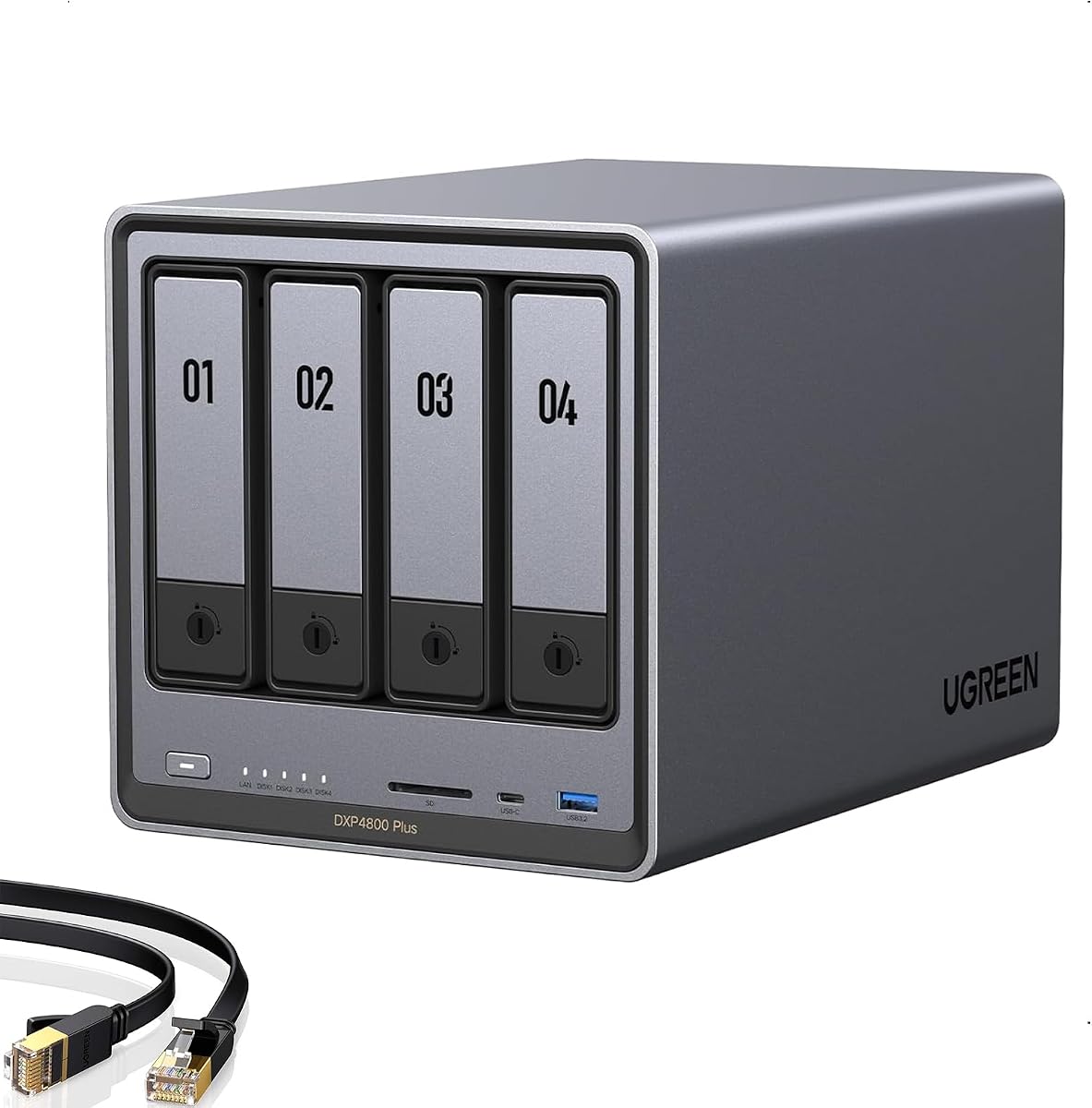
The UGREEN DXP4800 Plus is a four-bay NAS for families, creators, and small teams that need a larger storage platform with high-speed networking. Its 4.6 rating reflects a well-rounded offering, while support for Linux clients, Docker, virtual machines, and a 10GbE port makes it particularly relevant to users who want one system to handle files, applications, and collaboration.
We may earn a commission when you buy through this link, at no additional cost to you.
The networking specification is the clearest advantage for intensive Linux workflows. Backups of a 1GB file are advertised at less than one second using either the 10GbE port or 10Gbps USB connection, although real performance depends on the router, processor, drives, file size, and other equipment. Four bays also offer more freedom for RAID layouts and allow storage to grow without replacing a two-bay appliance immediately.
Its maximum advertised capacity of 144TB is based on RAID 0 with compatible drives, so buyers should understand the relationship between usable capacity and redundancy. The enclosure supports up to 50 million 1MB photos or 98,000 1.5GB movies, according to the supplied information. Compatible third-party hard drives from major brands are accepted, but the storage media itself is not included.
Choose the DXP4800 Plus when Linux performance, fast backups, and room for containerized services matter. It is a particularly sensible middle ground between the compact DXP2800 and the more specialized DXP4800 GT. Users who need only simple personal storage may find the DH2300 more appropriate, while those who need a very large multi-user environment may prefer the additional connectivity of the GT.
Four drive bays provide a useful balance between capacity, redundancy, and enclosure size. The 10GbE port can remove the bottleneck of a 1GbE network when moving large Linux workloads, backups, and media files between compatible clients and storage.
Docker and virtual machine support make the DXP4800 Plus more than a basic shared-folder appliance. Linux users can deploy compatible services, while the broad device support helps families and small teams connect from Windows, macOS, Linux, iOS, Android, and browsers.
We may earn a commission when you buy through this link, at no additional cost to you.
The UGREEN DH2300 is the most approachable NAS in this guide and a sensible budget choice for a Linux user who primarily needs private shared storage. It holds a 4.5 rating, supports backups from Linux and other major device platforms, and provides a two-bay design that can handle up to 64TB of raw capacity with compatible drives.
We may earn a commission when you buy through this link, at no additional cost to you.
Its strengths center on simplicity. The system includes a 4GB of onboard memory and a 1GbE port, while automatic backup support helps move files away from phones, computers, and tablets. AI features can tag faces, locations, text, and objects, detect duplicate images, and make a large personal library easier to search. RAID modes, two-factor authentication, permission controls, and encrypted transfers reinforce the privacy focus.
The compromises are important for Linux administrators. This model does not support Docker, virtual machines, or SAN Manager, and Plex cannot be run through Docker. Its performance is positioned for personal storage and entertainment rather than demanding server applications. A wireless network card is not included, so Wi-Fi would require an external USB adapter, and the product is designed for wired Ethernet use.
The DH2300 is best for a household or individual who wants to move beyond scattered external drives and recurring cloud storage without paying for application-server hardware. It is a sensible choice for Linux file sharing, local media storage, and automated backups, but it is not the right platform for containers, virtual machines, or intensive multi-user workloads.
The DH2300 focuses on the jobs that matter to first-time NAS owners: centralized storage, automatic device backups, easy sharing, and searchable photo libraries. A Linux user can use it as a dependable private repository without needing application-server features.
A 1GbE port is sufficient for routine document access and many personal backups, while advertised transfers reach 125MB/s. The absence of Docker, virtual machines, and SAN Manager makes this an appliance for storage rather than a general-purpose application server.
We may earn a commission when you buy through this link, at no additional cost to you.
The Western Digital 4TB WD Red Plus is not a NAS enclosure, but it is one of the most relevant products for anyone building a NAS for Linux. It is a 3.5-inch internal hard drive specifically designed for continuous operation in RAID-optimized NAS systems with as many as eight bays.
We may earn a commission when you buy through this link, at no additional cost to you.
The drive uses CMR recording technology, a 5400 RPM spindle, a 128 MB cache, and the SATA 6 Gb/s interface. Those characteristics make it a straightforward storage building block for a Linux file server, photo archive, or backup target. NASware tuning is included, while Western Digital also provides warranty and support coverage for the product.
Its limitation is obvious but important: a bare hard drive cannot share files, manage users, monitor drive health, or protect data on its own. It must be installed in a compatible NAS or Linux enclosure, and it should be selected according to that system's official compatibility guidance. A complete system may also require multiple matching drives, a suitable backplane, and adequate cooling.
This is a good practical choice for a buyer assembling a NAS rather than selecting a ready-made appliance. Its 4TB capacity is modest for archives, but a larger Red Plus capacity may be needed as the library grows. If you want a turnkey system with a management interface, data-protection features, and Linux connectivity, choose one of the complete NAS models instead.
WD Red Plus drives are tuned for NAS environments and continuous operation rather than intermittent desktop use. Their availability in capacities from 2TB to 12TB makes it possible to choose a size that fits the enclosure and the user's data-growth pattern.
The listed CMR specification is valuable when planning RAID arrays. Linux administrators should still confirm enclosure support, use identical drives where appropriate, and build every array with a clear recovery strategy rather than relying on drive failure as the only backup.
We may earn a commission when you buy through this link, at no additional cost to you.
The UGREEN DXP4800 GT is the most performance-oriented UGREEN model here and a premium choice for Linux users who want the NAS to handle demanding backups, media processing, containers, virtual machines, and multi-user workloads. Its 4.6 rating is supported by a Ryzen Embedded R2514 processor, dual 10GbE connectivity, and an unusually broad collection of expansion and connectivity options.
We may earn a commission when you buy through this link, at no additional cost to you.
The Ryzen chip provides four cores, eight threads, and speeds up to 3.70GHz. It is paired with 8GB of DDR4 memory that can be expanded to 64GB, with ECC capability available through a compatible upgrade. Two 10GbE ports can support up to 20Gbps aggregate bandwidth with suitable network equipment, making the enclosure well suited to large file transfers, multi-user access, and 4K or 8K workflows.
Storage flexibility is another major attraction. The system supports four SATA drive bays, two U.2 NVMe positions, and up to 16TB across two M.2 SSD slots, with a total maximum of 144TB. It also includes USB-A 10Gbps, USB-C 10Gbps, USB 2.0, 4K HDMI, and an SD card slot for importing media without a separate reader.
The DXP4800 GT is a strong recommendation for creators, technical professionals, and small offices that treat their NAS as an application platform rather than a passive file repository. The trade-offs are cost, heat, and complexity. Drives are not included, Docker-based media applications require manual setup, and prospective ECC users must install compatible ECC memory rather than relying on the supplied module.
The Ryzen R2514 and expandable memory give the DXP4800 GT more headroom for Docker containers, virtual machines, backups, and media processing. Linux users can organize workloads across the system while using the four-bay chassis as a centralized storage platform.
Each 10GbE port offers substantial headroom for large backups and multi-user access, while compatible link aggregation can increase aggregate bandwidth. Reaching the advertised theoretical rates requires matching switches, cabling, clients, storage, and workloads; the NAS alone cannot guarantee them.
SATA, U.2 NVMe, M.2 NVMe, USB, and SD inputs let creators move data into the system through several routes. This mixed approach is useful for separating large archives from fast working files, although the drive combination must remain within the model's supported configuration.
We may earn a commission when you buy through this link, at no additional cost to you.
The Synology DS925+ is a four-bay diskless NAS designed for users who want a managed storage platform with strong transfer performance. It carries a 4.3 rating and offers sequential read and write throughput of up to 522/565 MB/s, along with dual 2.5GbE ports for faster transfers and network redundancy.
We may earn a commission when you buy through this link, at no additional cost to you.
Synology's integrated suite covers file and photo management, data protection, virtualization, and surveillance. For a Linux user, that combination makes the DS925+ appealing as a dependable shared repository with a polished management environment. The two 2.5GbE ports are useful for connected-client workflows and can add redundancy if one network path becomes unavailable, subject to appropriate switch and configuration support.
The main consideration is ecosystem philosophy. A Synology NAS offers tightly integrated applications and a three-year limited hardware warranty, but it is less of a blank canvas than a conventional Linux server. Buyers must confirm that the apps and Linux client access methods they need are supported by the current DSM release. The unit is diskless, and only drives appearing on the official compatibility list should be used.
The DS925+ is best for a home office, creative team, or technically experienced user who values Synology's integrated management and transfer speed. It is less suitable for someone who wants unrestricted operating-system customization. For Linux application containers and direct server control, the UGREEN DXP4800 GT may be a more natural fit.
Advertised sequential performance reaches 522 MB/s read and 565 MB/s write. These figures are most relevant to large, sequential transfers and depend on the installed drives, network equipment, client, and workload, so sustained results will vary.
Built-in file, photo, protection, virtualization, and surveillance tools create a coherent management experience. This makes the DS925+ attractive to administrators who want dependable client services without assembling every component themselves.
We may earn a commission when you buy through this link, at no additional cost to you.
The Synology DS425+ is the strongest all-around choice in this guide for a Linux user seeking a balanced private-cloud and file-server system. Its 4.7 rating is the highest among the products with listed scores, and the combination of four bays, support for more than 10 concurrent users, and speeds advertised around 278 MB/s makes it well suited to homes and small offices.
We may earn a commission when you buy through this link, at no additional cost to you.
The data-management proposition is especially compelling. Granular access controls and audit logs help organize company documents, client files, and media assets, while RAID redundancy, automated backups, and snapshot technology create multiple layers of protection. For Linux administrators, those are more immediately useful benefits than a large collection of experimental applications because they address access control, recovery, and everyday reliability.
The DS425+ also supports a professional surveillance configuration with up to 30 IP cameras, motion detection, and secure remote access. It can therefore handle more than a basic private file share, particularly for a household or small business that wants storage, shared workflows, and camera management in one system. The four-bay chassis also gives the user room to choose a RAID layout that matches the required capacity and protection level.
As the Editor's Choice, the DS425+ is the most complete recommendation for users who value integrated reliability, access governance, and balanced performance. It does not offer the same freedom as a general-purpose Linux server, and compatible storage drives are not included. Linux users who require Docker-heavy customization should compare it with the DXP4800 GT, while those who only need personal file storage should consider the DH2300.
RAID redundancy, automated backups, and snapshots work together to reduce recovery risk. Linux users should still maintain an independent backup, but this combination provides a more robust operational layer than relying on a single shared volume.
Support for concurrent access from more than 10 users, granular permissions, and audit logs makes the DS425+ practical for shared company material. Its listed media speed of 278 MB/s is also appropriate for routine office files, streaming, and medium-sized creative workflows.
The platform can serve as a private cloud for files and photos while supporting up to 30 IP cameras. That versatility makes it more than a simple Linux file share for users with home or business surveillance requirements.
We may earn a commission when you buy through this link, at no additional cost to you.
The Synology DS725+ begins as a compact two-bay NAS but provides a clear path toward much larger storage through the DX525 expansion unit. With a 4.1 rating, it is a practical choice for a Linux user who wants to start with fewer drives and add capacity later rather than committing to a larger four-bay enclosure immediately.
We may earn a commission when you buy through this link, at no additional cost to you.
Expansion can add five drive bays and raise the maximum listed capacity to 140TB, making the system relevant to growing media libraries, small-business repositories, and long-term archives. The data-protection foundation includes RAID redundancy, automated backups, and snapshot technology. These features protect availability while the storage footprint expands.
The DS725+ also supports a professional surveillance environment with up to 30 IP cameras, motion detection, secure remote access, advanced analytics, and unlimited retention periods according to the supplied description. For a Linux user, the platform offers useful centralized services without requiring a separate Linux server for every function.
Its trade-off is that the advertised future capacity requires another hardware purchase, and the base unit is diskless. The 4.1 rating is the lowest among the Synology models with numerical feedback, so buyers should not treat it as a performance verdict on its own. Overall, it fits users who value a staged expansion path, strong data management, and a compact starting footprint.
A two-bay base enclosure keeps the initial setup manageable, while the DX525 adds five drive bays when the collection outgrows the original system. This is useful for Linux users who want to increase capacity without replacing the entire NAS and every service configured on it.
Support for 30 cameras, motion detection, secure remote viewing, advanced analytics, and unlimited retention periods makes the DS725+ suitable for coordinated home or business monitoring. Local storage keeps the workflow within the NAS platform.
We may earn a commission when you buy through this link, at no additional cost to you.
The Synology DS224+ is a two-bay NAS aimed at users who want efficient shared storage, photo management, backups, and surveillance in a compact system. It does not have a numerical rating in the supplied product data, so this review evaluates its documented specifications rather than assigning a score that the source does not provide.
We may earn a commission when you buy through this link, at no additional cost to you.
The Celeron J4125 is a four-core processor rated at 2.0GHz, with turbo capability up to 2.7GHz, and it is paired with 6GB of non-ECC DDR4 memory. The listed configuration also includes 36TB from two 18TB SATA hard drives. Its two 1GbE LAN ports are straightforward, but they will be the first limitation for users moving large Linux files across a fast local network.
Energy efficiency is a clear strength. Operational power use can be as low as 15 watts, and Synology highlights improved indexing speeds in Synology Drive and Synology Photos. Integrated security features support centralized access, while file, photo, and surveillance management make the DS224+ a practical compact server for a home or small office.
Choose the DS224+ when low power consumption, simple management, and a two-bay footprint matter most. It is less appropriate for high-bandwidth transfers, large expansion projects, or users who need to run multiple application containers. A higher-rated four-bay model may be worth considering if longevity and room for future drives are equally important.
An operating power use as low as 15 watts helps control the energy required to keep a personal file repository available. That makes the DS224+ a sensible option for a home server that runs continuously without demanding a high-power processor platform.
The DS224+ is designed to improve response times and indexing within Synology Drive and Synology Photos. These improvements are especially visible when browsing substantial collections rather than moving one very large file through a saturated network.
We may earn a commission when you buy through this link, at no additional cost to you.
The QNAP TS-453Be is a four-bay mini tower NAS with a 5.0 rating, making it one of the highest-rated products in the supplied data. It pairs a four-bay enclosure with an Intel Celeron J3455 quad-core processor, 8GB of DDR3L memory, and a listed 16TB configuration, offering an established alternative for Linux users who want a broad collection of network services.
We may earn a commission when you buy through this link, at no additional cost to you.
Its QTS 4.3.4 feature list includes File Station, Music Station, Video Station, HD Station, Notes Station, FTP Server, Print Server, Download Station, Photo Station, QSync, Hybrid Backup, VPN Server, Qtier, Qfiling, Qcontactz, and Qmail Email Agent. The hardware also includes Intel HD Graphics, while RAID choices cover JBOD, RAID 0, RAID 1, RAID 5, RAID 6, and RAID 10.
The system is not a new release, and its J3455 processor reflects an older architecture. Users should verify current operating-system compatibility, application updates, Linux client support, and hardware support before purchasing. The listing also contains conflicting configuration notes: the title references included memory and storage, while another bullet says hard drives and memory upgrades are sold separately and require installation.
The TS-453Be is best for a Linux user who values a wide QTS feature set, multiple RAID layouts, and a four-bay format. Its listed 5.0 rating is encouraging, but the configuration ambiguity warrants careful attention. Check the package contents and the seller's current offer, and consider a newer platform if you require contemporary processing performance or the latest expansion ecosystem.
The QTS application list covers file access, media, backup, synchronization, printing, downloading, and VPN functions. This breadth gives Linux users several ways to organize shared resources, although every application should be checked for present compatibility and security updates.
JBOD, RAID 0, RAID 1, RAID 5, RAID 6, and RAID 10 cover everything from simple pooling to redundancy-heavy configurations. Select the layout according to the required balance of usable capacity, write performance, and recoverability rather than treating RAID as a substitute for backups.
The supplied listing refers to 8GB of memory and 16TB of storage in the title but also says drives and upgrades are not installed. Confirm the exact package contents before ordering, especially when comparing the chassis with a diskless system.
We may earn a commission when you buy through this link, at no additional cost to you.
The right Linux NAS depends on how you will use the storage, which applications must run, how much data must be retained, and whether growth or network speed matters most. These factors should guide the decision before you compare individual models.
A NAS processor matters most when the system will run containers, virtual machines, indexing, media processing, or several simultaneous users. The UGREEN DXP4800 GT uses an AMD Ryzen Embedded R2514 with expandable DDR4 memory, the DXP2800 uses an Intel N100 with 8GB DDR5, and the DXP4800 Plus is built for advanced app use. By contrast, the DH2300 is a storage-focused entry model with 4GB onboard memory and no Docker or virtual machine support.
Bay count determines how many drives you can use now and how easily the system can grow. Two-bay models such as the DXP2800, DH2300, DS725+, and DS224+ are compact, while four-bay systems provide more immediate flexibility. The Synology DS725+ can also add five bays through DX525, whereas the DXP4800 GT supports a mix of SATA, U.2 NVMe, and M.2 storage. Maximum-capacity figures are theoretical and depend on the exact drive combination.
Network speed should match your largest realistic transfers and the storage hardware behind them. A 1GbE port is adequate for routine documents but can constrain large Linux backups, while 2.5GbE provides a useful middle tier. The UGREEN DXP4800 Plus and DXP4800 GT offer 10GbE, with the latter including two ports and link-aggregation potential. The DS925+ uses dual 2.5GbE, while the DS425+ lists 278 MB/s media speeds and the DS224+ uses two 1GbE ports.
Linux users should distinguish between connecting a Linux client to shared files and running a complete Linux workload on the NAS. The UGREEN DXP4800 Plus and DXP4800 GT explicitly support Docker and virtual machines, and Plex can be run through Docker with manual setup on the GT. The DXP2800 also supports Docker, virtual machines, and compatible Plex applications. The DH2300 explicitly omits these server-application features, while integrated platforms such as Synology and QNAP should be evaluated based on their current application and client compatibility.
RAID helps maintain availability after a drive failure, but it is not a backup. The Synology DS425+ and DS725+ combine RAID redundancy, automated backups, and snapshot technology, while the UGREEN systems offer RAID support and security features such as permissions, two-factor authentication, and encrypted transfers. A responsible Linux setup should combine a suitable RAID layout with versioned or immutable backups stored somewhere else. The WD Red Plus drive can contribute to a RAID array, but it cannot provide those services by itself.
Hard drives remain useful for large archives, backups, and media libraries, while SSDs are better suited to active databases, container images, virtual machines, and frequently edited projects. The DXP2800 includes two M.2 NVMe slots, while the DXP4800 GT supports SATA drives, two U.2 NVMe positions, and two M.2 slots. The supplied Western Digital Red Plus 4TB is a 5400 RPM CMR drive designed for continuous NAS operation in systems with up to eight bays.
A NAS may run continuously, so processor efficiency, cooling, and drive power draw influence long-term operating demands. The Synology DS224+ is highlighted for operating power usage as low as 15 watts, making it attractive for a compact always-on service. More powerful systems may provide greater application capability and faster networking, but they also require appropriate ventilation. Place the enclosure in a stable environment with airflow, surge protection, and an orderly shutdown plan rather than treating it like an disposable consumer gadget.
A polished interface can matter as much as raw specifications, particularly for a first-time NAS owner. Synology models emphasize integrated file, photo, backup, virtualization, and surveillance tools. UGREEN provides guided setup, on-screen tips, a knowledge center, troubleshooting resources, and specialist support, with a two-year warranty on the listed models. QNAP's long application list is broad but needs current compatibility checking. Before buying, confirm documentation quality, firmware maintenance, warranty terms, and the availability of support for your preferred Linux workflows.
Start by confirming compatibility rather than installing drives immediately. Check the NAS manufacturer's supported drive list, choose drives of a suitable capacity and type, and verify whether the product listing includes storage and memory. For a Linux-oriented deployment, document the intended share structure, user groups, permissions, backup destinations, and applications before configuring the network.
Install the drives according to the enclosure instructions, create the intended storage pool, and choose RAID according to your capacity and recovery requirements. Then connect the NAS over Ethernet, complete guided setup, update its management system, and test access from a compatible Linux client. Enable users, groups, encrypted transfers, two-factor authentication where available, and the exact backup services needed for the workload.
Ongoing care includes monitoring drive health, keeping the NAS software updated, and reviewing logs for failed backups or unusual access. Keep at least one independent backup outside the NAS, test restoration periodically, and replace or expand drives only after confirming enclosure support. Shut the system down cleanly during maintenance, maintain airflow, and avoid placing it in a hot, enclosed, or easily disturbed location.
No. These products are NAS appliances with their own management systems, and the supplied data does not establish that any model can replace its operating system with a general-purpose Linux distribution. The relevant question is whether the NAS supports your Linux clients, shared-file workflows, and desired applications. UGREEN models that explicitly support Docker and virtual machines offer the most clearly documented flexibility for Linux-style application workloads.
No. A NAS is a storage and service platform, but automated backup tasks still need to be configured for the computers and data that matter. RAID can preserve access after certain drive failures, but it does not protect against deletion, corruption, ransomware, or loss of the entire device. Keep versioned or immutable backup copies on a separate system and test that you can restore them.
Most of the diskless products in this guide require separate storage. The UGREEN DXP2800, DXP4800 Plus, DH2300, and DXP4800 GT explicitly exclude drives, and the Synology DS925+, DS425+, and DS725+ are also sold without drives. Use the manufacturer's compatibility list, match capacity to the bay limits, and consider mixing drive types only when the system explicitly supports that configuration.
It is enough for documents, general file sharing, and many modest backups, but it can become a bottleneck with large media files, virtual machine images, or frequent transfers. A 2.5GbE model offers a useful upgrade, while 10GbE is appropriate for demanding local workflows. The NAS, switch, cables, client, and storage must all support the intended speed for real benefits to appear.
The UGREEN DXP4800 Plus and DXP4800 GT explicitly support Docker and virtual machines, and the DXP2800 is also described as supporting both. Plex can run through Docker on the DXP4800 Plus and DXP4800 GT, although the GT requires manual setup. The DH2300 does not support Docker, virtual machines, or SAN Manager.
Not always. A NAS drive is optimized for continuous operation and RAID-oriented workloads, while a desktop drive may be designed for lighter or intermittent use. The Western Digital Red Plus 4TB is rated for NAS systems with up to eight bays, but it should still be checked against the enclosure's official compatibility list. Capacity, recording method, workload rating, and bay support all matter.
The best choice depends on capacity, performance, and acceptable rebuild behavior. RAID 1 mirrors a two-drive pool, while RAID 5 or RAID 6 can be more space-efficient in larger arrays, and RAID 10 favors performance and redundancy. RAID 0 increases capacity and speed but has no redundancy. Whichever layout you select, maintain a separate backup because RAID does not protect against accidental deletion or broader system loss.
Choose two bays for compact personal storage and a manageable initial build, especially if you plan to add a larger enclosure later. Choose four bays when you want more immediate flexibility, stronger RAID options, or enough room to separate data pools. The Synology DS725+ is the clearest expandable two-bay option because it supports the DX525, while the DXP4800 GT offers the broadest mixed high-speed storage options.
The Synology DS425+ is the strongest balanced recommendation because it combines a high 4.7 rating, four bays, support for more than 10 users, granular controls, audit logs, snapshots, automated backups, and surveillance capabilities. The UGREEN DXP4800 GT takes the premium position for Linux-focused application work, offering a Ryzen processor, dual 10GbE connectivity, Docker, virtual machines, and mixed HDD and SSD expansion.
For a simpler or less demanding setup, the UGREEN DH2300 provides private storage, device backups, RAID, and security controls in an approachable two-bay enclosure. Linux users should prioritize the workloads they actually need: a fast file share, virtual machines, containers, media processing, or surveillance. Also verify the operating system's current Linux client and application support before purchase, and choose only compatible drives.
Finally, remember that the products differ significantly in whether storage and memory are included. Some listings show a theoretical maximum based on a particular RAID arrangement, while others require separate drives or even contain conflicting package-content notes. Check current prices, availability, drive compatibility, warranty terms, and the exact bundle configuration before ordering, since all of these details can change.