
Noctua NL-LC1-36
4.8Editor score
High-performance 360mm radiator
Acoustically optimized fans
Multi-socket mounting system
Explore the best Quiet GPU Cooling Solution options, comparing noise levels, airflow, compatibility, installation needs, cooling designs, and budgets for
A quiet GPU cooling solution must remove heat effectively without adding distracting fan noise to a gaming rig, workstation, media center, or compact computer. The right choice depends on whether you need dedicated graphics-card cooling, additional case airflow, a CPU cooler that supports a quieter system, or a simple USB-powered fan for nearby equipment.
We compared the ten products in this guide by examining their stated noise levels, cooling mechanisms, airflow specifications, power requirements, dimensions, mounting options, and device compatibility. The list includes air coolers, all-in-one liquid coolers, USB cooling fans, a graphics-card replacement fan, and a custom-loop GPU water block rather than treating every cooling product as the same type of solution.
Each review explains where the product fits, what design details matter, and which compromises may affect your build. Ratings and specifications reflect the supplied product information, while availability and pricing can change; always verify the current listing, socket support, and physical clearance before purchasing.
4.8Editor score

4.8Editor score

4.4Editor score
The comparison below places dedicated graphics-card hardware, CPU-focused cooling solutions, and powered auxiliary fans side by side so readers can distinguish cooling capacity, noise control, installation requirements, and the kinds of systems each product is designed to support.




The Thermalright Peerless Assassin 120 Vision MAX combines a substantial dual-tower air cooler with a five-inch magnetic IPS display, giving it a distinct combination of cooling, monitoring, and visual customization. Its 4.8 rating is the highest among the listed products, and the design is especially appealing to builders who want a quiet system without sacrificing the appearance of a finished enthusiast PC. The screen can display system parameters and custom themes through TRCC control software.
We may earn a commission when you buy through this link, at no additional cost to you.
Cooling relies on six 6mm copper heat pipes, a nickel-plated micro-engraved copper base, and a dual-fan tower arrangement. The offset design is intended to accommodate tall RAM heat spreaders and GPU installations, while the 164mm height requires a case with enough clearance. Six 6mm pipes also means additional heat-transfer capacity than a basic four-pipe cooler, making this more appropriate for sustained processor loads that can indirectly affect overall system noise and cooling demands.
The main trade-off is physical and setup complexity. A large air cooler demands a spacious case, careful planning around the motherboard, and enough clearance above the board. The display also requires the motherboard's nine-pin USB connection plus correct software setup, so it is not the simplest option for a first-time builder. Users who want only a basic CPU cooler may find the display unnecessary, but the included monitoring functionality gives the product a clear identity beyond standard tower-cooler aesthetics.
This is an excellent choice for a polished gaming or workstation build with adequate case clearance and a preference for air cooling. It combines a high rating, substantial heat-pipe hardware, a large display, ARGB lighting, and a layout designed around modern component clearance. For the best balance of features and visual appeal in this guide, it is the leading recommendation.
The five-inch IPS panel can show live system information, custom backgrounds, and video playback through TRCC. It is more useful than decorative lighting alone because it provides at-a-glance feedback while the system is running. Proper USB and software connections are essential to unlock the full feature set.
The offset heat-sink and fan arrangement is designed to clear tall memory modules and reduce GPU interference. That makes the cooler more practical in visually dense builds, although the 164mm height still needs to be checked against the chosen chassis.
We may earn a commission when you buy through this link, at no additional cost to you.
The Thermalright Assassin X120 Refined SE is a conventional single-tower CPU air cooler aimed at builders who want effective heat dissipation without the height, complexity, or visual footprint of a dual-tower model. It earns a 4.7 rating and pairs four 6mm heat pipes with a 120mm TL-C12C PWM fan. The stated maximum noise level of 25.6dB(A) makes it a sensible choice when low acoustic output matters.
We may earn a commission when you buy through this link, at no additional cost to you.
Its aluminum heat sink, metal fasteners, AGHP heat-pipe treatment, and S-FDB fan bearing are designed for stable cooling and durability. The included fan reaches 1550 RPM and produces up to 66.17 CFM of airflow, giving it more moving air than a small decorative case fan. The cooler is also broad in motherboard support, covering current and older Intel platforms as well as AM4 and AM5.
Buyers must still account for its 148mm height and the space required for the fan and heat-sink tower. Four heat pipes are not equivalent to the larger pipe count and dual-tower architecture of the Peerless Assassin 120 Vision MAX, so this model makes more sense for moderate processors, compact cases, and builds that prioritize simplicity. It also leaves the graphics card to the cooling hardware already installed in the chassis.
Choose the Assassin X120 Refined SE when you need a proven, quiet CPU cooler with broad platform support and limited case space. It may not be a dedicated GPU cooler, but a cooler CPU can reduce overall system heat and fan demand, helping create a quieter environment around a high-performance graphics card. It is a balanced recommendation for practical, unobtrusive builds.
The TL-C12C fan supports motherboard-controlled PWM adjustment, allowing its speed to respond to system demand. Its 25.6dB(A) maximum specification and 66.17 CFM airflow make it useful for case cooling or pairing with the included CPU cooler without producing the highest acoustic output.
Mounting support spans AM4, AM5, and a long list of Intel LGA sockets. That makes the cooler practical across mixed generations of hardware, although buyers should still confirm the exact socket and required backplate before ordering.
We may earn a commission when you buy through this link, at no additional cost to you.
The be quiet! Pure Loop 3 360mm is a high-capacity all-in-one liquid cooler intended for demanding applications and lightly overclocked systems. Its 4.4 rating reflects a product that combines a powerful pump, three high-speed PWM fans, and a large 360mm radiator with an explicit focus on quiet operation. The closed-loop motor and the pump's three-phase design are intended to keep sound smooth at both low and high rotational speeds.
We may earn a commission when you buy through this link, at no additional cost to you.
The included Pure Wings 3 120mm fans are designed to move air through the radiator efficiently, with a maximum stated noise level of 30.9dB(A). Their closed-loop motor function maintains a steady speed regardless of resistance, which is particularly useful for radiator mounting. A daisy-chain connection method also reduces the number of separate fan cables, helping achieve a cleaner case interior and easier connection to the available motherboard headers.
The compromise is installation demands. A 360mm radiator occupies a substantial portion of a compatible chassis, and the system includes a pump, radiator, fans, and more involved mounting hardware than a conventional air cooler. Although flexible tubes and an accessible refill port simplify installation and maintenance compared with some custom-loop projects, this is still more complex than a simple tower cooler. It also focuses on CPU cooling rather than direct contact with the graphics card.
For a high-end quiet build with room for a 360mm radiator, the Pure Loop 3 360mm is a premium option with a coherent acoustic design. It is best suited to creators, gamers, and enthusiasts who prioritize sustained cooling capacity, clean wiring, and low acoustic output over a simple installation or a small case footprint.
A smooth six-pole pump motor and radiator fans with a closed-loop motor function address different sources of mechanical and tonal noise. The result is a liquid cooler designed to remain acoustically composed while responding to different thermal loads.
Daisy-chaining allows the three radiator fans to share a chain rather than requiring a separate header for each unit. This can reduce cable clutter and make the build more attractive, particularly in a system with limited case-management space.
We may earn a commission when you buy through this link, at no additional cost to you.
The Cooler Master 240 Core II combines a 240mm liquid cooler with an infinity-mirror pump housing and fully customizable ARGB lighting. Its 4.6 rating makes it one of the stronger all-round options in the list, particularly for builders who want a modern appearance and flexible motherboard-based lighting control. The dual-chamber pump design is intended to improve water flow toward the CPU hotspot on Ryzen 7 and Intel Ultra 7-class processors.
We may earn a commission when you buy through this link, at no additional cost to you.
Its cooling fan operates from 650 to 1,750 RPM under dynamic PWM control, allowing the system to balance airflow and sound. The product supports AM5, AM4, LGA 1851, and LGA 1700 through included mounting brackets, while CryoFuze thermal paste is supplied for installation. These details make the package relatively complete for a new CPU-cooler setup, although graphics-card cooling still depends on the case and GPU's own fan configuration.
The infinity-mirror lighting is the defining trade-off. It creates a strong visual centerpiece, but it also makes the cooler more dependent on software and compatible motherboard controls than a plain black unit. A 240mm radiator is also easier to accommodate than a 360mm model, yet it still requires a compatible case and careful attention to fan and radiator orientation. This is a cooling package for users who want both performance and visual presentation.
The 240 Core II is a strong match for a colorful mid-size or full-size gaming build with a supported socket. It provides quiet PWM control, a modern liquid-cooling format, and lighting that can synchronize with the rest of the system. For those who prioritize appearance alongside practical CPU cooling, it is a compelling alternative to the larger premium AIO.
The pump's dual-chamber layout is designed to direct water more efficiently toward the processor's concentrated heat areas. That focus on targeted flow can be valuable in systems that also contain a powerful graphics card generating substantial heat.
The infinity-mirror cover and ARGB illumination are designed for customization through compatible motherboard software. This makes the cooler especially suitable for builds in which fans, memory, and other lighting are already being synchronized.
We may earn a commission when you buy through this link, at no additional cost to you.
The PLD09220S12H is a replacement cooling fan for selected EVGA GeForce RTX 3070, RTX 3080, RTX 3080 Ti, RTX 3090, and RTX 3090 Ti FTW3 graphics cards. Its 4.4 rating and dedicated graphics-card application distinguish it from the general-purpose USB fans and CPU coolers in this guide. It is intended for users who need to service an existing GPU rather than redesign an entire cooling system.
We may earn a commission when you buy through this link, at no additional cost to you.
The fan measures approximately 87 by 87 by 22 millimeters, runs on DC 12V, draws 0.55A, and uses a four-pin connector. The stated compatibility list covers FTW3 Ultra Gaming variants of the specified EVGA cards. Its black finish and three-fan product designation are intended to match the appearance and cooling layout of the supported models, helping preserve a coherent factory-style look.
The major limitation is model specificity. This is not a universal GPU cooler and should not be assumed to fit any card sharing a similar chipset or general dimensions. There is also no published noise or airflow figure in the supplied specifications, making it impossible to judge acoustic output as precisely as with the CPU and USB cooling options. A replacement fan must be matched by the original part number, connector arrangement, mounting positions, and intended airflow direction.
This product is recommended only for a builder who has confirmed the exact EVGA FTW3 model and can replace the original fan correctly. In that situation, it offers a focused way to restore cooling to a compatible graphics card. For a broader or more confidently specified quiet upgrade, the 140mm USB fan or a complete case-cooling setup is generally easier to match to different hardware.
Compatibility extends to specific FTW3 families, not every RTX 3070 through 3090 variant. Check the card's model label and original fan part number before buying, since a similar product name does not guarantee identical mounting or electrical connections.
A replacement fan is most useful when the original assembly has failed, become noisy, or no longer cools effectively. Because noise and airflow details are not supplied for this model, it is best viewed as a targeted maintenance option for confirmed compatible hardware.
We may earn a commission when you buy through this link, at no additional cost to you.
The X4 Quiet USB Cooling Fan is a flexible auxiliary cooling pad for routers, laptops, receivers, amplifiers, DVRs, game consoles, and computer cabinets. Its 4.1 rating is lower than those of the leading CPU and AIO products, but its purpose is different: it provides broad, powered airflow around a device without requiring internal installation. The dual 140mm configuration and 18dB stated operating noise make it appealing for quiet living-room or office setups.
We may earn a commission when you buy through this link, at no additional cost to you.
Its 11-blade high-pressure fans deliver a stated 65.8 CFM of airflow at 850 RPM. The manufacturer also claims the unit can reduce device temperatures by 30% within 30 seconds in specified conditions, though results will vary according to the device, placement, ambient environment, and existing ventilation. Hydraulic bearings, ABS construction, and a stated service life exceeding 40,000 hours support the product's durability positioning.
The raised feet serve two purposes: they elevate devices for airflow and allow the unit to be stacked with another compatible fan. Two USB ports support powering the fan and charging another device, while the one-touch switch and 31.5-inch cable make placement easy. The limitation is scope: this cannot remove heat from inside a desktop GPU's cooler or replace a case's pressure-balanced airflow, so it is an addition rather than a direct substitute.
The X4 is best for a console, router, network cabinet, AV receiver, or other enclosed device that needs extra ambient cooling with minimal visual or acoustic disruption. It is less relevant to a high-end desktop graphics card, but it can help maintain a cooler environment around a compact gaming system or media center where case airflow is limited.
The 140mm fan format provides broad airflow while the stated 18dB operation remains suitable for offices, bedrooms, and quiet entertainment areas. Actual sound varies with surface resonance, cable movement, and the speed setting used by the connected source.
Raised feet create clearance beneath devices and allow a second unit to be stacked. This turns a simple cooling pad into a configurable arrangement for areas where more vertical space and airflow are available.
We may earn a commission when you buy through this link, at no additional cost to you.
The Thermalright TL-C12C X3 is a three-pack of 120mm PWM fans designed for cases, radiators, and compatible CPU coolers. Its 4.6 rating reflects a versatile approach to quiet system cooling: each fan combines a maximum speed of 1550 RPM with a stated maximum noise level of 25.6dBA, so builders can add airflow in multiple positions without mixing unrelated fan models.
We may earn a commission when you buy through this link, at no additional cost to you.
Automatic motherboard control is supported through the four-pin PWM connection. The S-FDB bearings are designed to reduce blade vibration, while four soft silicone corner pads help limit transferred vibration and surface friction. Each fan produces up to 66.17 CFM of airflow and 1.53mm H2O of static pressure, giving it enough stated capability for case ventilation and radiator use as described in the product information.
The three-fan format does create placement demands. A small chassis may not have three suitable positions, and each fan still needs sufficient intake, exhaust, or radiator space to perform as intended. This package does not directly cool a graphics card's processor, but it can improve overall chassis airflow, help move air past graphics-card intake areas, and reduce the workload on a case's existing fans when properly configured.
The TL-C12C X3 is a strong choice for builders who want a coordinated set of quiet PWM fans rather than a single premium cooler. It is particularly useful in a case-refresh project, a new build requiring several case fans, or a system with a compatible radiator. For a direct GPU replacement, however, this is only an indirect solution.
Buying three matching fans simplifies cable management, visual consistency, and replacement planning. The identical PWM characteristics also make it easier for motherboard software to manage their speed as a coordinated group.
S-FDB bearings and soft corner pads address the small vibrations that can make a spinning fan seem noisier than its headline specification. Stable mounting and unobstructed airflow remain important for achieving the intended acoustic result.
We may earn a commission when you buy through this link, at no additional cost to you.
The Noctua NL-LC1-36 is a 360mm all-in-one liquid cooler built around thermal performance, acoustic refinement, and straightforward installation. It shares the highest supplied rating in the list at 4.8. The package combines a large radiator with three NF-A12x25 G2 PWM fans, making it suitable for high-performance CPUs, quiet workstations, and enthusiast systems where sustained processing loads are common.
We may earn a commission when you buy through this link, at no additional cost to you.
Acoustic design appears throughout the cooler. The pump includes a three-layer soundproofing structure and a tuned-mass damper effect to lower mechanical noise and vibration. The three fans use a speed-offset arrangement for acoustic optimization, while the Asetek Emma V2 closed-loop platform provides the underlying liquid-cooling system. Mounting options for AMD AM5 and Intel LGA1851 can be offset to assist with hotspot optimization.
As with any 360mm cooler, the decisive trade-off is chassis compatibility and installation complexity. The radiator must fit in a suitable case, and its fans require adequate airflow and connection points. The SecuFirm2 multi-socket mounting system helps simplify the CPU-side installation, but the package does not directly cool a graphics card. For a system where the CPU and GPU both generate substantial heat, careful case planning remains necessary to avoid recirculating warm air.
The Noctua is a strong premium recommendation for builders who prioritize a refined acoustic package and have room for a large radiator. It is especially relevant to near-silent gaming PCs and workstations where a high-rated, well-engineered cooler can form the center of the cooling plan. Users should still match the radiator to the case and plan GPU intake and exhaust around it.
The pump's three-layer acoustic structure, tuned-mass damper effect, and fan speed offsets address distinct vibration and tonal issues. This comprehensive approach makes the cooler attractive for systems intended to remain unobtrusive during long work or gaming sessions.
Mounting offsets are available for AMD AM5 and Intel LGA1851, allowing the block's contact area to be positioned for hotspot optimization. The included NT-H2 thermal paste and paste guard further support a clean, straightforward installation.
We may earn a commission when you buy through this link, at no additional cost to you.
The CORSAIR XG3 RGB Hybrid GPU Water Block is one of only two entries designed specifically to cool graphics-card hardware, and it takes the more advanced route by adding a water block to a custom loop. Its 3.5 rating is the lowest in the group, which makes sense for a specialized product whose installation demands and dependencies place it beyond ordinary plug-and-play upgrades. The payoff is direct cooling of the GPU and nearby VRAM.
We may earn a commission when you buy through this link, at no additional cost to you.
The hybrid design uses a custom cooling loop to cool the graphics processor and video memory while a dedicated fan handles the circuit board and voltage-regulator module. Eighteen individually addressable RGB LEDs create the lighting effect, and a built-in temperature sensor supports monitoring through CORSAIR iCUE. Compatibility is listed for the RTX 5080, RTX 5070 Ti, and RTX 5070, but the exact board and cooler fit should be verified for the specific card.
This is a custom-loop component, not a complete water-cooling kit. A builder needs compatible tubing, a pump, reservoir as desired, fittings, coolant, radiator capacity, and a case capable of accommodating the loop. iCUE LINK devices also require a separately sold System Hub. Those requirements increase cost, setup time, and the number of potential failure points compared with a standard GPU cooler or plug-in USB fan.
The XG3 is best suited to an experienced custom-loop builder who wants the graphics card to be a visible centerpiece and is prepared to manage the full loop. For most gamers, a quieter stock GPU configuration, improved case airflow, or a dedicated GPU fan replacement will be more accessible. Even so, the hybrid approach is a compelling option for enthusiasts seeking direct GPU cooling with coordinated lighting and sensor support.
The water block places liquid cooling directly on graphics-card components, while the auxiliary fan targets the board and VRM area. This hybrid approach can remove heat closer to its source and reduce reliance on the card's original air-cooling assembly.
The XG3 must be integrated with a pump, radiator, fittings, tubing, and adequate case space. Builders unfamiliar with custom loops should expect a more involved setup, careful leak checking, and ongoing attention to loop operation and coolant maintenance.
We may earn a commission when you buy through this link, at no additional cost to you.
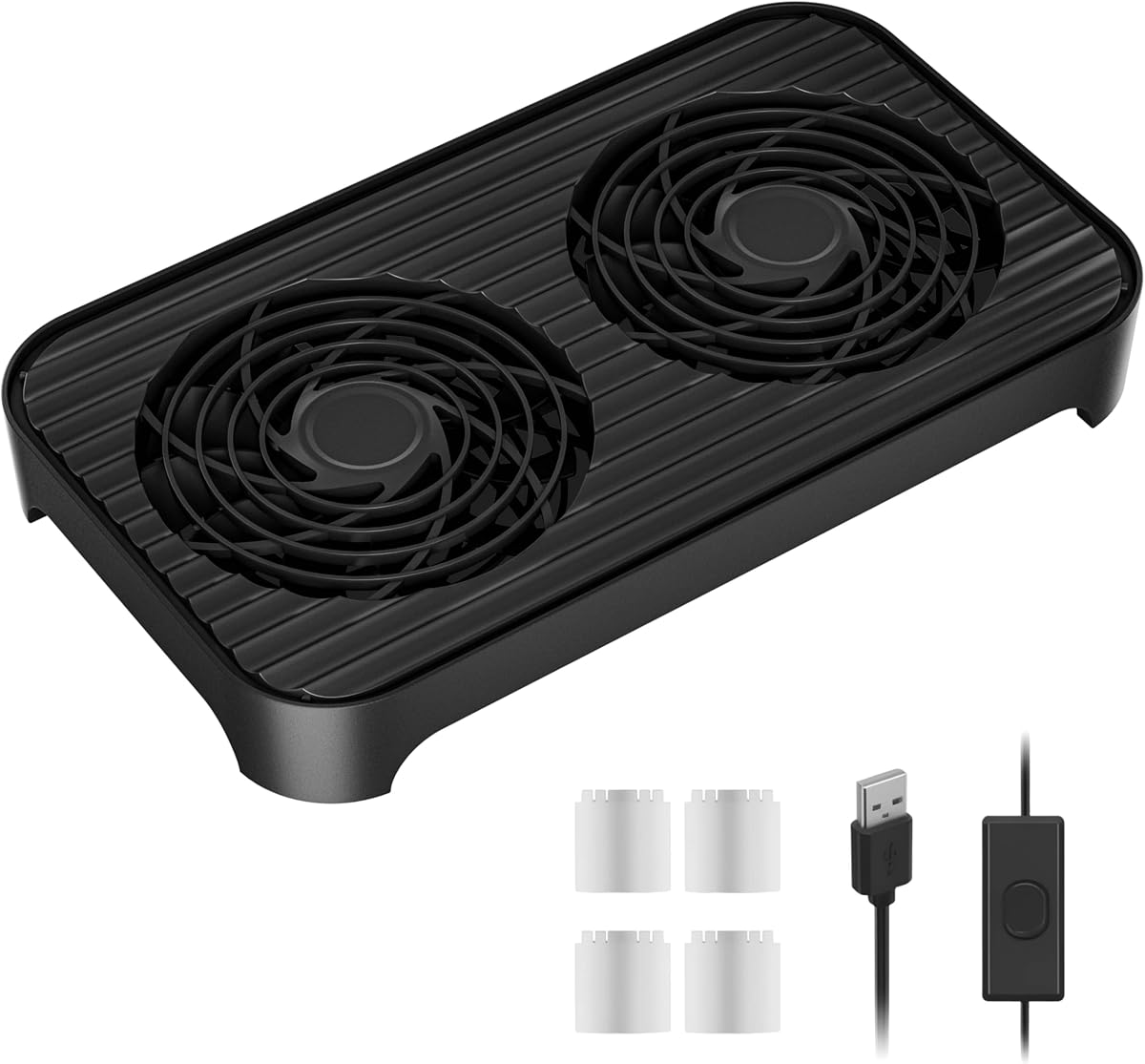
The ELUTENG Dual Cooling Fan is an accessible USB-powered cooling accessory for routers, laptops, TV boxes, receivers, phones, game consoles, projectors, instruments, and hard-drive enclosures. It has a 4.4 rating and offers two connected 80mm fans that run simultaneously. That makes it more useful for adding directional airflow around small electronics than for cooling a desktop graphics card internally.
We may earn a commission when you buy through this link, at no additional cost to you.
Three selectable speeds are controlled from a dedicated controller, with listed rotational speeds of 2050, 2400, and 2750 RPM. The stated noise range is 25.6dB at the weak setting and 32.5dB at the strong setting. This range lets users reduce sound when possible and increase airflow when cooling demand rises, making the product adaptable to offices, libraries, studies, or entertainment spaces.
The dual-row arrangement provides more airflow than a single compact fan, and the removable rubber shock absorbers help improve stability and reduce vibration. Metal side grilles protect fingers and wiring, while a protected cable joint addresses a common point of wear. The limitation is form factor: each 80mm fan is much smaller than a 120mm or 140mm case fan and cannot replace a GPU's heatsink or radiator.
The ELUTENG is best for improving airflow around compact electronics or a console placed in a cabinet. It is easy to deploy because it draws power from USB and can be positioned horizontally or vertically. For a desktop graphics card, it is a supplemental accessory at best; buyers seeking genuine GPU cooling should look to a confirmed replacement fan, improved case ventilation, or a custom water block.
The controller allows the user to begin at a lower setting and increase output when needed. This is particularly useful in quiet rooms where maximum speed may create more noise than the task requires.
The two connected fans can be oriented horizontally or vertically, and the one-meter cable provides reasonable placement flexibility. The raised rubber feet help keep the assembly stable and reduce vibration transfer to the supporting surface.
We may earn a commission when you buy through this link, at no additional cost to you.
The most useful quiet GPU cooling solution depends on the exact hardware involved. Start by identifying whether you need direct contact with a graphics card, additional case airflow, CPU cooling to support a quiet system, or powered airflow around a separate electronic device.
A desktop GPU requires cooling at the card itself, usually through its existing cooler, a compatible replacement fan, additional case airflow, or a custom water block. A general USB fan can improve the environment around a console or router but cannot remove heat from a graphics processor or graphics memory. CPU coolers and AIOs can improve overall chassis thermal performance, yet they do not directly cool the GPU. Matching the product to the target prevents an expensive but ineffective purchase.
Noise specifications are most useful when they use the same unit and measurement standard, which is not always the case across manufacturers. The listed products range from a stated 18dB for the X4 Quiet USB Cooling Fan to 30.9dB(A) for the be quiet! Pure Loop 3 360mm. The PLD09220S12H replacement GPU fan does not include a stated noise figure, making it difficult to compare acoustically. Always consider sound at a realistic distance, because a fan that measures well in isolation may still be audible during a game or video call.
Airflow figures indicate how much air a fan is designed to move, while static pressure indicates how well it can push air through a restrictive component. The X4 and Thermalright TL-C12C X3 are listed at 65.8 and 66.17 CFM respectively, and the Assassin's included fan is also listed at 66.17 CFM. Larger case fans do not automatically outperform compact USB fans, because fit, noise, pressure, and placement determine real performance. The highest compatible airflow is not necessarily the quietest option.
CPU coolers must match the processor socket, while replacement GPU fans must match the exact board revision and mounting arrangement. The Assassin X120 Refined SE supports numerous Intel and AMD sockets, and the Peerless Assassin 120 Vision MAX covers AM4, AM5, and several Intel platforms, with the latter requiring the motherboard's original AMD backplate. The PLD09220S12H is limited to listed EVGA FTW3 variants, and the CORSAIR XG3 requires careful confirmation of the specific graphics-card model.
Air-cooler height, radiator length, tube routing, and GPU dimensions must all fit inside the chosen chassis. The Peerless Assassin 120 Vision MAX stands 164mm tall, while the Assassin X120 Refined SE stands 148mm. The Pure Loop 3 and Noctua both use 360mm radiators, and the Cooler Master uses a 240mm radiator. A component that fits in isolation may still conflict with tall memory, the side of a case, drive cages, or a graphics card installed beneath the CPU cooler.
USB-powered fans are convenient for consoles, routers, and electronics, while PWM case fans need a compatible four-pin header. The ELUTENG and X4 products draw power from USB, and the X4 includes two USB ports. Large AIO coolers can consume several fan and pump connections, which is why the Pure Loop 3 offers daisy-chaining. The CORSAIR custom-loop product also depends on iCUE LINK hardware, including a separately sold System Hub. Connection planning helps prevent unused headers or excessive cable clutter.
A plug-in USB fan offers immediate airflow with little setup, while an AIO requires radiator mounting and CPU-block installation. A custom GPU water block requires a complete loop, careful fitting, leak testing, and ongoing maintenance. Air coolers avoid pump and coolant concerns but can be tall and heavy. The right complexity level depends on your confidence, the available case space, and whether you want a maintainable everyday system or a fully integrated enthusiast build.
Cooling hardware only works well when the case has a coherent airflow path. Intake fans should supply cool external air to the GPU and radiator, while exhaust fans remove rising warm air. Placing every fan on the same side can circulate hot air internally, and positioning an auxiliary pad where it merely recirculates the same warm air will limit results. Test the completed layout under realistic workloads and adjust fan curves to preserve quiet idle operation.
Begin by documenting the exact device, socket, connector, mounting hardware, and case dimensions. For a replacement GPU fan, power down the system, disconnect the power cable, remove the graphics card as directed by its manufacturer, and confirm that the replacement matches the original fan's model and orientation. For an AIO or tower cooler, install the appropriate backplate and mounting components before attaching the cooler, and verify that no cables obstruct the fans.
USB-powered cooling pads are simpler: connect the fan to a suitable USB power source, select the lowest speed initially, and position the unit so intake and exhaust remain unobstructed. Avoid placing the pad on soft fabric, and make sure the attached cable cannot be pinched by a closing case or cabinet. For case fans, connect the four-pin PWM cables, enable automatic control in the motherboard software, and create a gradual fan curve rather than running every fan continuously at maximum speed.
After installation, watch temperatures and listen for changes under load. Fine-tune PWM curves, close unused case openings, clean dust from filters and heatsinks, and ensure graphics-card intake areas are not blocked by cables or storage drives. Custom-loop systems require regular leak checks, stable fittings, correct coolant levels, and attention to pump operation. Replacement fans and auxiliary pads should also be inspected periodically for vibration, rubbing, loose screws, and cable wear.
The quietest choice depends on whether sound is coming from the graphics card, CPU cooler, case fans, or a failed GPU fan. The X4 Quiet USB Cooling Fan has the lowest stated figure in this guide at 18dB, but it cools external devices rather than a desktop graphics processor. For a complete quiet system, choose a well-matched CPU cooler, retain the GPU's efficient stock fan or use a compatible quiet replacement, and tune the case fan curve.
A USB fan can move room air toward a graphics card and may help reduce the temperature of surrounding components, but it cannot directly cool the GPU processor, memory, or voltage modules. Meaningful GPU cooling requires a properly mounted heatsink and fan, a compatible replacement fan, or a custom water block. Use USB fans primarily for consoles, routers, laptops, receivers, and compact external equipment.
Not necessarily. A noisy GPU fan may need cleaning, replacement, lower fan settings, improved case airflow, or a card with a more efficient cooler. A water block can provide excellent direct cooling, but it introduces pump noise, maintenance, installation complexity, and the need for a complete custom loop. Many quiet systems are better served by a quality air-cooled CPU and a healthy GPU fan with a sensible PWM curve.
Use the original part number and the exact board model rather than relying on the graphics processor name alone. Confirm the fan dimensions, connector, mounting screw positions, and airflow direction. The PLD09220S12H in this guide, for example, is specifically listed for selected EVGA FTW3 variants and should not be assumed to fit every RTX 3070, 3080, or 3090 card.
There is no universal answer because noise depends on motor design, blade construction, speed, mounting, airflow restriction, and operating temperature. A larger fan can move more air at a lower speed, while a small fan may need to spin faster to produce equivalent pressure. Compare stated noise levels, then ensure the selected size fits the available space and is not fighting a restrictive filter or heatsink.
More fans can make a system quieter if they allow every installed fan to run at a lower speed. If additional fans create extra vibration or compete for limited static pressure, they may instead add noise. A balanced intake-and-exhaust layout, clean filters, sensible fan curves, and a correctly sized radiator or heatsink usually matter more than fan quantity alone.
A powered USB cooling pad is often the most practical option because it can be placed under or beside a console without modifying the internal hardware. The X4 offers dual 140mm fans, a raised stackable design, and a low stated noise level, while the ELUTENG dual 80mm design provides three manually adjustable speeds. Position the pad so it draws in cooler room air and does not obstruct the console's own vents.
Yes. Temperature monitoring confirms that the cooler is mounted correctly, the fan is spinning in the right direction, and the case has adequate intake and exhaust. Check idle and sustained-load temperatures, watch for throttling, and listen for new sounds. A quiet fan that has stopped moving can do more harm than a louder fan running at a healthy, controlled speed.
The Thermalright Peerless Assassin 120 Vision MAX stands out as the most feature-rich overall recommendation, combining a dual-tower air cooler with an integrated display, ARGB lighting, and broad platform support. The Noctua NL-LC1-36 and be quiet! Pure Loop 3 360mm are stronger choices for quiet, high-capacity liquid cooling, while the ELUTENG Dual Cooling Fan is the most approachable option for auxiliary airflow around compact electronics.
Prioritize the actual heat source before choosing hardware. A confirmed GPU replacement or custom water block addresses the graphics card directly, whereas USB fans and case fans improve ambient airflow. CPU coolers matter for a complete quiet system, but still need to be coordinated with the GPU and case. Measure every clearance, verify every connector, and choose fan curves that preserve quiet operation without allowing heat to accumulate.
Ratings, specifications, and product availability can change, and current prices should be checked on the linked listings before purchase. Review the exact socket, GPU revision, radiator dimensions, mounting requirements, and power connections one final time. With that compatibility check completed, the right product can provide a materially quieter system while maintaining the cooling performance your hardware needs.