
Philips Hue Smart Dimmer Switch Remote
4.7Editor score
Four favorite scene cycles
Flexible three-way mounting
Hue Bridge required
Compare the 10 best radio controlled light switches, including RF remote kits, smart Wi-Fi switches, dimmers, range, installation needs, and key features.
Radio controlled light switches make everyday lighting easier to operate by adding remote, wireless, voice, or app-based control. A useful model should match the available wiring, deliver dependable range, support the intended bulbs, and offer a control method that fits the household. The best choice depends as much on installation details as on features.
This guide compares ten remote-controlled switch options across RF outlet kits, in-wall wireless relay systems, Wi-Fi switches, and smart dimmers. We evaluated the supplied specifications, ratings, range claims, load limits, expandability, installation requirements, and supported control methods. The list also distinguishes simple push-button systems from app-connected and dimming-capable models.
Each review identifies the product's strongest use case while noting important trade-offs such as neutral-wire requirements, added hubs, receiver placement, or limited dimming support. Ratings reflect the supplied customer feedback and can change over time. Current prices also fluctuate, so readers should confirm the latest listing, compatibility information, and installation requirements before purchasing.
4.7Editor score

4.7Editor score

4.6Editor score
The table below compares the ten products by control method, range, electrical capacity, and installation style, making it easier to identify the most appropriate system for a particular room or household need.




The BN-LINK five-receiver kit combines broad household control with a straightforward plug-in format. It carries a 4.7 rating and stands out because it includes five receivers and two remotes, allowing several lamps, fans, holiday decorations, or small appliances to be operated without adding wall wiring. Its stated 100-foot line-of-sight range and 10-amp capacity make it a capable general-purpose remote system.
We may earn a commission when you buy through this link, at no additional cost to you.
Its main strength is flexibility. The learning-code arrangement lets users pair multiple outlets, while each receiver can also be operated directly. RF signals are designed to pass through doors and walls, which is more useful than a system limited to line of sight. The outlets are rated for 120 volts, 10 amps, and 1,200 watts, providing enough capacity for many ordinary household fixtures and approved small appliances.
There are practical compromises. The receivers are plug-in units, so each one occupies a wall receptacle, and the stated load ceiling is lower than that of several higher-capacity alternatives. Shop vacuums are explicitly excluded. The system also does not provide app-based scheduling, voice integration, or dimming, making it more appropriate for dependable manual remote control than for a connected smart-home installation.
This is the strongest general recommendation for readers who want one remote to operate multiple household devices. The included batteries and ready-to-go setup reduce the work required at startup, while pairing flexibility supports a larger system later. Buyers should position receivers for reliable signal coverage and verify that every intended load falls within the stated electrical limits.
Five receivers and two transmitters provide more coverage than a single-outlet kit. Users can assign outlets to different remotes or combine compatible outlets, making the package suitable for lamps, fans, decorations, audio systems, and other permitted electronics.
The stated 100-foot range is measured in line of sight, but the RF system is designed to operate through doors and walls. Actual performance can vary with construction, interference, and receiver placement.
We may earn a commission when you buy through this link, at no additional cost to you.
The SURAIELEC Wireless Light Switch Kit offers a higher-capacity receiver and a wall-switch format for readers who want remote control without pulling new cable through the walls. Its 4.6 rating reflects a well-regarded product, while the 15-amp rating and 1,875-watt maximum support many residential lighting and appliance applications.
We may earn a commission when you buy through this link, at no additional cost to you.
Installation is simpler than a conventional multi-way switch because the receiver is connected between the incoming power and the lighting load. The supplied remote and mounting bracket create a wireless switch location without replacing the light fixture or setting up a Wi-Fi network. Dynamic coding is designed to keep multiple sets independent, and the system can be expanded with additional transmitters and receivers.
The most important installation caveat is the neutral-wire requirement. This may rule out the kit in older homes or switch boxes that do not provide a suitable neutral conductor. The receiver is described as weatherproof, making it more location-flexible than an ordinary indoor-only receiver, but outdoor suitability should still be confirmed against local electrical codes and the manufacturer's complete instructions.
The kit is well suited to creating wireless three-way or four-way arrangements, moving a switch location, or giving people with mobility limitations a portable control. It is less appropriate for homes without neutral wires or for users who specifically want dimming, voice control, and remote access through an app.
With a stated maximum of 15 amps and 1,875 watts, this receiver offers more headroom than the 10-amp BN-LINK packages. That makes it useful for a greater variety of compatible household loads.
Additional transmitters and receivers can create control from several locations. Dynamic coding is intended to prevent interference when separate sets are installed in one room or nearby area.
We may earn a commission when you buy through this link, at no additional cost to you.
This three-outlet BN-LINK package offers a middle ground between a single-receiver system and the larger five-receiver kit. It has a 4.7 rating, includes three outlets and one remote, and uses the same learning-code RF approach that makes BN-LINK systems easy to expand or reorganize.
We may earn a commission when you buy through this link, at no additional cost to you.
The package is particularly useful for several holiday decorations, bedside lamps, ceiling fans, or other approved devices that should be switched on and off together. Plug-in receivers avoid in-wall modifications, while the stated 100-foot line-of-sight range and wall-penetrating RF operation support use throughout a typical home. Each outlet can be controlled remotely or directly.
The limitation is that only one transmitter is included, although additional compatible BN-LINK remotes and outlets can be paired. The 10-amp, 1,200-watt rating is adequate for many lights and small appliances but falls below the 15-amp alternative. As with other BN-LINK products, shop vacuums are not compatible.
This kit is a strong choice for someone who wants several remote outlets without handling a larger multi-receiver system. It is especially attractive around seasonal lighting displays, where one handheld remote can simplify daily activation and deactivation. Users should still confirm that connected devices fit the load limits and that the receivers are positioned where the radio signal can reach them.
Three receivers make it possible to organize multiple compatible lights under one remote. This is especially useful for holiday displays, reading lamps, and other collections that benefit from coordinated switching.
The outlets can be programmed to suit the user's preferred remote arrangement. This makes it possible to reorganize controls without replacing the entire system or adding complex network configuration.
We may earn a commission when you buy through this link, at no additional cost to you.
The Wireless Light Switch and Receiver Kit combines an in-wall receiver with a detachable decorator rocker switch. Its 4.6 rating and 200-foot stated range distinguish it from many simple RF outlet kits, while the magnetic switch design offers unusual placement flexibility for bedside, entryway, and handheld control.
We may earn a commission when you buy through this link, at no additional cost to you.
Unlike a plug-in outlet, the compact receiver is wired between power and the lighting fixture. That installation method avoids full in-wall rewiring but does require basic electrical work and suitable box space. The rocker switch fits standard or multi-gang wall plates and can be removed for use as a portable controller or attached to a metal surface.
The receiver is rated for 15 amps, with stated limits of 1,875 watts overall and separate allowances for tungsten, fluorescent, and LED loads. A compact 1.38-by-2.54-inch housing is designed to fit within a rose, canopy, junction box, or switch box. Programmable pairing allows multiple devices or switches to be grouped.
This product is ideal for a homeowner who values a traditional-looking switch and a broad operating range without needing voice assistants, app access, or schedules. It is less suitable for plug-and-play renters because the receiver must be installed. Checking box dimensions and load requirements before ordering can prevent installation surprises.
The detachable rocker unit can remain in a wall plate, sit in a user's hand, or attach magnetically to a convenient metal surface. That versatility makes it easy to create control where a light is actually used.
A stated 200-foot range provides useful coverage for larger homes and separated control points. Obstacles, building materials, and device placement can still affect real-world performance.
We may earn a commission when you buy through this link, at no additional cost to you.
The BN-LINK single-outlet kit is a focused solution for controlling one lamp, fan, decoration, or compatible small appliance. It carries a 4.6 rating and includes everything needed to begin, including remote batteries. Its plug-in receiver and simple push-button transmitter make it one of the least complicated ways to add remote control.
We may earn a commission when you buy through this link, at no additional cost to you.
The RF system operates through doors and walls with a stated range of up to 100 feet in line of sight. The outlet can also be switched manually, and the learning-code feature permits expansion with additional compatible outlets and remotes. It is rated for 120 volts, 10 amps, and 1,200 watts, and it remains off following a power interruption.
The obvious trade-off is scale: one remote and one receiver cover only the initial device. Users who want to control a room full of lamps or a large seasonal display will need extra components. The plug-in receiver also occupies an existing wall socket, while shop vacuums are explicitly outside the compatibility list.
For a bedroom lamp, a hard-to-reach fan, or a single holiday display, this kit delivers the essential function without demanding an app, hub, or wall rewiring. It is the most budget-conscious option in the roundup and a sensible starting point for buyers who may later expand the system.
The package includes one remote and one outlet, reducing the number of components to configure. That makes it approachable for first-time users who only need remote control for one lamp or appliance.
Although only one outlet is included, learning-code pairing allows additional compatible BN-LINK components to be added. Users can start modestly and create a broader household system over time.
We may earn a commission when you buy through this link, at no additional cost to you.
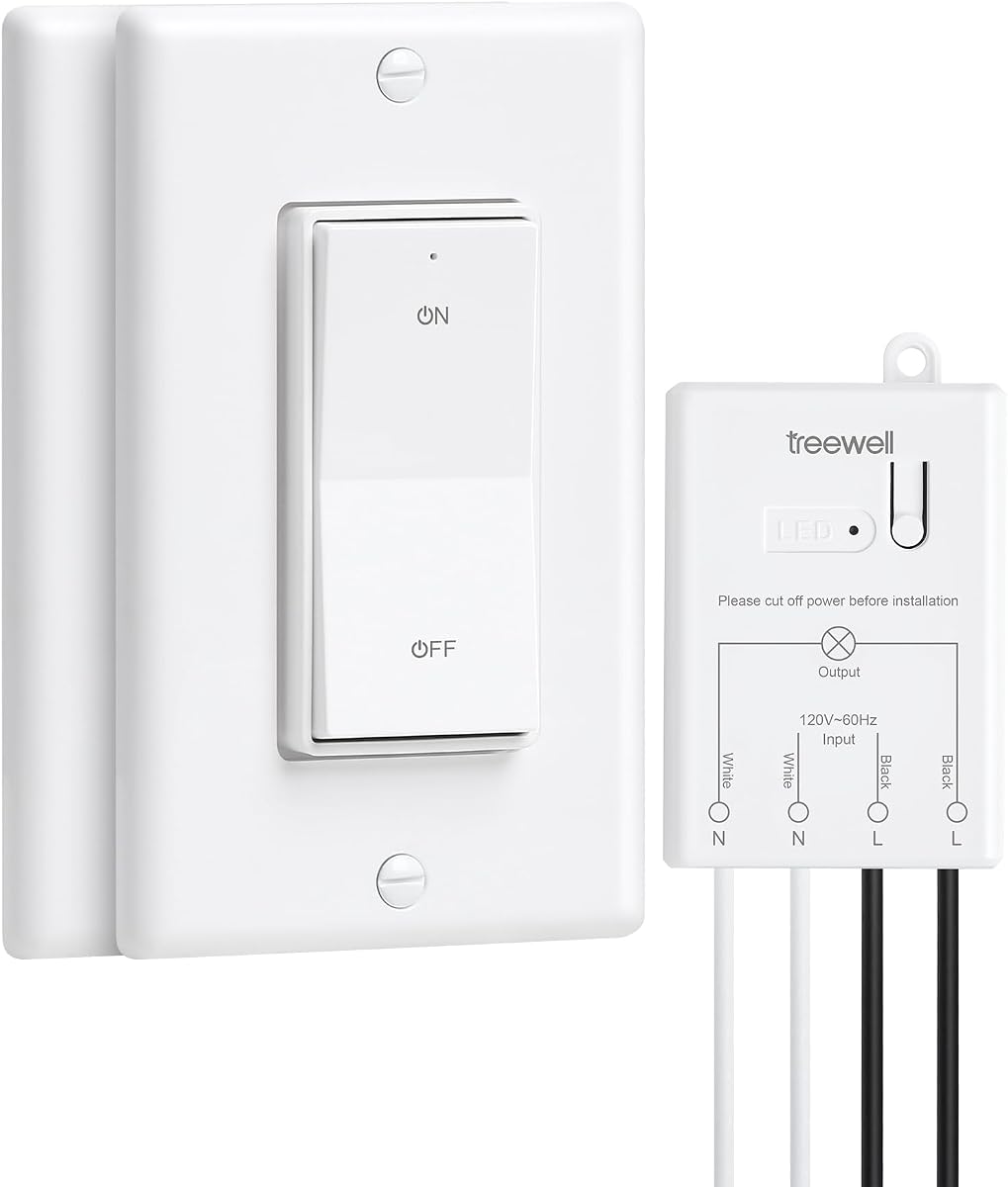
The Treewell 3-Way kit is intended to add or relocate a switch so the same light can be operated from two separate locations. It has a 4.6 rating and builds on the detachable decorator-switch concept with a receiver rated for 10 amps and 1,200 watts. The stated 200-foot range supports flexible placement in larger spaces.
We may earn a commission when you buy through this link, at no additional cost to you.
The receiver connects between the power and lighting fixture, reducing the need for complex in-wall rewiring. Pre-programmed operation is intended to provide immediate control, while the included magnetic rocker switch can be mounted in a standard or multi-gang wall plate, carried by hand, or attached to metal.
Its 10-amp rating is lower than the 15-amp wireless rocker kit, with stated maximums of 1,000 watts for tungsten, 600 watts for fluorescent, and 200 watts for LED. The compact 1.38-by-1.96-inch receiver is designed for confined electrical boxes. Pairing supports multiple devices, but there is no dimming or connected-home functionality.
This kit is a strong option for stairs, hallways, large bedrooms, and entrances where a second switch location is useful. It suits homeowners who want the appearance and behavior of a three-way arrangement without a complete rewiring project. Buyers with higher loads should choose a higher-rated system and confirm local electrical requirements.
The system is designed to operate a light from two separate locations, a familiar arrangement for stairs, hallways, and rooms with multiple entrances. It delivers that convenience without requiring a complete new wiring layout.
The magnetic rocker can remain neatly installed in a wall plate or be removed and used around the home. This creates a practical option for children, guests, or anyone who benefits from having the controller nearby.
We may earn a commission when you buy through this link, at no additional cost to you.
The Syantek five-outlet system is a broad RF bundle designed for controlling household appliances from two included remotes. It earned a 4.7 rating and includes five compact outlets, making it a practical option for households that want remote control over several lamps, fans, heaters, decorations, sound systems, coffee pots, or charging devices.
We may earn a commission when you buy through this link, at no additional cost to you.
The system's RF signal is stated to work through doors, walls, and windows, with up to 100 feet of line-of-sight range. Custom programming allows one remote to operate multiple outlets and permits one outlet to respond to several remotes. Its compact format is intended to use only one wall socket per receiver, helping preserve access to remaining outlets.
This is a manual remote system rather than an app-connected one. It cannot provide internet access, location-based control, or voice-assistant support. Each receiver also needs a physical wall outlet, and the supplied information describes it as an indoor product. The outlet remains closed after a power cut, which helps prevent unattended devices from restarting unexpectedly.
The Syantek bundle is a good choice for households seeking several independently controllable points without complex programming. The two remotes can be placed in different rooms, while the five outlets cover a broad collection of everyday devices. It is especially useful for users who want easy push-button access but do not need connected automation.
Five outlets and two remotes provide a generous starting point. The components can organize different rooms, devices, or user groups without requiring additional purchases for a multi-device setup.
A handheld push-button controller can be easier to operate than a standard wall switch for some older adults or people with mobility limitations. Placement near a bed, armchair, or frequently used entrance can make daily operation more comfortable.
We may earn a commission when you buy through this link, at no additional cost to you.
The Leviton Decora Smart Switch brings Wi-Fi, app control, voice integration, and automation to a conventional wall-switch format. Its 4.5 rating makes it the lowest-rated product in this roundup, but that difference is slight, and the category offers a distinctly different experience from basic push-button RF kits.
We may earn a commission when you buy through this link, at no additional cost to you.
The My Leviton app allows users to check light status, control fixtures remotely, and create schedules. Compatibility includes Google Assistant, Amazon Alexa, Apple Siri, Apple Home, SmartThings, and Home Assistant, while Matter readiness supports broader smart-home interoperability. A particularly useful feature is the ability to schedule exterior lights around sunset for security and convenience.
The important trade-off is dependence on a connected ecosystem and its installation requirements. Unlike a simple plug-in RF outlet, a smart wall switch must be wired into the electrical box and may have neutral-wire or compatibility requirements that vary by application. This product also does not include a separate handheld controller, so users control it through a phone, voice platform, or the physical switch.
This Leviton model is best for someone who wants to check and adjust lights while away, automate evening illumination, or use voice commands throughout the home. It is less suitable for a simple bedroom lamp where a portable remote and plug-in receiver would be faster and less involved. Confirm wiring and bulb compatibility before installation.
Smartphone access lets users check whether lights are on and make changes while at work or away. This convenience extends well beyond the room where the physical switch is located.
Schedules can turn lights on or off at chosen times, while voice-platform support enables hands-free operation. Matter readiness also makes the switch easier to incorporate into a mixed smart-home system.
We may earn a commission when you buy through this link, at no additional cost to you.
The Philips Hue Smart Dimmer Switch Remote is a premium wireless controller for an established Hue lighting system. It carries a 4.7 rating and expands control without requiring a new in-wall switch. The V2 battery-powered unit dims, brightens, turns lights on and off, and cycles through four favorite Hue scenes.
We may earn a commission when you buy through this link, at no additional cost to you.
Its installation flexibility is notable. The remote can be mounted to a wall with the included adhesive, attached to a metal surface through its magnetic backing, or removed from the wall plate and used as a portable remote. Setup occurs through the Hue app, where users select the lights to control and personalize behavior.
The significant requirement is a Hue Bridge. The switch is not an independent RF system for ordinary lamps; it is designed to work with Hue lights and the connected Hue ecosystem. Buyers without an existing Bridge must account for that additional component and its placement before considering the remote. Users seeking broad smart-home compatibility may prefer the Leviton's wider platform support.
This Philips Hue remote is the most compelling choice for a household that already uses Hue and values nuanced lighting control. It gives children, guests, and other family members a simple physical interface for everyday scenes while preserving app-based automation. It is less suitable for a first-time buyer who only wants one simple remote-controlled lamp.
Dimming and brightening make this controller useful for reading, relaxing, entertaining, and nighttime navigation. The ability to cycle through four favorite scenes brings familiar controls directly to household members.
Adhesive wall mounting, magnetic placement, and handheld use allow the controller to go wherever it is most useful. It can remain near a doorway, sit beside a bed, or travel with a user around the home.
We may earn a commission when you buy through this link, at no additional cost to you.
The Lutron Caseta 3-Way Smart Dimmer Kit is a complete premium lighting-control package consisting of a Caseta smart dimmer, a three-button Pico remote, and a Pico wall-plate bracket. It earned a 4.7 rating and is designed for homeowners who want a new switch location, dimming, and connected control in one installation.
We may earn a commission when you buy through this link, at no additional cost to you.
The dimmer is stated to work with up to 150 watts of LED and 600 watts of incandescent or halogen lighting. It can control multiple fixtures, and the included Pico can be mounted flush on a wall, placed over a junction box, or kept on a nightstand or side table. A key installation advantage is that no neutral wire is required, making the kit accessible to more existing switch boxes.
Full connected functionality requires a Lutron Hub, which supports connectivity with Alexa, Apple HomeKit, Google Home, Ring, and other services. The hub is designed to operate without Wi-Fi for reliable local control, while the Lutron app adds remote access, scenes, schedules, geofencing, smart-away features, and timers. The wallplate is not included, and users should also confirm dimmable bulb compatibility.
This kit is ideal for a homeowner building a polished smart-lighting system or adding control at the top and bottom of a staircase. It costs more conceptually and in equipment requirements than a simple RF kit, but it delivers an integrated dimmer, portable remote, and mature smart-home features. It is less attractive for someone who needs only a basic plug-in remote for one outlet.
The kit can add a control point by replacing an existing switch and placing the Pico elsewhere. Since no neutral wire is required, it can be easier to install in homes where full rewiring would be inconvenient.
The dimmer supports common LED as well as incandescent and halogen lighting, with stated maximums of 150 watts for LED and 600 watts for incandescent or halogen. Existing compatible bulbs can remain in use.
We may earn a commission when you buy through this link, at no additional cost to you.
The right radio-controlled light switch depends on control method, installation conditions, receiver capacity, range, and desired smart-home features. Comparing those factors before ordering helps prevent compatibility problems and ensures the system remains useful over time.
Basic RF kits use a handheld push-button remote and a receiver that communicates through radio frequency. They generally operate without an app, hub, internet connection, or complex account setup. In-wall wireless switches look more conventional and may be installed between power and a fixture, while plug-in outlet receivers require no wiring at all. Wi-Fi switches, Hue remotes, and Lutron systems support connected control, scenes, voice assistants, or scheduling but introduce additional ecosystem requirements. Choose the method that matches the desired level of automation rather than assuming every radio-controlled switch offers app access.
Receiver capacity is expressed through voltage, amperage, wattage, and sometimes separate LED, tungsten, or fluorescent limits. The products in this guide range from 10 amps and 1,200 watts to 15 amps and 1,875 watts, with one product listing 1,250 watts for tungsten, 1,000 watts for fluorescent, and 200 watts for LED. A higher headline wattage figure does not necessarily apply to every bulb type, so check the exact load chart for the intended fixture. Shop vacuums are also expressly excluded from the BN-LINK products, and other high-draw equipment may require a different system.
Plug-in outlet systems offer the easiest installation because they use an existing receptacle. Wireless relay receivers must be connected between the power and lighting load, and some in-wall kits require a neutral wire. The Lutron Caseta kit is notable because it does not require a neutral wire, while the SURAIELEC kit explicitly does. Always verify box space, conductor availability, and local code requirements before purchasing a hardwired receiver. A product that avoids rewiring can still involve qualified electrical work when the receiver must be placed inside a wall.
Range claims should be read carefully. Several products state up to 100 feet in line of sight, while the decorator rocker and Treewell kits claim up to 200 feet. RF signals may pass through doors, walls, and windows, but distance, building materials, obstructions, interference, and receiver orientation can affect actual performance. Installing the receiver in a protected box may also weaken signal reception. For large homes or masonry construction, consider a system explicitly designed for longer range and place the receiver where it can receive a clear radio signal.
Think about whether one remote should operate one device, several devices, or devices in multiple rooms. BN-LINK learning-code systems, the SURAIELEC system, the wireless rocker kits, and the Syantek outlets support programmable combinations. Some packages include multiple remotes, while the single-outlet BN-LINK kit starts with one transmitter. Expansion is not necessarily universal across every brand, so confirm compatibility within the same product family. Planning a larger layout before installation can make future controls easier to add and organize.
A radio signal alone does not guarantee smartphone, voice, or internet control. The Leviton Decora Smart Switch provides Wi-Fi app access, scheduling, voice-assistant support, and Matter compatibility. The Philips Hue remote requires a Hue Bridge and is intended to work within the Hue system. The Lutron Caseta kit also requires a Lutron Hub for its full connected features. Check which accounts, hubs, applications, and voice platforms are already available before choosing a connected model.
Most of the outlet and relay kits provide on-and-off control only. The Philips Hue remote and Lutron Caseta dimmer are better choices when gradual brightness adjustment and scene selection are priorities. Dimming also requires compatible dimmable bulbs, and the receiver's separate load limits for LED, tungsten, and fluorescent fixtures should be reviewed. Incompatible bulbs may flicker, fail to dim properly, or create unnecessary installation problems. Confirm both the switch and the lamp support the intended control method.
Look for relevant safety listings and compliance marks appropriate to the product and region. The BN-LINK kits are identified as ETL and FCC certified, the Syantek system as FCC certified and ETL listed, and other products have their own listed standards where specified. These marks provide useful evidence of third-party evaluation, but they do not make every installation appropriate. Users must still follow the manufacturer's wiring instructions, observe electrical limits, and comply with local building and electrical codes.
Before installation, identify whether the system uses a plug-in outlet or an in-wall receiver. Plug the BN-LINK and Syantek outlets into suitable receptacles, confirm that connected loads are compatible, and test each pairing before rearranging furniture or mounting controls. For hardwired systems, switch off the circuit breaker, verify the circuit is de-energized, and follow the receiver's wiring diagram exactly. The Lutron Caseta and Philips Hue products also require their respective setup procedures, including the appropriate hub or Bridge where specified.
Pair and program remotes before putting the system into everyday use. For learning-code RF kits, follow the supplied pairing sequence and test each control independently. A wide-area RF receiver may need to be positioned outside a metal box or at a point with a stronger signal. For smart devices, complete app pairing, name the lights, assign rooms, and configure schedules or scenes before removing temporary packaging or labels.
Maintain the system by keeping receivers dry, vents unobstructed, and remotes accessible. Replace remote batteries when commands become slow or intermittent, and avoid exposing non-weatherproof units to moisture even if they are used indoors. Test the system periodically, especially after power outages, and do not exceed the rated amperage or wattage. If a switch behaves unexpectedly, unplug plug-in receivers or turn off the circuit before inspecting hardwired components.
Yes. The BN-LINK, SURAIELEC, Syantek, and Treewell RF systems use radio-frequency communication and do not require Wi-Fi, an app, or an internet connection. They are controlled by physical remotes or wireless wall switches. The Leviton Decora, Philips Hue, and Lutron Caseta options rely more heavily on connected ecosystems, hubs, apps, or voice platforms, so their setup requirements are different.
Most of the systems in this guide support programmable control of multiple compatible devices. BN-LINK learning-code outlets can be paired with multiple remotes, SURAIELEC can be expanded with extra transmitters and receivers, and the Syantek system supports custom programming across its five outlets. Expansion compatibility should be confirmed within the same product family, and every connected load must remain within the receiver's rating.
It depends on the model. The SURAIELEC Wireless Light Switch Kit requires a neutral wire, while the Lutron Caseta Smart Dimmer Kit is specifically described as requiring no neutral wire. Plug-in BN-LINK and Syantek outlets avoid in-wall neutral requirements because they use an existing receptacle. Confirm the wiring requirements of the exact model and inspect the switch box before proceeding.
The RF kits in this roundup have stated ranges ranging from 100 to 200 feet. These are maximum figures, and actual performance depends on walls, doors, metal objects, electrical interference, and receiver placement. RF signals generally work through ordinary interior walls better than Wi-Fi, but a long-range claim should not be treated as guaranteed coverage in every building.
Only models designed for dimming should replace a functioning dimmer. The Philips Hue Smart Dimmer Remote and Lutron Caseta Smart Dimmer Kit support adjustable brightness, while the basic outlet and relay kits are intended primarily for on-and-off operation. Any dimming installation also requires compatible dimmable bulbs, and the stated LED, tungsten, and fluorescent load limits should be checked.
Only use a receiver outdoors when its listed specifications expressly permit outdoor exposure. The SURAIELEC receiver is described as weatherproof and suitable for locations including lofts, attics, and outdoor settings. The Syantek outlet is described as indoor, and ordinary indoor receivers should not be exposed to rain or condensation. Local electrical codes and manufacturer guidance still apply.
The RF products here are designed to communicate through doors and walls, which is one of their main advantages over ordinary infrared remotes. Performance can still decline with distance, dense building materials, metal obstructions, and poorly positioned receivers. Adding a second compatible switch or testing the system before permanent installation can help identify coverage issues.
The BN-LINK and Syantek outlet systems are described as remaining off after a power interruption, helping prevent connected devices from turning on unexpectedly. Other systems may behave differently, so users should review the instructions for their specific model. After an outage, it is also wise to check that remotes are still paired and that connected loads have not changed.
The BN-LINK five-receiver kit is the strongest all-around option because it combines several outlets, two remotes, a 100-foot range, and expandable learning-code control without requiring network setup. The Philips Hue Smart Dimmer Remote stands out as the premium choice for an established Hue household, while the BN-LINK single-outlet package is the most budget-conscious way to add remote control to one device.
Prioritize compatibility before features. Verify whether the system is plug-in or hardwired, whether a neutral wire is available, whether the receiver fits the box, and whether the bulbs and appliances fall within the electrical ratings. Then consider whether the desired experience is a simple handheld remote, a wall switch at multiple locations, dimming and scenes, or full app-based automation.
Product ratings, availability, and prices can change, so review the current listing before ordering. Also read the manufacturer's complete installation instructions and consult current local electrical requirements. With those checks completed, the right radio-controlled switch can provide a noticeable improvement in convenience, accessibility, lighting control, and everyday home automation.