
EBL D Rechargeable Batteries and Universal Charger
4.4Editor score
Four 10000mAh D cells
Universal charger included
Charge and discharge modes
Built-in safety protections
Explore the best Rechargeable C D Batteries, comparing capacity, charger compatibility, recharge life, low self-discharge, and device fit.
Rechargeable C and D batteries offer a practical way to power flashlights, radios, cameras, and other high-drain devices without repeatedly replacing disposable cells. The right set should balance usable capacity, reliable charging, low self-discharge, physical compatibility, and a sensible included accessory setup.
We compared ten rechargeable C and D battery products using the information supplied for each listing, focusing on cell chemistry, advertised capacity, charger support, recharge-cycle claims, self-discharge performance, packaging, and the number of batteries included. The guide covers dedicated C and D sets as well as broader household assortments.
Each review highlights the product most likely to suit a particular need, from pre-charged C cells to high-capacity D batteries and mixed-size collections. Ratings, product details, and availability can change over time, so readers should verify the current listing and charger requirements before ordering.
4.4Editor score

4.5Editor score
4.4Editor score
The table below places all ten rechargeable C and D battery options side by side, highlighting the cell sizes, capacities, charger arrangements, and practical differences that matter most when choosing a reusable battery setup.


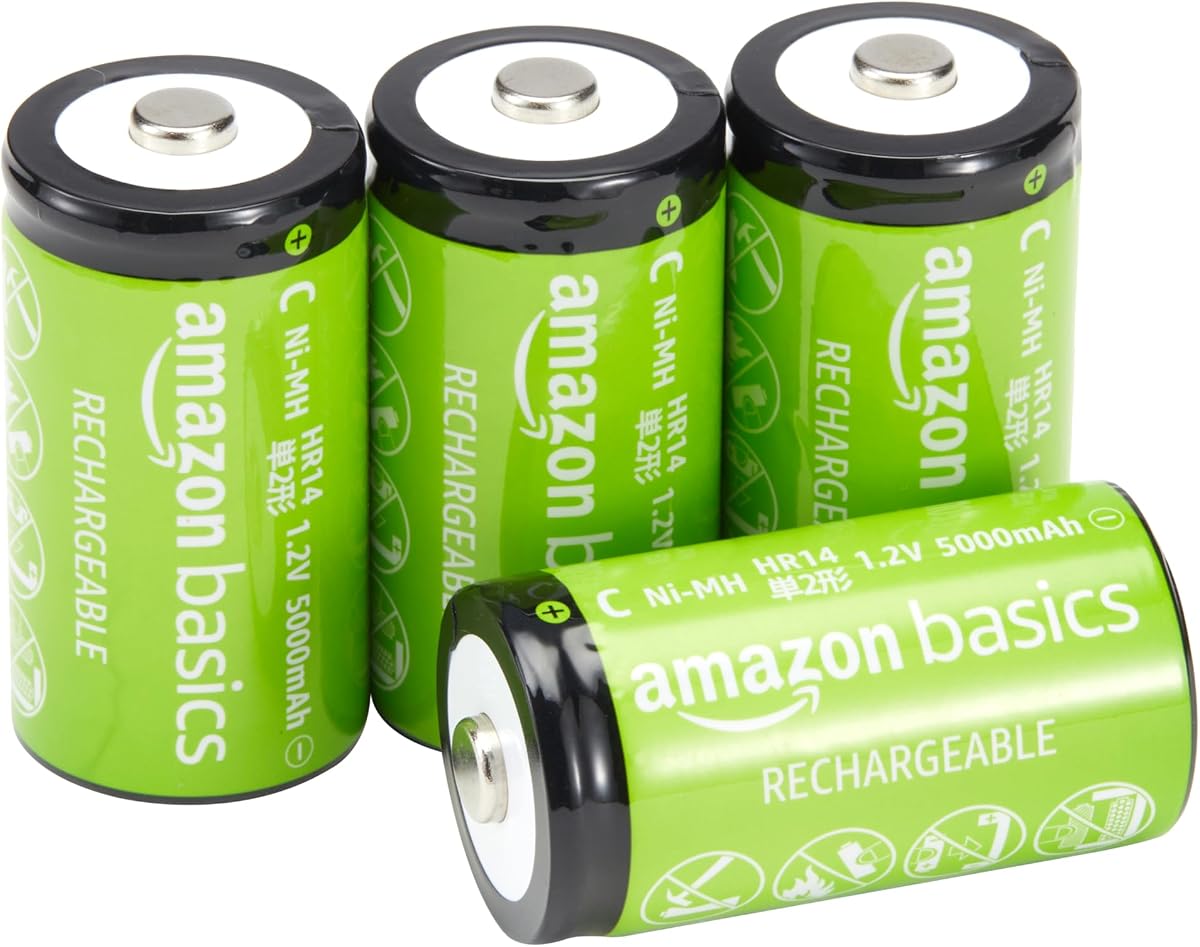
The Amazon Basics 4-Pack is a strong all-around choice for rechargeable C cells because it combines 5000mAh NiMH batteries with pre-charged convenience and a straightforward four-cell format. Its 4.4 rating reflects a broadly favorable customer response, while the listed specifications make it suitable for lights, radios, and other compatible electronics.
We may earn a commission when you buy through this link, at no additional cost to you.
The main advantage is the balance between capacity and storage behavior. Amazon Basics says the cells maintain 80% capacity for 24 months, making them appealing for households that do not use every battery regularly. They can be recharged up to 1000 times, and the recycling-oriented packaging adds a modest practical and environmental benefit.
The main limitation is that a charger is not included. Buyers who do not already own a NiMH charger will need to account for that extra accessory, and the four-pack is smaller than some of the larger C-cell sets in this guide. Neither issue reduces the core appeal for people who want a compact, ready-to-use set.
This is a particularly good recommendation for shoppers who want reliable C batteries without paying for a bundled charger. It is less suitable for people seeking a large collection or a complete household battery system. For most single-device users, however, the pre-charged cells, 5000mAh rating, and low self-discharge claim make this a convincing top choice.
The stated ability to retain 80% capacity for 24 months is useful for emergency equipment and occasional-use devices. It also makes the set easier to store than batteries that need regular top-ups, although actual results depend on storage temperature and charging habits.
Four cells cover two common device configurations without creating unnecessary bulk. The set is straightforward to label, rotate, and distribute among compatible C-sized products.
We may earn a commission when you buy through this link, at no additional cost to you.
This EBL package is attractive for buyers who want high-capacity D batteries and a charger in the same purchase. The four 10000mAh cells are paired with a universal charger supporting one to four AA, AAA, C, or D rechargeable batteries, plus one or two 9V batteries. The product carries a 4.4 rating.
We may earn a commission when you buy through this link, at no additional cost to you.
Its charger is more versatile than a dedicated C-only unit. It offers charge, discharge, and error-detection modes, displays charging progress for AA, AAA, C, and D cells, and automatically transitions from fast charging to trickle charging. Compatibility with several common formats also makes it useful for households with mixed battery inventories.
The listing emphasizes protections against overcharging, short circuits, incorrect battery installation, and non-rechargeable or damaged cells. Users must still confirm that every battery inserted is compatible with the charger. The included AC adapter and user manual make the setup more complete than battery-only alternatives.
This set is best for D-heavy users who also want a charger for smaller rechargeable cells. It may be unnecessary for someone who already owns a suitable universal charger, but the convenience of receiving everything together and the unusually broad charger support justify its place among the strongest budget-oriented options.
The charger handles up to four AA, AAA, C, or D cells and up to two 9V batteries. That flexibility reduces the need to maintain several chargers when a household uses more than one rechargeable battery format.
The LCD provides charging progress for AA, AAA, C, and D batteries. That makes it easier to determine when a cycle is complete and helps distinguish a normal charge from an error condition.
We may earn a commission when you buy through this link, at no additional cost to you.
The EBL 4-Pack with LCD Smart Charger combines 5000mAh C cells with one of the more capable universal chargers in this roundup. Its 4.5 rating is among the strongest listed, and the bundle is aimed at people who want both C batteries and a flexible charging station.
We may earn a commission when you buy through this link, at no additional cost to you.
The charger uses independent channels and can accommodate combinations of AA, AAA, C, and D rechargeable batteries. Its LCD indicates charging status, identifies errors, and supports a repair function for flagged cells. Type-C input and a backup input add flexibility, although the instructions specify a compatible 2.0A adapter, which is not included.
The NiMH C cells have no memory effect according to the listing and can be recharged up to 1200 times. That cycle claim exceeds the 1000-recharge figure associated with several other options, although actual longevity depends on usage patterns, charging equipment, temperature, and cell condition.
This is an excellent choice for a household that already uses rechargeable AA, AAA, C, or D batteries. The included charger adds visible controls and independent channels that can be valuable when managing several cells. Buyers who want a completely plug-and-play package may prefer a set that includes the power adapter.
Independent charging channels allow cells to be managed individually rather than forcing every battery to follow one shared channel. This is useful when only some cells need charging or when you want clearer status information for each position.
The LCD can display an error when a battery is damaged or installed incorrectly and offers a repair function. Buyers should interpret repair mode as a maintenance feature rather than a guarantee that every damaged cell can be restored.
We may earn a commission when you buy through this link, at no additional cost to you.
This EBL D-cell bundle is built around four 10000mAh rechargeable batteries and a universal LCD charger. It is a natural choice for high-drain equipment that accepts standard D cells, with a 4.4 rating and a charger capable of handling AA, AAA, C, and D formats.
We may earn a commission when you buy through this link, at no additional cost to you.
The 10000mAh rating gives these cells a strong capacity position among the listed D alternatives. The charger provides independent channels, a clear display for charging status, and indicators for damaged batteries or installation errors. Type-C input and a backup port add setup flexibility for shoppers who already own suitable charging equipment.
A notable detail is the explicit 1.2V nominal voltage, which reflects the chemistry's operating characteristics. The product also notes no memory effect and uses ProCyco technology to support recycling-related handling. As with many electronics accessories, actual runtime varies with device demand and operating temperature.
This package is best for users who need durable D batteries and want a smart charger without buying two products separately. It is less convenient for plug-and-play buyers because the adapter is excluded, but the charger features and high-capacity cells make it a strong option for a prepared household.
The advertised 10000mAh capacity makes these cells appropriate for equipment that draws meaningful power over extended periods. Device fit, battery contacts, and runtime remain important factors, so the manufacturer's requirements should take priority over capacity alone.
Type-C input and a backup connection provide flexibility at the wall or power-bank level. The listing specifies that only a 2.0A adapter should be used, and the adapter itself is not part of the package.
We may earn a commission when you buy through this link, at no additional cost to you.
The EBL 8-Pack is the most substantial dedicated C-cell set in this guide. It provides eight 5000mAh NiMH batteries with a 4.5 rating, making it especially useful for households or offices that run more than one C-sized device.
We may earn a commission when you buy through this link, at no additional cost to you.
The cells arrive pre-charged, so they can be used without a first charging cycle. More importantly for long-term storage, the listing says improved low self-discharge allows them to maintain 80% capacity after three years of non-use. They are compatible with C NiMH chargers and are described as suitable for high-drain devices.
The main compromise is that no charger is included. Buyers who need only one device or one pair of cells may find eight batteries more than necessary, and extra cells require responsible storage and rotation. ProCyco technology is included to support recycling, while the no-memory-effect characteristics of NiMH help simplify charging routines.
This is a strong recommendation for buyers who want a ready-to-deploy C battery inventory. It is especially useful for flashlights, radios, cameras, and other compatible equipment used regularly. For occasional use, the smaller four-cell options may be more convenient.
An eight-cell package makes it easy to equip several products at once or keep replacements close at hand. That convenience is especially valuable in homes with multiple flashlights, radios, or other compatible C-powered devices.
The stated three-year storage retention is a meaningful advantage for emergency kits and seasonal equipment. Keeping cells in a cool, dry place can help preserve their condition between uses.
We may earn a commission when you buy through this link, at no additional cost to you.
The Energizer Rechargeable C 2-Pack is a compact option for a single compatible product. It has the highest customer rating in this roundup at 4.6, and its straightforward pair format is well suited to flashlights, portable radios, and other devices that take two C cells.
We may earn a commission when you buy through this link, at no additional cost to you.
The batteries are described as precharged and designed to help prevent leaks, an important consideration for equipment that may sit unused or remain connected for long periods. They are also made with 7% recycled batteries. The product information says they can be charged hundreds of times when used with an Energizer battery charger.
The limitation is obvious but important: only two cells are included, and the charger is not part of the package. This makes the set less appealing for multi-device households than the larger EBL packs. Its compact format is nevertheless a benefit for travelers, emergency kits, and anyone who wants to keep a spare pair without managing a large collection.
This is a sensible pick for one-device users who prefer a recognizable battery brand and value leak-resistant construction. Buyers who already own a charger and need several replacement cells should consider the eight-pack EBL alternative, while those wanting a simple branded pair will find this option easy to manage.
The listed leak-resistant design helps reduce the risk of electrolyte damage when batteries are stored or used in compatible equipment. It does not eliminate the need to remove cells from long-unused devices or to inspect aging batteries.
Two cells are all that many flashlights and radios require, keeping storage and rotation simple. It is a particularly convenient format for a travel kit or a single high-use device.
We may earn a commission when you buy through this link, at no additional cost to you.
The Energizer Recharge Universal 2-Pack gives buyers a compact branded option for D-powered devices. Its 4.4 rating is solid, and the product information emphasizes a design intended to prevent leaks, making it relevant for flashlights and other compatible equipment.
We may earn a commission when you buy through this link, at no additional cost to you.
The cells are made with 7% recycled batteries and can be recharged hundreds of times when paired with an Energizer battery charger. Their construction also supports a reduced-waste approach compared with continually replacing disposable cells. The listing also points to up to a three-year battery life for long-lasting use.
Unlike several EBL D-cell choices, this product does not provide a specific mAh capacity in the supplied information. That makes direct capacity comparisons more difficult, and buyers focused on maximum runtime should pay close attention to device requirements and charger compatibility. The two-cell pack is also smaller than four- and six-cell options.
This is a good fit for someone who wants a simple pair of branded rechargeable D batteries for one product. It is less suitable for shoppers who want a larger inventory, a bundled charger, or a clearly stated high-capacity specification. Its main strengths are simplicity, leak-resistant design, and established brand familiarity.
The two-cell format keeps the purchase small while covering the most common D-battery device configuration. It is easy to store, carry, and use as a dedicated replacement pair.
These batteries require a compatible Energizer charger, which is not included. Existing charger ownership makes this option more convenient, while first-time rechargeable-battery buyers should plan for the additional accessory.
We may earn a commission when you buy through this link, at no additional cost to you.
The EBL six-pack provides a middle ground between compact two-cell D sets and larger household inventories. It includes 10000mAh NiMH batteries, has a 4.5 rating, and focuses on high-capacity cells rather than bundling a charger.
We may earn a commission when you buy through this link, at no additional cost to you.
A notable practical detail is the reclosable packaging, which helps keep unused cells organized and protected during storage. The batteries are described as replacements for standard D-size and NiCd rechargeable batteries, while their NiMH chemistry gives them the familiar no-memory-effect benefit and broad support for smart or universal chargers.
Because no charger is included, this product is most attractive to people who already have NiMH charging equipment. It also provides fewer cells than the EBL four-cell sets with bundled chargers, but the six-cell quantity is convenient for keeping spare cells organized without buying a large mixed-size assortment.
This is a good recommendation for D-heavy users who want high capacity and organized storage but do not need an included charger. It may also suit people transitioning from NiCd rechargeable cells, provided they verify that the device and charger are compatible with the specified NiMH chemistry.
Reclosable packaging is a small but meaningful convenience for loose rechargeable cells. It reduces the chance of mixing batteries with unrelated items and keeps unused cells together between charging cycles.
The 10000mAh specification gives the cells a clear performance identity, but charging equipment is separate. This keeps the package focused for buyers who already own a compatible NiMH smart or universal charger.
We may earn a commission when you buy through this link, at no additional cost to you.
The Tenergy 68-Pack is the most comprehensive collection in the guide, covering AA, AAA, C, D, and 9V rechargeable NiMH batteries. It includes eight C cells at 5000mAh and eight D cells at 10000mAh, alongside larger quantities of smaller cells and four 9V batteries.
We may earn a commission when you buy through this link, at no additional cost to you.
This assortment is designed for households and offices with varied device requirements. The listed devices include TV remotes, gaming controllers, smoke detectors and alarms, flashlights, and cameras. The cells can be reused up to 1000 times and have no memory effect, allowing them to be recharged without following a strict depletion schedule.
A compatible smart universal charger with rapid-charge technology must be purchased separately. That makes the initial setup less convenient than a bundled kit, but it also gives buyers flexibility over charging location and equipment. The 68-piece format may be excessive for one or two devices, so the primary appeal is broad coverage rather than minimalism.
This is the strongest choice for a broad household battery replacement program. It reduces the need to source AA, AAA, C, D, and 9V cells separately and provides useful quantities of the larger formats. Buyers should first confirm which devices they want to power and whether their charger supports every included size.
Covering five common rechargeable formats makes the bundle especially useful for mixed-device households. It can support remote controls, small electronics, flashlights, radios, and other compatible equipment without separate shopping trips.
The C cells are listed at 5000mAh and the D cells at 10000mAh, providing a meaningful distinction for higher-drain equipment. Runtime still depends on the device, contacts, temperature, and age of the cells.
We may earn a commission when you buy through this link, at no additional cost to you.
The Tenergy 26-Pack offers a more compact mixed-format alternative to the 68-piece bundle. It includes eight AA, eight AAA, four C, four D, and two 9V NiMH rechargeable cells, giving shoppers useful coverage without acquiring the largest possible inventory.
We may earn a commission when you buy through this link, at no additional cost to you.
The C cells are listed at 5000mAh and the D cells at 10000mAh. Product information says the high-density NiMH cells can be recharged up to 1000 times and have no memory effect. The assortment is suitable for everyday devices such as gaming controllers, TV remotes, wireless computer peripherals, clocks, and flashlights.
A compatible charger is not included, so this set is most attractive to shoppers who already have a suitable universal charger or plan to buy one. Its lower total count also means it may not satisfy an office or a home with numerous large-format devices, but four C and four D cells are enough to cover several common configurations.
This is a good final recommendation for people who want broad household coverage in a manageable quantity. It combines the two large formats with smaller and 9V batteries while avoiding the storage demands of a 68-cell package. Confirm charger compatibility before use and keep the assortment organized by cell size.
Twenty-six cells cover several formats while remaining easier to store and rotate than a much larger collection. It suits homes that want flexible coverage without maintaining an oversized battery inventory.
The included AA, AAA, C, D, and 9V cells support many household electronics. Device-specific requirements and charger limitations should still be checked before replacing batteries with this mixed NiMH set.
We may earn a commission when you buy through this link, at no additional cost to you.
Choosing rechargeable C and D batteries involves balancing capacity, charger design, cell format, storage behavior, and the number of batteries you need. These factors determine whether a set is convenient in daily use or merely technically rechargeable.
C and D batteries are not interchangeable in every device. Check the battery compartment, the device manual, and the markings on the original cells before purchasing. C cells are generally suited to compact flashlights, radios, and similar equipment, while D cells offer a larger format for devices designed around that size.
Choose the exact size and quantity your equipment requires, then buy a few extra cells for rotation.
The supplied listings commonly describe C cells as 5000mAh and D cells as 10000mAh. Higher advertised capacity can translate into longer runtime between charges, but it is not the only factor determining performance. Device demand, battery age, temperature, and contact quality all influence the result.
Compare capacity within the same cell size and use it as a practical endurance indicator rather than a guarantee of identical runtime.
A charger that works with AA or AAA cells is not automatically appropriate for larger C and D batteries. Look for explicit support for the cell size and chemistry you own, paying attention to channel count, input requirements, and any included adapter. Some universal chargers support several formats, while dedicated chargers may handle only one or two.
Confirm both size and rechargeable chemistry before inserting batteries, and follow the charger's instructions.
Pre-charged means the cells are intended to be usable when the package arrives, although checking the charger's indicator is still sensible. A product that includes a charger may make the first setup more convenient, while a battery-only set requires separate compatible charging equipment.
Pre-charged is most useful for immediate use; long-term buyers should still consider low self-discharge.
Low self-discharge matters when batteries sit unused in an emergency kit, a seasonal device, or a rarely used radio. Some listings claim that cells retain 80% capacity for 24 months or three years. Treat these as manufacturer claims and store batteries in a cool, dry place to help preserve performance.
For infrequent use, prioritize low self-discharge and consistent charger monitoring over maximum cell count.
Two-cell packages suit one device, four- and six-cell sets make rotation easy, and larger assortments cover several devices or formats. Buying too few can leave you short during a charging cycle, while buying too many creates unnecessary storage and rotation work. Count active devices and decide whether you want spare cells immediately available.
A moderate quantity is usually easiest to manage, especially when several batteries share one charger.
LCD displays, individual channels, error indicators, discharge modes, and automatic trickle charging can make a charger more useful across different battery conditions. These features are particularly helpful when your collection includes mixed capacities or partially used cells. They also provide clearer feedback than a simple light, although more advanced screens require compatible power inputs.
Look for automatic cutoffs and clear charging-status feedback, especially for high-capacity cells.
The listed chargers include protections such as short-circuit detection, overcharge timing, negative-delta cutoffs, and detection of unsuitable batteries. These features reduce charging risk, but they do not excuse using the wrong chemistry or damaged cells. Never charge a battery that is visibly damaged, leaking, or not explicitly supported by the charger.
Use only compatible rechargeable cells, inspect them periodically, and retire questionable batteries promptly.
Before first use, identify the correct cell size and chemistry, inspect the contacts, and confirm that the charger supports the batteries. Insert each cell according to the polarity markings. If the batteries are supplied pre-charged, they can generally be used immediately, although a full charge on a compatible charger can help establish a consistent starting point.
Charge the cells on a surface that is stable, dry, ventilated, and away from combustible materials. Follow the charger's instructions, do not leave charging unattended, and remove batteries when charging is complete if the manual recommends it. Avoid mixing old and new batteries, different chemistries, or cells with visibly different levels of damage unless the charger is specifically designed for that use.
For storage, remove cells from devices that will remain unused for long periods, keep them in their original or a labeled container, and place them in a cool, dry location. Rotate cells across devices so they do not sit indefinitely in the same equipment. Retire cells that develop swelling, leakage, corrosion, or other signs of damage, and recycle rechargeable batteries through an appropriate program.
Often, yes, but you should check the device manual for voltage and battery-type requirements. Most rechargeable C and D NiMH cells operate at 1.2 volts nominal, while alkaline cells typically use 1.5 volts. Some devices accept both, while others may require an adjustable or regulated voltage. Never place a rechargeable cell in a device or charger that is not designed for that chemistry.
You need a charger that explicitly supports the battery size and rechargeable chemistry. A universal NiMH charger may handle AA, AAA, C, and D cells, while other chargers are limited to smaller formats. Check the charger instructions and never assume a charger is compatible simply because the batteries fit physically.
The numbers describe each cell's advertised capacity, while C and D describe physical size. A 5000mAh C cell and a 10000mAh D cell are not direct substitutes because they may not fit the same device or charger. Actual runtime depends on the device's power draw, battery age, temperature, and contact quality.
The supplied product information ranges from hundreds of cycles to as many as 1000 or 1200, depending on the model and brand. Recharge-cycle claims are maximum-style specifications rather than guarantees for every cell. Charging practices, temperature, discharge depth, and battery age all influence real-world longevity.
For long periods of inactivity, removing them is generally prudent because it reduces the chance of leakage and minimizes energy loss. Keep the cells in a dry, cool container and avoid extreme heat, humidity, and direct sunlight. If a device is used regularly, rotate the cells so the same battery is not always left in a particular compartment.
Several chargers in this guide support both C and D cells along with AA and AAA formats, but channel counts and battery quantities vary. Make sure the charger has enough independent bays for the cells you intend to charge and follow any stated input-current requirements. A physical fit alone does not confirm compatibility.
NiMH rechargeable cells usually operate around 1.2 volts nominal, while alkaline cells begin around 1.5 volts and decline over time. Some devices are designed for the lower rechargeable voltage, while others may show reduced performance or issue low-battery warnings. Consulting the manufacturer is the safest way to verify compatibility.
Replace cells that swell, leak, corrode, crack, or show other visible damage. If a healthy-looking battery no longer holds a useful charge or causes a charger error repeatedly, retire it rather than continuing to use it. Recycling through an approved battery-recycling program is preferable to putting rechargeable cells in ordinary household trash.
The Amazon Basics C-cell pack is the most balanced standalone choice for most buyers, combining pre-charged 5000mAh cells with low self-discharge and a simple four-pack format. For users who want a charger and more visible controls, the EBL C-cell and LCD charger bundle is especially versatile. High-capacity D users may prefer the EBL D sets with universal or smart chargers.
Prioritize the factors that affect your own routine: confirm physical compatibility, choose a charger that supports the exact size and chemistry, and consider low self-discharge if batteries will sit unused. Pack quantity matters too, since two cells suit one device while larger sets are better for multiple devices, spares, and mixed battery formats.
Ratings, product specifications, and prices can change, so check the current listing before purchasing. Also verify included accessories, adapter requirements, and charger safety features. With that final check, the right rechargeable C and D setup can provide dependable, reusable power for compatible household and high-drain equipment.
