
SanDisk 32GB Ultra
4.7Editor score
32GB SDHC capacity
Up to 100MB/s read speed
Compact everyday storage
Looking for SD Cards for Trail Cameras? Compare 10 options for capacity, speed, durability, compatibility, and dependable outdoor wildlife recording in 2026.
SD cards for trail cameras must work reliably in cold, heat, moisture, dust, vibration, and constant recording conditions. Capacity matters, but speed, endurance, compatibility, and low-power operation also influence whether important wildlife images and videos are captured without interruptions. A card that seems inexpensive can still underperform when a camera needs sustained writing performance.
This guide compares 10 full-size SD and SDHC options offered for trail cameras and other compatible recording devices. We evaluated the supplied specifications, including capacity, pack quantity, speed class, video performance, durability claims, and intended device compatibility. The list includes single cards, multipacks, general-purpose options, and cards designed specifically for demanding outdoor use.
Each review explains the product's strongest traits, practical limitations, and likely buyer. The top selections include the GIGASTONE 5-Pack for its combination of capacity, speed, and useful mini cases, the PNY 3-Pack for explicit trail-camera features, and the GardePro 64GB card for advanced video specifications. Product availability and prices can change, so confirm current details before purchasing.
4.7Editor score

4.7Editor score

The comparison below organizes all 10 options by capacity, pack quantity, stated performance, and outdoor suitability, helping trail-camera owners identify the card format and feature set that best matches their equipment and recording habits.




The GIGASTONE 32GB SD Card 5-Pack earns the Editor's Choice position because it balances several trail-camera needs rather than optimizing for only one. Its stated up-to-80MB/s transfer speed, UHS-I interface, Class 10 rating, and U1 speed grade support Full HD recording, while the five included mini cases make it easier to keep each card organized between deployments. The product carries a 4.7 customer rating.
We may earn a commission when you buy through this link, at no additional cost to you.
Capacity is one of the most important practical advantages. Five 32GB cards let an owner rotate among locations, carry spares, or use separate cards for different cameras without handling a loose collection of memory. Each card measures 32 by 24 millimeters, so it uses the standard full-size SD format rather than the much smaller microSD shape. The listed specifications also state that the cards are waterproof, temperature-proof, x-ray-proof, shock-proof, and magnetic-proof, which is reassuring for equipment exposed to variable outdoor conditions.
There are some trade-offs. Thirty-two gigabytes is moderate rather than generous for extended high-resolution video, so frequent retrieval may be necessary in high-activity areas. The package also does not advertise V30, U3, or 4K capabilities. That is not a problem for many Full HD trail cameras, but buyers using demanding 4K recording should verify their camera's requirements. The stated five-year limited warranty adds useful protection compared with no manufacturer warranty.
This is the strongest general recommendation for hunters, wildlife watchers, and property owners who want several dependable cards at once. It is especially useful for cameras that specifically support SDHC cards and Full HD video. Choose this pack when rotation, organization, and broad outdoor protection matter more than maximum capacity per card. It is a balanced choice for regular trail-camera monitoring without requiring the most advanced speed class available.
Five separate cards make rotation simple and reduce the chance of overwriting valuable footage while data is still being reviewed. The included mini cases provide a practical way to identify, protect, and transport each card separately.
The Class 10 and U1 ratings are well suited to the Full HD recording profile described in the product information. They also provide enough stated performance for the compatible digital cameras, camcorders, DSLRs, and PCs listed by the manufacturer.
We may earn a commission when you buy through this link, at no additional cost to you.
The SanDisk 32GB Ultra is the straightforward budget-oriented option in this guide. It provides 32GB of SDHC storage, a listed read speed of up to 100MB/s, and a 4.7 customer rating. Those qualities make it a practical starting point for a trail camera that records standard-resolution images and Full HD video, particularly for a buyer who wants one dependable card without purchasing a larger multipack.
We may earn a commission when you buy through this link, at no additional cost to you.
Its 100MB/s read specification is useful when moving images and videos from the camera to a computer or another compatible device. The card's familiar SanDisk branding and SDHC format also make it straightforward to evaluate against camera requirements. Because it is a single card, it can serve one camera at a time or function as a spare while another card is being reviewed and cleared.
The supplied product information is much less detailed than it is for several competing options. It confirms the brand, 32GB capacity, SDHC type, and up-to-100MB/s speed, but it does not list specific durability certifications, sustained write speed, video speed class, or environmental resistance. Those omissions do not make the card unsuitable, but buyers who need documented 4K performance or extensive outdoor protection may receive more useful guidance from another product.
This card makes sense for a single standard-definition or Full HD trail camera, a modest wildlife-monitoring setup, or a buyer who already knows their camera supports 32GB SDHC media. It is also a sensible spare-card choice because the same 32GB format makes rotation straightforward. Confirm the camera's memory specification, format the card as recommended, and maintain a regular backup routine before relying on it during an active hunting or wildlife season.
One 32GB card is easy to manage and can cover many standard trail-camera workflows. It is a good fit when recording volume is moderate and footage can be transferred regularly.
The stated read speed of up to 100MB/s can shorten file-transfer waits when a card is connected to a compatible computer. This is especially useful after a camera retrieves a large collection of images and short videos.
We may earn a commission when you buy through this link, at no additional cost to you.
The PNY 32GB Elite U1 V10 SDHC 3-Pack is the most explicitly trail-camera-focused option among the top selections. Its 4.1 rating is lower than the 4.7 earned by the leading products, but its specifications are unusually direct: sequential read speed up to 100MB/s, Class 10 performance, U1 support, and V10 video capability. It is designed for outdoor devices that need to store HD wildlife photographs and 1920 by 1080 video.
We may earn a commission when you buy through this link, at no additional cost to you.
The three-card format creates a practical rotation system. One card can remain in the camera, one can be used for a second camera, and the third can be kept as a spare or in transit. Its stated durability is also a major selling point. The product information claims resistance to shock, temperature, water, drops, x-rays, wearout, vibration, electrostatic discharge, and humidity, all relevant to cards repeatedly handled near equipment exposed to the elements.
The main limitation is that its V10, U1, and Class 10 ratings emphasize Full HD rather than high-bitrate 4K recording. Buyers with a 4K trail camera should confirm that the camera does not require V30 or U3 media. The 4.1 rating also warrants more caution because it is below the ratings of the highest-ranked alternatives, although individual experiences can vary by camera, firmware, and use pattern.
This 3-Pack is well suited to hunters, wildlife researchers, and outdoor enthusiasts who want cards marketed specifically for trail cameras and HD recording. It is a good choice for multi-camera rotation, particularly where environmental resistance is a priority. It is less compelling for high-end 4K workflows, but within the Full HD category, its feature set is focused and understandable.
The product is explicitly positioned for trail cameras and outdoor devices, making its temperature, moisture, drop, vibration, and shock resistance especially relevant. Those claims support use in exposed installations rather than only indoor cameras.
The V10 rating is intended for uninterrupted Full HD video at 1920 by 1080, while U1 and Class 10 support image capture and standard HD workflows. This combination fits many trail cameras without requiring premium 4K speed classes.
We may earn a commission when you buy through this link, at no additional cost to you.
The STEALTH CAM 16GB SDHC card is a compact choice for remote cameras that need economical storage and low power use. Its 4.6 rating reflects generally favorable customer feedback, while the product information emphasizes high-speed transfers, broad compatibility with digital trail cameras, and a Class 10 speed rating for photos and video.
We may earn a commission when you buy through this link, at no additional cost to you.
Low power consumption is a meaningful distinction for a battery-powered trail camera. A card that can handle recording and transfer duties without imposing unnecessary energy demands may be useful in installations where battery life is limited. The card supports devices using SDHC standards, and its stated universal compatibility makes it relevant not only to hunting cameras but also to other compatible electronic devices.
The central compromise is capacity. Sixteen gigabytes can hold a useful amount of still imagery, but video-heavy settings may require more frequent card changes. Because the package contains one card, owners running several cameras or seeking a continuous rotation system may need additional cards. The specifications also do not provide a detailed V30, U3, or 4K performance claim, so advanced-resolution recorders should verify compatibility first.
This card is best for a single remote trail camera, a lightweight scouting setup, or an owner who transfers files regularly and wants to minimize power demand. It is particularly attractive when 16GB is enough to create a practical balance between recording space and device efficiency. For users who create more data or require redundancy, one of the 2-packs offers greater operational flexibility.
The product's stated low-power design is particularly relevant where a camera operates away from mains electricity. It helps prioritize efficient recording and transfer behavior in remote installations.
Sixteen gigabytes remains practical for many photo-led trail-camera jobs. It is best paired with a regular retrieval schedule so valuable wildlife activity is not overwritten.
We may earn a commission when you buy through this link, at no additional cost to you.
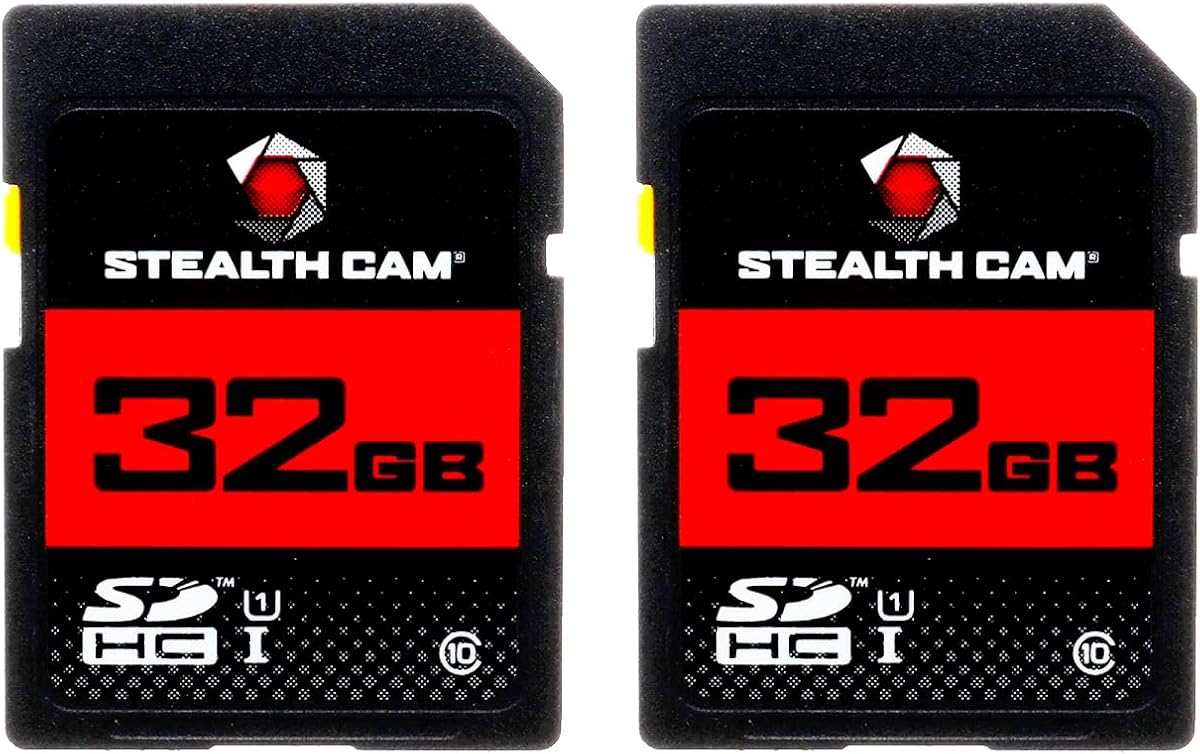
The STEALTH CAM 32GB 2-Pack provides a useful middle ground between a single compact card and a larger multipack. It has a 4.7 rating, 32GB of capacity per card, and a Class 10 speed rating. The two included cards make it possible to alternate between deployments or keep a spare ready without carrying a much larger collection.
We may earn a commission when you buy through this link, at no additional cost to you.
The product information highlights high-speed data transferring, universal compatibility with most digital hunting trail cameras, and low power consumption. Together, those features address the basic operating requirements of a remote game camera: dependable recording, reasonably efficient power use, and straightforward media transfer. Thirty-two gigabytes is also more comfortable than 16GB for sites that generate a meaningful number of short video clips.
It does not claim V30 or U3 performance, and the description does not specifically address 4K recording. That limits its appeal for cameras with advanced high-bitrate requirements. It also has fewer cards than the GIGASTONE 5-Pack and PNY 3-Pack, so it may not provide enough redundancy for a larger installation. Nevertheless, two cards are often more useful than none because one can remain in a second camera or act as an immediate spare.
This 2-Pack is a strong choice for hunters or wildlife observers running one or two cameras. It balances storage, convenience, and rotational flexibility without requiring a large accessory bundle. It works especially well for Full HD or standard trail-camera workflows. Confirm card-format support, maintain backups, and establish a routine for moving files before the card reaches its capacity limit.
Two 32GB cards make it easy to keep one card active and another ready for transfer. This arrangement is ideal for a pair of cameras or a single camera with a dependable spare.
Class 10 speed, broad device compatibility, and low power consumption make the card a natural fit for hunting and scouting cameras. The 4.7 rating also supports its position among the stronger customer-rated options here.
We may earn a commission when you buy through this link, at no additional cost to you.
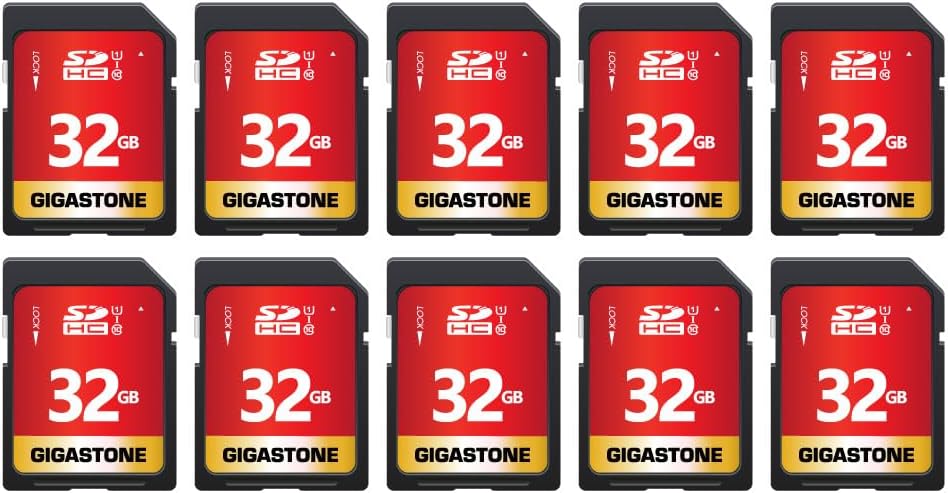
The GIGASTONE 32GB 10-Pack is the largest collection in this guide, with ten full-size SDHC cards and ten mini cases. Its 4.6 rating is solid, and the core specifications match the highly rated 5-Pack: up to 80MB/s transfer speed, UHS-I, U1, and Class 10 performance. It is aimed at Full HD recording across digital cameras, camcorders, DSLRs, PCs, and compatible trail cameras.
We may earn a commission when you buy through this link, at no additional cost to you.
For a serious monitoring operation, the number of cards can be a decisive advantage. Ten cards allow rotation among many cameras, separation by location, or stockpiling spare media for remote installations. Individual mini cases help prevent cards from being mixed together in a gear bag and provide some protection while cards are being transported.
The disadvantage is organizational complexity. A ten-card set is unnecessary for one camera and creates more opportunities to insert the wrong card or forget to retrieve one. As with the smaller GIGASTONE multipack, the specifications focus on Full HD rather than 4K, and the stated environmental protections do not eliminate every possible failure mode. Cards still need careful handling and routine backups.
This pack is most appropriate for wildlife professionals, hunting properties with several cameras, or users who want a substantial reserve of compatible media. It is less attractive for a minimal single-camera setup. The investment in quantity is justified when uninterrupted rotation and having an immediate spare at each site outweigh the need for larger individual cards or advanced video classes.
Ten cards give operators a scalable way to keep multiple cameras supplied. Labeling each card by camera or location can simplify retrieval and prevent accidental reuse before files are backed up.
Ten mini cases match the ten cards and help organize a large collection. They also make it easier to keep a spare protected while another card is being transferred.
We may earn a commission when you buy through this link, at no additional cost to you.
The GardePro 64GB Full-Size SD Card stands apart through its combination of high capacity and advanced speed ratings. It is designed for trail cameras, security cameras, and other full-size SD devices, with 64GB of storage, V30, U3, and Class 10 ratings, and a stated read speed of up to 100MB/s. It is the only product in this comparison explicitly marketed for high-bitrate 4K video.
We may earn a commission when you buy through this link, at no additional cost to you.
The V30 and U3 classes indicate stronger sustained performance than the U1 and V10 options found in most of the list. That makes the card relevant to cameras that record 4K, continuous bursts, or other demanding workflows. Its 64GB capacity also reduces the frequency at which footage must be copied or removed, while the stated industrial-grade components target stability in outdoor and long-term scenarios.
The notable weakness is the absence of a numerical customer rating in the supplied information. A 4.6 or 4.7 rating would provide additional evidence about long-term reliability, but none is available here. It is also a single-card package, so buyers operating several trail cameras will need additional media. Finally, advanced speed classes cannot compensate for an incompatible device, and cameras may impose their own capacity or file-format limitations.
This is the premium recommendation for owners of 4K-capable trail cameras, high-volume locations, or users who prefer fewer card changes. Its 64GB capacity and V30/U3 performance offer a more future-oriented foundation than standard Full HD cards. It is also a sensible choice for compatible security cameras and other full-size SD recorders. Confirm the camera's supported capacity, speed class, and file system before purchase.
The V30 and U3 ratings are the standout technical features because they address sustained high-bitrate recording and fast continuous shooting. They make this card a better match for advanced cameras than standard U1 media.
Sixty-four gigabytes can hold substantially more media than the 16GB and 32GB options. This is useful for busy locations where frequent visits to retrieve footage would be inconvenient.
We may earn a commission when you buy through this link, at no additional cost to you.
The HME 16GB 2-Pack is built around simple compatibility and rugged use. It has a 4.6 rating, two 16GB cards, and broad support for devices with an SDHC slot. The product information positions the cards for trail-camera images and videos as well as nature photography, research, and general outdoor documentation.
We may earn a commission when you buy through this link, at no additional cost to you.
Two cards give users enough flexibility to rotate media without carrying a large multipack. The cards can be inserted into a trail camera, transferred to a smartphone, tablet, or computer through a compatible device, and then reused. The described resistance to temperature extremes, moisture, and rugged handling is valuable for repeated outdoor use.
Capacity is the main limitation. Sixteen gigabytes may require more regular retrieval in video-heavy locations, and the small size leaves less margin for delayed collection. The product information does not state a precise speed class, sustained write speed, or V30 and U3 support, so buyers should compare it with their camera's requirements. Compatibility with an SDHC slot is necessary, but it is not a substitute for confirming a camera's preferred capacity and format.
This pack is a good fit for users with two modest trail cameras, researchers collecting manageable amounts of data, or anyone who values a rugged two-card kit. It is less appropriate for advanced 4K recording or long intervals between retrievals. For those needs, the GardePro 64GB option offers more capacity and more clearly stated speed classes.
The stated resistance to temperature extremes, moisture, and rough handling suits cameras exposed to changing outdoor conditions. Durable components are most valuable when cards are handled repeatedly in the field.
SDHC compatibility allows the cards to move between a trail camera and compatible systems such as a smartphone, tablet, or computer. This flexibility simplifies regular review and backup routines.
We may earn a commission when you buy through this link, at no additional cost to you.
The Stealth Cam 32GB SD Memory Card is a straightforward, game-camera-focused option. Its 4.6 rating indicates generally positive customer reception, while the product information confirms compatibility with SD-card-compatible game cameras and a 32GB capacity. It is designed to increase usable storage and permit media to be uploaded, erased, and reused without a stated loss of quality.
We may earn a commission when you buy through this link, at no additional cost to you.
The card's appeal lies in its uncomplicated purpose. It gives a compatible camera more room than a small-capacity card and avoids the complexity of a multipack. A single 32GB card is easy to track, label, and manage, which can be helpful in a basic one-camera installation or as a designated spare.
The supplied information does not specify a read speed, write speed, video class, or environmental-resistance rating. That makes it harder to evaluate against more technically detailed products. Buyers who need confirmed 4K capability, industrial durability, or low-power operation may prefer a card with those claims stated explicitly. Compatibility also depends on the camera's supported format and capacity limit.
This card is best for owners of an SD-compatible game camera who want a simple 32GB upgrade and regularly transfer files. It can be particularly useful as a single spare kept in a camera bag. Confirm compatibility, format the card according to the camera's instructions, and avoid erasing footage until a separate backup has been verified.
The 32GB capacity provides additional room for images and video without the need for a large accessory bundle. It is a practical single-card solution for straightforward installations.
The product information specifically says the card supports uploading data, erasing it, and reusing it without loss of quality. Regular backups remain essential because routine reuse always carries some operational risk.
We may earn a commission when you buy through this link, at no additional cost to you.
The STEALTH CAM 16GB 2-Pack is a compact rotation solution for trail cameras and other compatible devices. It carries a 4.6 rating and includes two 16GB SDHC cards. Like the related STEALTH CAM options, its information emphasizes high-speed data transfer, Class 10 performance, broad compatibility, and low power consumption.
We may earn a commission when you buy through this link, at no additional cost to you.
Two cards make a dependable spare or allow a simple two-camera setup. The low-power emphasis is especially useful in remote installations, while Class 10 performance suits standard image and video recording. The package is also less bulky than a five- or ten-card collection, making it manageable for a hunter carrying equipment over uneven ground.
Sixteen gigabytes is the limiting factor. At a location with frequent motion or repeated video recording, the cards may fill quickly and require more frequent visits. There is no stated V30, U3, or 4K rating, so it is not the strongest choice for advanced-resolution cameras. As with any small card, losing one member of the pair would also reduce the user's immediate rotation options.
This 2-Pack suits a budget-conscious owner of one or two cameras who retrieves media regularly. It is especially attractive where low power consumption and easy rotation matter more than large capacity. For busy sites or advanced video, choose a 32GB or 64GB option with more detailed speed information and establish a dependable off-site backup process.
A pair of 16GB cards provides an immediate spare and simple rotation without the bulk of a larger multipack. Labeling each card by camera or location can make the workflow more reliable.
Class 10 speed supports the standard photo and video workloads described for game cameras. It remains a sensible choice for Full HD devices that do not require V30 or U3 media.
We may earn a commission when you buy through this link, at no additional cost to you.
A useful trail-camera memory card must fit the device, sustain the required writes, survive outdoor handling, and hold enough media for the interval between visits. Capacity, speed class, compatibility, durability, power efficiency, and card-management strategy should be considered together.
The first step is to identify the exact card format and capacity supported by the trail camera. Most products in this guide are full-size SD or SDHC cards, and the HME cards are specifically described as working with SDHC slots. A card can physically fit while still being unusable if its format, capacity, file system, or minimum speed class falls outside the camera's specifications. Older cameras may have smaller capacity limits, while newer 4K models may demand V30 or U3 performance. Check the camera manual rather than relying only on the slot shape or the card's marketing language.
Capacity should reflect how much video the camera records and how often it can be visited. The 16GB cards in this guide are useful for lighter workloads and regular retrieval, while 32GB offers more room for mixed photo and video activity. The 64GB GardePro is the strongest option for long intervals or high-volume locations because it delays the need to replace media. More capacity is not automatically better, however, and some cameras place limits on card size or require particular formatting. Buyers should also consider whether they will use one card or rotate several identical cards.
Class 10, U1, and V10 are common across trail-camera cards and generally target standard HD workflows. V30 and U3 indicate stronger sustained performance, making them more appropriate for high-bitrate 4K recording, continuous bursts, and demanding video devices. Read speed helps when transferring files, but sustained write performance is the more important factor during recording. A card with a high headline read speed should still be checked for the video and application speed classes required by the camera.
Trail cameras operate in locations where cards may encounter temperature changes, moisture, dust, vibration, impact, and rough handling. The PNY 3-Pack lists resistance to shock, temperature, water, drops, vibration, electrostatic discharge, humidity, x-rays, and wearout. Both GIGASTONE multipacks state resistance to water, temperature, x-rays, shock, and magnetic effects, while the HME cards emphasize temperature extremes, moisture, and rugged handling. These claims vary by product, so buyers should compare the protections relevant to their installation rather than treating all durability language as equivalent.
A trail camera often runs on batteries or a remote power supply, making energy efficiency important. Several STEALTH CAM products explicitly advertise low power consumption, which can be a meaningful advantage in remote locations. The specification does not reveal exact battery savings, and card performance alone cannot determine total runtime, but it identifies a product designed with power-conscious recording in mind. Buyers should still use high-quality batteries where appropriate, follow the camera manufacturer's guidance, and monitor low-battery warnings.
A multipack can be more useful than one large card because it makes rotation, transport, and emergency replacement easier. The GIGASTONE 5-Pack and 10-Pack include mini cases, while the PNY and STEALTH CAM multipacks provide multiple cards without case details. Label each card by camera, location, or date, and use a separate drive to back up important footage before erasing it. Rotation should not replace backups; it simply reduces downtime when a card is full, being reviewed, or temporarily unavailable.
The number of cards should match the size and redundancy requirements of the monitoring system. A single card is sufficient for a simple setup, two cards support rotation or a second camera, and three or more cards are useful for multiple locations. The ten-card GIGASTONE pack offers the largest reserve but requires disciplined labeling and storage. Mini cases, as included with both GIGASTONE multipacks, are useful for keeping cards separated and protected during transport. Avoid buying a large pack if its cards are likely to remain unused and forgotten.
Customer ratings can help identify products with broadly positive experiences, but they are not laboratory tests and do not guarantee performance in every camera. Eight products in this guide have numerical ratings from 4.1 to 4.7, while the GardePro card has no rating available in the supplied data. The PNY's 4.1 rating is still positive, and the technical specifications remain valuable when making a comparison. Read customer feedback for recurring issues, especially card recognition or compatibility, while also consulting the camera manufacturer's requirements.
Before inserting a new card, confirm that its format, capacity, and speed class are supported by the trail camera. Many cameras perform best when the card is formatted in the device itself, so use the camera's menu rather than formatting the card on a computer unless the manual specifically instructs otherwise. Label each card with its camera or location, insert it securely, and perform a short test recording before relying on it for an extended monitoring period.
Handle cards by their edges and keep them in a clean, dry place when they are not inside a camera. Do not bend, twist, or remove them while the device is writing data. When retrieving footage, use a compatible reader and copy files to a separate drive or cloud destination before erasing them. Maintain at least two copies of important wildlife, hunting, or security recordings, and verify that the second copy opens correctly rather than assuming a successful file transfer is enough.
Inspect cards during routine camera visits, especially after severe weather, impact, or a card-recognition error. Retire any card that is physically damaged, repeatedly unreadable, or no longer recognized. Format a reusable card in the camera after confirming its backup, and avoid leaving the same card continuously in a high-traffic location when rotation is possible. A planned replacement interval helps reduce the risk that aging media becomes the weak point in an otherwise reliable camera setup.
The best capacity depends on whether the camera records still images, short video clips, or continuous high-resolution video. A 16GB card can work well for photo-led monitoring with frequent retrieval, while 32GB is more flexible and 64GB reduces how often files must be transferred. Always confirm that the camera supports the selected capacity. More storage does not replace the need to back up valuable footage before a card is erased.
A standard HD trail camera may work with Class 10 and U1 media, with V10 providing a clear Full HD video designation. Cameras that record 4K, high-bitrate video, or rapid bursts can benefit from V30 or U3 cards. The camera manual should identify the required class. Using a card above the minimum requirement is generally sensible, while a card below that requirement can cause recording errors, dropped clips, or failed captures.
No. Physical size is only one requirement; the camera must also support the card's SDHC format, 32GB capacity, file system, and minimum speed class. Some older devices impose lower capacity limits, while some newer cameras require faster sustained writing. Check the manufacturer's compatibility list and format the card in the camera before the first deployment.
A multipack is often more operationally useful because it enables rotation, provides an immediate spare, and reduces downtime while one card is being transferred. A single 64GB card, such as the GardePro option, may be better for a high-volume 4K camera where long intervals between retrievals matter. The right choice depends on camera count, recording volume, retrieval schedule, and the speed and capacity requirements of the equipment.
Transfer footage on a schedule that prevents the active card from filling before the next visit. Wildlife activity can be unpredictable, so smaller cards and video-heavy settings may require more frequent checks. Copy each new file to a separate drive or cloud service, verify the backup, and only then erase the card. Keeping two copies protects against a failed card, accidental deletion, or a damaged recording device.
Many cards in this guide include specific claims for temperature, water, moisture, shock, vibration, or other environmental resistance. Those claims make them better suited to outdoor use than cards without documented protection, but they do not make a card indestructible. Keep cards protected in their cases during transport, avoid leaving them exposed unnecessarily, and retire any card that has been bent, crushed, wet beyond its rating, or repeatedly rejected by a device.
Formatting in the trail camera is generally the safer choice because the device can create the file system and allocation pattern it expects. Computer formatting may be useful for card recovery or general file transfer, but it is not always compatible with a camera's requirements. Follow the camera manual, and do not format a card while important footage has only one remaining copy.
A card designed for low power consumption may reduce the energy needed for storage operations in some deployments, but it is only one part of total runtime. Battery capacity, camera settings, recording frequency, temperature, and wireless activity can have a larger effect. Products such as the STEALTH CAM cards explicitly emphasize low power use, making them sensible choices for remote setups, though no exact runtime improvement is stated in the supplied information.
The GIGASTONE 32GB 5-Pack is the most balanced overall selection, combining a strong 4.7 rating, up-to-80MB/s stated speed, Class 10 and U1 ratings, outdoor protection claims, and five organizing cases. The SanDisk 32GB Ultra serves as the budget pick for a simple single-camera setup, while the PNY 32GB Elite 3-Pack is built around explicit trail-camera use, Full HD recording, and extensive environmental protection.
Prioritize compatibility and sustained writing requirements before comparing headline speeds. A 16GB card can be sufficient for a photo-focused camera with regular retrieval, 32GB is often the most flexible general capacity, and 64GB with V30 and U3 ratings makes sense for a 4K or high-volume camera. Whichever capacity is chosen, use multiple cards when possible and maintain a separate backup before erasing important recordings.
Product details, customer ratings, availability, and prices can change, so check the current listing and the trail camera's requirements before ordering. Confirm the supported format, maximum capacity, required speed class, and file system, then format the card in the camera. A carefully selected card paired with a disciplined retrieval and backup routine is the foundation of dependable wildlife monitoring.