
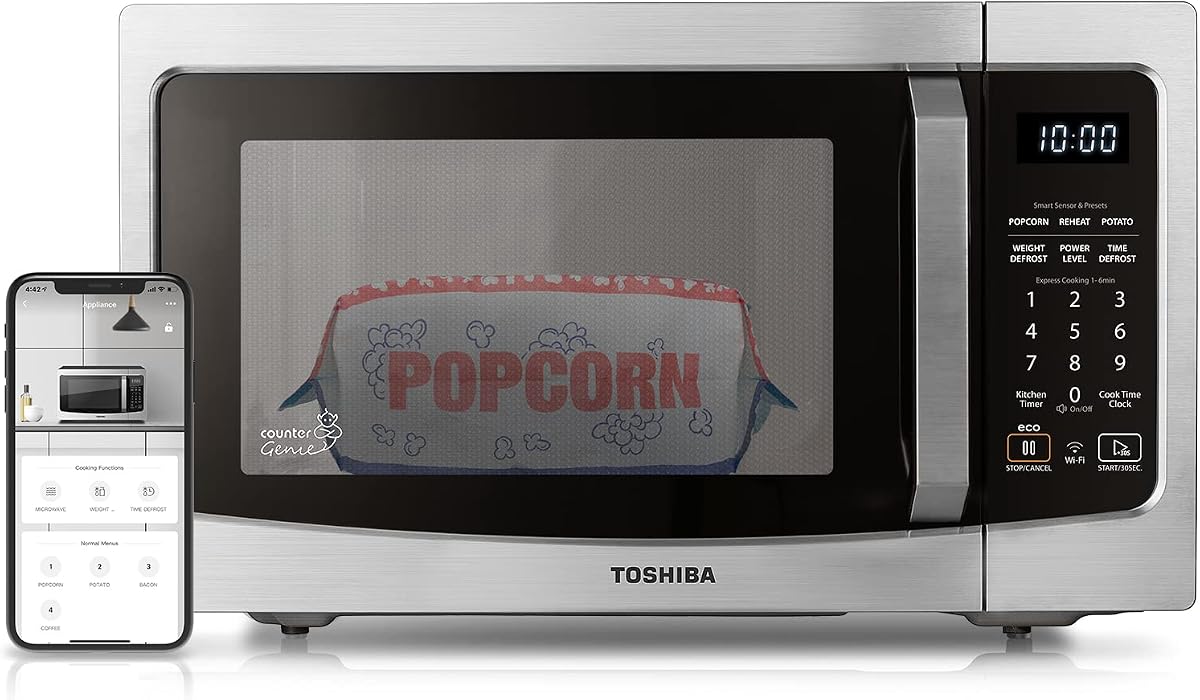
TOSHIBA Microwave Oven, 0.9 Cu.Ft, 900W, Black Stainless Steel
4.5Editor score
Compact 0.9-cubic-foot capacity
Six convenient preset menus
Two-step child safety lock
Explore the best smart microwaves of 2026, comparing sensor cooking, capacity, power, inverter technology, design, safety, and everyday convenience.
Smart microwaves combine familiar countertop cooking with sensors, automatic programs, inverter heating, and in some cases voice-control compatibility. A worthwhile model should do more than warm leftovers: it should adjust to different foods, make reheating more consistent, and provide a clear, approachable way to prepare everyday meals.
We compared all ten featured microwaves using the specifications and features supplied for each model, including capacity, output power, sensor programs, turntable design, child locks, preset controls, defrost options, and dimensions. The guide covers compact units, larger family models, voice-ready appliances, flatbed designs, and an air-fryer combination.
Each selection highlights a different reason to consider a smart microwave, from practical value to advanced cooking capability. Ratings and specifications can change, product availability varies, and current prices fluctuate, so readers should confirm the latest listing details and dimensions before making a final purchase.
4.5Editor score

4.5Editor score

4.2Editor score
This side-by-side comparison covers capacity, cooking power, sensor intelligence, physical design, and safety features across ten smart microwaves, helping readers identify the model that best fits their available space, cooking routine, and preferred level of automation.




The TOSHIBA Flatbed Microwave Oven with Inverter Technology combines a 4.5 rating with several features that improve the basic microwave experience. Its 1.3-cubic-foot capacity and 1,200-watt output place it in a versatile middle ground, while the absence of a traditional turntable creates a stable, uncluttered cooking area.
We may earn a commission when you buy through this link, at no additional cost to you.
Its standouts are the Origin Inverter system and 11 moisture-sensitive automatic menus. The inverter system is described as providing even cooking, precise temperature control, improved texture, and quieter operation, while the sensor adjusts microwave power by detecting moisture. The flat interior also makes it easier to reheat differently shaped dishes or warm multiple plates without turntable noise or stuttering.
There are some practical compromises. Its 1.3-cubic-foot cavity is not intended for oversized family dishes, and removing the turntable means buyers should check the dimensions of square cookware before purchasing. The 1,200-watt rating is suitable for routine reheating and cooking, but it does not make this an air-fryer appliance, and users should not expect a separate crisping element.
This is the strongest all-around choice for readers who want sensor automation without giving up precise power control. It is particularly attractive to households that dislike noisy or stuttering turntables, clean square dishes regularly, and want a broad selection of automatic programs. For those priorities, its combination of inverter technology, flatbed construction, and 11 smart menus makes it the most balanced model in the guide.
A flat cooking floor allows square plates, storage containers, and multiple dishes to sit level without a rotating plate beneath them. That design improves stability, reduces turntable noise, and creates a smooth surface that is easier to wipe down after reheating several foods at once.
The built-in smart sensor detects moisture and adjusts power for foods such as pizza, pasta, and vegetables. Combined with Origin Inverter technology and 11 manual power levels, this gives cooks both automatic convenience and direct control when a dish needs a gentler or more deliberate treatment.
We may earn a commission when you buy through this link, at no additional cost to you.
The compact TOSHIBA 0.9 Cu.Ft model is a practical entry into smart microwave cooking, earning a 4.5 rating while keeping its footprint and feature set focused. Its external dimensions of 18.7 by 13.3 by 10.7 inches make it well suited to apartments, dorm rooms, offices, and other spaces where every inch of the counter matters.
We may earn a commission when you buy through this link, at no additional cost to you.
Despite its compact size, it includes 6 preset menus for foods such as popcorn, pizza, and potatoes. It also offers 11 power levels, a clock, a kitchen timer, defrosting by weight or time, and one-touch starting for one- through six-minute cooking sessions. A two-step child lock provides an additional layer of protection against unintended operation.
The trade-off is straightforward: 900 watts of output and a 0.9-cubic-foot interior place limits on heating speed and cookware size. Its 10.6-inch glass turntable is smaller than those in the mid- and large-capacity models, so oversized plates may not fit. Nevertheless, it covers the essential functions without making the controls unnecessarily complicated.
Choose this microwave for a smaller kitchen, a secondary cooking area, or anyone who primarily reheats portions, prepares drinks, and cooks small snacks. It offers a strong rating, useful automation, and a clear control layout in a relatively small appliance. For compact-space shoppers seeking more than a basic microwave, it is the most economical balance in this roundup.
The model avoids unnecessary specialty functions while preserving the controls used most often. Six presets, eleven power levels, quick-start buttons, defrost modes, a timer, and a clock cover the core needs of a compact kitchen without requiring a large countertop footprint.
Its size makes it well suited to an office break room, guest suite, or secondary appliance station. The 900-watt output is adequate for individual meals and beverages, while the child lock and easy-clean black stainless-steel appearance help it fit into shared or family spaces.
We may earn a commission when you buy through this link, at no additional cost to you.
The TOSHIBA OptiChef PRO MAX is the feature-rich premium option in this guide. Its 4.2 rating reflects a model built around more than ordinary reheating: the ChefFry Plus system adds a top fan and heating element, allowing the appliance to perform selected air-fryer-style cooking alongside microwave functions.
We may earn a commission when you buy through this link, at no additional cost to you.
The 2.4-inch color screen and responsive user interface make the advanced feature set easier to navigate. An intuitive humidity sensor supports even heating and moisture retention, while Origin Inverter technology is designed to improve texture, preserve flavor, and control cooking temperature. The 1.3-cubic-foot cavity can accommodate a 13-inch pizza or a whole chicken.
Its size is the biggest caveat. At 21.8 by 17.8 by 12.8 inches, it requires substantially more counter space than the compact choices. The combination design and touchscreen also add complexity for users who want nothing more than simple reheating. Prospective buyers should consider ventilation clearance and the appliance's care requirements as well as its dimensions.
This model is best for home cooks who want to consolidate heating and crisping tasks or simply prefer a visually advanced, sensor-driven interface. It may also appeal to buyers who are comfortable learning multi-stage programs and selecting cooking modes. For a user willing to allocate the space, it is the most distinctive and advanced smart microwave here.
The top fan and heating element add a crisping method that a standard microwave cannot provide. This makes the appliance useful for preparing browned or crisp-topped foods while retaining the speed and convenience of microwave cooking for reheating and routine meal preparation.
The full-color 2.4-inch display presents cooking information in a more visual format than a conventional keypad. It is particularly appropriate for buyers who appreciate guided interfaces, multiple cooking modes, and smart-sensor assistance.
We may earn a commission when you buy through this link, at no additional cost to you.
The TOSHIBA 1.6 Cu.Ft Smart Sensor model is built for cooks who need more interior room than a standard compact microwave provides. It holds a 4.3 rating, delivers 1,200 watts of output, and includes a 13.6-inch turntable that can accommodate a 13-inch pizza and other larger dishes.
We may earn a commission when you buy through this link, at no additional cost to you.
Smart sensor menus are programmed for popular foods including pizza, potatoes, and vegetables. Convenience features extend beyond the presets, with auto defrost, fast cooking, a memory function, multi-stage cooking, a child safety lock, a clock, and a kitchen timer. A position-memory turntable returns to its starting point, which can make loading and retrieving larger dishes more consistent.
The main disadvantage is its physical scale. External dimensions of 21.77 by 17.91 by 12.87 inches require ample counter space, and the large turntable adds depth around the cooking cavity. It also lacks the voice-control or touchscreen experience offered by some of the more advanced models, so its intelligence is focused on automatic food sensing rather than connected operation.
This microwave suits larger households, frequent reheaters, and anyone who regularly prepares a 13-inch pizza or family-sized portions. Its combination of generous capacity, high output, sensor menus, and useful memory functions gives it a strong practical foundation even without smart-home integration.
A 1.6-cubic-foot cavity and 13.6-inch turntable create a useful step up from compact models. This extra room makes the appliance more accommodating for pizza, larger serving dishes, and family portions without moving to the very largest category in the guide.
The pre-programmed sensor menu adjusts cooking for common foods, while 10 power levels and multi-stage cooking provide control for more involved tasks. Defrosting, fast cooking, memory settings, a timer, a clock, and a child lock round out a capable everyday control set.
We may earn a commission when you buy through this link, at no additional cost to you.
The TOSHIBA 1.3 Cu.Ft Smart Microwave is the most clearly connected model in the guide. It earns a 4.4 rating and supports hands-free operation through Alexa and an echo device, as well as app control, making it appealing to shoppers who want to start or manage cooking without touching the keypad.
We may earn a commission when you buy through this link, at no additional cost to you.
Its built-in humidity sensor automatically adjusts cooking power based on the moisture detected in the food. Updating preset menus cover foods such as popcorn, potatoes, pizza, and vegetables. The appliance also includes a two-step child lock and a sound on/off control that silences the completion beep.
Voice compatibility comes with important conditions. The echo device is not included, and using the connected features requires the appropriate setup. Buyers should also consider whether they want appliance operation tied to an account or network. Traditional controls remain useful, but the special appeal lies in the option to begin a task from a supported device.
This is a strong choice for Alexa households, busy cooks, and anyone who values hands-free heating. The humidity sensor adds genuine cooking intelligence beyond voice activation, making it more than a convenience-only feature. For shoppers comfortable with connected devices, it is a distinctive and practical smart microwave.
The integrated Alexa support allows compatible users to operate the microwave by voice, while app control provides another way to access its functions. These options are useful when hands are occupied or when starting a reheating cycle before entering the kitchen.
The built-in humidity sensor detects moisture and adjusts cooking power, helping food reheat more evenly. The mute function is equally practical in open-plan homes or late-night kitchens because it removes the completion beep without disabling the appliance.
We may earn a commission when you buy through this link, at no additional cost to you.
This TOSHIBA stainless-steel microwave offers a balanced combination of capacity, power, and familiar controls. It has a 4.4 rating, a 1.2-cubic-foot interior, 1,000 watts of output, and a 12.4-inch glass turntable. Those specifications place it squarely in the mainstream countertop category.
We may earn a commission when you buy through this link, at no additional cost to you.
Smart Sensor Technology adjusts cooking time and power according to food humidity. Six presets cover popular categories such as pizza, vegetables, and sensor reheating, while 10 power levels support tasks ranging from gentle reheating to boiling liquids. Defrosting can be performed by weight or time, and one-touch starting provides quick access to full-power cooking from one to six minutes.
Its limitations are modest. Six presets offer less variety than models with 11 or 13 automatic menus, and it does not include voice or app controls. It also lacks inverter technology or a flat cooking floor, so buyers seeking those specific benefits should look elsewhere. For standard reheating and everyday cooking, however, the conventional design is familiar and straightforward.
This microwave is a sound choice for buyers who want a stainless-steel countertop model with sensor assistance but not a complex connected interface. Its moderate footprint, 10 power levels, and practical defrost options make it a versatile middle-ground option for singles, couples, and family kitchens.
The model focuses on familiar functions rather than app-based controls or elaborate displays. Automatic sensor reheating, direct power selection, and quick-start buttons allow efficient operation while keeping the learning curve low.
Defrosting by weight or time gives cooks two ways to handle frozen ingredients. Ten power levels and a kitchen timer add flexibility, allowing users to reduce microwave intensity for tasks that need gentler heating.
We may earn a commission when you buy through this link, at no additional cost to you.
The black TOSHIBA 1.2 Cu.Ft microwave delivers the same practical 1,000-watt performance and smart-sensor foundation as the stainless version, while earning a 4.4 rating. It is a straightforward choice for shoppers who prioritize reheating consistency and easy controls over decorative finishes or connected features.
We may earn a commission when you buy through this link, at no additional cost to you.
The humidity-based Smart Sensor Technology automatically adjusts time and power, and 6 preset menus cover common foods and reheating applications. Users also receive 10 power levels, a clock, a kitchen timer, defrosting by weight or time, and a one-touch start for one- through six-minute full-power sessions. A 12.4-inch glass turntable provides a familiar rotating cooking platform.
The 1.2-cubic-foot interior is large enough for common dinner plates but not as accommodating as the 1.6- and 2.2-cubic-foot options. Six presets are fewer than some competing models offer, and there is no voice or app integration. Buyers who want abundant manual power control and efficient reheating will find plenty to like, while those seeking broader program selection may prefer a newer model.
This microwave is well suited to daily lunch preparation, frozen meal reheating, and quick household cooking. Its black appearance works particularly well in modern kitchens, and its 10 power levels provide useful control for everything from warming beverages to preparing larger portions.
The sensor examines humidity and adjusts time and power automatically, reducing the need to guess how long leftovers require. This makes the model particularly effective for routine reheating, which is one of the most common reasons households buy a microwave.
Ten power levels support a wide range of tasks, and the clock and kitchen timer add useful organization. Defrosting by either weight or time and one-touch start options help users move quickly through routine kitchen tasks.
We may earn a commission when you buy through this link, at no additional cost to you.
The TOSHIBA 1.2 Cu.Ft Smart Sensor model combines a 4.5 rating with a particularly broad set of 13 preset menus. It delivers 1,000 watts of output and 1,600 watts of input power, fitting into a conventional countertop format with external dimensions of 20.6 by 14.8 by 11.8 inches.
We may earn a commission when you buy through this link, at no additional cost to you.
Its sensor cooking programs cover a range of dishes, snacks, and beverages, while 10 power levels offer manual control when an automatic program is not appropriate. A memory function can save and retrieve dish settings, which is useful for meals cooked repeatedly. Defrosting by weight or time, mute mode, and a two-step child lock add practical everyday features.
The model does not include the inverter system or flatbed arrangement found in the leading selection, and it has no connected voice or app functions. Its 1,000-watt output is also lower than the 1,200-watt models in the roundup. Buyers seeking a large cavity or specialized crisping function should also consider alternatives, though the 1.2-cubic-foot size remains practical.
This is a strong choice for users who want many automatic choices in a relatively compact appliance. The memory function, 13 presets, and 10 power levels make it particularly adaptable for varied households, while the modern black stainless-steel finish and two-step child lock suit family kitchens.
Thirteen programs offer a wider selection than most models in the guide, including choices for dishes, snacks, and drinks. Automatic sensor cooking can reduce guesswork while still leaving enough flexibility for food that does not match a standard program.
The memory function stores commonly used dish settings for quick retrieval. It is a subtle feature with meaningful value for households that prepare the same beverages, side dishes, or portions every day.
We may earn a commission when you buy through this link, at no additional cost to you.
The Farberware 1.6 Cu.Ft Smart Sensor model is an approachable, full-size countertop microwave with a 4.3 rating. Its 1,100-watt output, 1.6-cubic-foot capacity, and six one-touch options make it a practical choice for families that regularly heat larger portions but do not need advanced connected features.
We may earn a commission when you buy through this link, at no additional cost to you.
Ten power levels and multi-stage cooking provide substantial manual control. Automatic sensor cook settings, plus dedicated buttons for popcorn, potatoes, and pizza, cover common tasks. Defrosting can be completed by weight or time, and the clear LED display combines a clock with a kitchen timer. Interior lighting lets users monitor food without opening the door.
Its primary drawback is that six preset options are less extensive than the 11 or 13 menus offered by several TOSHIBA models. It also lacks a touchscreen, voice assistant, app, flatbed design, and inverter system. Those omissions do not undermine the basic function, but they make it less attractive for buyers seeking the latest cooking interfaces.
This microwave suits buyers who value recognizable controls, easy cleaning, a child safety lock, and sufficient capacity for family meals. The clear display and straightforward one-touch operation reduce friction in the kitchen, making it an accessible option for new cooks, older users, and households that do not want to manage complicated menus.
The 1.6-cubic-foot interior offers room for substantial dishes while the controls remain easy to understand. Ten power levels and multi-stage cooking give experienced users control without requiring a specialized touchscreen.
A clear LED display, kitchen timer, clock, and interior light make the appliance easy to monitor. The easy-to-clean interior and exterior also suit busy kitchens where regularly wiping down the cavity is important.
We may earn a commission when you buy through this link, at no additional cost to you.
The Panasonic NN-SN97JS has the largest capacity in the guide, combining a 2.2-cubic-foot cavity with 1,250 watts of output. It carries a 4.0 rating and is aimed at serious home cooks who need more room, stronger performance, and a wide selection of automatic programs.
We may earn a commission when you buy through this link, at no additional cost to you.
Cyclonic Wave technology and Inverter Technology are designed to maintain consistent power and support even preparation without overcooking. The built-in Genius Sensor adjusts power and timing according to the food, while 20 preset menu items offer extensive automatic selection. Inverter Turbo Defrost accelerates thawing, and a dedicated food-warming feature keeps soups, gravies, and desserts ready before serving.
The trade-offs are size and complexity. Its large cabinet, 16.5-inch turntable, and 2.2-cubic-foot interior require a generous countertop or appropriate built-in space. It also has the lowest rating among the ten models, and the extensive program selection may take more time to learn than a simpler keypad layout. The stated 1250 watts should be understood as the listed output figure rather than a guarantee of faster results for every task.
This model is most appropriate for large households, entertainers, and cooks who frequently prepare sizable dishes. It stands out for its 20 presets, 16.5-inch turntable, inverter system, and food-warming function. For buyers who can accommodate its dimensions and value capacity and advanced sensor programs above compact convenience, it is a distinctive high-capacity option.
The 2.2-cubic-foot cavity and 16.5-inch turntable offer substantially more room than the other selections. That additional space can be valuable for family meals, entertaining, and containers that would crowd a smaller unit.
Twenty presets, sensor-adjusted timing, Turbo Defrost, and a food-warming mode create a broad set of automated functions. Inverter and Cyclonic Wave technologies support the goal of consistent cooking while the food-warming feature helps coordinate timing with the rest of a meal.
We may earn a commission when you buy through this link, at no additional cost to you.
Choosing a smart microwave means balancing interior size, heating technology, sensor automation, countertop space, and control preferences. The most useful model is not necessarily the one with the most features, but the one whose capabilities align with the meals, dishes, and routines of its owner.
Capacity is one of the most important distinctions among these models. The guide includes compact 0.9-cubic-foot options, practical 1.2- and 1.3-cubic-foot designs, 1.6-cubic-foot family models, and a 2.2-cubic-foot Panasonic. A larger cavity can accommodate more serving dishes, larger portions, and rectangular containers, but it also requires more counter space and may have a larger turntable. Measure the available width, depth, and height before choosing, and leave room to open the door and handle hot dishes safely.
Choose capacity according to the food and cookware you use regularly. A compact unit is best for individual portions, while a larger model makes more sense for family leftovers, pizza, or entertaining. Exterior dimensions are as important as stated capacity because cabinet depth, ventilation, and outlet placement can determine whether a larger appliance works in your kitchen.
Smart sensor systems detect characteristics such as humidity and adjust power or cooking time. This automation is especially useful for reheating because leftovers contain different amounts of water and do not always heat uniformly under a fixed time setting. Some products offer only 6 basic food presets, while others provide 11, 13, or 20 automatic programs. More presets can be convenient, but menu labels and the ability to override power are arguably more useful than quantity alone.
Look for sensor reheating alongside useful manual controls. A good smart microwave should make common foods easy to prepare without removing all user control. If consistent reheating is your main goal, favor a strong sensor system and multiple power levels; if you enjoy experimenting, also consider a model with inverter heating and a broad range of presets.
Inverter technology is intended to provide a steadier stream of microwave power, supporting more precise temperature control and improved texture than a basic on-off system. It is especially relevant for delicate reheating, cooking, and foods that benefit from gentler energy delivery. A flatbed design removes the rotating turntable, creating a stable cooking surface and making square dishes easier to use. It can also reduce turntable noise and simplify cavity cleanup.
Neither feature is mandatory for every household. Traditional turntables remain effective and familiar, while conventional heating can still handle routine reheating. Prioritize inverter or flatbed construction when consistent results, quiet operation, low-profile cookware, or easier cleaning are central to your needs. Check the interior floor and dish dimensions before committing to a turntable-free model.
Connected microwaves can add genuine convenience by allowing supported voice commands or app operation. Among the featured options, the TOSHIBA 1.3-cubic-foot Smart Microwave supports Alexa and app control, with an echo device required but not included. Buyers should understand that connected operation may involve network setup, an account, compatible devices, and a learning process for voice commands. It is best for households already invested in a compatible smart-home environment.
Do not equate app compatibility with better cooking. The same model also uses a built-in humidity sensor and standard presets for direct control. If you mainly want hands-free starting and status checking, the connected model is compelling. If connectivity adds complexity without solving a real need, a traditional keypad, auto defrost, memory functions, and sensor menus may provide a more satisfying experience.
Output power affects heating speed and the ability to cook larger portions, while the number of power levels determines how finely the microwave can be controlled. Most selections offer 10 or 11 levels, allowing lower settings for warming, melting, or more delicate preparation. The larger models reach 1,100 to 1,250 watts, compared with 900 watts in the compact unit and 1,000 watts in several mainstream models.
Higher wattage is useful, but it should not be the only consideration. Sensor cooking, inverter behavior, cavity size, and the user's intended recipes all influence results. Choose at least 10 power levels, familiar quick-start controls, and a timer. Multi-stage cooking is an added advantage when the user wants different power levels during a single cycle rather than repeating manual starts.
A child safety lock is particularly important in homes with young children or in shared spaces. Several models use a two-step process to prevent accidental activation, while others provide a standard lock. The feature does not eliminate the need for adult supervision, and buyers should still keep the appliance away from children who cannot safely use it. Interior lighting, mute mode, and a clear display also contribute to usability by helping adults monitor and control cooking with less noise.
Prioritize a lock that is easy for adults to operate and difficult for children to bypass. Consider a mute function if frequent beeps are disruptive, and inspect the door and control design for everyday ease of use. Safety features should complement safe habits such as using suitable cookware, opening the door carefully, and checking heated food before serving.
Defrosting is a basic function, but the details affect convenience. Most models offer defrost by weight and defrost by time, giving users different ways to thaw ingredients. The Panasonic adds Inverter Turbo Defrost, while several TOSHIBA models provide memory functions for storing frequently used dish settings. A kitchen timer and clock are standard on most units, but the Farberware's clear LED display and the OptiChef's color screen present information differently.
Think about how often you will thaw frozen food and whether you repeatedly prepare the same dishes. Weight-based defrosting is useful for larger cuts, while timed defrosting offers direct control. Memory functions save effort only when the same settings are used repeatedly. Treat these conveniences as useful supplements rather than substitutes for good core heating performance.
The products span traditional keypads, compact digital displays, a larger LED display, and a 2.4-inch color touchscreen. Traditional controls are generally easier to learn and may be preferable for users who want quick, repeatable button presses. A color screen is more informative and visually modern, but it adds complexity and may not improve basic reheating. Flatbed interiors are particularly easy to wipe clean because there is no turntable or rotating support to remove.
Choose the interface that matches your comfort with technology. Check whether the display shows the time, power, and active settings clearly, and look for a mute control if the completion beep is bothersome. Also consider the finish: black stainless steel hides fingerprints better than some bright surfaces, while a traditional stainless finish may coordinate more easily with existing appliances. The most important cleaning feature is an interior cavity that suits your routine and the food you cook.
Begin by removing packaging and any protective film from the keypad or display, as noted in the product guidance for some models. Place the microwave on a stable, level surface with appropriate ventilation clearance, and confirm that the turntable or turntable-free interior is clean and correctly assembled. Before the first use, wash the glass turntable and removable supports according to the manual and give the interior a light cleaning.
For sensor reheating, place food in a microwave-safe container, cover it loosely when appropriate, and select the relevant preset. Manual power settings work best for tasks that need more control: choose a lower level for melting or delicate reheating and increase it as needed. Use defrost-by-weight for suitable frozen foods, and remember that the presence and amount of moisture can change both cooking time and the result.
Clean spills promptly, especially around the door seal, turntable, and interior walls. Use a soft cloth or sponge and follow the manufacturer's cleaning instructions, avoiding harsh chemicals and cleaning the cavity while food residue is hot. For connected models, keep the installed application and compatible voice assistant updated, and review the manual for specific network, child-lock, mute, and built-in-installation requirements.
A smart sensor evaluates characteristics of the food, commonly its moisture level, and automatically adjusts cooking time or microwave power. This can make reheating more consistent because foods with different moisture contents do not all need the same duration. Sensor cooking is still a convenience rather than a guarantee, so users should check food during longer reheating or cooking cycles and stir or rotate it when directed.
Inverter microwaves can be better because they regulate energy more steadily instead of cycling fully on and off at a set interval. That approach may support more even heating and help protect sensitive foods from overheating. The actual result also depends on the food, container, portion size, and chosen program, so inverter capability should be considered alongside sensor functions and overall usability.
A 1.6- or 2.2-cubic-foot model provides the most generous interior in this guide and is useful for large plates, pizza, or entertaining. Households that primarily reheat individual portions may find a 1.2- or 1.3-cubic-foot unit sufficient. Measure the counter area and review the turntable diameter because a large cavity also means a larger appliance and potentially more clearance around the door.
A flatbed cooking floor removes the need for a rotating turntable, allowing square or low-profile dishes to sit steadily on the cavity floor. This can reduce turntable noise and stuttering while making the interior easier to clean. The trade-off is that buyers should check the available cavity height and floor dimensions, especially if they rely on tall dishes that might rotate in a conventional model.
The TOSHIBA 1.3-cubic-foot Smart Microwave in this guide supports hands-free operation through Alexa and an echo device. The echo device is not included, and compatible smart-home setup is required. Buyers should also retain knowledge of the normal keypad because connected features can depend on network availability or account settings.
The featured models range from 900 to 1,250 watts of output, and the appropriate level depends on capacity and cooking habits. Compact models are generally intended for smaller portions, while 1,100- to 1,250-watt units offer more power for heating and preparing larger dishes. More watts do not replace proper cookware, sensible portion sizes, or food rotation when the cooking manual recommends it.
A child lock is a useful safeguard in a household with young children because it reduces the risk of accidental activation. The two-step locks in this guide require more than a single press, adding a useful layer of protection. The lock does not replace supervision, so children should only use the appliance when age-appropriate and able to follow safe microwave practices.
A color display can make a multifunction appliance easier to navigate and gives cooking information a more modern appearance. The TOSHIBA OptiChef PRO MAX uses a 2.4-inch display alongside air-fryer-style cooking, while several other models use straightforward keypads. Choose a color interface if you enjoy guided features and do not mind more advanced controls; a conventional keypad may be better for quick, uncomplicated reheating.
The TOSHIBA Flatbed Inverter 1.3 Cu.Ft stands out as the most well-rounded model because it combines inverter heating, 11 sensor menus, 11 power levels, and a stable turntable-free interior. The compact TOSHIBA 0.9 Cu.Ft option offers the strongest value for limited spaces, while the OptiChef PRO MAX delivers the most advanced features with air-fryer-style cooking and a color touchscreen.
For most buyers, prioritize the combination of capacity, usable controls, and sensor performance rather than choosing solely by the number of programs. Larger households may favor the Farberware, TOSHIBA 1.6-cubic-foot, or Panasonic 2.2-cubic-foot models, while connected users should consider the Alexa-ready TOSHIBA only if they already use a compatible smart-home setup. Measure the space, check dish fit, and think carefully about how often each feature will be used.
Product ratings, specifications, and prices can change, and promotions are not permanent. Before buying, confirm the current listing, dimensions, electrical requirements, included accessories, warranty details, and any smart-home compatibility. Those final checks will help ensure that the chosen smart microwave fits both the available space and the way you actually intend to cook.