
Nyonio Kids Watch
4.1Editor score
Nineteen sports modes
Bluetooth phone notifications
Five-to-seven-day working time
A smartwatch for kids can combine activity tracking, communication, location awareness, and child-friendly entertainment in a wearable children can use independently. The right choice depends on whether the priority is simple movement tracking, two-way calling, GPS monitoring, emergency contacts, or a balance of activities and parental controls.
This guide compares ten products using the supplied specifications and customer ratings, focusing on tracking, connectivity, location, battery life, durability, and everyday usefulness. It includes the Fitbit Ace 2, Garmin kids watches, 4G GPS models, standalone fitness trackers, and a replacement Fitbit charger so readers can distinguish broad capabilities clearly.
Each review explains who the product is best suited for, along with its notable limitations and required subscriptions or setup. Ratings and product details reflect the source information, while prices and availability can change, so readers should confirm current listings and terms before purchasing.
4.1Editor score

4.6Editor score

3.4Editor score
As an Amazon Associate we earn from qualifying purchases.
This side-by-side comparison highlights the major differences among activity trackers, GPS-equipped phones, Garmin smartwatches, standalone fitness watches, and a replacement charger, helping parents identify the right feature set for their child.


The Fitbit Ace 2 is the strongest all-around choice for a child who primarily needs an approachable fitness tracker rather than a full phone on the wrist. Its 4.6 rating is the highest among the listed products, and the feature set centers on steps, active minutes, sleep, goals, and child-friendly encouragement rather than complex communication controls.
We may earn a commission when you buy through this link, at no additional cost to you.
Its strongest advantages are simplicity and endurance. The tracker records steps and active minutes, connects to a child account with a limited kid view, and turns goals into virtual badges and on-screen celebrations. It is water resistant to 50 meters, making it suitable for swimming and everyday water exposure, while the stated battery life reaches five days depending on use and other factors. Sleep tracking, bedtime reminders, and silent alarms also help establish a daily routine.
The important limitation is that the Ace 2 does not provide cellular calling, GPS location reporting, geofencing, or remote monitoring. Friends can participate in step challenges and exchange messages within the connected app experience, but the watch itself is not an independent communication device. Its compatibility range for syncing is also only up to six meters, so it is designed to stay close to the paired phone during data synchronization.
This is a strong recommendation for parents seeking a simple activity and sleep tracker that a younger child can use without handling a distracting screen full of calls and apps. It is less suitable for a child who needs to check in independently while traveling or who must call a parent from school. For those needs, a GPS-equipped 4G model or Garmin Bounce is a better functional match.
The Ace 2 uses steps, active minutes, virtual badges, and celebrations to make movement feel rewarding. That focus may be especially useful for children who are not ready to manage the larger feature set of a phone-style smartwatch.
Water resistance to 50 meters and up to five days of stated battery life make the tracker convenient for active routines. Actual duration varies with use, and animated clock faces require more frequent charging.
We may earn a commission when you buy through this link, at no additional cost to you.
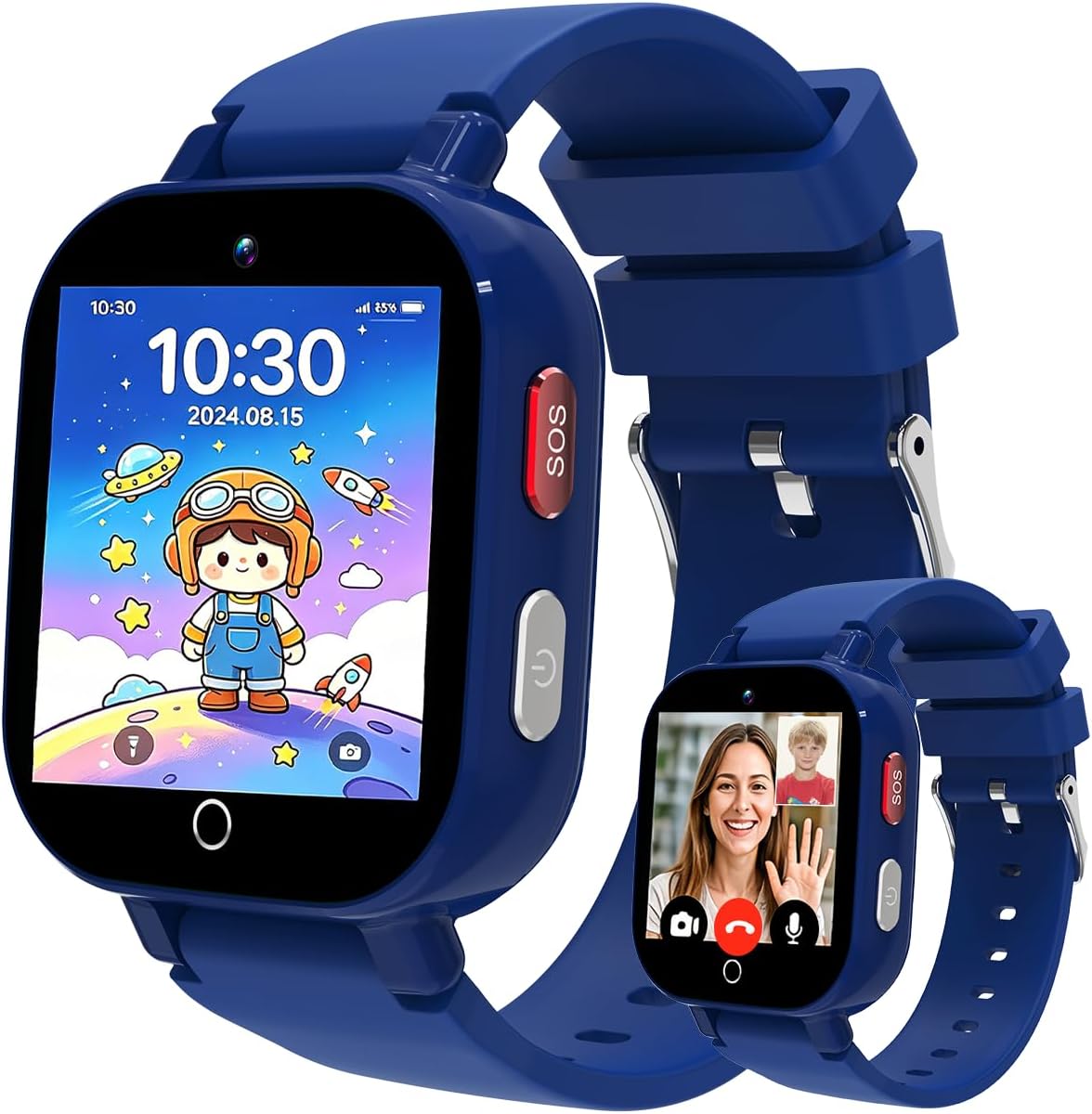
This 4G Kids Smart Watch offers the broadest combination of communication, location, and entertainment in the guide. Its 4.1 rating reflects a capable but complex alternative to simple trackers, and the included SIM card plus support for 4G, Wi-Fi, and multiple positioning systems distinguish it from watches that only mirror phone notifications.
We may earn a commission when you buy through this link, at no additional cost to you.
Location tools include real-time tracking through Google Maps, location history, daily-route viewing, multiple geofences, safe-zone alerts, and remote ringing. Communication includes video calls, voice calls, text, emojis, voice messages, and family group chats. A press-and-hold SOS function calls preset contacts, while remote listening lets parents hear the surrounding environment when needed. These tools create a more independent phone alternative for a child on the go.
Parental controls are extensive but may require time to configure. The app supports contact management, unknown-call blocking, dial-pad disabling, class mode, scheduled power controls, remote shutdown or restart, call restrictions, and customizable settings. The watch also includes an AI voice assistant, translation, image recognition, a camera, games, a stopwatch, calculator, alarms, and sports modes, but this breadth can make it more complicated than a focused fitness tracker.
The product is best for parents who specifically need GPS, geofences, independent calling, and school-time controls. It supports iOS and Android devices and has IP68 waterproof protection, with stated daily-use battery life of five days and standby time of seven days. However, it only supports use in the United States, and families must account for the included SIM, cellular service, app configuration, and the child's need to learn which functions to use.
Real-time maps, route history, multiple geofences, safe-zone alerts, and remote ringing give parents several ways to check on a child. The location system combines GPS, GLONASS, Galileo, BeiDou, QZSS, NavIC, Wi-Fi, and LBS positioning.
Class mode can limit distracting features during designated periods. Scheduled power settings, call restrictions, contact controls, and remote device management add further supervision for school days and family routines.
We may earn a commission when you buy through this link, at no additional cost to you.
The Garmin Bounce is designed for families that want communication and location features in a more restrained kids smartwatch rather than a full entertainment device. It carries a 4.1 rating and supports two-way text and voice messaging, real-time location checks, parent-defined boundaries, and an assistance feature through the Garmin Jr. app.
We may earn a commission when you buy through this link, at no additional cost to you.
The watch gives parents meaningful oversight without exposing children to the broad app ecosystem found on many phone-style watches. Parents can check a child's whereabouts, receive notifications when the child enters or leaves defined boundaries, and exchange texts or voice messages through the Garmin Jr. app. The Assistance function lets a child quickly send family contacts a message with live location when network data coverage is available.
There are meaningful dependencies and trade-offs. Messaging, real-time tracking, and boundary notifications require an active subscription and LTE connectivity. The stated battery life reaches only two days between charges, and connected feature use and network conditions can significantly affect that duration. The watch also lacks the camera, games, AI assistant, and broader entertainment functions found in the 4G models in this comparison.
The original Garmin Bounce is best for a child old enough to benefit from two-way communication but whose parents prefer a focused ecosystem built around location and family contact. It is also a sensible alternative for families already comfortable with Garmin's connected services. Buyers who want longer intervals between charges or standalone entertainment should compare the newer Bounce 2 or a 4G watch instead.
Real-time location and parent-defined boundary notifications provide useful context without giving the child unrestricted smartphone access. The feature depends on an active subscription, LTE service, and suitable network coverage.
Text and voice messaging allow a child to contact family through the Garmin Jr. app. Compared with a camera-equipped entertainment watch, the Bounce offers a smaller and more purposeful communication experience.
We may earn a commission when you buy through this link, at no additional cost to you.
The Garmin Bounce 2 is the most advanced Garmin option in the guide and receives the Best Premium designation because it adds calling, voice commands, music, richer sports apps, and comprehensive parent-management tools. Its 3.4 rating is the lowest listed score, so the recommendation comes with an explicit caution about its value relative to its more limited customer feedback.
We may earn a commission when you buy through this link, at no additional cost to you.
Communication is a major step up from the original Bounce. Children can make two-way calls, send texts, record voice messages, activate functions through voice commands, and place calls by voice. Location tracking and parent-defined boundaries remain available, and the Assistance feature can send a live-location message and initiate a call to family contacts. Garmin manages the LTE connectivity subscription, which avoids the need to switch phone providers.
The Bounce 2 also includes GPS-based sports apps for running, biking, pool swimming, and more. Children can listen to music through the watch or compatible headphones, subject to Amazon Music Unlimited or Amazon Prime. The parent app supports tasks, scheduled alerts, alarms, step tracking, sleep monitoring, rewards, and school mode, creating a broad mix of communication, activity, and responsibility tools.
Trade-offs are substantial. The watch requires an active subscription and LTE connectivity for core communication and location functions. Its stated battery life is up to two days, with connected use significantly affecting duration. The 3.4 rating suggests that prospective buyers should review current customer feedback carefully. It is best for families prioritizing the Garmin ecosystem, independent calling, sports tracking, and parental organization over the lowest rating in the field.
Garmin manages the watch's LTE connectivity subscription, while direct calling and voice messaging improve independence. Families can keep the wearable tied to the Garmin Jr. app rather than managing a separate wireless carrier.
GPS sports apps complement task assignment, behavior rewards, step tracking, sleep monitoring, and school mode. These functions make the Bounce 2 useful for families trying to combine movement goals with household responsibilities.
We may earn a commission when you buy through this link, at no additional cost to you.
This version of the 4G Kids GPS Watch shares the same broad feature platform as the other two models in that family and carries a 4.1 rating. It is a versatile option for parents who want location, calling, safety tools, entertainment, and parental settings in one device, while the repetition in available models means buyers should compare listings and variant details carefully.
We may earn a commission when you buy through this link, at no additional cost to you.
The watch supports real-time GPS location, location history, daily routes, multiple geofences, safe-zone notifications, and remote ringing. It also offers 4G video calls, ordinary voice calls, text, emojis, voice messages, and family group chats. Wi-Fi support can reduce cellular data use, while GPS, Wi-Fi, and LBS positioning work together to provide location updates in different environments.
The entertainment and smart-feature suite is extensive. An AI voice assistant, translation, image recognition, camera, album, games, stopwatch, calculator, alarms, and sports modes can make the watch engaging outside school. At the same time, these extras increase the device's complexity. Parents must balance the child's need for independent contact with sensible limits, using class mode, unknown-call blocking, dial-pad restrictions, scheduled power controls, and remote management.
This model is recommended for children who need a mixture of communication and entertainment and whose parents will actively configure the controls. IP68 protection, stated five-day daily-use battery life, seven-day standby time, and compatibility with iOS and Android support everyday use. The watch is limited to the United States, and the included SIM does not remove the need to think about cellular service, activation, and consistent charging.
Camera access, games, an album, AI functions, and sports modes extend the watch beyond communication and location. These extras are most suitable for older children who can manage screen features without becoming distracted during school.
The press-and-hold SOS action calls preset contacts, while remote listening provides additional context in emergencies. Scheduled power controls, class mode, and geofence alerts make the device adaptable to daily family routines.
We may earn a commission when you buy through this link, at no additional cost to you.
The third 4G Kids GPS Watch in the comparison provides the same core mix of real-time positioning, 4G communication, and extensive parental controls. With a 4.1 rating, it stands as a credible option for families who want a phone-like watch for a child and value the breadth of the app controls.
We may earn a commission when you buy through this link, at no additional cost to you.
Its positioning system supports GPS, GLONASS, Galileo, BeiDou, QZSS, NavIC, Wi-Fi, and LBS data. Parents can follow location history, review routes, create several safe zones, refresh a child's position, or remotely ring the watch. The child can communicate by video call, voice call, message, emoji, voice note, or family group chat, with a SIM card or Wi-Fi providing the connection.
The control suite is a major selling point. Parents can manage approved contacts, block unknown calls, disable the dial pad, enable class mode, schedule power-on and power-off times, remotely restart or shut down the device, and set call restrictions. An SOS button calls preset contacts, while remote listening and app notifications offer additional visibility. These controls help make a feature-rich watch more practical, although they still require active supervision.
This model fits families that need location and communication but also want games, camera functions, an AI assistant, translation, and sports modes for downtime. The stated battery figures reach five days during daily use and seven days on standby, although actual results depend on usage. It is restricted to US support and requires cellular or Wi-Fi setup, so it is less convenient for families outside the country or seeking a completely independent activity tracker.
The watch can combine GPS, Wi-Fi, and LBS information with support for several satellite systems. That layered approach is intended to make location updates more useful in a range of everyday settings.
Approved contacts, blocked calls, class mode, scheduled power controls, and remote device management let adults adapt the watch to school, bedtime, and travel routines. Clear setup is essential for these safeguards to work as intended.
We may earn a commission when you buy through this link, at no additional cost to you.
The Nyonio Kids Watch is the Best Budget choice for families seeking many fitness features in a child-friendly 1.5-inch watch. Its 4.1 rating matches the larger communication models, while the product centers on activity, sleep, reminders, customization, and phone notifications rather than GPS or independent cellular service.
We may earn a commission when you buy through this link, at no additional cost to you.
The watch automatically tracks steps, distance, calories burned, and daily activity. Its 19 indoor and outdoor sport modes include activities such as running, jumping rope, and basketball. Overnight monitoring records deep sleep, light sleep, and awakenings, while a vibrating alarm offers a quieter wake-up than a conventional audible alarm. Sitting and drinking-water reminders can help children build habits throughout the day.
Bluetooth connectivity supports notifications for calls, SMS, and services such as WhatsApp, but the watch cannot make or answer calls and messages independently because it has no SIM card or separate Wi-Fi connection. Some configuration and detailed data viewing use an app, despite the product title's no-phone or app wording. The magnetic charging cable supports a stated working time of up to five to seven days, depending on use.
This is a strong recommendation for an active child between roughly six and fourteen who wants a colorful, customizable fitness watch without cellular complexity. It is less suitable for parents who need GPS, geofences, video calling, or emergency contact functions. Its customizable interfaces, uploaded photos, TPU strap, IP68 protection, and 19 sport modes make it feel more like a personal activity accessory than a basic step counter.
The combination of pedometer data, 19 sport modes, overnight sleep stages, heart-rate measurement, and calorie tracking gives the watch more depth than a simple step counter. It is suited to children building consistent movement and sleep routines.
A color touchscreen, adjustable brightness, lift-to-wake behavior, more than 60 interface options, DIY faces, and an adjustable TPU strap help the watch feel personal. Children can upload favorite images while the strap is designed for daily activity.
We may earn a commission when you buy through this link, at no additional cost to you.
The Kids Multifunction Fitness Watch is aimed at children who want a playful wearable with more entertainment than a conventional fitness tracker. Its 3.9 rating places it below the other general-purpose models, but the feature mix—18 games, a camera, customizable faces, and activity tracking—gives it a distinct purpose for entertainment-oriented use.
We may earn a commission when you buy through this link, at no additional cost to you.
Activity tracking includes steps, distance, calories burned, active minutes, and sleep quality. The watch also provides a timer, stopwatch, calculator, calendar, alarms, pedometer, flashlight, and multiple theme styles. More than 22 languages, three switchable themes, palm-activated screen wake-up, and dynamic wallpapers make the 1.83-inch touchscreen easy to personalize.
The camera opens the door to selfies, a photo gallery, and favorite-photo watch faces. Eighteen games are described as suitable for multiple ages and intended to support logical thinking, hand-eye coordination, reflexes, and discrimination. That makes the watch more engaging for younger children, although parents seeking academic outcomes should view games as entertainment rather than a substitute for instruction.
This model is best for a child who will use the watch as a standalone personal device for movement, photos, and light entertainment. It does not provide the GPS, geofencing, SOS system, video calls, or cellular messaging found in the 4G products. IP68 protection adds everyday durability, but the absence of independent communication means it is most appropriate when the child does not need to contact adults while away from a phone.
Eighteen games add variety to a watch that otherwise resembles a standard fitness tracker. The product description emphasizes logical thinking, hand-eye coordination, reflexes, and visual discrimination as part of the play experience.
The front camera supports selfies, a gallery, and custom photo faces. This makes the watch feel like a personal entertainment accessory rather than a device limited to counting steps and monitoring sleep.
We may earn a commission when you buy through this link, at no additional cost to you.
The black Kids 19-Sport Fitness Watch offers a balanced alternative to the pink Nyonio model, combining activity monitoring, sleep information, phone notifications, and extensive customization in a 1.5-inch touchscreen. Its 4.1 rating gives it a strong score among standalone trackers, and it is designed for boys and girls approximately six to fourteen years old.
We may earn a commission when you buy through this link, at no additional cost to you.
Automatic tracking covers steps, distance, calories burned, and daily movement. The child can choose among 19 indoor and outdoor sports modes, including running, jump rope, and basketball. Overnight monitoring records deep sleep, light sleep, and awakenings. A vibrating alarm with more than 15 alarm options provides a quieter wake-up, and reminders for sitting and drinking water support healthy routines.
Bluetooth notifications can mirror incoming calls, SMS, and social-service messages such as WhatsApp from a connected phone. The watch cannot make or answer calls or send messages independently because it has no SIM card and no separate Wi-Fi connection. The stated working time of five to seven days varies with use, and the magnetic charging cable makes routine recharging straightforward.
This watch is a good choice for a child who wants fitness and sleep data but does not need independent calling or GPS. The customizable interface, DIY dial, uploaded-photo support, adjustable TPU strap, and brightness control help it fit daily life. Buyers should verify app permissions and notification behavior on their family's phones, and should understand that Bluetooth is a convenience connection rather than a cellular safety service.
Step, distance, calorie, heart-rate, and sleep information can help a child follow broad activity trends. The watch also includes sitting and hydration reminders, supporting more than simple step counting.
More than 60 interface options, DIY faces, uploaded photos, adjustable brightness, and an easy-install TPU strap make the watch adaptable to different preferences. The automatic lift-to-wake display reduces unnecessary button presses.
We may earn a commission when you buy through this link, at no additional cost to you.
This charger is not another kids smartwatch, but it is included in the comparison because it may be useful to anyone already using a Google Fitbit Ace LTE Kids Smartwatch. It has a 4.1 rating and fulfills a narrow accessory need: replacing a lost or damaged charging dock.
We may earn a commission when you buy through this link, at no additional cost to you.
The sylacor Charger Dock is designed specifically for the Fitbit Google Ace LTE Kids Smartwatch. A functioning charger is important because this category of connected watch depends on routine power for syncing and daily use, and losing the original dock can otherwise interrupt the setup or charging cycle.
The main trade-off is simply that the package contains only the replacement charger. It does not include a smartwatch, charging cable, wall adapter, watch body, or other accessories. It is also not described as a universal Fitbit charger, so owners of other Fitbit models should verify their device before ordering.
This is the right purchase only for a parent or caregiver who already owns a compatible Ace LTE and needs its dedicated dock. It is not an alternative to the Fitbit Ace 2 or any of the GPS smartwatches reviewed above. Confirm the exact watch model and connector before buying, because the inclusion of this accessory does not make the product itself a wearable tracker.
A dedicated replacement dock helps maintain the normal charging cycle for a compatible Ace LTE. For a child's watch, avoiding gaps in charging can reduce interruptions to syncing and everyday use.
The charger is specifically designed for the Fitbit Google Ace LTE Kids Smartwatch and does not include the watch itself. Compatibility should be confirmed carefully to avoid ordering the wrong accessory.
We may earn a commission when you buy through this link, at no additional cost to you.
The most useful kids smartwatch is the one that matches a child's age, independence, and daily routine without creating unnecessary complexity. Start with the required functions, then examine connectivity, location accuracy, battery claims, durability, parental controls, and the ongoing cost or setup associated with the device.
Begin by deciding whether the watch should primarily motivate movement, support sleep habits, provide two-way communication, or report a child's location. The Fitbit Ace 2 emphasizes steps, active minutes, goals, sleep, and a child account. The Nyonio and other standalone models concentrate on sports, step counts, sleep, alarms, and phone notifications. The Garmin Bounce models and 4G GPS watches add direct communication, location, geofencing, and remote controls. A camera and games may be entertaining, but they should not displace the safety or activity functions a family actually needs.
A watch with Bluetooth notifications remains dependent on a nearby phone, while a 4G watch can operate independently over cellular service. Garmin Bounce models require an active subscription and LTE connectivity for messaging, location, and other connected functions. The 4G models in this guide include a SIM card, while their location and calling features still depend on compatible service. Always confirm coverage, account requirements, plan terms, and whether the included SIM can be activated conveniently. A subscription or cellular plan can materially change the long-term value of a smartwatch.
For independent travel, examine real-time location, location history, geofences, safe-zone alerts, remote ringing, and emergency assistance. The 4G watches combine GPS, Wi-Fi, and LBS information and support several satellite systems. Garmin uses the Garmin Jr. app for real-time checks and parent-defined boundaries. GPS-based fitness trackers are useful for movement but do not replace independent location monitoring. Also consider who can be contacted, how SOS functions are triggered, and whether remote listening is appropriate for your family's privacy expectations.
The Fitbit Ace 2 lists up to five days of battery life, while the Nyonio and 19-sport models list five to seven working days. Garmin Bounce models list up to two days, and the 4G products list five days of daily use with seven days of standby. These figures are not directly equivalent: LTE strength, animation, calling, GPS use, and other connected features can materially change battery duration. Consider how often the child will realistically charge the watch and whether a short battery life creates missed tracking or communication.
Kids wear watches while washing hands, playing outside, and participating in sports. The Ace 2 is water resistant to 50 meters, the Nyonio and 19-sport fitness watches have IP68 protection, and the 4G products also specify IP68 protection. Garmin describes the original Bounce as swim-friendly, while the Bounce 2 includes pool swimming among its sports activities. Water-resistance ratings are not the same as permission for every activity, so check the specific watch instructions and avoid charging or exposing a device to water beyond its stated limits.
Useful parental tools include approved contacts, unknown-call blocking, class mode, geofences, school locks, scheduled reminders, task assignment, remote shutdown, and sleep or behavior monitoring. The 4G models offer detailed app controls, while Garmin offers school mode, tasks, alerts, rewards, steps, and sleep monitoring. Bluetooth-only watches offer less oversight because they cannot act as independent communication devices. The best control system is not necessarily the one with the longest list; it is the one a parent can understand, configure, and maintain consistently.
Younger children generally benefit from simple goals, large icons, short interactions, and limited menus. The Ace 2 offers a limited kid view and goal celebrations. Older children may appreciate the 4G models' camera, games, AI tools, and group chats, but those features can also distract during school. Garmin provides a more purposeful balance, while camera-equipped activity watches prioritize play. Match the interface to the child's maturity and establish class mode or screen-time rules before the watch becomes part of the daily routine.
A purchase decision should include the watch body, app compatibility, cellular setup, subscription terms, charging cable, waterproof expectations, and customer support. The Ace LTE charger in this guide is only a replacement dock and does not include a watch. Some product listings refer to apps despite the phrase no phone or app needed, so read the details carefully. Check which phone operating systems are supported, what data access the app requires, and whether a family member's phone must remain nearby for a chosen device to work as expected.
Begin with the manufacturer's setup instructions, charging the watch fully and installing the specified app on the parent's compatible phone. For cellular models, activate the included SIM or the service required by the provider, then create or sign in to the appropriate parent account. Garmin Bounce models require an active subscription and LTE service. Review contact permissions, safe zones, class mode, notification settings, and school schedules before allowing the child to use the watch independently.
Establish a consistent charging routine based on the product's stated battery life. Fitbit Ace 2 users should expect less convenient charging when animated clock faces are used, while heavily connected GPS or calling use can shorten the life of a Garmin Bounce or 4G watch. Check the device before bed, clean the wrist and charging contacts, and avoid using a damaged cable or incompatible charger. For the Ace LTE replacement dock, confirm that the watch model matches before ordering and allow the device to charge according to its own instructions.
Teach the child which functions are safe to use, how to make an approved contact, and when to use SOS or Assistance features. Teach children not to share personal information, upload photos publicly, or accept contact requests without a parent's permission. Check location history and notifications respectfully, explain which alerts matter, and periodically review blocked contacts, class schedules, and geofences. Rinse or wipe water-exposed watches as directed and never charge a wet device.
The Fitbit Ace 2 is best described as a child-focused activity tracker with sleep tracking, reminders, goals, and an app-based social feature. It does not provide independent cellular calling, video calling, GPS reporting, or geofencing. Families seeking a phone alternative should consider a 4G or Garmin model instead.
The supplied product information states that an active subscription and LTE connectivity are required for core features such as real-time location, boundary notifications, two-way messaging, and calling. Garmin manages the Bounce 2's connectivity subscription, so buyers should review current service terms before purchasing.
The product information for each of the three 4G Kids GPS Watch listings states that the watch only supports the United States and does not support other countries. Families outside the US should confirm regional compatibility before ordering or activating the included SIM card.
A fitness tracker primarily records movement, sleep, alarms, and simple phone notifications, often through Bluetooth. A GPS smartwatch adds independent cellular communication, location history, geofences, emergency contact features, and remote parental controls. The latter is more useful for independent travel but usually requires service and more setup.
The Nyonio Kids Watch and the black 19-sport fitness watch cannot make or answer calls and messages independently. They do not support SIM cards or separate Wi-Fi and use Bluetooth to mirror notifications from a connected phone. Consider a 4G or Garmin model when direct calling is essential.
The Nyonio Kids Watch and black 19-sport fitness watch list a working time of up to five to seven days. The Ace 2 states up to five days, while the 4G models list five days of daily use and seven days of standby. Garmin Bounce models list up to two days. Actual results vary with use and connected features.
No. It is a replacement charging dock designed specifically for the Google Fitbit Ace LTE Kids Smartwatch, and only the charger is included. It is useful for owners who already have a compatible watch but need a replacement dock; it does not include the watch or provide tracking features.
For independent travel or school use, geofences and class mode can be highly useful. Geofences notify parents when a child enters or leaves a defined area, while class mode blocks distracting features during designated periods. These tools work best when they are configured with realistic locations and schedules and reviewed regularly.
The Fitbit Ace 2 is the strongest overall choice for a child who needs simple activity goals, sleep tracking, and positive encouragement without cellular complexity. The Nyonio Kids Watch stands out as the Best Budget option for broad sports modes, reminders, customization, and Bluetooth notifications, while the Garmin Bounce 2 earns the Best Premium designation for calling, voice commands, music, sports apps, and deeper parental organization.
Prioritize the function your child will genuinely use: movement and sleep for a basic tracker, safe geofences and independent communication for travel, or a focused family ecosystem for calling and location. Also account for the child's age, subscription requirements, app setup, battery habits, and the difference between Bluetooth notifications and true cellular independence. The right watch should support family goals without creating more management than the parent can sustain.
Ratings, product features, service terms, prices, and availability may change, so check the current Amazon listing and manufacturer details before buying. Confirm device compatibility, cellular coverage, account requirements, water-resistance guidance, and what is included in the package. Those final checks can prevent an attractive feature list from becoming a frustrating ownership experience.