
TRUECABLE Outdoor Quad Shield Coax
4.6Editor score
500-foot direct-burial cable
UV-resistant polyethylene jacket
Sweep tested to 3 GHz
Compare 10 of the best Quad Shield RG6 Coaxial Cables for satellite, antenna, cable TV, internet, CCTV, and professional installations, with detailed ratings
Quad Shield RG6 coaxial cables add layers of foil and braid around their signal conductors to reduce electromagnetic and radio-frequency interference. The right cable depends on run length, installation environment, connector arrangement, conductor material, and whether the line must be buried, routed through walls, or connected to consumer equipment.
This guide compares ten options across practical categories such as shielding, impedance, jacket rating, conductor construction, installation convenience, and supported applications. The selections include ready-to-connect cables, installer-oriented spools, indoor-rated runs, and direct-burial cable for demanding outdoor installations.
Each review explains who the cable is best suited to, along with its strongest features and unavoidable trade-offs. Ratings reflect the supplied customer feedback, while technical descriptions come from the listed product information. Current listings, availability, and market conditions can change, so confirm the final specifications before purchasing.
4.6Editor score

4.7Editor score

4.7Editor score
The table below compares all ten cables by length, shielding, conductor, and installation design, making it easier to identify the right option for home connections, professional jobs, or outdoor routing.



The Cables Direct Online 100-foot black quad-shield cable is a convenient all-in-one option for connecting satellite dishes, antennas, cable boxes, televisions, and compatible internet equipment. It carries a 4.6 customer rating, and its standout advantage is the combination of a generous 100-foot length, quad-layer shielding, and attached F-pin and BNC connectors.
We may earn a commission when you buy through this link, at no additional cost to you.
Shielding is especially relevant in homes or buildings where nearby electronics, power wiring, or high-frequency equipment could introduce interference. The cable uses a solid copper-clad steel conductor and a durable PVC jacket, while its construction is specified for digital HD use up to 3 GHz. That combination makes it suitable for common home entertainment and satellite applications without requiring a separate termination kit.
The trade-off is that this is a preterminated extension rather than a flexible bulk spool. A user who needs unusual connectors, a custom path, or a very short segment may find the fixed 100-foot length inconvenient. Copper-clad steel is also less conductive than solid copper, although it remains a common and practical RG6 conductor for standard installations.
Choose this cable when you want a straightforward satellite, antenna, or television connection with enough length to cross a room and avoid several adapters. It is particularly attractive for home users who value simple installation, recognizable connector types, and quad shielding without the need to terminate bulk coax themselves.
The attached F-pin and BNC connectors make this a practical choice for common satellite, antenna, and cable-TV arrangements. It removes the need to crimp or splice connectors for a straightforward extension run.
Quad-layer shielding helps protect high-frequency signals from electromagnetic and radio-frequency interference. This is useful around entertainment systems, routers, and other electronics that may generate nearby electrical noise.
We may earn a commission when you buy through this link, at no additional cost to you.
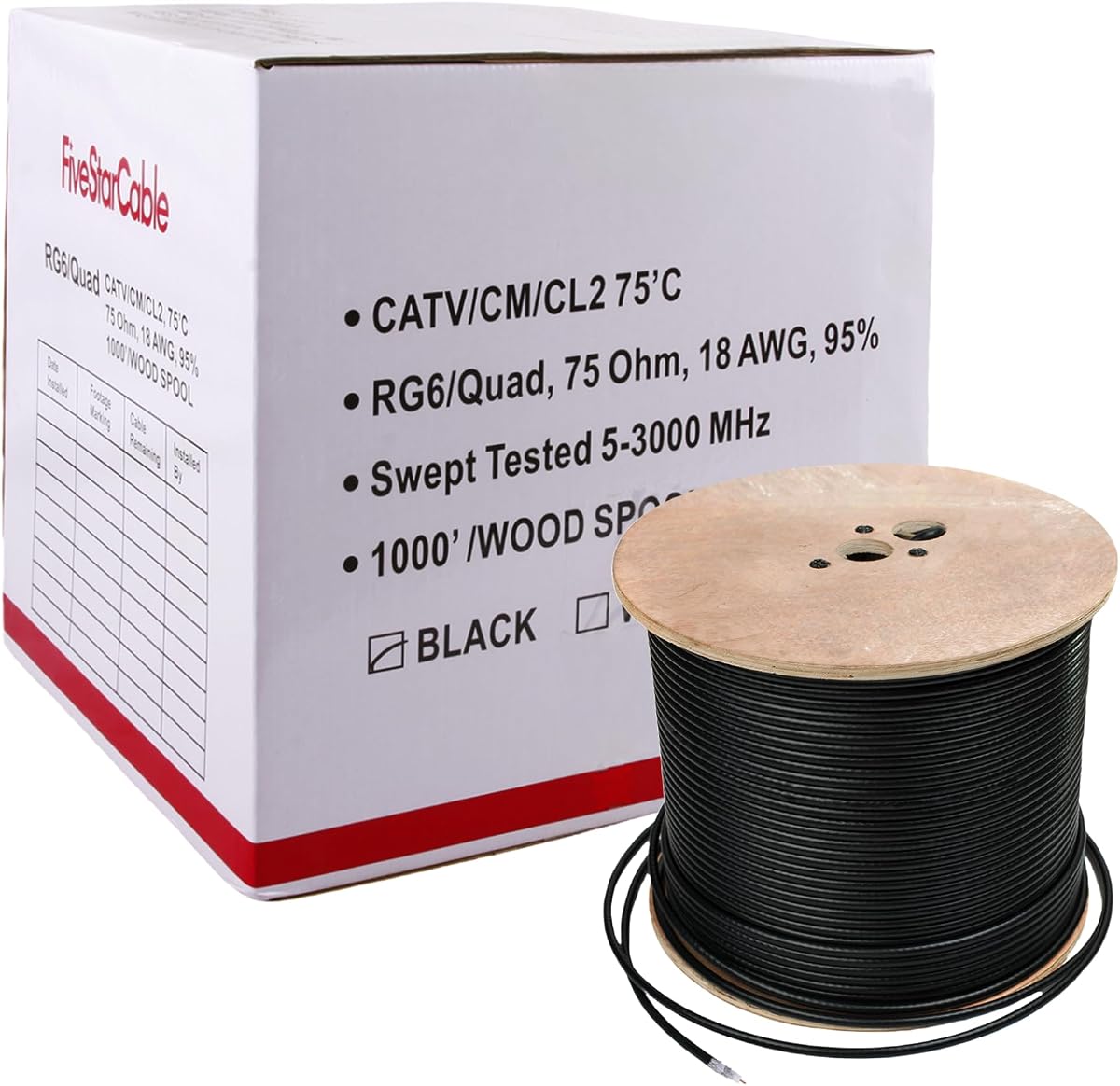
The Five Star 1,000-foot black spool is a substantial bulk option for contractors, advanced home users, and anyone completing an extended installation. Its 4.5 rating reflects generally favorable customer feedback, while the spool format and detailed construction make it more useful for planned cable routing than for a quick connection.
We may earn a commission when you buy through this link, at no additional cost to you.
The cable uses an 18 AWG copper-clad steel center conductor, a cellular polyethylene dielectric, and 75-ohm RG6 construction. Its quad shield combines 60% and 40% double braid with aluminum foil, providing a layered defense against interference. The flexible PVC jacket is intended to withstand everyday handling, wear, and environmental exposure during installation.
Its main limitation is that it arrives as a spool rather than a finished cable with installed connectors. That means installers need appropriate RG6 compression connectors and a compatible crimping tool, along with a way to route and secure the cable. The copper-clad steel conductor is less conductive than solid copper, which may matter for specialized satellite power or long-run requirements.
This is a strong selection for a new home run, multiple television locations, an antenna distribution project, or a commercial installation that consumes substantial cable. It suits buyers who value length, shielding, and recognized listing more than tool-free installation.
A 1,000-foot spool provides enough length to complete several routes without stopping for more cable. That makes it useful for new construction, structured wiring, and installations with multiple branch points.
The 60% and 40% braid layers work together with aluminum foil to improve resistance to interference. This construction is intended for broadcast, satellite, cellular, and CCTV environments where signal integrity matters.
We may earn a commission when you buy through this link, at no additional cost to you.
The Cables Direct Online 75-foot black cable sits between shorter patch-style leads and the longer 100-foot version in this guide. It has a 4.6 customer rating and provides an accessible preterminated route for television, antenna, satellite, cable-box, or compatible modem connections.
We may earn a commission when you buy through this link, at no additional cost to you.
Its quad-layer shield, solid copper-clad steel conductor, and PVC jacket support stable high-frequency transmission. The listed 3 GHz digital capability makes it relevant for contemporary HD television and satellite equipment, while the attached F-pin and BNC connectors simplify connections to compatible sources and displays.
Because the length is fixed, this cable is less adaptable than bulk coax. It cannot be shortened without cutting and re-terminating it, and buyers whose devices use different connector styles will need appropriate adapters or a different cable. The copper-clad steel center conductor also remains less conductive than a solid copper alternative.
It is an excellent choice for a medium-distance room or patio connection when a 50-foot lead is too short and a 100-foot cable creates excess slack. The combination of moderate length, ready-made connectors, and layered shielding makes it one of the easiest products in the roundup to install.
At 75 feet, the cable offers enough reach for many common household layouts without carrying as much unnecessary slack as a longer extension. It is a practical middle ground for satellite dishes, antennas, and television installations.
The listed 3 GHz specification and quad-layer construction align well with modern high-frequency AV systems. They also help maintain a stable connection when the line passes near household electronics or other potential interference sources.
We may earn a commission when you buy through this link, at no additional cost to you.
The trueCABLE 1,000-foot quad-shield coax is the strongest all-around selection for installers who want a solid copper conductor, detailed certification, and a jacket designed for riser applications. Its 4.7 rating places it among the highest-rated products in the list, while its technical specifications support use across CATV, HDTV, satellite, router, modem, antenna, and audiovisual systems.
We may earn a commission when you buy through this link, at no additional cost to you.
The construction includes a solid 18 AWG bare copper conductor, 60% and 40% aluminum wire braiding, and dual layers of bonded aluminum foil. That shielding is especially useful in challenging environments, while bare copper provides strong transmission performance and is identified as preferable to copper-clad steel for satellite installations requiring power to the LNB. The cable is sweep tested up to 3 GHz and certified to ANSI/TIA 568.4-D for CATV RG6 at 150 feet.
Its PVC jacket carries CMR, CATVR, and CL2 fire-safety ratings, making it appropriate for walls, between floors, and other non-plenum spaces. It is not described for every plenum environment, so building codes and local requirements still matter. As a bulk spool, it also requires proper connectors and termination tools, adding labor compared with a ready-made cable.
For new construction, professional residential work, structured cabling, and long-lived installations, this product offers the most complete balance of conductor quality, shielding, certification, and practical packaging. It is the recommendation for buyers who intend to terminate the cable correctly and need more than a temporary extension.
The solid bare copper center conductor supports efficient signal transfer and is specifically highlighted for satellite installations that carry voltage to the LNB. It is a meaningful upgrade over copper-clad steel when conductor conductivity is a priority.
The CMR, CATVR, and CL2-rated jacket is intended for walls, floor separations, and other non-plenum spaces. Its mild flame-retardance helps address vertical installation concerns while providing durable physical protection.
We may earn a commission when you buy through this link, at no additional cost to you.
The 500-foot quad-shielded coaxial cable in an easy-pull box is a versatile middle ground for installers covering a medium-sized home or commercial job. It has a 4.6 rating and supports HDTV, satellite, cable television, internet, and CCTV installations, making the single spool useful across several common low-voltage categories.
We may earn a commission when you buy through this link, at no additional cost to you.
Its four-layer foil-and-braid shielding is designed to suppress EMI and RFI interference, while the 75-ohm impedance supports modern AV and internet systems. An 18 AWG copper-clad steel conductor provides the signal-carrying core, and the easy-pull box is intended to make longer installation runs faster and less frustrating.
The PVC jacket is described as resistant to weather, ultraviolet rays, and abrasion, giving it useful outdoor durability when installed appropriately. However, this is a CL2-rated cable rather than a direct-burial product, so soil contact or underground routing may call for a cable with a more specialized jacket. Connector termination is also required after the box is opened.
This option makes sense for a contractor who wants convenient packaging without purchasing a full 1,000-foot spool. It is also appropriate for a confident DIY user planning a structured run, provided they have the correct compression connectors, crimping tool, and understanding of the intended installation path.
The easy-pull box is designed to reduce tangles and improve handling during installation. Its 500-foot length covers substantial routes while remaining more manageable than a larger spool.
The 75-ohm design is suitable for modern television, satellite, internet, and CCTV systems. That makes the box useful for installers who regularly handle more than one type of coax-connected equipment.
We may earn a commission when you buy through this link, at no additional cost to you.
The TRUECABLE 500-foot outdoor quad-shield coax is the premium choice for direct-burial, above-ground exterior, and conduit-based runs. It carries a 4.6 rating and distinguishes itself through a weather-resistant polyethylene jacket, solid bare copper conductor, and certification-oriented testing up to 3 GHz.
We may earn a commission when you buy through this link, at no additional cost to you.
The 75-ohm cable uses a four-layer shield combining 60% and 40% aluminum braid with dual layers of 100% foil. It is listed for cable television, HDTV, satellite, modems, SD-SDI, HD-SDI, 3G-SD, and antenna applications, giving it broad compatibility across professional audiovisual and broadcast systems.
Unlike ordinary PVC-jacketed coax, this cable is rated CMX for direct burial and can be installed in the ground or used in conduit. The polyethylene jacket is intended to withstand sunlight, dirt, snow, and moisture. Even so, correct trenching, burial depth, and local code compliance remain essential; outdoor-rated construction does not eliminate installation workmanship.
The bare copper center conductor is another meaningful advantage for long runs and satellite systems that require power at the LNB. This cable is best for a serious outdoor antenna or satellite installation, especially when the route crosses soil, exposed areas, or conduit between buildings.
The CMX-rated polyethylene jacket is the key differentiator, allowing the cable to be buried directly or routed through conduit. It is also described to tolerate sunlight, dirt, snow, and moisture during outdoor service.
Dual foil layers and two braid levels provide strong interference protection. Combined with 3 GHz sweep testing, this construction suits demanding television, satellite, antenna, and professional video applications.
We may earn a commission when you buy through this link, at no additional cost to you.
The GE 25-foot quad-shield RG6 is the best compact choice in the guide, especially for nearby televisions, antennas, cable modems, satellite equipment, and home-theater connections. Its 4.7 rating is among the strongest listed, and the short, preconnected design makes it particularly approachable for basic household extensions.
We may earn a commission when you buy through this link, at no additional cost to you.
The cable has a solid-core conductor, maximum shielding, and support for digital signals up to 3 GHz. Gold-plated compression connectors offer corrosion resistance and a convenient screw-on connection that requires no tools, eliminating the most common source of installation frustration for basic coax extensions.
Its flame-retardant construction also makes it suitable for long-term in-wall uses involving video surveillance, internet, or home theater. However, 25 feet is not much length when the source is in another room, outside, or at a different wall. Buyers should measure the complete route before assuming the cable will reach.
Choose it for a short indoor jump, a nearby antenna, or a simple home-theater connection where tool-free installation matters most. It is not intended to replace bulk cable for a new-construction run, but for its intended scale it provides a tidy and dependable solution.
The screw-on compression connectors can be attached without a crimping tool. This simplifies replacement, rearrangement, and setup for consumers who may not have coax termination equipment.
The cable is described as flame retardant and suitable for in-wall installations. That makes it more appropriate for permanent indoor routing than an unrated temporary patch cable.
We may earn a commission when you buy through this link, at no additional cost to you.
The Cables Direct Online 100-foot white cable offers the same practical ready-to-connect format as its black counterpart, but with a jacket designed to blend more discreetly into light-colored walls or visible installation areas. It holds a 4.6 customer rating and supports satellite, cable television, antenna, television, and compatible internet-device connections.
We may earn a commission when you buy through this link, at no additional cost to you.
Quad-layer shielding helps preserve signal quality around electrical noise, while the solid copper-clad steel conductor and robust PVC jacket support dependable high-frequency transfer. F-pin and BNC connectors are already installed, and the listed construction is suitable for digital HD applications up to 3 GHz.
The limitations match those of other preterminated extensions in the group. The cable cannot be adjusted without cutting and reconnecting it, and the copper-clad steel conductor is not equivalent to solid copper for every demanding satellite or long-run scenario. Any excess slack also needs to be managed neatly.
It is a good choice when appearance as well as convenience matters, such as a visible room installation, mounted television, or antenna lead routed along a pale wall. The 100-foot length gives ample reach, while the attached connectors make installation quick.
The white jacket is the main distinction from the equivalent black model. It can blend more naturally with light walls, trim, and entertainment areas where a dark cable would stand out.
F-pin and BNC fittings support common satellite, antenna, and audiovisual arrangements. Their preinstalled design is useful when users want to avoid selecting or crimping a separate termination.
We may earn a commission when you buy through this link, at no additional cost to you.
The Five Star 1,000-foot white spool is well suited to large AV, CATV, and MATV installations where a discreet jacket and substantial cable length matter. It has a 4.7 rating and provides 75-ohm RG6/U cable with a solid 18 AWG copper-clad steel conductor.
We may earn a commission when you buy through this link, at no additional cost to you.
Shielding is provided by 60% and 40% double braid together with an aluminum foil layer, creating a quad-shield configuration intended to reduce interference. A cellular polyethylene dielectric separates the conductor from the shield, while the white PVC jacket offers a practical visual alternative in finished spaces.
As with other bulk cables, the spool does not include finished connectors, so proper RG6 termination equipment is necessary. The copper-clad steel center conductor is common for this type of installation but may not be the ideal choice for a specialized satellite run requiring high conductivity or power delivery to the LNB.
This product is well matched to new residential wiring, structured audio-video work, broad CATV distribution, or MATV installations. Choose it over a black spool when the cable may remain visible and the white jacket better matches the surroundings.
The stated CATV/MATV and audiovisual uses make this cable relevant to technicians building structured distribution rather than simply making one short device-to-device connection.
The white jacket preserves the appearance of a larger professional installation while offering 1,000 feet for multiple runs. It is especially useful where dark cable would be visually distracting.
We may earn a commission when you buy through this link, at no additional cost to you.
The Cables Direct Online 50-foot white quad-shield cable provides a convenient middle-length option for satellite dishes, antennas, television systems, cable boxes, and compatible internet equipment. Its 4.6 rating and preterminated design make it a straightforward choice for users who do not need a full spool or a very short patch lead.
We may earn a commission when you buy through this link, at no additional cost to you.
The cable uses a solid copper-clad steel conductor, a durable PVC jacket, and layered shielding intended to resist electromagnetic and radio-frequency interference. Its stated digital HD capability extends to 3 GHz, supporting modern high-frequency entertainment and satellite signals. F-pin and BNC connectors are attached at the ends for convenient setup.
The main compromise is limited routing flexibility. A fixed 50-foot length cannot accommodate an unusually complex path without excess slack, and it cannot be shortened without cutting and re-terminating the cable. The copper-clad steel center conductor is also less conductive than solid copper for specialized high-performance applications.
It is a good option for a medium room, a nearby outdoor antenna, or a satellite extension where a discreet white jacket and immediate connector compatibility are priorities. Buyers should measure first and verify that their equipment uses the appropriate connector types.
Fifty feet provides enough reach for many common device placements without the extra bulk of a 75- or 100-foot cable. It works well for moderate room and short outdoor-extension layouts.
The white jacket reduces visual prominence while the quad-layer shield helps maintain signal stability around common sources of interference. The combination suits straightforward satellite, antenna, and television extensions.
We may earn a commission when you buy through this link, at no additional cost to you.
The right coax cable depends on more than length. Consider the conductor, shielding, jacket rating, connector arrangement, route, and the devices involved before making a selection.
Measure the entire path rather than only the straight-line distance between devices. Include wall routing, bends, service loops, desk placement, and any changes in elevation. A modest extra allowance can make installation easier, but excessive slack should be avoided because it can create poor connections, occupy unnecessary space, and complicate cable management.
Short preterminated leads suit nearby equipment, while 500- and 1,000-foot spools suit planned residential or commercial runs. Confirm that the cable can physically reach through planned conduit or wall cavities.
Both solid copper and copper-clad steel are widely used in RG6 cable. Bare copper generally provides higher conductivity, which is particularly relevant for long runs and satellite installations that send power to the LNB. Copper-clad steel offers a practical alternative for standard television, antenna, internet, and entertainment connections where extreme electrical demands are not present.
Choose solid bare copper when signal performance, voltage handling, or a professional installation is the priority. Copper-clad steel is suitable for many ordinary extensions and structured TV runs.
Quad shield cable commonly combines foil and braid layers, often described as dual foil plus dual braid or four total layers. This layered approach helps reject EMI and RFI from power systems, electronics, motors, networking equipment, and other nearby sources. More shielding can be helpful in commercial environments, densely wired homes, and runs passing near high-output equipment.
Look for clear shielding descriptions rather than relying only on the phrase quad shield. Coverage percentages, bonded foil, and braid construction provide a more useful view of actual interference protection.
The jacket determines where a cable may safely be installed. CL2 and riser-rated cables are intended for indoor and wall applications, with flame-safety ratings that vary by type. CMX direct-burial cable has a jacket designed for soil exposure, while a weather-resistant outdoor jacket supports above-ground exterior routing. Local building and electrical codes remain authoritative.
Use CL2 or appropriate riser cable indoors, outdoor-rated or CMX cable for exposed exterior routes, and direct-burial cable when it will contact soil. Never assume a standard PVC jacket can withstand burial conditions.
Preterminated cables are faster to install and reduce the need for connector tools. They are best for standard connections involving F-type or BNC fittings, short extensions, and common consumer equipment. Bulk spools offer length and routing freedom but require the correct compression connectors, a suitable crimping tool, and care during termination.
Choose a ready-made cable for convenience and a spool for a planned route. Check the connector gender and type carefully, because a nominal F-pin or BNC label may not match every device.
Modern television, satellite, antenna, internet, and CCTV systems all rely on coax, but their requirements can differ. A cable specified for digital HD use up to 3 GHz is suitable for many contemporary high-frequency installations. Professional video, cellular, broadcast, MATV, and SDI applications may place greater emphasis on certification, bandwidth, and shielding.
Match the cable to the intended service and check its stated frequency support. For a complex system, verify both the cable and every connector before installation.
The two most common fittings in this group are F-type and BNC. F-type connectors are widely associated with television, antenna, satellite, and modem equipment, while BNC connectors appear on many coax and video installations. Some products offer one connector at each end, while others may be configured differently. Adapters can add cost, create extra connection points, and introduce avoidable signal or reliability concerns.
Confirm the connector on both the source and destination before buying. For bulk cable, use compatible RG6 compression connectors and the correct crimping tool, and verify that the tool supports the connector body being used.
A tangle-free reel or easy-pull box can save considerable time and reduce cable damage during long runs. Sequential footage markings are especially useful when installers need to track remaining length. Flexible jackets also matter when coax must bend around corners, enter conduit, or pass through framing.
For professional work, prioritize packaging that keeps the cable clean and untangled. For basic household extensions, a preconnected cable in a manageable length is usually the simplest choice.
Plan the route before cutting or unpacking the cable. Identify the source and destination, measure the complete path, verify connector compatibility, and check whether the installation requires indoor, riser, outdoor, conduit, or direct-burial ratings. Keep coax separated from parallel power wiring where practical, and avoid sharp bends that could stress the conductor or jacket.
For bulk cable, attach the correct RG6 compression connector with a compatible crimping tool, inspect the finished connection, and test the line before permanently securing it. For preterminated cable, connect the cable directly to the specified equipment without adding unnecessary adapters. Tighten threaded fittings by hand and avoid using excessive force on the connector barrels.
Once installed, inspect accessible connectors for looseness, corrosion, moisture, or damage. Keep outdoor terminations dry and protected according to the manufacturer’s instructions, and do not bury a cable unless its jacket is specifically rated for direct burial. If signal quality changes, check connections, equipment inputs, splitters, and nearby interference sources before replacing the entire run.
Quad shield RG6 is a 75-ohm coaxial cable surrounded by four shielding layers, commonly two foil layers and two braid layers. Those layers help reject EMI and RFI while a center conductor carries the signal. The construction is useful for television, satellite, antenna, internet, CCTV, and professional audiovisual connections.
Quad shield can offer greater interference protection than double shield because it adds another pair of shielding layers. The practical benefit is greatest near busy electrical environments or on installations that carry high-frequency signals. In simpler setups, a well-terminated double shield cable can perform adequately, so cable quality and workmanship still matter.
Solid copper generally offers higher conductivity than copper-clad steel, making it a strong choice for long runs, satellite systems, and installations where power must reach the LNB. Copper-clad steel is widely used for ordinary television, antenna, cable, and internet extensions and can be perfectly suitable within its intended specifications.
Only when its jacket and installation rating explicitly permit the intended outdoor exposure. A CL2 or riser cable may be appropriate for an exposed exterior run depending on local requirements, but direct burial requires a cable rated for soil contact such as CMX. Protect compatible outdoor connectors from moisture and follow local electrical and building codes.
Quad shield RG6 normally uses the same connector families as other RG6 cable, including F-type and BNC. The connector must be compatible with both the cable and the equipment. For bulk cable, use RG6-compatible compression connectors and a matching crimping tool to create secure, properly dimensioned terminations.
No. The spool provides 1,000 feet of raw cable, and the installed run may be shorter after routing, trimming, service loops, and termination losses. Professional installations often reserve extra length for future service or branching needs, but unnecessary excess should be coiled and secured appropriately rather than left hanging.
The 75-ohm rating identifies the cable’s designed characteristic impedance, which helps maintain a stable relationship between voltage and current along the transmission line. It is the standard impedance for many broadcast, television, satellite, antenna, and modern communications systems. Matching the cable and connected equipment supports consistent signal transfer.
Not always. Copper-clad steel can suit many standard home and commercial runs, while bare copper becomes more attractive for longer distances, specialized satellite power requirements, or demanding professional applications. The correct decision also depends on cable length, installation environment, local standards, and the equipment being connected.
The trueCABLE 1,000-foot riser spool is the leading choice for professional-quality construction, offering bare copper, extensive shielding, certification, and a wall-rated jacket. TRUECABLE’s 500-foot direct-burial model is the premium outdoor option, while the compact GE 25-foot cable is the most approachable choice for a nearby indoor connection.
Prioritize the installation environment before the marketing language. Select a direct-burial jacket for underground routes, a suitable riser rating for wall or floor runs, and preterminated leads when convenience matters more than custom routing. Conductor material and connector type should then be matched to the signal path and the equipment involved.
Finally, confirm the listed length, impedance, shielding, jacket rating, and connector configuration against the current product listing before ordering. Ratings and customer feedback can change, and installation conditions vary, so the most suitable cable is ultimately the one that matches the route, environment, and devices in your specific system.