
Canon EOS Rebel T7 DSLR Camera EF-S 18-55mm f/3.5-5.6 is II Lens Kit
4.6Editor score
24.1MP APS-C CMOS sensor
Built-in Wi-Fi and NFC
Optical viewfinder with 95% coverage
Street photography rewards cameras that are ready before the moment arrives. A responsive autofocus system, dependable exposure control, compact design, and comfortable handling can make the difference between observing a scene and chasing it. The right model also depends on your priorities, whether that is low-light capability, close focusing, video, or simply carrying less gear.
This guide compares ten DSLR, mirrorless, compact, and entry-level digital cameras for street photography using the supplied specifications. It considers autofocus behavior, sensor and lens information, portability, stabilization, connectivity, video features, and practical control layouts. The list includes conventional zoom kits, fixed-lens compacts, creator-oriented cameras, and more accessible models designed for everyday shooting.
Each review explains who the camera is likely to suit, what it does especially well, and where compromises appear. The Canon EOS R50 stands out as the most balanced modern option, while the Fujifilm X100V offers a specialized premium street-photography experience. The Canon Rebel kits remain approachable entry points. Product listings and prices can change, so confirm the current specifications, accessories, and availability before buying.
4.6Editor score

4.7Editor score

4.7Editor score
As an Amazon Associate we earn from qualifying purchases.
The comparison below highlights the major differences among these ten cameras, including sensor type, lens range, autofocus features, stabilization, and connectivity. It is designed to show which model best matches a particular street-photography style rather than treating every camera as a direct substitute.




The Canon EOS Rebel T7 is an accessible DSLR for photographers who want a traditional camera with a viewfinder and interchangeable-lens system. It carries a 4.6 rating and centers on a 24.1MP APS-C CMOS sensor. For street work, the optical viewfinder, straightforward controls, and included 18-55mm lens make it a practical first camera for observing people and city activity.
We may earn a commission when you buy through this link, at no additional cost to you.
The 9-point AF system and AI Servo AF are the most important features for moving subjects. The lens offers a useful wide-to-standard perspective range, allowing one camera to handle environmental scenes, street details, and moderately tight compositions. Wi-Fi and NFC simplify transferring images to a compatible device, while the approximately 95% optical-viewfinder coverage helps frame without immediately displaying the captured image.
The main limitation is that the Rebel T7 is deliberately basic. Its 9-point AF system is less sophisticated than the newer systems found in the R50, X100V, RX100 VII, and LUMIX L10. The native ISO range also demands careful exposure control in dim conditions. These shortcomings make it better suited to daylight, good light, and photographers who are still learning how to anticipate focus and shutter settings.
Choose the Rebel T7 if you want a traditional DSLR, an optical viewfinder, and a straightforward upgrade path without starting with a complex body. It is a sensible budget choice for learning street photography, especially if predictable handling matters more than advanced subject recognition or exceptional low-light capability. The supplied lens is also a credible reason to select this particular kit.
The Rebel T7 provides the exposure feedback and optical framing many photographers expect from a DSLR. Its physical controls make changes to focus and drive modes direct, which can help beginners build good habits.
Built-in Wi-Fi and NFC support convenient transfers after a shooting session. The camera can also serve as a webcam through compatible Canon software, adding versatility beyond still photography.
We may earn a commission when you buy through this link, at no additional cost to you.
The double-lens Rebel T7 kit combines a 4.7 rating with a broader set of optical choices than the standard kit. Its 24.1MP APS-C sensor provides the same fundamental image-resolution class, while the included EF-S 18-55mm and EF 75-300mm lenses let street photographers move from broad environmental views to distant details.
We may earn a commission when you buy through this link, at no additional cost to you.
Dual Pixel CMOS AF and eye detection make this version more capable for people, pets, and candid moments than a basic nine-point system. AI Servo AF remains available for moving subjects, and the optical viewfinder offers approximately 95% coverage. For video, Full HD 1080p recording and camera-based sharing features provide a useful foundation for visual stories linked to street photography.
Carrying two lenses is the central trade-off. The 75-300mm can isolate distant gestures, signage, and architectural details, but it is not a compact everyday companion and requires deliberate lens changes. The 18-55mm remains the more natural street lens, while the longer zoom is most useful when you cannot approach your subject. Full HD is also modest compared with the 4K capabilities of several newer alternatives.
This kit is a strong choice for a photographer who wants one body and multiple perspectives without selecting every lens separately. It is particularly useful for travel, urban exploration, and street events where visual scale changes quickly. If video is a priority rather than a secondary concern, a mirrorless body with oversampled 4K recording may be a better long-term fit.
The standard zoom handles close street interactions and wider environmental scenes. The telephoto adds a distinct visual perspective, helping photographers isolate details without moving closer.
Dual Pixel CMOS AF and eye detection can reduce the effort involved in maintaining focus on people. AI Servo AF remains useful when subjects begin moving through the frame.
We may earn a commission when you buy through this link, at no additional cost to you.
This renewed Canon EOS Rebel T7 provides the familiar core specifications of the DSLR at an accessible entry point. It has a 4.6 rating, a 24.1MP APS-C sensor, and an 18-55mm lens. That combination is enough for learning composition, observing light, and building a consistent routine around everyday street scenes.
We may earn a commission when you buy through this link, at no additional cost to you.
The 9-point AF system with AI Servo AF handles moving subjects, while Scene Intelligent Auto reduces the number of decisions required by a new photographer. A 3-inch LCD supports menu navigation and image review, and Wi-Fi and NFC allow convenient sharing after the walk. ISO 100-6400 expands to 12800, giving the camera some flexibility when evening light becomes challenging.
A renewed product naturally calls for more attention to condition than a new listing. Inspect the body, glass, controls, display, battery compartment, lens mount, and included accessories carefully. The older 9-point AF layout also lacks the subject-aware capabilities seen in contemporary mirrorless cameras, and the 18-55mm lens is a general-purpose option rather than a specialist street prime.
This is a sensible choice for a budget-conscious beginner who values Canon handling and the flexibility to change lenses later. It may also appeal to anyone comfortable buying a used camera with an established product platform. Confirm the seller's return terms and the exact included items, then inspect the unit promptly. For a newer autofocus experience, compare the R50 before deciding.
Scene Intelligent Auto helps the camera make a reasonable initial response to changing scenes. This can be useful while a photographer is concentrating on finding subjects rather than configuring every setting.
Review the sensor, lens glass, autofocus behavior, screen, ports, and battery contacts. A careful inspection and clear return policy are especially important when condition varies between sellers.
We may earn a commission when you buy through this link, at no additional cost to you.
The Cameras for Photography 5K is a feature-oriented, compact model aimed at beginners and content creators. Its 5 rating accompanies advertised 80MP still images, 5K UHD video, a fill light, Wi-Fi, and a rotating 3-inch IPS display. Those specifications make it appealing for street sequences that combine photographs, short videos, and social-ready framing.
We may earn a commission when you buy through this link, at no additional cost to you.
The autofocus is specified to operate from 3.93 inches to 6.56 feet, with instant shutter response for supported shooting situations. Thirty creative filters, including black-and-white and retro-inspired looks, help photographers develop a visual style. The screen can flip 180 degrees sideways and rotate 270 degrees, making high and low viewpoints more accessible, while the removable lens hood provides some control over stray light.
Street photographers should pay attention to the focus-distance limitation and understand that resolution alone does not determine image quality. Sensor size, lens quality, processing, dynamic range, and light determine real-world results. The included accessories, battery, storage card, and compact body are convenient for beginners, but a dedicated prime lens and a more advanced autofocus system would serve serious daily street work better.
Choose this model for accessible experimentation, social content, and an unusually broad set of built-in creative tools. It is less compelling as a professional working camera, yet its 5 rating and approachable feature set make it a capable option for a new photographer building confidence. Check the supplied card, accessories, and warranty details before purchasing.
Thirty filters provide quick visual transformations without requiring a separate editing workflow. This makes the camera particularly convenient for experimentation and social-oriented projects.
The articulated screen, five-minute video capability, and webcam function extend the camera beyond still images. It can serve creators who want a single device for visual documentation.
We may earn a commission when you buy through this link, at no additional cost to you.
The Sony RX100 VII is a high-performance compact built for photographers who want serious autofocus and lens range without carrying an interchangeable-lens body. It has a 4.1 rating, a 20.1MP 1.0-type stacked CMOS sensor, and a Zeiss Vario Sonnar T 24-200mm lens with an F2.8-4.5 aperture range.
We may earn a commission when you buy through this link, at no additional cost to you.
Its phase-detection and contrast-detection AF systems support rapid focusing, while AI-based real-time tracking follows people, animals, and other subjects. Real-time Eye AF applies to human subjects in stills and movies. Blackout-free shooting reaches up to 20fps with extensive AF and AE calculations, useful when a street gesture or passing expression lasts only a fraction of a second.
The lens is the camera's defining strength. A 24mm-equivalent wide end helps with environmental scenes, while the 200mm-equivalent end reaches distant details without changing lenses. Active-mode stabilization and 4K recording with S-Log3 support serious video work. The trade-offs are the premium positioning, compact body controls, and the fixed lens, which cannot be exchanged for an ultra-wide or specialist option.
This is an excellent choice for travel and street photographers who value pocketability, reach, and dependable tracking. It is less suitable for anyone expecting a traditional grip, extensive physical controls, or the ability to specialize the lens. The RX100 VII is best understood as a complete focal-length toolkit in one pocket.
The built-in 24-200mm lens spans environmental views to distant details. That range reduces lens changes and helps the photographer respond immediately to changing street compositions.
Real-time Eye AF, AI-based tracking, and fast continuous shooting support candid moments. These features are particularly useful when a subject approaches, turns, or moves across a crowded frame.
We may earn a commission when you buy through this link, at no additional cost to you.
The Canon EOS R50 is the most balanced recommendation in this guide because it combines a lightweight mirrorless design, modern autofocus, creator-friendly video, and a versatile standard zoom. Its 4.7 rating reflects a camera positioned for new photographers and content creators who want capable street tools without a complex professional body.
We may earn a commission when you buy through this link, at no additional cost to you.
The supplied 18-45mm lens covers wide to standard focal lengths, making it suitable for environmental street portraits, architecture, movement, and daily observations. Dual Pixel AF provides subject tracking, face detection, and eye detection, while oversampled 4K recording supports detailed video. Creative Assist and vertical-video tools make the camera approachable without preventing more deliberate manual control.
Its main compromise is the modest kit lens. The supplied zoom is a practical starting point but does not provide the low-light performance or distinctive rendering of a fast prime. The product information also does not identify an integrated viewfinder, so photographers who strongly prefer an optical or electronic finder may need to check the exact body configuration and accessories. The R50 otherwise emphasizes ease of use and portability.
Choose the R50 for a modern, lightweight camera that can handle both stills and moving visual stories. It is a particularly convincing first serious camera because the autofocus and video features are modern while the body remains approachable. Add a compact fast prime later if low-light work and stronger subject separation become central to your photographic practice.
Dual Pixel AF, face detection, eye detection, and subject tracking reduce the need for manual refocusing during candid encounters. These features are useful when the decisive moment arrives unexpectedly.
Oversampled 4K video, vertical shooting support, and Creative Assist make the R50 useful for documenting street activity in formats suited to contemporary platforms. Photos and motion can share the same lightweight setup.
We may earn a commission when you buy through this link, at no additional cost to you.
The Fujifilm X100V is purpose-built for photographers who want a dedicated everyday camera. Its 4.7 rating, fixed 23mm F2 lens, compact body, and sophisticated viewfinder make it one of the most compelling street-photography tools in this list. The normal-angle lens encourages direct interaction and visual storytelling rather than distant observation.
We may earn a commission when you buy through this link, at no additional cost to you.
A 26.1MP back-illuminated X-Trans CMOS 4 sensor and X-Processor 4 provide detailed files, wide dynamic range, fast processing, and precision autofocus performance down to -5EV. The 23mm F2 aperture supports low-light work and natural subject separation. Its hybrid viewfinder can switch between a 0.52x optical finder and a 3.69M-dot electronic display, with an electronic rangefinder window inside the optical view.
The fixed lens is both the X100V's greatest strength and its defining limitation. It offers a consistent, ready-to-shoot perspective, but it cannot widen or extend without accessories. The camera also occupies a premium position. For some photographers, its distinctive film simulations and traditional controls justify that specialization; for others, the R50's interchangeable lenses and lower entry point are more practical.
Buy the X100V if you want one exceptional street camera rather than a general-purpose system. The combination of a fast normal lens, excellent finder, compact design, and strong sensor makes it ideal for deliberate daily photography. It is particularly rewarding for photographers who value the act of framing through an optical-style viewfinder and limiting themselves to one intentional focal length.
The hybrid finder lets photographers frame with an optical view while retaining exposure information in a small electronic window. It provides an engaging, near-traditional shooting experience without abandoning modern tools.
A 23mm F2 lens gives the camera a natural documentary perspective and useful low-light capability. The constraint can improve consistency because the photographer works with the same visual language every day.
We may earn a commission when you buy through this link, at no additional cost to you.
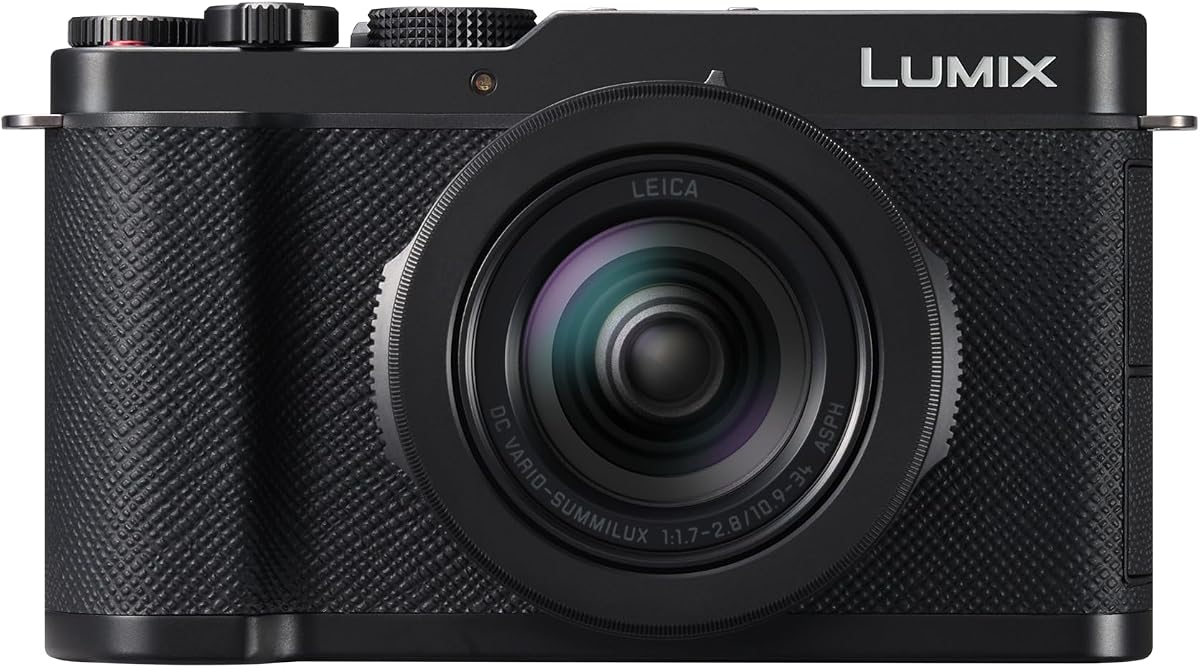
The Panasonic LUMIX L10 combines a 20.4MP sensor with a bright Leica DC Vario SUMMILUX 24-75mm F1.7-2.8 zoom in a compact metal body. Its 4.4 rating and premium construction position it as a capable everyday camera for photographers who value a real electronic viewfinder, strong lens specification, and refined handling.
We may earn a commission when you buy through this link, at no additional cost to you.
The 2.36M-dot OLED viewfinder is especially useful for composing in bright sunlight, while the 1.84M-dot free-angle monitor supports horizontal and vertical content. AI tracking can identify eyes, faces, pets, vehicles, and urban sports subjects. Built-in stabilization supports sharper stills and smoother MP4 Lite footage. The lens also focuses as close as three centimeters, giving street photographers an option for small details.
Real Time LUTs and the L.Classic and L.ClassicGold styles allow distinctive looks to be applied in-camera. The multi-aspect sensor can switch among 4:3, 3:2, and 16:9 framing without cropping, which is useful for varied output. The fixed 24-75mm lens, however, cannot be exchanged, and the compact body may not satisfy photographers who prefer a larger grip or dedicated physical controls.
The L10 is a strong match for travel, street observation, and evening walks where low light matters. Its viewfinder, bright lens, stabilization, and subject tracking offer a balanced feature set. Choose it over a generic compact when the camera's physical design and rendering are central to the experience.
The F1.7-2.8 zoom provides a useful brightness advantage, while stabilization reduces camera shake. Together they support evening and shaded-street work from a compact setup.
Switching between 4:3, 3:2, and 16:9 lets the photographer choose how a scene is composed. The open-ended framing workflow is useful when one moment might suit several final formats.
We may earn a commission when you buy through this link, at no additional cost to you.
The Duluvulu 4K camera is a straightforward compact for casual street documentation, travel, and beginner content creation. It carries a 4.2 rating and combines advertised 48MP still images with 4K video, autofocus, and a 16X digital zoom. The lightweight body and 3-inch IPS screen make it easy to carry and operate.
We may earn a commission when you buy through this link, at no additional cost to you.
A 180-degree flip screen supports selfies and vlogging from the front-facing perspective. Autofocus, face and smile detection, exposure compensation, continuous shooting, time-lapse, slow motion, and a fill light add flexibility for changing street conditions. Two rechargeable batteries and a supplied SD card support extended shooting and immediate transfer to a computer by USB.
The 16X figure is digital rather than optical, so it should not be compared directly with a telephoto lens. Its sensor, lens, and processing chain are also less documented than those of established enthusiast cameras, making objective image-quality comparisons difficult. The advertised 48MP mode is best viewed as a feature to evaluate in real conditions rather than a guarantee of fine detail at every focal length.
Choose this camera for a simple, inexpensive way to document daily life, experiment with video, or introduce a teenager to photography. It is less appropriate for demanding print work or situations where reliable subject tracking and optical reach are critical. The included accessories and two-battery arrangement make it convenient as a spare or casual travel camera.
Autofocus, exposure compensation, face detection, and a straightforward button layout reduce the learning curve. These features let new users concentrate on moving through a scene rather than learning a complex interface.
Two rechargeable batteries reduce interruptions during longer outings. The ability to use the camera as a webcam and transfer files by USB also makes it useful for online content.
We may earn a commission when you buy through this link, at no additional cost to you.
The 8K Digital Camera 88MP is a feature-heavy entry-level camera designed for travel, daily moments, events, and online video. Its 4 rating, advertised 88MP photo mode, 8K recording, touchscreen, Wi-Fi, and dual-lens arrangement create a versatile package for users who want photography and moving images in one device.
We may earn a commission when you buy through this link, at no additional cost to you.
The quick autofocus system, 3.2-inch IPS touchscreen, and 360-degree mode dial make operation approachable. Front and rear lenses support selfies, vlogging, and flexible shooting angles. Six-axis stabilization is designed to reduce shake during movement, while a built-in flash, slow motion, continuous shooting, and several scene modes broaden the creative options. Wi-Fi transfer through the iSmart DV2 app supports quick sharing.
Its 16X zoom is digital, so distant details should not be expected to match a true telephoto lens. The product information provides limited detail about sensor dimensions and optical lens characteristics, making claims about 88MP resolution or professional image quality difficult to assess. As with any specification-heavy compact, practical output depends heavily on the sensor, optics, and processing pipeline.
This camera is worth considering for a beginner who values touchscreen operation, flexible video formats, and abundant modes. It can also function as an inexpensive secondary camera for casual documentation. Photographers seeking consistent autofocus, superior low-light performance, interchangeable lenses, or a dedicated viewfinder should instead consider one of the established Canon, Sony, Fujifilm, or Panasonic models.
The dual-lens design lets creators switch between self-facing and standard viewpoints. This adds flexibility for street interactions, quick commentary, and travel documentation.
Time-lapse, filters, portrait, scene, slow-motion, landscape, auto, and program modes provide convenient starting points. A 360-degree dial helps change settings without navigating a complex menu.
We may earn a commission when you buy through this link, at no additional cost to you.
The best street camera balances portability, responsive focusing, dependable exposure, and a lens that suits the photographer's preferred distance. The following factors help separate a convenient everyday camera from one that can handle fast-moving people, changing light, and quick changes in composition.
A camera you are willing to carry is more useful than a theoretically superior model left at home. Consider body size, lens bulk, grip comfort, controls that can be adjusted quickly, and whether the camera suits a one-handed street workflow. Compact fixed-lens models reduce setup time, while mirrorless bodies provide more lens flexibility but may require a dedicated bag and deliberate kit selection.
Street scenes often contain people who are already moving when the photographer raises the camera. Modern phase-detection, subject-recognition, face, and eye systems can make candid work more consistent. A traditional 9-point AF system remains usable, but it may demand more deliberate target placement. Look for continuous autofocus and reliable tracking rather than relying only on a fast initial acquisition rate.
A wide lens can place people within their environment and make close interactions comfortable. A normal prime offers a natural perspective and often stronger low-light performance, while a telephoto can isolate distant details. A standard zoom provides flexibility, and a fixed lens encourages consistency. Compare equivalent fields of view, maximum aperture, close-focusing ability, and whether the lens can be exchanged later.
Even street work continues after daylight, particularly in markets, transit areas, nightlife, and shaded streets. A bright lens, capable autofocus, higher usable sensitivity, and effective stabilization help when light is limited. Stabilization can reduce camera shake, but it cannot fully prevent blur from subject movement. The best results come from combining stabilization with a shutter speed suited to the action.
A viewfinder can make it easier to frame in bright sunlight, compose at eye level, and notice distracting edges before pressing the shutter. Optical and electronic finders offer different experiences. Electronic displays expose exposure settings and allow focus aids, while optical finders create a direct, natural connection to the scene. The LCD remains essential for low and high angles.
Street photography increasingly includes short video sequences for social platforms. 4K recording provides flexible cropping, while subject tracking, vertical orientation, and simplified color tools support quick publishing. Higher resolution and frame rates also increase storage demands and can reveal the camera's limits in difficult light. Decide how much video you need rather than choosing solely on the largest advertised resolution.
A street photographer often needs to change exposure, focus, and drive settings without drawing attention. Direct dials, rear command controls, programmable buttons, and a responsive touchscreen all have advantages. Automated modes help beginners, while manual or semi-manual controls support photographers who already understand exposure. The best interface is the one that lets you react quickly without losing visual attention.
A camera platform becomes more useful when it can grow. Interchangeable lenses, memory card support, Wi-Fi transfer, and compatible software can extend the system. Check the supplied storage, battery situation, charging method, strap, lens hood, and available accessory support. For a first purchase, a complete kit with a usable lens is often more practical than a body alone.
Begin by learning the camera's basic exposure triangle, focus mode, drive mode, and ISO controls. Use a conservative shutter speed when people are moving, check the focus indicator before shooting, and adjust exposure compensation when bright clothing, windows, or dark walls dominate the frame. Review images regularly to learn how the camera renders shadow, highlights, and fast movement rather than waiting until the end of a walk.
For candid work, move slowly, keep the camera near eye level, and avoid repeatedly raising it in the same pattern. When a subject enters a better light, wait for a gesture or relationship to develop. A longer lens lets you work from a distance, while a wide lens encourages proximity. Make several frames around decisive moments because expressions, reflections, and passing arrangements can change in an instant.
Protect the camera without making it awkward to use. Keep the lens cap or cover in place when the camera is not being shot, clean the front element with a proper lens cloth, and avoid touching exposed sensor glass. Store the body in a dry protective bag, remove batteries during long periods of non-use, and periodically check cards and transfer important files to more than one location.
There is no single best camera type for every street photographer. A compact fixed-lens model is fast to carry and keeps framing consistent, while a mirrorless camera offers greater lens flexibility and modern subject tracking. A DSLR can remain effective when its autofocus and handling suit the photographer. The most important factors are reliable focus, comfortable portability, and a lens perspective you enjoy using.
A prime lens can encourage a consistent approach and often provides a wider maximum aperture than a general-purpose zoom. That extra light can help in dim streets and produce stronger subject separation. However, a zoom lets you change perspective without changing lenses, which can be useful when movement occurs quickly. Many photographers begin with a standard zoom and add a fast prime later.
The correct speed depends on how much the subject or camera is moving. A faster shutter can freeze gestures, while a slower speed can create intentional motion blur. In low light, stabilization and a bright lens help you preserve sharpness, although subject movement may still blur. Check the resulting image and increase the speed when a candid moment looks soft.
Stabilization is helpful because photographers often work handheld and may use slower shutter speeds in shaded or evening locations. It reduces movement caused by the photographer, but it does not completely stop blur when a person moves. Good stabilization, autofocus performance, and sensible shutter settings work together. The X100V, RX100 VII, and LUMIX L10 all list stabilization-related capabilities.
Mirrorless cameras often provide more modern autofocus, subject recognition, and compact bodies, which can favor candid street work. DSLRs may offer optical viewfinders, established controls, and broad lens ecosystems. The R50 stands out in this list for modern tracking and 4K video, while the Rebel T7 provides a less complex traditional experience. Choose according to your comfort, priorities, and preferred handling.
A comfortable strap, spare battery, compact storage card, lens cloth, and protective bag cover the most immediate needs. A second lens can help when working in different light, but a camera that is too large to carry is not improved by additional equipment. Choose accessories that support mobility rather than items that are merely left at home.
Autofocus is generally more practical when people move unpredictably, especially with modern face, eye, or subject tracking. Manual focus can be valuable for a predetermined composition, a stationary subject, or a deliberate zone of focus. Many street photographers use both, relying on autofocus for candid encounters and manual focus when they have established a specific scene.
High resolution can provide room for cropping and large prints, but it does not guarantee superior results. Lens quality, focus, stabilization, exposure, sensor size, and the light available all influence the final image. Treat advertised resolution as one feature in a larger evaluation rather than the sole reason to choose a camera.
The Canon EOS R50 is the most complete all-around recommendation because it pairs a light body, capable Dual Pixel autofocus, a useful 18-45mm lens, and modern 4K video features. The Canon Rebel T7 kit is the more approachable traditional option, while the double-lens Rebel bundle adds valuable framing flexibility. For photographers seeking a specialized premium compact, the Fujifilm X100V's fast 23mm lens and hybrid viewfinder create a particularly compelling street-focused tool.
Prioritize the camera you will actually carry, the lens perspective that suits your style, and autofocus you can trust in changing conditions. A pocketable compact such as the Sony RX100 VII or LUMIX L10 can be highly capable, while the X100V favors a consistent fixed perspective. Entry-level models can be excellent for learning, but their large-resolution and video claims should be assessed alongside lens and sensor information.
Before purchasing, review the current product listing, exact package contents, lens compatibility, warranty, and return terms. Market conditions and prices can change, and accessories or configurations may vary between sellers. Taking time to verify those details will help ensure that the chosen camera fits both your creative ambitions and your everyday carrying habits.