
Fluke 17B+ Digital Multimeter
4.8Editor score
CAT III 600V safety rating
AC/DC voltage to 1000V
Current measurements to 10A
Temperature to 400C
Compare the best Fluke Digital Multimeter models for accuracy, safety, measurement range, features, ruggedness, and professional electrical testing needs.
A reliable digital multimeter is essential for diagnosing electrical faults, checking circuits, verifying components, and confirming safe working conditions. Fluke builds models for students, electricians, field technicians, and industrial maintenance teams, so the right choice depends on the measurements you need and the environments in which you work.
This guide compares ten Fluke digital multimeters and clamp-meter combinations using their listed measurement functions, safety ratings, display features, environmental protection, and supplied accessories. It covers practical options ranging from compact entry-level meters to rugged True-RMS models designed for advanced troubleshooting, industrial equipment, and non-linear electrical loads.
The selections show where each model stands out, from budget-friendly diagnostic capability to advanced frequency filtering, temperature measurement, current testing, and extreme-environment durability. Ratings and specifications reflect the supplied product information, while availability and pricing can change. Always confirm the current product details and accessories before purchasing.
4.8Editor score

4.8Editor score

4.7Editor score
The following comparison highlights the principal measurement capabilities, safety classifications, and distinguishing features of each Fluke model, including two clamp-focused selections.




The Fluke 17B+ is a well-rounded electrical multimeter for residential, commercial, and industrial troubleshooting. Its 4.8 rating reflects a strong customer reception, while its combination of AC and DC voltage, current, resistance, continuity, diode, capacitance, frequency, and temperature measurements gives it unusually broad utility for the model class.
We may earn a commission when you buy through this link, at no additional cost to you.
The meter supports voltage measurements to 1000V and current measurements to 10A, making it suitable for common panel checks, automotive diagnosis, component testing, and basic system troubleshooting. Resistance, continuity, capacitance, and diode functions help narrow down faults, while the included type K thermocouple expands the instrument into temperature monitoring up to 400C.
Its main limitation is that it lacks the advanced signal-processing features associated with Fluke's industrial models. There is no stated low-pass filtering, peak capture, or IP67 sealing. Those omissions make it less specialized for drive troubleshooting or harsh environments, but they do not diminish its value for routine electrical work.
The 17B+ is a strong recommendation for electricians, maintenance technicians, students, and serious DIY users who want temperature capability without moving to an advanced model. It balances measurement breadth, a CAT III 600V safety rating, and a 4.8 customer rating particularly well.
The included type K thermocouple allows temperature checks up to 400C, helping verify heating and cooling systems, identify overheating components, and confirm whether a thermal fault exists. This useful capability separates the 17B+ from basic meters limited primarily to electrical quantities.
Voltage, current, resistance, continuity, diode, capacitance, and frequency functions let a technician move from symptom to component-level checks without changing instruments. That versatility makes the meter useful for panel work, equipment servicing, and electrical troubleshooting.
We may earn a commission when you buy through this link, at no additional cost to you.
The Fluke 117 is a compact field electrician's meter centered on fast voltage detection and dependable troubleshooting. Its 4.8 rating, True-RMS capability, automatic AC/DC selection, and low-impedance mode make it especially effective when working with modern lighting, electronic controls, and non-linear loads.
We may earn a commission when you buy through this link, at no additional cost to you.
VoltAlert technology detects AC voltage without requiring direct contact, which helps identify energized conductors quickly and supports safer preliminary checks. AutoVolt automatically selects AC or DC voltage, reducing setup errors, while the 600.0 mV DC range provides 0.1 mV resolution for lower-level measurements.
Low input impedance is a particularly valuable feature because it helps prevent false readings caused by ghost voltage. The large white LED backlight improves readability in confined or poorly illuminated spaces, and the stated 400-hour typical battery life is useful for technicians who work away from convenient power sources.
The supplied information does not list current or temperature measurement for this model, so buyers whose work regularly requires those functions should consider a more comprehensive alternative. Even so, the 117 is an excellent recommendation for electricians prioritizing voltage checks, speed, accurate readings, and field convenience.
VoltAlert allows a technician to identify AC voltage without touching the conductor. It is especially helpful during initial fault-finding, when quickly determining which circuits may be energized narrows the investigation before probes are connected.
The low-impedance mode helps suppress misleading readings from induced or ghost voltage. That makes the 117 useful when checking switched circuits, where a conventional high-impedance meter can display voltage even after the circuit appears inactive.
We may earn a commission when you buy through this link, at no additional cost to you.
The Fluke 15B+ focuses on the measurements most often required for general electrical diagnostics. It carries a 4.8 rating and combines AC and DC voltage measurements to 1000V with AC and DC current measurements to 10A, providing a practical foundation for residential, commercial, automotive, and panel work.
We may earn a commission when you buy through this link, at no additional cost to you.
Resistance, continuity, diode, and capacitance functions broaden its usefulness beyond basic voltage checks. Technicians can test components, check conductive paths, investigate suspected short circuits, and identify faulty diodes without relying on separate instruments for routine tasks.
Compared with the 17B+, the 15B+ does not list temperature measurement or an included thermocouple in the supplied information. It also lacks the specialist signal capture and filtering features of the 87V. Those are meaningful omissions for advanced users, but the 15B+ remains highly capable for routine troubleshooting.
This model is a sensible choice for new technicians, electricians who need a dependable general-purpose meter, and owners of small workshops seeking a broad range of electrical tests. Its straightforward specification set and 4.8 rating make it a practical, versatile option.
Supporting both AC and DC current up to 10A makes the 15B+ more useful for general fault-finding than a basic voltage-only instrument. A dedicated input terminal for current measurements also helps technicians use the correct connection during testing.
Resistance, continuity, diode, and capacitance tests allow users to examine components and wiring paths after identifying a problem. These functions make the meter suitable for more than confirming whether a circuit is energized.
We may earn a commission when you buy through this link, at no additional cost to you.
The Fluke 87V is designed for advanced troubleshooting where unstable readings and intermittent signals need careful analysis. Its 4.8 rating reflects strong user confidence, while the adjustable low-pass filter, rapid peak capture, and switchable display resolution distinguish it as an industrial-grade diagnostic instrument.
We may earn a commission when you buy through this link, at no additional cost to you.
The Fluke-designed low-pass filter improves frequency measurements on adjustable speed drives, where drive-related noise can interfere with ordinary readings. Peak Capture detects intermittent events as quickly as 250 microseconds, helping technicians catch brief pulses that a conventional meter may miss during normal sampling.
Switchable high display resolution offers 6000 to 20000 counts, making small changes easier to see. The meter measures up to 1000V AC and DC and carries CAT III 1000V and CAT IV 600V safety ratings. Its supplied package includes TL75 test leads, AC175 alligator clips, and an 80BK temperature probe.
This is the strongest choice here for industrial electricians, motor-control specialists, maintenance teams, and advanced electronics troubleshooters. Although it is more specialized and complex than general-purpose models, those extra capabilities directly address difficult real-world signals that simpler meters may not resolve.
The adjustable low-pass filter is tailored to frequency measurements on adjustable speed drives. Reducing unwanted interference can produce a clearer and more dependable result when diagnosing inverter-fed equipment, motors, and related control systems.
Capture speed as fast as 250 microseconds gives the 87V an advantage when intermittent transients occur too quickly for ordinary readings. This makes it valuable for investigating switch events, brief spikes, and unreliable equipment behavior.
We may earn a commission when you buy through this link, at no additional cost to you.
The Fluke 117/323 Kit combines a general-purpose digital multimeter with a clamp meter for residential and commercial electrical work. Its 4.8 rating and two-instrument format make it convenient for technicians who regularly alternate between voltage diagnostics and high-current measurements.
We may earn a commission when you buy through this link, at no additional cost to you.
The 117 multimeter handles AC and DC voltage and current, with True-RMS accuracy for non-linear loads and low input impedance to limit false readings caused by ghost voltage. The 323 clamp meter adds true-RMS AC voltage and current measurements, including 400A AC current and 600V AC and DC voltage.
The package includes test leads, a TPAK case, and a carrying case. That is more equipment than a new homeowner may need, and the clamp meter is much larger than a standard handheld meter. However, for an electrician or maintenance technician, carrying both instruments can eliminate repeated trips to retrieve separate tools.
Choose this kit when your work regularly requires clamped current measurements alongside conventional probing. It is especially suitable for service visits, panel diagnostics, and commercial electrical maintenance where a compact, coordinated set is easier to organize than separate devices.
Pairing the 117 and 323 gives users both probe-based and clamp-based options in a single package. The included leads and carrying case simplify transport and help keep the components organized between jobs.
The 323 clamp can measure up to 400A AC current, making it useful for assessing larger loads without requiring the conductor to be disconnected. The 117 then supports detailed voltage, current, and component testing around the circuit.
We may earn a commission when you buy through this link, at no additional cost to you.
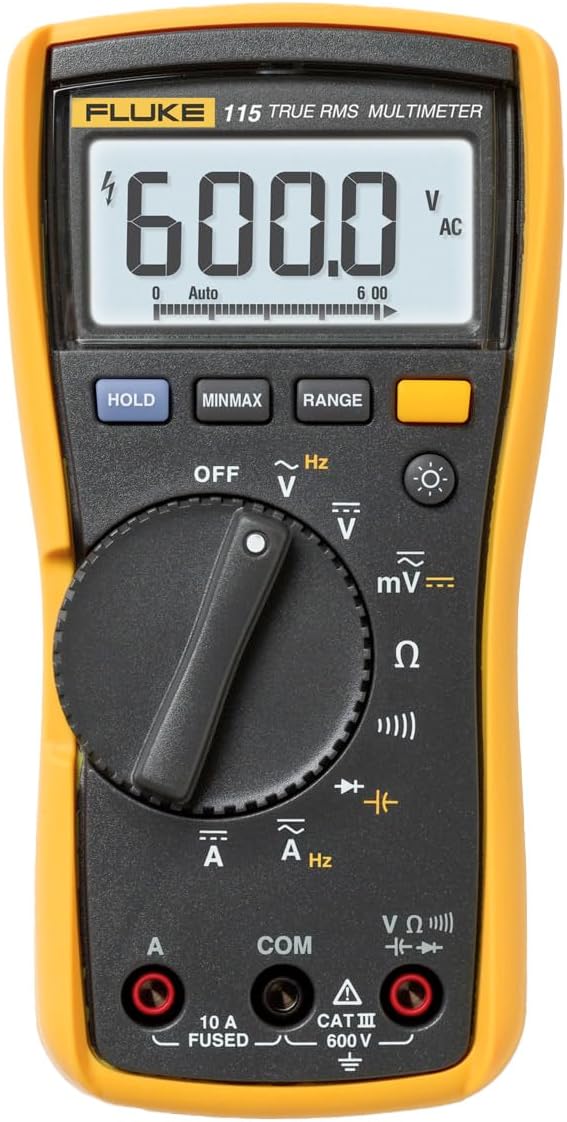
The Fluke 115 is a compact True-RMS digital multimeter created for field technicians who need reliable measurements in a manageable instrument. Its 4.8 rating and broad set of electrical functions make it a solid general-purpose option for service and maintenance work.
We may earn a commission when you buy through this link, at no additional cost to you.
True-RMS voltage and current readings improve accuracy on non-linear loads, while resistance, continuity, frequency, and capacitance functions cover common diagnostic tasks. Min, Max, and Average recording is valuable when a reading fluctuates and the technician needs to identify the highest, lowest, or stabilized value.
The CAT III 600V safety rating supports use in common residential, commercial, and industrial environments, and the large white LED backlight makes the display easier to read in poorly lit areas. The listed specifications do not mention temperature measurement, non-contact voltage detection, or environmental sealing.
The Fluke 115 is a good recommendation for technicians who value compactness, True-RMS performance, and signal recording without needing advanced drive filtering. It is especially effective for routine field service where an easy-to-read display and broad electrical test coverage matter most.
The compact format makes the 115 easier to carry and operate in confined spaces. It offers a balanced mix of measurement functions without the complexity of an advanced industrial instrument, making it approachable for field technicians.
Min, Max, and Average modes help technicians study changing signals over time. This is particularly useful when a value fluctuates during operation and a single instantaneous display would not show the relevant peak or settled average.
We may earn a commission when you buy through this link, at no additional cost to you.
The Fluke 87V MAX is built for technicians who need the capabilities of the 87V in demanding environments. Its 4.7 rating reflects strong overall performance, while IP67 sealing, four-meter drop resistance, and up to 800 hours of battery capacity distinguish it as the most environmentally robust selection here.
We may earn a commission when you buy through this link, at no additional cost to you.
True-RMS accuracy is available across the functions of the 87V, and upgraded test leads are included. CAT III 1000V and CAT IV 600V safety ratings support professional work on higher-energy systems. The built-in thermometer adds another practical source of information during equipment inspections.
Its environmental protection is especially relevant in industrial facilities, construction environments, workshops, and field locations where dust, moisture, or accidental drops are likely. The lengthy battery life also reduces downtime compared with a model that needs more frequent replacement during remote assignments.
The 87V MAX is a premium recommendation for industrial electricians, facilities teams, and mobile technicians who work in harsh conditions. For basic household checks, its specialized durability and advanced feature set may be more than necessary, but for demanding professional use it offers compelling resilience.
IP67 waterproof and dustproof protection helps the meter tolerate harsh conditions that can quickly damage lesser instruments. Combined with four-meter drop resistance, it is suited to industrial sites, utility areas, workshops, and outdoor service work.
Up to 800 hours of battery capacity supports extended use between charges. The benefit is especially noticeable for technicians who spend long periods away from outlets or who use intensive backlighting and measurement functions throughout the day.
We may earn a commission when you buy through this link, at no additional cost to you.
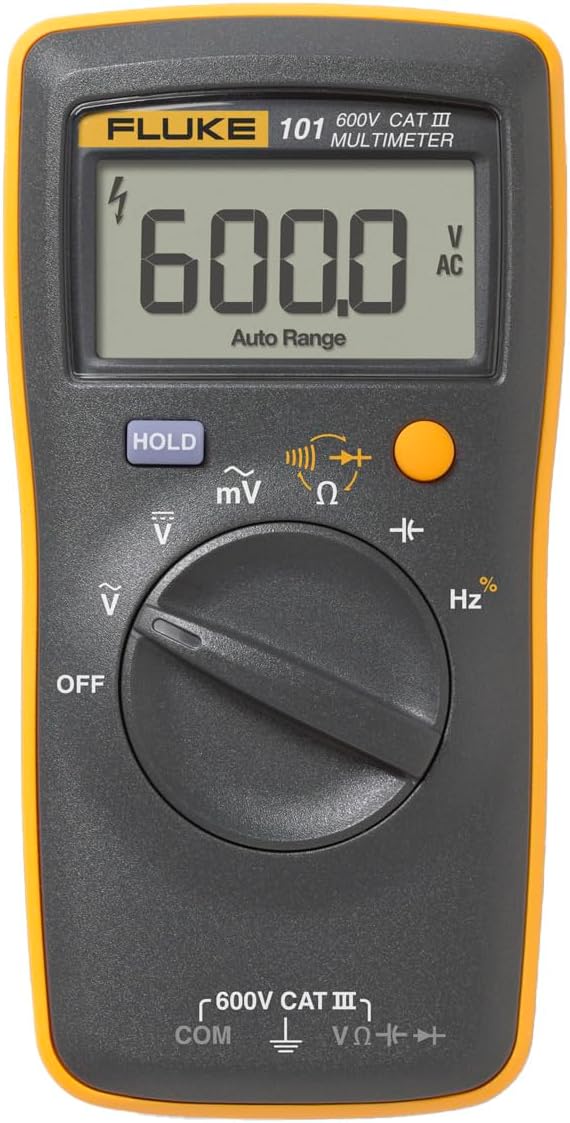
The Fluke 101 is a straightforward entry-level meter for basic electrical checks and component testing. Its 4.7 rating indicates solid customer satisfaction, while the small, lightweight design makes it approachable for students, new technicians, homeowners, and anyone needing a simple general-purpose instrument.
We may earn a commission when you buy through this link, at no additional cost to you.
The listed basic DC accuracy is 0.5%, and the meter carries a CAT III 600V safety rating. Diode and continuity testing with an audible buzzer lets users check circuits and components without needing to watch the screen continuously, which is convenient during hands-on repairs.
Its compact construction supports one-handed use and uncomplicated transport. The trade-off is a narrower feature set: the supplied information does not list current, capacitance, frequency, temperature, True-RMS operation, or non-contact voltage detection. It is therefore better suited to routine testing than professional diagnostics involving complex loads.
The Fluke 101 is a good first multimeter for learners and occasional users who need dependable resistance, continuity, and diode functions in a durable package. Experienced electricians who regularly measure current or investigate advanced systems should choose a more comprehensive model.
Resistance, continuity, and diode tests cover many common checks involving wiring, fuses, switches, and components. The audible continuity buzzer reduces the need to keep looking at the display during repeated tests.
The small, lightweight enclosure is comfortable to hold and simple to carry. That makes the 101 useful for students learning basic electrical diagnostics or for quick household and hobby-project checks.
We may earn a commission when you buy through this link, at no additional cost to you.
The Fluke 302+ is a compact digital clamp meter centered on measuring high AC current loads. Its 4.7 rating reflects a positive user response, while the 30mm jaw and 400A AC current capability make it useful for commercial electrical systems, motor circuits, and larger conductors.
We may earn a commission when you buy through this link, at no additional cost to you.
The clamp can also measure AC and DC voltage to 600V. It comes with a Fluke TL75 Hard Point Test Lead Set for general-purpose testing and a standard two-year manufacturer warranty. Its stated accuracy is 1.8%, providing a practical level of precision for routine troubleshooting tasks.
CAT IV 300V and CAT III 600V safety ratings support professional use around the specified measurement categories. The main limitation is that current measurement is limited to AC, so the clamp cannot directly measure DC current. It also lacks the broad resistance, capacitance, frequency, and diode functions of a full digital multimeter.
The 302+ is a strong choice for electricians and maintenance technicians whose priority is quickly measuring substantial AC currents. It also works as a supporting voltage meter, but users who need complete electrical diagnostics should keep a dedicated multimeter alongside it.
The 30mm opening is designed to accommodate larger conductors while retaining a compact overall shape. It is useful for checking compressor, motor, feeder, and equipment currents without fully disconnecting the conductor.
Clamping around a conductor provides a quick way to assess load current without opening the circuit. The 400A AC range supports troubleshooting on systems where conventional probe-based current measurement would be impractical or inconvenient.
We may earn a commission when you buy through this link, at no additional cost to you.
The Fluke 107 is a handheld digital multimeter that combines AC and DC current measurement with a broad set of diagnostic functions. Its 4.7 rating indicates favorable customer feedback, and its practical feature set suits technicians who want more than a basic continuity tester.
We may earn a commission when you buy through this link, at no additional cost to you.
AC and DC voltage, AC and DC current, resistance, and capacitance are supported. Frequency and duty-cycle measurements add value for electrical and mechanical diagnostics where understanding a repeating signal can be important. The CAT III 600V safety rating positions the meter for common professional and industrial environments.
Data hold keeps a measured value on screen, which is convenient when probes are occupied or the display is not directly visible. The backlit display supports work in dim conditions, helping technicians read results in panels, equipment rooms, and enclosed spaces.
The Fluke 107 is a good recommendation for technicians who regularly handle both AC and DC current but do not need advanced frequency filtering or rapid peak capture. It offers a practical balance of measurement coverage, readability, and handheld convenience for routine service work.
Measuring both AC and DC current gives the 107 wider relevance than meters with one current mode. This is helpful for service work that may involve line-powered equipment as well as DC circuits, control systems, batteries, or electronic loads.
Data hold preserves the last measurement for convenient reference, while the backlit display improves visibility in dark workspaces. Together, these features reduce interruptions during tasks where moving away from the display or losing a transient reading would be inconvenient.
We may earn a commission when you buy through this link, at no additional cost to you.
The right Fluke meter depends on the electrical quantities you need to measure, the characteristics of the loads you test, the required safety categories, and the physical conditions encountered during service.
Choose based on your typical workload rather than the highest available number. A broad range is useful for general electrical work, while a clamp meter is preferable when large conductors and high running currents are central to the job.
For modern electronics and electronically driven equipment, favor True-RMS accuracy. For straightforward continuity, resistance, and basic electrical checks, a simpler meter may meet the requirement without unnecessary complexity.
Match the safety rating to the installation category and voltage level you will encounter. Never assume a meter is suitable for every circuit simply because it can display the expected numerical value.
Use advanced capture and filtering when your work involves unstable signals or industrial drive systems. For routine component and voltage checks, a more straightforward meter is usually easier to operate.
Choose enhanced sealing and drop protection for industrial sites and mobile field work. For controlled indoor environments, a lighter model may be more comfortable and easier to manage.
Prioritize backlighting, readable digits, and recording functions for field work. Select a compact form factor when portability and one-handed use matter more than advanced signal analysis.
Choose specialized functions based on recurring diagnostic tasks, not just on a longer feature list. A useful function should save time, reduce ambiguity, or address equipment your standard meter cannot test effectively.
Evaluate the complete package rather than focusing only on the instrument. Useful matching leads, clips, probes, and storage can improve workflow, provided their specifications suit the intended measurements.
Before testing, identify the circuit, disconnect power when appropriate, and verify that the meter and its leads are in good condition. Select the function and range that match the expected measurement, then insert the leads into the correct input terminals. Always confirm the input assignment before placing probes on energized conductors, especially when moving between voltage and current measurements.
For voltage measurement, connect the meter in parallel with the component or circuit. For current measurement, interrupt the circuit and connect the meter in series using the designated current input. Avoid measuring current across a voltage source, as improper connection can damage the instrument or create a serious hazard. Use the non-contact detection mode, where available, only as an initial aid rather than the sole method of confirming that a circuit is de-energized.
After use, switch the meter off, remove test leads, and store it in a dry, protected location. Inspect probes for damaged insulation, clean the display and housing, and replace batteries when needed. For IP67-rated models, the sealing supports protection from dust and water, but the enclosure should still be kept closed and undamaged. Use only suitable replacement accessories and follow the manufacturer's instructions for service, calibration, and safety.
The Fluke 17B+ is the broadest general-purpose option in this group, covering AC and DC voltage and current, resistance, continuity, diode, capacitance, frequency, and temperature measurements. It also includes a type K thermocouple for temperature checks up to 400C. Users needing industrial signal filtering should consider the 87V instead.
True-RMS meters calculate the effective value of the entire AC waveform rather than relying on an averaged signal. This produces more dependable readings on non-linear loads such as variable-speed drives, dimmers, and some modern electronic equipment. The 117, 115, 117/323 Kit, and 87V MAX are listed with True-RMS capabilities.
A CAT rating indicates the type of electrical installation or energy source where a meter is designed to be used. CAT III applies to distribution equipment and panels, while CAT IV is intended for measurements closer to the origin of a low-voltage installation. Always confirm the rating, voltage limit, probe suitability, and environmental conditions before testing.
A digital multimeter is better for voltage, resistance, continuity, diode, capacitance, and many detailed diagnostics. A clamp meter is better for measuring current around a conductor without opening the circuit, especially at high current levels. The Fluke 117/323 Kit combines both approaches, while the 302+ specializes in high-current AC clamping.
Ghost voltage can appear when a high-impedance meter detects a small induced charge on an apparently inactive conductor. Low input impedance draws more current from the circuit and can suppress that misleading signal. The Fluke 117 and the 117/323 Kit list low-impedance functionality for this reason.
The Fluke 87V MAX is the strongest environmental match because it has an IP67 waterproof and dustproof rating, four-meter drop resistance, and up to 800 hours of battery capacity. It also retains advanced 87V functions and True-RMS accuracy. Industrial users should still follow handling and probe-care instructions.
It depends on the model. The Fluke 17B+, 15B+, and 107 list both AC and DC current measurement, while the Fluke 302+ lists AC current only. The 117/323 Kit includes AC and DC current capability in the 117 multimeter, with the 323 clamp focused on AC current and voltage.
The Fluke 101 is a sensible introductory meter for basic resistance, continuity, and diode checks. Its compact design, audible continuity buzzer, CAT III 600V rating, and 4.7 customer rating make it useful for learning and light-duty checks. Students or professionals who regularly need current, capacitance, frequency, temperature, or True-RMS readings should choose a more advanced model.
The Fluke 17B+ stands out as the strongest all-round value, combining broad electrical measurement coverage with temperature testing to 400C. The Fluke 117 is particularly well suited to electricians who want non-contact detection, automatic voltage selection, True-RMS accuracy, and low-impedance testing, while the Fluke 87V MAX delivers the most demanding combination of advanced capability and environmental protection.
Prioritize the functions and safety categories required by your actual work rather than selecting solely by model hierarchy. General service may favor the 17B+ or 15B+, drive and motor troubleshooting favors the 87V, and high-current jobs may make the Fluke 302+ or 117/323 Kit more relevant. Compact models remain effective when portability and basic diagnostics are the priorities.
Product availability, configurations, accessories, and pricing can change, so review the current listing before buying. Confirm the measurement ranges, safety ratings, included leads, and environmental requirements against the work you intend to perform, and select the model that provides the necessary capability without unnecessary complexity.
