
6.5-Foot Soft-Spike Cat Mat
4.0Editor score
Flexible 78-inch barrier
Soft rounded plastic spikes
Weather-resistant construction
Cats can quickly turn a thriving garden into a network of dug-up soil, urine-marked beds, and damaged foliage. The best cat deterrents for gardens combine scent, texture, or physical boundaries to make treated spaces less appealing without resorting to trapping or dangerous methods.
This guide compares ten garden cat deterrents across ten essential-oil, granular, spray, and physical-barrier options. We considered the stated ingredients, coverage, installation, intended settings, weather resistance, maintenance needs, suitability for gardens, and suitability for indoor and outdoor spaces.
Each pick reveals a different way to discourage unwanted cat activity, from broad-area granules to discreet repellent balls and customizable spike mats. Ratings reflect the supplied customer feedback, while product details and availability can change, so readers should confirm current information and pricing before purchasing.
4.0Editor score

4.6Editor score

4.6Editor score
As an Amazon Associate we earn from qualifying purchases.
The comparison below highlights each product's deterrent method, placement style, garden coverage, and weather-related features so you can compare practical options without overlooking installation and maintenance requirements.


Nature's Mace Cat Mace Cat Repellent 2.5 lb Granules has a 3.2 customer rating, but it remains a practical option for gardeners who need to cover broad areas rather than a single edge or planter. Its primary appeal is a plant-based scent barrier designed to discourage digging, urination, defecation, and chewing around flowerbeds, lawns, patios, pots, and other designated zones.
We may earn a commission when you buy through this link, at no additional cost to you.
The 2.5-pound container is advertised as covering as much as 1,400 square feet, making it one of the more expansive options in this guide. The granules can be spread evenly over soil, mulch, or another problem area, and the manufacturer describes them as weather-resistant for year-round outdoor use. They may also be applied indoors, which adds flexibility for protecting potted plants and other areas where cats have established unwanted habits.
The trade-offs are the modest customer rating and the maintenance schedule. The instructions call for early application when cat activity is first noticed and reapplication every two to three weeks, so this is not a set-and-forget solution. Its scent-based training approach may also require consistency, particularly if rain, wind, traffic, or other disturbances shift the granules around a heavily used bed.
This product is best for gardeners protecting an extensive patch of mulch, a collection of flowerbeds, or several separate outdoor zones. It is less appropriate for someone wanting a nearly invisible barrier with minimal maintenance. For those priorities, the 12-pack plant-based repellent or repellent balls may be easier to manage, while a spike mat offers a completely different sensory deterrent.
The stated coverage of up to 1,400 square feet makes these granules useful when cats are roaming across an open lawn or repeatedly disturbing multiple beds. Even distribution is important, so apply the product across the entire zone cats frequent rather than concentrating it only around visible damage.
The formula uses plant-based ingredients and a potent scent intended to make treated areas less inviting. Because scent-based deterrence works best through repeated exposure and consistent boundaries, this option pairs well with routine garden maintenance and prompt reapplication.
We may earn a commission when you buy through this link, at no additional cost to you.
The 12-Pack Plant-Based Repellent is the most versatile scent-based choice in this guide, combining a 4.6 customer rating with simple placement and coverage of up to 60 days. Instead of mixing, spraying, or cutting a product, users set individual packs in the areas where cats are most active, making this a convenient fit for gardens, porches, lawns, trash areas, carpets, and indoor marking spots.
We may earn a commission when you buy through this link, at no additional cost to you.
Its plant-based formulation is a major selling point for gardeners who prefer a naturally derived approach. The individual packs can be distributed around a flowerbed, along a frequently crossed path, or near furniture that attracts unwanted scratching. This distributed placement is more targeted than spreading a broad scent field, and it reduces the disruption caused by treating an entire yard when only a few edges need attention.
The largest uncertainty is that the supplied information does not identify the individual botanical components or explain the precise release mechanism. It states that the repellent gives off a scent cats avoid and is designed to be safe around children, household pets, and plants when used as directed. The 60-day figure is a stated maximum, so weather, sunlight, moisture, and the intensity of cat activity may affect how long each pack performs.
This is an excellent first option for most homeowners because it requires little skill, works in multiple environments, and has a strong customer rating. Place packs where cats repeatedly cross, not merely where damage is visible, and keep the boundaries consistent. Gardeners who prefer a visible physical barrier can consider the 6.5-foot soft-spike mat as a complementary or alternative solution.
Twelve packs give you enough units to establish a visible perimeter or protect several hot spots without repeatedly handling a large container. Space them according to the instructions and reposition them if cats begin using a new route.
The same packs can address outdoor garden traffic and indoor marking or scratching areas. That versatility makes them useful for households dealing with a cat entering through an open door, using a window, or repeatedly crossing a specific threshold.
We may earn a commission when you buy through this link, at no additional cost to you.
The 6.5-Foot Soft-Spike Mat has a 4 customer rating and offers a fundamentally different approach to garden cat control. Its 78-by-11-inch plastic strip uses soft, rounded spikes to make walking, scratching, and digging uncomfortable without using electricity, loud noises, or harsh sprays.
We may earn a commission when you buy through this link, at no additional cost to you.
The long, narrow format is especially useful along garden borders, balcony railings, window sills, fence tops, steps, and the edges of raised beds. Because the plastic can be cut with scissors, bent, wrapped, or joined with additional strips, one mat can be adapted to awkward corners and unusually shaped beds. Textured backing helps it remain in place on wood, tile, grass, and concrete.
Physical barriers have an obvious limitation: they only work where cats actually step. A gap, a low point, or an uncovered alternate route can let a determined cat bypass the spikes. Weather resistance is a stated benefit, yet long-term performance still depends on secure placement and avoiding areas where foot traffic, mowing, or gardening could disturb the strip.
This is the best pick for gardeners who dislike scented deterrents, want to avoid repeated spraying, and can identify the exact edge cats use to enter a bed. It also works well around a compost pile, planter, patio table, or other concentrated problem area. Buyers should place the spikes before cats establish another path and check the barrier regularly for movement or damage.
The flexible strip can be trimmed for plant pots, steps, and corners, then bent around curved surfaces. Joining sections allows a continuous edge around a bed, path, or ledge where a standard rectangular mat would leave vulnerable gaps.
Unlike scent-based options, the mat produces no odor and needs no reapplication schedule. It is a particularly attractive choice for gardeners who want a physical boundary that operates continuously without mixing, spraying, or replacing cartridges.
We may earn a commission when you buy through this link, at no additional cost to you.
Bonide Go Away Rabbit, Dog, and Cat Repellent Granules have a 3.3 customer rating and stand out for households dealing with more than one type of garden nuisance. Although the keyword centers on cats, the same cinnamon and thyme oil formula is also designed to discourage rabbits and dogs from lawns, mulch, flowerbeds, trees, and shrubs.
We may earn a commission when you buy through this link, at no additional cost to you.
The one-pound container is ready to use, and its dispenser cap is intended to distribute pellets more evenly than pouring them by hand. The active ingredients are described as natural, people and pet safe when used as directed, biodegradable, and suitable for use around desirable plants. That makes the product appealing to gardeners who want a familiar botanical deterrent rather than a physical modification of their beds.
The manufacturer correctly describes the product as a behavior-modification aid that may need to be supplemented with other techniques. Its 3.3 rating indicates mixed customer experiences, and granule-based scent products can lose effectiveness as weather and foot traffic disturb the treated surface. It is also less targeted than the cat-only products in this list because it must address several animal behaviors.
This option makes the most sense when cats are not the only visitors creating damage. Gardeners with only a cat problem may prefer the stronger 4.6 rating of the 12-pack plant-based repellent, while those who dislike scent entirely can use a spike strip. For mixed nuisance populations, Bonide offers a straightforward, broad-purpose tool.
Cinnamon and thyme oils provide a botanical deterrent intended to discourage cats, dogs, and rabbits. This multi-animal approach can simplify garden protection when several kinds of animals enter the same beds or cross the same lawn.
The listed oils are described as biodegradable and intended not to harm desirable plants when used correctly. As with any granular treatment, follow the label directions and avoid unnecessary application on edible crops or areas where pets may spend extended time.
We may earn a commission when you buy through this link, at no additional cost to you.
The TSLBW 12-piece spike-mat set has a 4.1 customer rating and offers modular physical protection for garden beds, lawns, potted plants, and other common cat stopping points. Each 6.2-by-8-inch strip includes eight U-shaped pegs, allowing the plastic barrier to be secured in soil without relying on adhesive.
We may earn a commission when you buy through this link, at no additional cost to you.
The set's main strength is flexibility. Individual strips can be cut into different lengths and shapes, then joined to follow a planter edge, trace a bed, or guard a frequently used opening. The same product can also be used near doors, windows, cars, wardrobes, and sofas, giving owners a reusable deterrent for both garden and household problem areas.
The spikes are described as uncomfortable for an animal's paws and feet without harming skin or paws. Even so, physical deterrents need careful placement, particularly in areas where people, children, or pets might accidentally step on them. The individual pieces are shorter than the 6.5-foot mat in this guide, so covering a long border requires a little more assembly.
This set is a good match for gardeners who want a chemical-free barrier and already know where cats cross. It may work especially well around a small vegetable patch, a group of pots, or the edge of a newly planted bed. Choose it when peg-based soil installation is preferable to a continuous strip, and inspect the pegs after rain or strong winds.
The included U-shaped pegs help hold each strip in soil around plants and garden borders. Secure the mat along the full width of a crossing point so cats cannot easily squeeze past on either side.
Twelve small mats can be cut and arranged to fit irregular beds or concentrated areas. They are especially useful when a single long barrier would be difficult to position without leaving excess material exposed.
We may earn a commission when you buy through this link, at no additional cost to you.
The Petfolio 12-Pack Scat Mat has a 4 customer rating and provides substantially larger individual panels than most modular spike sets in the guide. At 16 by 13 inches, each mat can protect a meaningful section of a potted-plant cluster, patio edge, garden path, or indoor surface, while the 12-piece count offers broad coverage for multi-zone protection.
We may earn a commission when you buy through this link, at no additional cost to you.
The product is described as a durable, animal-friendly deterrent made from plastic, with spikes intended to discourage rather than injure. The panels can be connected or cut to suit the space, and included stickers can hold them in place. That makes them convenient for applications where digging or pegging is impractical, including a countertop, a carpeted room, or the base of an indoor planter.
Compared with the smaller TSLBW strips, these panels are easier to combine into a continuous surface because each one covers more area. The trade-off is their greater size and more visible presence. Users also need to ensure the panels sit securely because movement can reduce their effectiveness, and areas subject to frequent human foot traffic may be better suited to a less exposed placement.
Petfolio is a good choice for people who want one multipurpose pack to address a cat entering a garden, jumping onto furniture, or disturbing planters. For a narrow boundary where minimal visual impact matters, the 6.5-foot strip may be easier to conceal. This set is better when coverage area and flexible installation matter more than a nearly invisible finish.
Each 16-by-13-inch panel gives you a useful starting area around a plant or along a patio. Connecting several panels can create a larger uninterrupted deterrent zone without cutting each piece into a new shape.
The mats can serve as garden, furniture, carpet, and countertop deterrents. Their tool-free connection and adhesive options make them especially useful where outdoor soil installation is not possible.
We may earn a commission when you buy through this link, at no additional cost to you.
The 10-Pack Repellent Balls share the highest customer rating in this guide at 4.6 and offer an unusually complete garden-deterrent package. The formula uses natural peppermint, lemon, and ginger extracts, deliberately excluding irritating chemicals and camphor, while the accompanying mesh bags make the balls easier to position in gardens, on patios, near furniture, and around rubbish bins.
We may earn a commission when you buy through this link, at no additional cost to you.
Each ball is individually sealed for storage and is designed to release scent continuously for 30 to 60 days. The manufacturer says the scent remains consistent after rain, watering, and seasonal weather changes, although real-world results will depend on exposure, placement, and the number of cats visiting the area. The recommended spacing is one ball every 40 to 80 inches, with increased density used for stronger coverage.
The mesh-bag system is a thoughtful premium detail. It helps keep the repellent contained while allowing it to sit in a garden bed, beside a fence, near a sofa, or beside a trash can. The formula is described as safe for people, pets, and plants, making it suitable for households seeking a scented alternative to a spike barrier, although users should still follow all placement directions.
This is the most complete premium pick for a garden containing several separate cat routes. Its natural extract list, flexible indoor-outdoor use, extended protection period, and storage bags distinguish it from simpler options. It is best for gardeners willing to place multiple units around the perimeter and adjust their positions as cat behavior changes.
Peppermint, lemon, and ginger provide a more varied scent profile than single-ingredient alternatives. The formula is positioned as a gentle deterrent for people, pets, and plants, without relying on irritants or camphor.
The included drawstring bags make each ball easy to place without direct contact with soil or upholstery. They also allow a gardener to move the unit quickly when a new cat route develops.
We may earn a commission when you buy through this link, at no additional cost to you.
The Nine Essential-Oil Cat Deterrent Balls have a 4 customer rating and focus on uncomplicated outdoor deployment. Each ball uses plant-based essential oils—including peppermint, camphor, lemongrass, garlic, and lemon—to create a scent intended to discourage cats from entering gardens, flowerbeds, patios, lawns, and mulch.
We may earn a commission when you buy through this link, at no additional cost to you.
Because the units are ready to use, there is no measuring, mixing, or spraying. Gardeners can position them around trash bins, potted plants, flowerbeds, driveways, fences, and other gathering places where cats are regularly observed. Slow-release delivery is intended to provide continuous scent without repeated application throughout the day.
The main consideration is that the scent profile includes camphor and garlic, which may not suit people who are sensitive to strong aromas or who want only a mild botanical profile. The information also does not provide a precise duration for each ball, so users should monitor the scent and replace units as needed. The product is focused on outdoor areas rather than broad indoor use.
This option is a good straightforward choice for a garden with several discrete problem spots, especially around bins and low borders. It is less suited to households wanting one thoroughly documented ingredient list beyond the five named oils or a product that explicitly advertises indoor application. The 10-pack peppermint, lemon, and ginger balls may be a better fit for a more neutral scent and flexible indoor-outdoor use.
Peppermint, camphor, lemongrass, garlic, and lemon create a varied aroma that cats are expected to avoid. The combination may be useful where a single familiar scent no longer has much effect.
The balls require no mixing and are positioned directly where cats travel. Replacing them as the scent fades turns the product into a simple, scheduled part of routine garden upkeep.
We may earn a commission when you buy through this link, at no additional cost to you.
The Natural Peppermint Cat Deterrent has a 3.7 customer rating and offers a straightforward plant-based approach to common garden problems. It is designed to discourage digging, spraying, and property damage by using peppermint oil, a scent cats are described as disliking, while remaining safe for people, pets, and plants when used as directed.
We may earn a commission when you buy through this link, at no additional cost to you.
The product can be placed in yards, gardens, lawns, flowerbeds, mulch, patios, furniture areas, trash zones, and indoor spaces where cats should not go. That broad list of applications makes it useful for homeowners trying to protect a garden while also managing a cat that spends time on furniture or uses an indoor area for marking.
Its primary weakness is the lack of a specific coverage duration or precise placement measurement. The instructions say to replace the deterrent as needed depending on weather conditions and the cat's activity level, so performance will depend on monitoring the treated location. The 3.7 rating also suggests that experiences are mixed, which is common with products whose effectiveness depends heavily on scent intensity and uninterrupted placement.
Buyers should choose this product for a straightforward peppermint-based deterrent without complicated preparation. It is best for establishing consistent scent points along common garden paths or beside vulnerable planters. Those wanting a longer stated duration and mesh storage bags may prefer the 10-pack botanical balls, while gardeners who dislike scent should consider a spike mat.
Peppermint oil supplies the active scent in a compact, plant-based formula. It can be used at targeted points rather than across an entire lawn, helping focus protection where cats actually travel.
The same deterrent can address outdoor garden traffic and indoor scratching or marking areas. This makes it useful for a cat that moves between a protected garden and the home.
We may earn a commission when you buy through this link, at no additional cost to you.
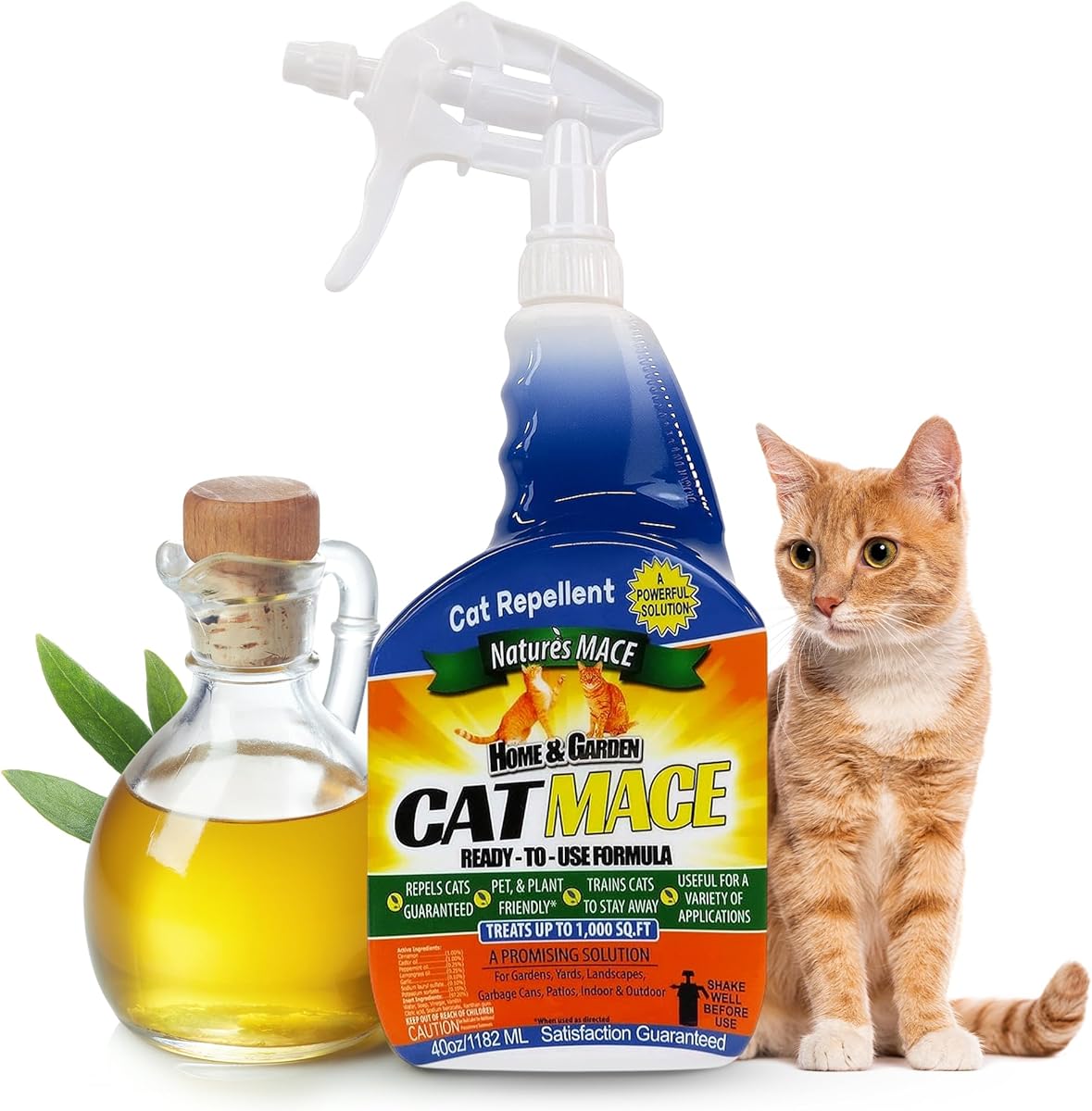
Nature's Mace Cat Mace Cat Repellent 40 oz Spray has a 3.4 customer rating and provides a targeted liquid option for beds, walkways, decks, trash bags, furniture, and other areas where unwanted cat activity occurs. The ready-to-use formula requires no mixing or measuring and is advertised as covering up to 1,000 square feet.
We may earn a commission when you buy through this link, at no additional cost to you.
Its scent-aversion approach uses essential oils such as peppermint and castor oil. The manufacturer presents the spray as a training tool and provides a structured schedule: daily application for the first seven to ten days, twice during the following week, and once weekly thereafter. This schedule makes consistency more important than with a permanent physical barrier, but it may be practical for a specific bed or threshold.
Users are advised to shake the bottle and test it on a hidden fabric area because staining is possible. That caution matters for upholstered patio furniture, indoor sofas, and other surfaces where a physical barrier would leave no residue. The spray must also be reapplied according to the stated routine, and heavily weathered or frequently disturbed outdoor areas may require extra attention.
This spray is best for gardeners who want to reinforce a specific boundary through scent and repetition, especially when a cat has already formed a strong habit. It is less appealing for someone seeking one-time installation, and the lower rating warrants testing on a small area first. A spike mat can provide a persistent physical boundary where spray reapplication is inconvenient.
The product is designed around repeated exposure during the first several days, followed by a reduced maintenance schedule. Applying it consistently teaches the cat that a specific surface now carries an unpleasant scent.
A spray allows precise treatment of a doorway, planter, trash bag, or narrow walking route. It can be more efficient than covering an entire garden when only a small area attracts repeated cat visits.
We may earn a commission when you buy through this link, at no additional cost to you.
The right garden deterrent depends on the cat's route, the size of the protected area, your tolerance for scent, and how much maintenance you are willing to perform. Comparing these practical factors is more useful than choosing solely by the strongest marketing claim.
Scent-based deterrents work by making an area less attractive through peppermint, lemon, ginger, cinnamon, thyme, castor oil, or other plant-derived ingredients. They are easy to distribute around multiple hot spots and can work indoors as well as outdoors, but their effectiveness depends on scent strength, weather exposure, freshness, and whether the cat crosses the treated area repeatedly. Physical spike mats create an uncomfortable texture underfoot. They do not depend on scent or repeated spraying, but they only protect the exact edges and surfaces they cover.
Match the product to the area involved rather than relying on an exaggerated coverage estimate. Granules are useful for spreading across mulch, lawn, or a collection of beds. Repellent balls suit separated points along fences, paths, pots, and trash areas. Long spike strips work well along narrow borders, while multiple spike panels can protect larger or irregular surfaces. Before buying, walk the garden and identify every route cats use, including gaps under fences, stepping stones, windowsills, and corners beside doors.
A product that works in both settings can be especially useful when the same cat moves between the garden and house. Repellent packs, selected balls, granules, and sprays commonly appear in both categories, but their ingredients and directions differ. A physical mat may also be used on countertops, carpets, sofas, or floors, provided the spikes remain out of reach of people and pets. Always follow the manufacturer's stated surface and placement instructions rather than assuming every indoor use is interchangeable with outdoor use.
Gardens are exposed to rain, sunlight, irrigation, wind, temperature changes, and foot traffic, all of which can affect a deterrent. Physical spike mats should have weather-resistant construction and secure anchors. Scent products should be placed in protected locations where possible, and their replacement schedule should reflect actual exposure. For granules, inspect the surface for uneven distribution and bare patches. For balls, check whether the scent remains present after a period of heavy watering or severe weather.
Look for products that clearly state their ingredients and direct users to apply them as labeled. Several options in this guide use plant-based or biodegradable components, but natural does not automatically mean suitable for every animal or plant. Keep all deterrents inaccessible to curious pets, follow edible-crop restrictions where provided, and avoid placing concentrated oils where paws or skin may contact them. Test sprays on hidden surfaces and observe pets after introducing any new scent near frequently used paths.
Scent deterrents often require reapplication as their odor fades, while spike mats can remain effective for longer if they stay secure. Ready-to-use packs and balls demand less handling than spraying, and mesh bags make scent dispensers easier to move. A spray is useful for precise boundaries but creates the most visible maintenance routine because the instructions call for frequent treatment during the initial training period. Select the level of upkeep you can sustain, because inconsistent application is likely to undermine a scent-based approach.
Some gardeners prefer a nearly invisible solution, while others prioritize a strong physical boundary. Repellent packs can be tucked behind pots or garden ornaments, whereas exposed spike strips remain noticeable. Long mats can follow the natural contour of a bed and blend with a less prominent edge, but visible black or brightly colored plastic may not suit a formal landscape. Consider whether the appearance will be acceptable year-round and whether the barrier could obstruct mowing, watering, or routine plant care.
Customer ratings provide a useful but incomplete signal because people may apply products differently or have different expectations. The two leading scent options in this guide have 4.6 ratings, while the physical options fall between 4 and 4.1. Lower-rated products may still work for a particular cat or garden, but they deserve closer label review and small-scale testing. A high rating should inform the decision rather than replace judgment about coverage, ingredients, and maintenance.
Begin by identifying where cats enter, dig, urinate, scratch, or sleep. Photograph or mark the affected route, then choose a deterrent suited to that location. For scent products, place units at regular intervals along the route and begin immediately rather than waiting for the cat to establish another path.
Follow the product's application instructions exactly. Spread granules evenly, cut spike mats without leaving sharp exposed edges, or position mesh-covered balls where they will not be knocked over. For sprays, test a hidden area first and maintain the recommended training schedule. Avoid spraying directly onto plants, pets, people, electrical equipment, or surfaces that are not approved by the label.
Inspect the protected area regularly and adjust as needed. Reapply faded scents, reset shifted mats, tighten pegs, or move a dispenser to a new crossing point. Combining a physical boundary with a discreet scent deterrent may improve consistency, but using several products at once is unnecessary unless the label permits it and the garden can be monitored safely.
The most effective option is usually the one that consistently covers the route your cat uses. Scent products work well when placed densely and refreshed, while spike mats are useful along a narrow, clearly identified boundary. Many gardeners get better results by correcting access points and using a deterrent consistently rather than applying several methods at random.
Several products in this guide are specifically described as plant-based, biodegradable, or safe around pets and plants when used as directed. Nevertheless, every garden and animal is different, so read the complete label and follow dilution, placement, and crop restrictions. Keep concentrates and used applicators away from curious animals, and test sprays on a small hidden area.
There is no universal response time because cats vary in familiarity, motivation, and the severity of the behavior. A scent deterrent may need repeated exposure over several days, while a physical barrier can discourage crossing immediately. Consistent placement, removal of alternative routes, and addressing attracting factors such as uncovered food or an inviting resting place can improve results.
Natural ingredients are not automatically safe for every crop, soil condition, or animal. Check whether the label permits application around edible plants and observe any waiting or harvest guidance. If the product is not explicitly approved for crops, place a physical barrier around the edible area or use a solution labeled for that specific use.
Use granules for broad, relatively even garden coverage, spray for precise treatment of a specific surface, repellent balls for separate hot spots along paths or boundaries, and spike mats for narrow edges that cats repeatedly cross. The best choice also depends on whether you prefer scent-based or physical deterrence and how much maintenance you can manage.
The cat may be using an uncovered route, the scent may have faded, or the product may not be dense enough around the area it frequents. Cats are also strongly drawn to food sources, shelter, and familiar routes. Check the entire boundary, refresh or reposition the deterrent, and remove attractants such as exposed garbage or pet food.
Only use a product whose label explicitly supports the relevant crop and application method. A physical spike mat can protect bed edges without introducing a sprayed substance, while scent or granular products should be applied only where the manufacturer says they are suitable. Avoid direct contamination of produce and follow all stated waiting or harvest instructions.
One well-placed product is often enough when it fully covers the cat's route and is maintained as directed. A second method can help if one physical edge is combined with scent points elsewhere, but stacking products is not automatically better. It can create unnecessary maintenance, strong odors, and safety concerns, so use only compatible products and follow every label.
The 12-Pack Plant-Based Repellent is the most versatile overall choice, combining a 4.6 customer rating, simple placement, and up to 60 days of stated coverage. The 6.5-Foot Soft-Spike Mat is the best physical and budget-oriented option, while the 10-Pack Repellent Balls offer the most complete botanical scent package for gardens with several separate problem spots.
Prioritize the route cats use, the surface being protected, and the maintenance you can realistically sustain. Broad gardens may benefit from granules or well-spaced scent packs, narrow boundaries work well with spike mats, and concentrated areas can be handled with targeted spray or repellent balls. Protecting access points and removing food or shelter attractants is just as important as choosing the product itself.
Product details, customer feedback, and prices can change, so check the current listing and label before ordering. Confirm coverage, ingredients, application instructions, and compatibility with your plants and pets. With the right placement and consistent care, a garden deterrent can make protected spaces cleaner and more enjoyable without using harmful methods.