
PRV Audio MDX800.4
4.7Editor score
Compact four-channel Class D design
800 watts RMS total output
Two-channel bridging capability
Our Mini Amp for Motorcycle guide compares 10 compact amps for power, channel flexibility, weather resistance, fit, and easier installation on your bike.
A mini amp for a motorcycle must deliver enough power for enjoyable sound while fitting neatly into limited storage spaces and coping with vibration, heat, and changing weather. The right model also needs clean wiring, useful controls, and a channel configuration suited to your speakers, whether you are building a compact two-speaker system or a more ambitious multichannel setup.
We compared all ten amplifiers by examining their stated power, channel flexibility, impedance, protection or environmental features, dimensions, filtering options, and suitability for motorcycles and powersports. The list includes compact four-channel models, marine-capable amplifiers, entry-level two-channel units, and higher-output Class D designs for riders with different installation and performance needs.
Each review explains where the amplifier stands out, which systems it suits, and what compromises buyers should consider. Our top selections represent the strongest combinations of output, compactness, flexibility, and motorcycle relevance, although rankings and product availability can change, so readers should verify current specifications and conditions before purchasing.
4.7Editor score

4.7Editor score

4.6Editor score
The comparison below highlights channel count, rated output, impedance, and enclosure dimensions so riders can identify the amplifier that best matches their speaker layout and available installation space.



The Timpano TPT-500.4 is a compact four-channel Class D amplifier aimed at tight vehicle installations. Its stated output is 500 watts RMS, divided into 125 watts per channel at 2 ohms, giving it more flexibility than a basic two-channel mini amplifier while retaining a small heatsink profile. No published customer rating was supplied for this model, so its evaluation here is based on the documented specifications rather than an aggregated user score.
We may earn a commission when you buy through this link, at no additional cost to you.
One of its most useful characteristics is the ability to operate in either four-channel or two-channel bridged mode. According to the product information, bridging a pair of channels can produce 225 watts RMS per bridged channel when a minimum impedance of 4 ohms is observed. That makes the amplifier relevant to both a four-speaker motorcycle system and a more concentrated two-speaker configuration, provided the speakers and wiring are compatible.
The amplifier also includes a two-way protection system intended to guard against overheating and speaker short circuits. That is especially valuable on a motorcycle because the enclosure may be exposed to vibration, compact airflow conditions, and extended operating temperatures. Its listed efficiency of 87% and full-range response from 10 to 24,000 Hz suggest a modern, practical design, although buyers should still provide sound mounting and airflow.
This is a sensible option for riders who want more channel flexibility than the BOSS CE102 without moving to a physically larger high-output amplifier. It is not the right choice for someone who places great importance on customer ratings, and its 2-ohm or bridged wiring must be followed carefully. For a small multichannel motorcycle build, though, the TPT-500.4 offers an appealing balance of compactness, protection, and configuration options.
Running four speakers independently gives the TPT-500.4 a natural role in a balanced motorcycle system, while bridging two channel pairs can provide more concentrated output. Riders should confirm speaker impedance and use the manufacturer wiring guidance before connecting bridged channels.
Thermal and short-circuit protection adds useful safeguards in a vibration-prone installation. The compact enclosure still needs to be securely mounted and positioned so the heatsink can dissipate heat rather than being pressed against a sealed body panel.
We may earn a commission when you buy through this link, at no additional cost to you.
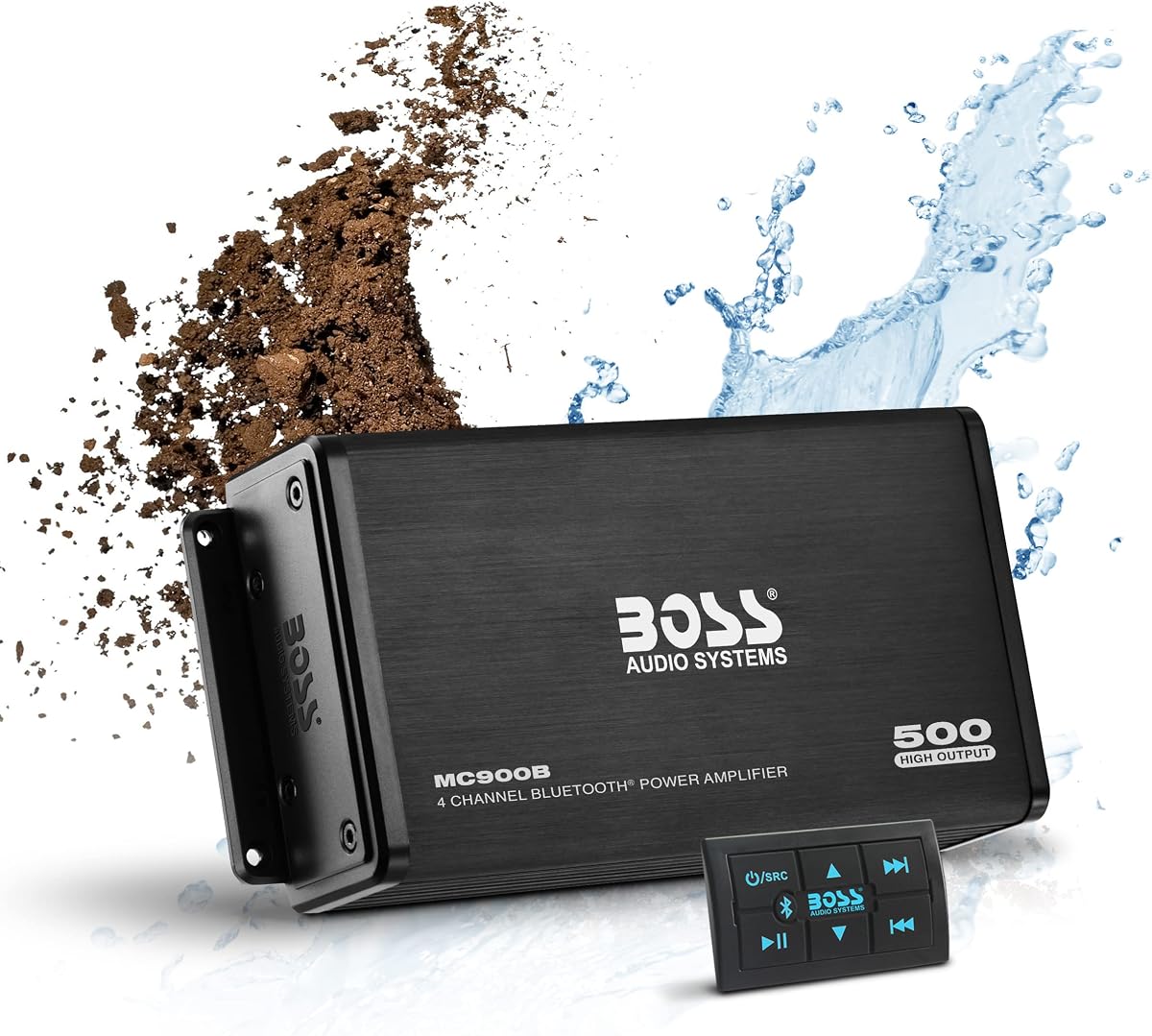
The BOSS Audio Systems MC900B stands apart from the other options because it includes a Bluetooth remote, an auxiliary input, and USB charging. Its four-channel Class AB design is described as weatherproof and is intended for light-weather environments such as boats and ATVs, making it a convenient choice for a motorcycle rider who wants control without installing a traditional head unit.
We may earn a commission when you buy through this link, at no additional cost to you.
Power output is listed at 125 watts maximum and 94 watts RMS per channel at 4 ohms. The full-range amplifier can run speakers and subwoofers, while its four channels provide considerable flexibility for front and rear positions, towers, or a multiway distribution. The included Bluetooth remote allows compatible phones and music players to stream directly, including use with services such as Spotify and Pandora.
Its physical measurements are 1.75 by 6.6 by 1.75 inches, and it weighs 2.9 pounds. That footprint is less diminutive than the smallest marine and Class D models in the list, but it remains relatively compact for a four-channel unit. Because the product is described as handling some light weather rather than full submersion, an enclosed or protected installation remains important, particularly on a motorcycle exposed to rain and road spray.
The MC900B is best suited to riders prioritizing convenient source control and auxiliary connectivity over maximum power density. It also carries a six-year Platinum Online Dealer Warranty when purchased through the stated retailer. For a straightforward four-speaker motorcycle system with phone connectivity, it provides a more self-contained experience than an amplifier that requires signals from a separate source.
The included wireless remote turns a compatible phone or media player into the primary audio source. That can reduce dashboard clutter and make it easier for riders to adjust music without opening a compartment or operating a separate motorcycle head unit.
Weather-oriented construction makes the MC900B relevant to bikes, ATVs, and boats, but light-weather resistance is not the same as waterproofing. A sealed fairing, console, or suitably protected mounting location is the safer installation strategy.
We may earn a commission when you buy through this link, at no additional cost to you.
The SounDigital 800.4 EVO combines 800 watts RMS with an unusually broad set of installation and tuning features for a compact amplifier. Its four channels can support door speakers, mids, tweeters, or a bridged subwoofer arrangement, while the product information explicitly identifies motorcycles, cars, and other tight installations as intended applications.
We may earn a commission when you buy through this link, at no additional cost to you.
Built-in high-pass and low-pass filters, gain controls, and bridging options allow the amplifier to adapt to a more sophisticated speaker arrangement. These controls are particularly valuable when a motorcycle uses separate tweeters and midrange speakers or when a subwoofer needs a restricted frequency range. The unit also uses an aluminum heatsink housing for strength and heat dissipation.
Environmental construction is another major selling point. Conformal-coated components are described as resisting moisture and vibration, making the amplifier a logical candidate for rough roads and exposed installations. Class D efficiency is also useful on motorcycles with limited electrical capacity because the product information describes lower heat generation and reduced power consumption compared with less efficient amplifier architectures.
The trade-off is that its broad feature set requires a more considered setup than a basic mini amp. Newer products can also have a shorter history of customer feedback than established models. Nevertheless, the 800.4 EVO is one of the strongest all-around choices here for a rider who wants motorcycle-specific environmental resistance, integrated filtering, and multiple channel options in one enclosure.
Adjustable high-pass and low-pass filters can help separate tweeters, midrange drivers, and bass sources without requiring additional external crossover boxes. Correct settings also reduce unnecessary stress on speakers by limiting frequencies they are not designed to reproduce.
Conformal-coated components and an aluminum chassis add durability in vibration-prone and damp environments. Protection does not remove the need for sensible routing, secure fastening, and avoiding locations where water can collect.
We may earn a commission when you buy through this link, at no additional cost to you.
The PRV Audio MDX1200.4 is the premium selection because it combines substantial output with a mini amplifier footprint. It supplies 300 watts RMS per channel at 2 ohms across four channels, totaling 1,200 watts, and can be bridged into a two-channel configuration with 600 watts RMS per pair at a minimum 4-ohm load.
We may earn a commission when you buy through this link, at no additional cost to you.
Digital Class D technology and a heavy-duty mini heatsink support high output in a relatively small enclosure. The listed dimensions are 6.75 inches wide by 5.90 inches long and 2.60 inches high. This is still manageable for many motorcycles, but it requires more mounting room than the postcard-size NVX or the particularly compact DS18 X2.
Its four independent channels make it suitable for a full speaker stage, with the option to pair channels for greater output. Because the product is specifically described as ideal for custom motorcycles, ATVs, and Slingshots, its design priorities align well with powersports systems. Buyers still need to ensure that the motorcycle's charging system, power wiring, grounding, and speakers can support the intended output.
This model is best for enthusiasts seeking the highest stated power among the compact four-channel selections without moving to a large marine or powersports amplifier. Its performance potential comes with greater installation demands than lower-output models, but for a carefully engineered high-power bike build, the MDX1200.4 offers exceptional flexibility in a relatively small package.
Class D efficiency allows the MDX1200.4 to deliver more usable output from a small chassis than many conventional designs. The mini heatsink should still be mounted with its airflow path unobstructed and away from heat-sensitive components.
Four independent channels support a broader multichannel system, while bridging provides additional power to two heavier loads. Select the arrangement that matches the speakers' rated impedance and the system's crossover strategy rather than choosing output figures alone.
We may earn a commission when you buy through this link, at no additional cost to you.
The BOSS Audio Systems CE102 is a compact two-channel amplifier for riders who want a straightforward way to power two motorcycle speakers. Its 100-watt output class and simpler architecture distinguish it from the higher-output, multichannel models in this guide. It is most appropriate for uncomplicated upgrades rather than elaborate systems with multiple speaker zones.
We may earn a commission when you buy through this link, at no additional cost to you.
The supplied product information is intentionally limited and emphasizes following all instructions precisely while strongly advising professional installation. With no further filter, bridging, environmental, or connectivity details provided, the CE102 should be judged as a simple two-channel unit rather than a feature-rich control platform.
Its biggest practical advantage is reduced system complexity. A rider using a conventional head unit, two fairing speakers, and standard power wiring may find that two channels are all the system needs. That avoids unused connections, complicated gain distribution, and the need to configure multiple crossovers, while keeping the audio path understandable.
The CE102 is best for a budget-conscious or space-conscious rider seeking a conventional amplifier upgrade. Its 3.7 rating is lower than the ratings of the other customer-reviewed products, and the available information does not highlight the efficiency, protection, or environmental features found elsewhere. Those factors make it more of a focused basic option than an all-terrain mini amp choice.
For a two-speaker motorcycle system, a two-channel amplifier can provide a direct upgrade without unnecessary controls or unused outputs. The rider gains practical channel matching while retaining a straightforward installation.
The supplied instructions emphasize precision and recommend professional installation. Riders should follow the manual, use appropriately rated wiring and protection, and confirm all electrical connections before operating the amplifier.
We may earn a commission when you buy through this link, at no additional cost to you.
The PRV Audio MDX2000.4 is the highest-output four-channel model in this roundup, providing 500 watts RMS per channel at 2 ohms for 2,000 watts RMS total. In bridged operation, the specification reaches 1,000 watts RMS per channel pair at a minimum 4-ohm impedance. It is aimed at ambitious powersports and custom motorcycle audio builds.
We may earn a commission when you buy through this link, at no additional cost to you.
Despite its output, the listed dimensions remain relatively compact at 9 inches wide, 5.90 inches long, and 2.60 inches high. The wide heatsink requires more horizontal space than the MDX800.4, MDX1200.4, QS400.4, and the other particularly small products. A motorcycle with a larger underseat or fairing cavity may accommodate it better than a bike with minimal enclosed storage.
Full-range digital Class D topology allows the amplifier to serve conventional speakers and subwoofers. Four independently usable channels provide flexibility, and bridging offers a more powerful two-channel arrangement. These options are useful for complex systems, but they also demand careful planning around impedance, speaker power handling, crossovers, and gain structure.
The MDX2000.4 is best for experienced enthusiasts whose speakers, wiring, battery, and charging system can support the load. For most riders, its output may be more than necessary, and installation becomes less forgiving than with a moderate-power mini amplifier. When headroom and maximum four-channel capability are the priority, however, it delivers an unusually powerful combination of channels and RMS output.
The 500-watts-per-channel specification gives the amplifier substantial headroom for multiple speakers and higher system demands. Actual results depend on speaker impedance, load, enclosure design, and installation quality.
The nine-inch width is manageable but meaningful on a motorcycle, while high output increases current draw. Riders should size the charging and electrical system for the intended operating level and verify that the mounting area can support the amplifier securely.
We may earn a commission when you buy through this link, at no additional cost to you.
The PRV Audio MDX800.4 combines a 4.7 rating with an especially useful balance of output and physical size. It produces 200 watts RMS per channel at 2 ohms for 800 watts RMS total, yet its listed dimensions are just 4.25 inches wide, 4.50 inches long, and 2.10 inches high. That makes it one of the most practical choices for space-conscious motorcycle installations.
We may earn a commission when you buy through this link, at no additional cost to you.
The four channels can be used independently for a broad speaker stage or bridged into two channels delivering 400 watts RMS per pair at a minimum 4-ohm impedance. Digital Class D technology supports efficient full-range operation, while surface-mount components are described as improving performance against vibration. The amp also uses eight-gauge power inputs and 14-gauge speaker outputs.
Compared with the MDX1200.4 and MDX2000.4, this model trades peak output for a smaller footprint and a lower power requirement. That balance makes it more realistic for many stock electrical systems. The trade-off is that riders seeking extremely high volume with low-impedance speakers will find less headroom than the larger PRV alternatives.
The MDX800.4 is our best budget pick for good reasons: it combines strong customer feedback, multichannel flexibility, useful power, and a compact chassis. It is particularly well suited to custom motorcycles, ATVs, and powersports builds where every inch matters. For riders wanting a balanced mini amp without oversizing the system, it is exceptionally difficult to dismiss.
The 2.10-inch height and square-ish footprint allow the amplifier to fit where longer models may not. Four channels still provide room for multiple speakers without the wiring complexity of a very large multi-channel system.
Two hundred watts per channel at 2 ohms is useful power for a well-matched motorcycle speaker set without imposing the highest possible demand on the bike's electrical system. Gain and crossover settings remain essential for clean results.
We may earn a commission when you buy through this link, at no additional cost to you.
The PRV Audio QS400.4 provides 100 watts RMS per channel at 2 ohms in a compact four-channel Class D enclosure. Its 4-inch width, 5.40-inch length, and 2-inch height make it suitable for motorcycles with limited compartment space, while its four-channel layout offers more routing options than a basic stereo amplifier.
We may earn a commission when you buy through this link, at no additional cost to you.
The manufacturer emphasizes efficiency as a key benefit, particularly for vehicles with constrained electrical systems. Bridging two channel pairs produces 200 watts RMS per bridged channel at a minimum 4-ohm impedance, allowing the amplifier to serve a more powerful two-speaker arrangement when the system design calls for it.
There is less information about environmental protection than with the SounDigital, BOSS marine, or NVX waterproof model. Riders should not assume that a compact powersports amplifier is fully sealed. Secure mounting, protected cable routing, and good airflow are still necessary to address vibration, moisture, and heat.
The QS400.4 is best for riders who need four channels and a compact full-range unit but do not require extreme output. It may work particularly well for a straightforward four-speaker motorcycle system using efficient, properly matched drivers. Buyers seeking a rugged waterproof enclosure or higher power would be better served by one of the models with stronger environmental or output specifications.
A compact Class D design can reduce heat and electrical demand compared with less efficient alternatives. The amplifier's actual contribution to battery load depends on output level, speaker efficiency, and how long the system is used.
One hundred watts per channel is enough for many efficient motorcycle speakers when the electrical signal and gain are properly matched. This is a suitability and clean-output choice rather than a volume contest.
We may earn a commission when you buy through this link, at no additional cost to you.
The NVX MVPA4 is the strongest environmental candidate in the guide, with an IPX67 waterproof rating and a design explicitly intended for marine, powersports, and motorcycle installations. Its postcard-sized enclosure and four-channel Micro Class D architecture make it especially interesting for riders who have very little room for an amplifier.
We may earn a commission when you buy through this link, at no additional cost to you.
Output is listed at 50 watts per channel into 4 ohms and 100 watts per channel into 2 ohms, for 400 watts true RMS in total. The amplifier can also be bridged for two-channel operation. Those figures are more modest than the high-output PRV models, making speaker efficiency and system design especially important when choosing it.
IPX67 protection is valuable on a motorcycle exposed to rain, spray, and dusty roads. However, a waterproof rating does not mean the amplifier can be submerged, and correct sealing, cable entry, mounting, and operation remain the installer's responsibility. The compact chassis should be mounted firmly to avoid vibration and should retain access to any adjustment controls.
The MVPA4 is best for a compact motorcycle system where environmental resistance matters more than maximum output. It also fits riders building marine or powersports equipment who want one compact platform for several vehicle types. Its 4.0 rating is respectable, and the combination of four channels, low profile, and IPX67 protection fills a specific and valuable niche.
IPX67 protection distinguishes this amplifier from models described only for light weather or routine vibration resistance. It is a strong option for exposed installations, provided connectors and mounting practices preserve the enclosure's protection.
Fifty watts per channel at four ohms is most effective with efficient, properly matched speakers. Riders seeking greater headroom may prefer a higher-output amplifier that still fits their available space.
We may earn a commission when you buy through this link, at no additional cost to you.
The DS18 X2 earns the Editor's Choice position by combining a 4.7 rating with one of the most attractive feature sets for a compact two-channel motorcycle amplifier. It delivers 140 watts RMS per channel at 4 ohms and 230 watts RMS per channel at 2 ohms, providing useful power in an enclosure designed specifically for tight installations.
We may earn a commission when you buy through this link, at no additional cost to you.
Its adjustable LPF, FLAT, and HPF modes let the rider choose low-pass filtering, full-range operation, or high-pass filtering. These settings are valuable for pairing the amplifier with dedicated tweeters, full-range speakers, or a subwoofer. That control makes the X2 more versatile than many basic two-channel models despite having only two channels.
Construction uses a four-layer-trace PCB and surface-mount technology intended to improve stability and durability. The ultra-compact form factor also reduces the visual impact of a custom build and makes it easier to conceal the amplifier within a fairing, underseat compartment, or other protected location. As with other mini amplifiers, secure mounting and controlled operating temperatures remain essential.
The DS18 X2 is best for a focused two-speaker motorcycle system where space is the overriding concern but the owner still wants meaningful output and filter selection. It is less flexible than the four-channel models for adding rear speakers or separate zones. Even with that limitation, its combination of compactness, 140-watt-per-channel output, onboard controls, and strong customer feedback makes it an especially complete choice.
The X2 delivers more stated continuous power per channel than many similarly small alternatives. That makes it attractive for efficient motorcycle speakers where space cannot accommodate a larger amplifier.
HPF, LPF, and FLAT positions let the amplifier adapt to different speaker roles without an external crossover. Selecting the correct mode helps improve frequency distribution and can prevent a tweeter or subwoofer from receiving unsuitable frequencies.
We may earn a commission when you buy through this link, at no additional cost to you.
The best motorcycle mini amplifier balances usable power, compact dimensions, electrical efficiency, speaker compatibility, environmental resistance, and installation convenience. These factors should be evaluated together rather than by output figure alone.
Begin with the speakers the amplifier will actually drive. A two-channel amplifier is often sufficient for a pair of fairing or handlebar speakers and keeps the wiring simple. A four-channel model provides more options for front and rear systems, tower speakers, separate tweeters, or a more flexible multichannel arrangement. Bridging can increase output to two loads, but it reduces the number of independently controlled channels.
Match the amplifier to the planned system rather than buying extra channels you will not use. Confirm whether the speakers need full-range amplification, dedicated high-pass or low-pass filtering, or a bridged connection. Extra outputs may create tuning complexity if the motorcycle system is intended to remain simple.
RMS output provides a more meaningful comparison than peak or maximum wattage. Compare each channel's continuous output at the impedance of the intended speaker, then check whether the amplifier remains stable at that load. The included models include two-ohm-capable designs and products intended for four-ohm bridged operation.
A higher headline wattage does not automatically create a better motorcycle system. Efficient speakers paired with a moderately powered amplifier can sound cleaner and place less demand on the electrical system. Conversely, very high output may be useful when the goal is substantial headroom, multiple speakers, or a more demanding powersports installation.
Measure the available compartment before choosing an amplifier, and compare those dimensions with the complete enclosure rather than relying on a photo. Height matters as much as length because a low-profile unit may fit under a seat or inside a fairing while a deeper chassis will not. Leave room for connectors, bends in the wiring, and access to gain and filter controls.
The most compact models in the guide measure only a few inches in each direction, while higher-output units can be substantially wider. A slightly larger amplifier may still be preferable if it offers a more appropriate channel count, cleaner thermal margin, or features needed by the system. Secure mounting should prevent the amplifier from moving under vibration.
Motorcycles encounter rain, road spray, dust, temperature changes, and continuous vibration. An amplifier described as weather-resistant or built for powersports use may be better suited to exposed areas than a basic car amplifier, while an IPX67-rated model offers the clearest environmental specification in this group. Water resistance is not the same as permission to submerge the unit.
Even a protected amplifier benefits from sensible installation. Use sealed cable entries where possible, avoid bodywork that traps water, provide strain relief, and route conductors away from sharp edges. Conformal-coated internal components and surface-mount construction can improve durability, but they do not replace secure mounting and careful wiring.
Built-in filters can simplify a system that uses speakers with different frequency roles. A high-pass filter protects tweeters from low-frequency energy, while a low-pass filter helps a subwoofer handle the intended bass range. Full-range mode is useful for conventional coaxial or full-range motorcycle speakers. An amplifier with adjustable controls can also reduce dependence on external crossover modules.
More controls are not automatically better. They must be set correctly and may require a signal source or test procedure to tune effectively by ear. Riders who want a simple, reliable installation should choose controls they understand and can revisit after the system is installed.
Class D amplifiers are prominent in the compact category because they can produce substantial output with lower heat generation than less efficient traditional designs. Lower heat and reduced power draw can be valuable on motorcycles with limited charging capacity, although output level still determines how much current the system uses during loud playback.
A rider does not need to operate an amplifier continuously at its maximum output, so an appropriately sized model may be more comfortable for the electrical system than the largest available unit. Consider battery condition, charging-system capability, power-wire gauge, grounding quality, and whether accessories are active during long rides.
The MC900B stands apart with Bluetooth, an auxiliary input, and USB charging, allowing a compatible phone or player to act as the source without a separate head unit. Other amplifiers in the guide focus primarily on power and channel flexibility, so riders using them may need an existing motorcycle audio source or a separate receiver.
Convenience features can simplify daily use, but they also add control complexity and may create dependency on a phone, app, or Bluetooth connection. Decide whether wireless control, charging, and multiple inputs are worth the added complexity for the way the motorcycle is actually ridden.
Look for evidence of thermal protection, short-circuit safeguards, durable heatsinks, and vibration-oriented component construction. These features help the amplifier survive the electrical and physical stresses of powersports use. A warranty can add confidence, but installation quality and following the manufacturer's instructions remain essential.
Also consider the availability of documentation and whether the product's protection features are clearly described. A model with modest but well-specified output and clear guidance may be easier to commission safely than one whose marketing emphasizes only maximum power.
Begin by planning the complete electrical path, including the amplifier location, speaker cables, remote or low-level signal cable, power lead, fuse, ground connection, and any high-pass, low-pass, or full-range settings. Disconnect the motorcycle battery before wiring and follow the amplifier manual. Use appropriately rated wiring and ensure the fuse is installed close to the battery connection so it can protect the cable if a fault occurs.
Mount the amplifier firmly on a vibration-resistant surface with the heatsink's airflow path unobstructed. Route cables away from sharp edges, exhaust components, suspension travel, and areas that collect water. Keep terminal connections secure, preserve the enclosure's weather resistance, and avoid placing the amplifier where road spray or moisture can enter through an unfinished cable opening.
Set gain before applying substantial volume, configure each filter according to the speaker's frequency range, and use a proper signal source with balanced output. Start with moderate levels and listen for distortion, excessive heat, or unwanted noise. Periodically inspect connections, mounting points, cable routing, and protective devices, particularly after rough rides or periods of heavy rain.
Yes, when its continuous output and impedance ratings match the speakers. A compact Class D unit can provide ample volume for two or more efficient motorcycle speakers while consuming less space than a conventional large amplifier. Matching matters more than wattage alone, so riders should verify channel power at the intended speaker impedance and check bridged requirements before connecting loads.
Choose two channels for a simple pair of speakers or a dedicated subwoofer setup. Four channels are more useful for multiple speaker locations, separate tweeters, or a system that may expand later. The additional flexibility also requires more careful gain and filter configuration, so riders should select the channel count that matches their present and likely future system.
A fairing can be an excellent location if it is large enough, firmly constructed, and positioned for airflow and cable access. The amplifier should not be compressed tightly against the fairing if doing so blocks heat dissipation. Riders should also account for water accumulation, vibration, service access, and the position of internal bodywork.
Yes. A rating such as IPX67 indicates resistance to dust and temporary immersion under defined test conditions, but it does not guarantee that every connector arrangement remains sealed. Use appropriate cable glands or sealed pass-throughs, avoid damaging the enclosure, provide strain relief, and follow the manufacturer's instructions for opening or terminating connections.
The appropriate wire size depends on amplifier output, current draw, total cable length, and the motorcycle's electrical system. Higher-output Class D amplifiers generally require heavier cable and properly rated protection than low-power units. Consult the amplifier instructions and use an electrical sizing method appropriate for the complete installation rather than relying on a universal gauge.
Bridging combines two amplifier channels to drive one load at higher voltage, often with increased output. It reduces the number of independently available channels and usually requires a minimum load of 4 ohms for the bridged pair in the listed models. The speakers must be compatible, and incorrect bridging or wiring can damage the amplifier.
Filters are useful whenever different speakers handle different frequency ranges. High-pass filtering protects small tweeters from bass, while low-pass filtering focuses a subwoofer on lower frequencies. Full-range operation can suit conventional coaxial speakers, but proper settings improve tonal balance and reduce unnecessary movement in drivers that should not handle certain frequencies.
A compact car amplifier can work on a motorcycle when it is electrically compatible, appropriately protected, and securely mounted. Marine or powersports models are generally better candidates for exposed environments because their construction addresses moisture and vibration more directly. The key factors are speaker impedance, power requirements, thermal conditions, and environmental protection.
The PRV Audio MDX800.4 is the best budget-balanced option because it combines four channels, 800 watts RMS of stated output, a compact 2.10-inch-tall chassis, and a 4.7 rating. The DS18 X2 is the Editor's Choice for riders seeking an even smaller enclosure, 140 watts RMS per channel at 4 ohms, and built-in filter modes, while the PRV Audio MDX1200.4 is the premium high-output selection for ambitious powersports and custom motorcycle systems.
Prioritize accurate speaker matching, the right channel configuration, and a footprint that fits the actual mounting location before focusing on the largest wattage figure. Environmental resistance, crossover controls, source connectivity, and the bike's electrical capacity should also influence the decision. In many cases, the most suitable mini amp is not the most powerful one but the one that integrates cleanly and operates efficiently within the designed system.
Product specifications, ratings, availability, and pricing can change, so readers should confirm the current details and instructions before buying. Comparing the amplifier with the intended speaker impedance, planned number of channels, available enclosure space, and complete wiring requirements will lead to a more reliable motorcycle audio upgrade.