
Epson Workforce ES-50
4.3Editor score
Portable sheet-fed design
72-inch maximum length
Searchable PDF OCR
A newspaper scanner should preserve fragile pages, capture fine print, and make large bound material easier to digitize than a conventional sheet-fed scanner. The right device depends on whether you scan loose broadsheets, bound books, photographs, or stacks of archival pages, as well as the size and condition of your collection.
This guide compares overhead scanners, A3 flatbeds, automatic document scanners, and photo-focused models using their stated capabilities, resolution, format support, OCR functions, compatibility, and physical design. It covers options for home archivists, libraries, schools, offices, photographers, and researchers rather than treating every scanner as suitable for full-size newspapers.
Each review explains what the product handles well, where its design presents trade-offs, and which users are most likely to benefit. Ratings and technical details reflect the supplied product information, while current availability and pricing can change, so readers should verify specifications before making a final purchase.
4.3Editor score

4.1Editor score

5.0Editor score
As an Amazon Associate we earn from qualifying purchases.
The table below compares all ten options by scanner type, maximum format, key imaging capability, and primary use. Overhead models are the most practical for bound books, A3 flatbeds handle large loose pages, while compact feeder and photo scanners suit narrower or more specialized collections.


The VIISAN Large Format Book & Document Scanner combines a 26MP camera with an A2 capture area, making it one of the most purpose-built choices for newspapers, books, maps, and large documents in this guide. Its 4.1 rating reflects a capable package, while the adjustable A2/A3 overhead design gives it unusually broad coverage. The foldable hinge and adjustable height also make it more adaptable than a fixed flatbed.
We may earn a commission when you buy through this link, at no additional cost to you.
Its strongest feature is the bundled scanning software. It digitally flattens curved pages, removes captured fingers, repairs damaged edges, and separates double-page spreads into individual images. Those functions directly address the most common problems encountered when digitizing bound books and newspaper supplements. Embedded OCR can convert scans into searchable PDF, Word, Excel, ePub, or text files, while the 26MP sensor and software-enhanced 600 DPI option target detailed archival output.
There are important limitations. The OfficeCam software supports x86 and x64 Windows architectures and macOS, but not ARM-based devices such as the Surface Pro X. The built-in LED is intended for dark conditions, and the manufacturer does not recommend using it in bright light or with very glossy paper. These restrictions make sense for a visual document camera, but they mean the scanner may not reproduce every reflective newspaper surface evenly.
This is the best overall option for users who need to scan oversized loose sheets, bound volumes, and delicate pages without feeding them through rollers. It suits archivists, educators, remote collaborators, and home users who value page correction and OCR. For conventional stacks of standard-size office pages, a sheet-fed model may be faster, but this scanner delivers the most relevant combination of format, image quality, and restoration tools for newspaper-style collections.
Automatic flattening, finger removal, edge repair, and spread separation reduce the manual editing normally required for books and folded newspaper supplements. This makes the software particularly useful for large, mixed-format archival projects.
The adjustable overhead frame alternates between A2 and A3 coverage, while its foldable construction simplifies storage. A maximum capture area of 594 by 420 millimeters is broad enough for many broadsheet pages, maps, and oversized albums.
We may earn a commission when you buy through this link, at no additional cost to you.
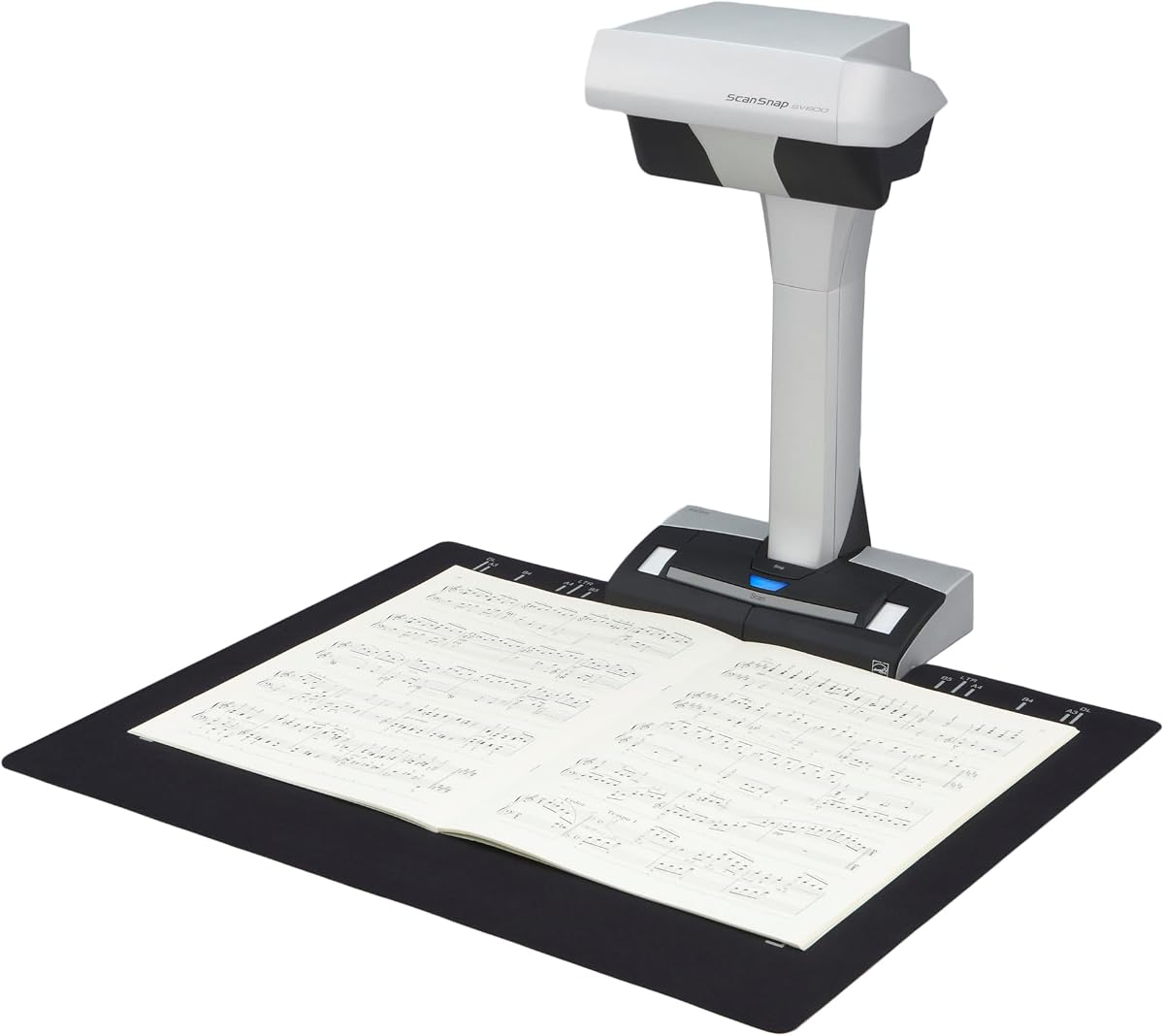
The ScanSnap SV600 is designed around a simple but important principle: newspapers and books should not need to be dismantled or pulled forcibly through a narrow feeder. Its overhead format captures material without cutting or damaging it, and the 4.1 rating reflects a proven design for bound documents. It is especially relevant to researchers working with bound newspaper archives, scrapbooks, magazines, and fragile papers.
We may earn a commission when you buy through this link, at no additional cost to you.
Several automated features improve the workflow. Auto Book Correction flattens pages and compensates for curve distortion, while the Point Retouch function removes fingers that appear near the edge of an image. Multi Document Detection can identify several business cards, photographs, or newspaper clippings in one capture and crop and rotate them automatically. Page Turning Detection begins a scan when a page turns, and Time Mode offers fixed-interval capture for continuous operation.
The trade-off is that it focuses on visual capture and correction rather than a large catalog of advanced OCR formats. It may also be less convenient than an automatic document scanner when processing conventional loose pages at volume. A user working primarily with standard office paper may value a 100-sheet feeder more than a non-damaging overhead platform. Conversely, a user preserving a century-old bound volume would likely accept the extra manual page handling for a much gentler process.
Choose the SV600 when the condition of the source material matters more than high-volume sheet feeding. Libraries, families preserving local history, and researchers handling fragile bound newspapers will find its correction and page-turn features especially practical. It is a focused book scanner rather than a universal imaging system, but within that category it offers a compelling balance of gentle handling and automation.
The overhead platform avoids cutting, bending, and force-feeding fragile pages. That makes the SV600 more suitable for brittle newspaper bindings and valuable books than a conventional automatic feeder.
Page Turning Detection and timed capture modes streamline continuous scanning. Automatic cropping and rotation for mixed documents further reduce the cleanup required after each session.
We may earn a commission when you buy through this link, at no additional cost to you.
The ScanSnap iX2500 is a high-speed automatic document scanner with a 4.3 rating, a 100-sheet feeder, and duplex throughput of up to 45 pages per minute. It is not a traditional newspaper scanner, but it is an excellent choice for users who have already separated a collection into individual clippings. Its strength is sustained processing of standard-size paper rather than preserving books or oversized broadsheet sheets.
We may earn a commission when you buy through this link, at no additional cost to you.
A large touchscreen makes operation more customizable than on many compact feeders. Users can select profiles and route scans to a computer, Mac, mobile device, or cloud service, while Quick Menu supports scan-drag-and-drop workflows. Automatic optimization, naming, and sorting make it useful for digitizing receipts, photographs, business cards, and other mixed archival material. Built-in Wi-Fi 6 and USB-C connectivity also provide flexibility in where scans are stored.
The limitation is fundamental: an automatic feeder cannot capture a spread from an open bound newspaper, and it is unlikely to accept a full broadsheet without folding or trimming. It is also less useful for books that must remain intact. The paper-handling system is designed to reduce jams and damage, but it cannot overcome the physical constraints of a rigid feeder. Users who need to preserve publication bindings should consider one of the overhead models instead.
Despite that qualification, the iX2500 is ideal for digitizing boxes of already-separated clippings, office archives, and routine documents. Its 4.3 rating, automatic optimization, and very high throughput make it the most attractive selection for users who value batch processing. In short, choose it for volume and organization, not for large-format book capture.
A 100-sheet feeder and 45-page-per-minute duplex speed make large stacks practical to process. The brake roller, multi-feed sensor, and skew detection are designed to support smooth, dependable feeding.
Wi-Fi 6, USB-C, and touchscreen profiles let users choose where every scan goes. Direct delivery to computers, mobile devices, or clouds can eliminate a repetitive manual transfer step.
We may earn a commission when you buy through this link, at no additional cost to you.
The Epson Workforce ES-50 is a portable single-sheet scanner rated 4.3, and it offers an approachable way to digitize loose newspaper pages, long documents, receipts, and identification cards. Its compact body and USB-powered operation make it practical for researchers who digitize away from a fixed office. Although it is not the most capable large-format option, it delivers a useful combination of portability, OCR, and flexible page length.
We may earn a commission when you buy through this link, at no additional cost to you.
Its most notable specification is the ability to scan documents up to 8.5 by 72 inches. That means a long clipping, narrow strip, or unusually tall page can be captured without being divided into standard sections. The scanner can process a page in approximately 5.5 seconds, and automatic feeding mode combines inserted sheets into one multi-page file. Nuance OCR can create searchable PDFs as well as editable Word and Excel documents.
The trade-off is manual page handling. A user must insert and retrieve each sheet one at a time, making the ES-50 slower than a 45-page-per-minute automatic feeder for a large box of clippings. It also cannot scan an intact bound newspaper, and the narrow feeding mechanism is not designed for large A2 or A3 broadsheets. It is best suited to loose, long-format pages that fit within its stated dimensions.
This is the best budget choice for students, home archivists, journalists, and travelers who need a compact scanner with genuine OCR. Choose it when portability and long-page support matter more than automatic feeding. For a small personal collection of clippings, it can provide a complete workflow at a much lower entry point than the large overhead and A3 flatbed models.
Support for sheets up to 72 inches is unusually useful for narrow newspaper strips and elongated records. It reduces the need to cut or awkwardly join unusual source material before scanning.
The scanner draws power through USB and requires no batteries or external supply. Windows and Mac compatibility makes it convenient to move between locations and pair with different computers.
We may earn a commission when you buy through this link, at no additional cost to you.
The VIISAN 3120 A3 Flatbed Scanner carries a 5.0 rating and offers a refined alternative to overhead models for users who want a fixed scanning surface. Professionally refurbished and function-tested, it is described as capable of meeting original factory specifications, with possible minor cosmetic signs of previous use. Its frameless A3 bed and 1200 DPI optical resolution make it especially attractive for detailed archival work.
We may earn a commission when you buy through this link, at no additional cost to you.
The scanner can handle documents up to approximately 304 by 426 millimeters, including books, magazines, newspapers, photographs, painting albums, and CAD drawings. Its 48-bit color depth preserves a wide tonal range, while the LED light source requires no warm-up. Auto-Scan starts a capture when the lid is closed, reducing the need to interact with a control button during a continuous workflow. Windows TWAIN and WIA plus macOS ICA support broaden platform compatibility.
The obvious caveat is its refurbished status. Buyers should expect signs of prior use, even though the unit is stated to have been inspected, cleaned, and tested. The largest A3 area also falls short of the A2 coverage offered by overhead options, so a full broadsheet may still need special handling. Finally, the stated eight-second A3 scan is tied to 200 DPI, while the highest resolution requires the supplied VIISAN software.
This scanner is a strong premium choice for libraries, schools, publishing teams, and serious home archivists who repeatedly scan loose large-format pages. It is more compact and predictable than a tall overhead camera while handling books better than a sheet feeder. Choose it when high resolution, color accuracy, and a dedicated A3 bed matter more than capturing the widest possible sheet in one frame.
The 1200 by 1200 DPI optical resolution and 48-bit color depth support detailed reproductions of photographs, fine newspaper print, and mixed-color documents. The supplied software is required to reach the maximum stated resolution.
Closing the lid triggers Auto-Scan, and the LED source needs no warm-up. These details support a smoother rhythm when processing many loose pages or working through a book.
We may earn a commission when you buy through this link, at no additional cost to you.
The VIISAN VF3240 A3 Scanner is built for users who want a large flatbed with unusually high resolution and quick throughput. Its 4.0 rating reflects a capable machine whose headline specifications are particularly attractive for newspapers, technical drawings, legal materials, and photo collections. The frameless bed and four-second A3 color capture at 200 DPI give it a clear productivity advantage over many conventional office scanners.
We may earn a commission when you buy through this link, at no additional cost to you.
Maximum optical resolution reaches 2400 by 2400 DPI, with 48-bit color and as many as 196 million effective pixels. The product supports Windows 7 through 11 through TWAIN or WIA and macOS 10.15 or later through ICA. A universal 100-to-240-volt power supply simplifies international use. One-touch buttons for scan, email, print, and PDF are also useful for routine office tasks that do not require extensive software navigation.
Resolution behavior differs by operating system. The manufacturer states that full A3 scanning at 2400 DPI requires macOS with native ICA support, while Windows users reach 1200 DPI for A3 through ViiScan. Microsoft restrictions limit the Windows WIA driver to 600 DPI. In addition, the CIS sensor is intended for flat paper and is not recommended for clothing, CDs, acrylic sleeves, or other three-dimensional objects. These limitations make the product less versatile than some flatbeds that include a lift or deeper scanning chamber.
The VF3240 is well suited to users who already have large, loose pages and require high fidelity rather than a non-damaging book-scanning workflow. A library digitizing loose newspaper pages, a designer scanning artwork, or an office preserving large reports can get strong results. It is less suitable for someone needing to photograph thick bound volumes from overhead or scan fragile items that cannot rest flat.
A maximum 2400 DPI optical setting is valuable when small type, halftone photographs, and line work must retain detail. 48-bit color provides broad tonal information for mixed archival material.
The stated four-second A3 scan applies to 200-DPI color mode. Actual times vary with resolution and settings, but this remains a strong option for processing large loose pages efficiently.
We may earn a commission when you buy through this link, at no additional cost to you.
The ScanSnap iX1300 is a compact automatic scanner that combines a space-saving vertical design with wireless and USB connectivity. Its 4.2 rating places it among the stronger options here for standard document-heavy workflows. Although it does not directly scan a spread or an oversized newspaper, it is useful for digitizing separated clippings, photographs, receipts, cards, and reports with little desk space.
We may earn a commission when you buy through this link, at no additional cost to you.
It can scan up to 30 pages per minute in duplex mode, automatically handling de-skewing, color optimization, and blank-page removal. The machine handles many document types, including thick items and plastic cards. Quick Menu allows a direct scan-drag-and-drop workflow, and ScanSnap Home helps organize, edit, and use the resulting files. Wi-Fi connectivity permits scanning to a Mac, PC, mobile device, cloud service, or Chromebook, and the scanner can operate without a computer.
As with any compact feeder, physical size is the central constraint. A full broadsheet generally needs to be folded or divided, and a bound volume cannot be captured without dismantling. The vertical design saves desk space, but it does not make the device suitable for oversized or fragile pages. Its strengths appear when processing conventional sheets quickly and sending the results into a digital organization system.
This scanner is a good choice for small offices, home workspaces, and users who want automatic batch capture without a large footprint. If your newspaper project involves a carton of already-cut clippings and limited desk space, the iX1300 is especially relevant. If the collection includes bound volumes or broad pages that must remain intact, move up to an overhead or A3 flatbed model.
The upright body can fit more easily on a crowded desk than a wide traditional feeder. Despite that compactness, the scanner supports 30-page-per-minute duplex operation for routine batch work.
Wireless operation allows direct delivery to mobile devices and cloud services. This is helpful for distributed archives or offices where scans should not pass through a central computer.
We may earn a commission when you buy through this link, at no additional cost to you.
The VIISAN S21 Pro extends the overhead-scanner concept with A2 and A3 versatility, a 26MP sensor, extensive OCR, and Gemini integration. Its 4.0 rating reflects a feature-rich product aimed at education, research, technical support, and archival users. Like the other VIISAN overhead option, it is better suited to capturing large pages and books without a rigid feeder than to processing conventional stacks automatically.
We may earn a commission when you buy through this link, at no additional cost to you.
A 90-degree foldable hinge and telescopic height adjustment allow the unit to move between A2 coverage of 594 by 420 millimeters and A3. The software can flatten curved pages, erase finger marks, repair damaged edges, and split two-page spreads into separate files. Its OCR engine supports more than 180 languages and converts images into searchable PDF, editable Word and Excel, ePub, or TXT formats. A claimed 26MP resolution supports 320-DPI optical output, with a software-enhanced 600-DPI option.
Gemini integration through the free VisualCam Lite web interface adds a different kind of utility. Users can request translation, summaries, reading guidance, or visual analysis, and the scanner also supports video recording and remote collaboration through third-party applications. The package includes the scanner, USB cable, scan pad, guidance, and manual button. Compatibility covers x86 and x64 Windows systems and macOS 10.15 or later, but not ARM devices such as the Surface Pro X.
Choose the S21 Pro when large-format page correction, multilingual OCR, and AI-assisted review are central to your workflow. It is a strong match for international archives, educators, and researchers who want more than a basic overhead camera. Be cautious with highly glossy or glare-prone newspaper stock, and verify that your computer uses a supported processor architecture before purchase.
Support for more than 180 languages broadens the practical value of OCR. Converting scans into searchable PDF, Word, Excel, ePub, or TXT files makes collection content easier to index and reuse.
Gemini integration can translate, summarize, or analyze content shown beneath the camera. The live feed and voice interaction are particularly relevant to education, research, and remote technical support.
We may earn a commission when you buy through this link, at no additional cost to you.
The Brother DS-640 is a compact mobile scanner built for users who need to capture papers away from a permanent workstation. It has a 4.3 rating, a body under one foot long, and a weight of about 1.5 pounds. Those portability characteristics make it appealing for journalists, students, and travelers collecting newspaper clippings in the field, provided the pages are loose and within the feeder's limits.
We may earn a commission when you buy through this link, at no additional cost to you.
It scans color and black-and-white documents at up to 16 pages per minute, and color does not reduce the stated speed. Power comes through an included micro USB 3.0 cable, eliminating the need for batteries or a separate power supply. The Brother iPrint&Scan application provides scan-to destinations including a computer, network, cloud services, email, and OCR. Windows, Mac, and Linux support is complemented by TWAIN, WIA, ICA, and SANE driver compatibility.
Automatic color detection and adjustment, image rotation on PC, bleed-through prevention, background removal, text enhancement, and color drop simplify preparing pages for later use. The included OCR and document-management software expands the machine's usefulness beyond basic image capture. Nevertheless, it remains a small feeder: it cannot scan an open bound publication or handle the full width of an oversized broadsheet without preparation.
The DS-640 is a sensible option for a mobile digitization kit or for occasional scanning of clippings and receipts. Its 4.3 rating and broad operating-system support make it approachable. Users creating a high-volume library workflow should look toward a larger automatic feeder, while those preserving bound newspapers should choose an overhead model. For moderate, portable capture, however, the DS-640 remains a practical tool.
The sub-one-foot length and approximately 1.5-pound weight make the scanner easy to place in a bag. USB power also removes the need to search for an outlet when digitizing documents away from home or the office.
Color adjustment, rotation, background removal, bleed-through reduction, and text enhancement reduce manual preparation. These features are particularly helpful for mixed batches of clippings and older paper.
We may earn a commission when you buy through this link, at no additional cost to you.
The Epson FastFoto FF-680W is the highest-rated product in this roundup, with a 4.5 rating, and it is built primarily as a fast photo and document scanner. It is an unusual but useful choice for newspaper archives that contain many photographs, illustrated front pages, postcards, and panoramas. It cannot scan a full broadsheet in one pass, so users would need to fold or separate oversized pages before capture.
We may earn a commission when you buy through this link, at no additional cost to you.
Its standout capability is rapid photo digitization. The scanner can process one photograph per second at 300 DPI and batch up to 36 photos at once. It supports Polaroid-style images, panoramas, postcards, and prints up to 8 by 10 inches. Automatic enhancement, color restoration, red-eye reduction, de-skewing, cropping, and rotation help revive older images, while a carrier sheet and microfiber cloth support careful handling of fragile prints.
The FastFoto app adds voice and text overlays and can create slideshows on a smartphone. For documents, the included Epson ScanSmart software includes OCR, while Single-Step Technology captures both the image and handwritten notes on the back in a duplex scan. Output options include 300 DPI for sharing, 600-DPI TIFF for archiving, and 1200 DPI for enlargement. Wireless and USB connections provide flexible placement, and Dropbox and Google Drive can be used for uploading and backup.
This scanner earns its place as a specialist option for photo-rich collections. It is a better choice than a standard office scanner when preserving images is the main objective, but it lacks the A2 overhead coverage, A3 flatbed, or long-page support offered by several competitors. Choose it for batches of loose newspaper photographs and illustrated pages rather than for bound volumes or oversized sheets.
Fast batch scanning and automatic photo enhancement make the FF-680W well suited to boxes of loose pictures. It handles multiple common print formats while restoring color and correcting common scan defects.
Single-Step duplex capture records an image and handwritten notes on its reverse in one operation. That feature is valuable for archival photographs whose context is written on the back.
We may earn a commission when you buy through this link, at no additional cost to you.
The best newspaper scanner depends on the physical format, condition, and volume of the collection. Start with how the originals are bound, then balance capture size, speed, image quality, correction software, and the destinations where the finished files need to go.
Overhead scanners photograph pages from above and are usually the safest choice for bound books, large broadsheets, and fragile material. A3 flatbeds provide high-resolution capture of loose pages, thick books, and albums without a tall camera stand. Automatic document scanners are efficient for standard-size, separated sheets but cannot preserve an open spread or capture most oversized pages in one pass. Photo-focused scanners sit between these categories, excelling at loose prints and illustrated material but offering less large-format flexibility.
Newspapers vary greatly in size, from tabloid sheets to broad traditional pages. An A3 scanner captures many standard large-format pages, while an A2 overhead scanner offers a safer margin for oversized material. Sheet-fed units may require a page to fit within the feeder width, and photo scanners may support only common print dimensions. Measure the longest and widest pages in the collection before deciding, including folded inserts, supplements, and pull-out sections.
Resolution determines how much fine print and halftone detail survives digitization. The options here range from compact feeders with standard office output to flatbeds offering 1200 or 2400 DPI optical resolution. High resolution is valuable for small type, photographs, and artwork, although file sizes increase. 48-bit color on capable flatbeds also supports a wide tonal range. For ordinary text searching, OCR may matter more than a very high nominal resolution.
Bound newspapers and books introduce curved pages, dark gutters, shadows, and fingers along page edges. Auto-flattening, curve correction, finger removal, edge repair, and automatic spread separation can save substantial editing time. The VIISAN overhead models and ScanSnap SV600 emphasize these functions. Before purchasing, preview the software with the page types you own and confirm that the required operating system and processor architecture are supported.
Automatic feeders can reach 45 pages per minute and reduce the work involved in scanning loose stacks. Their paper path is still less forgiving than an overhead camera or flatbed, especially for brittle, torn, or extremely old pages. A mobile sheet-fed scanner may be sufficient for a small number of clippings but tiring for a large archive. Overhead devices require careful page positioning, yet they impose less mechanical force on fragile originals.
A scanner should create usable files without forcing you into a complicated editing process. Look for searchable PDF, editable Word or Excel, automatic file naming, cloud delivery, and mobile-device support. OCR language support matters for international or multilingual archives. The VIISAN S21 Pro supports more than 180 languages, while several other products provide searchable PDF and standard editing formats. Check whether the required software runs on Windows, macOS, Linux, or mobile platforms.
A 300-DPI color image of a large page can occupy much more space than a monochrome document scan, and high-resolution archival output increases storage demand further. Cloud delivery is convenient, but long-term preservation may require local copies in more than one location. Consider naming conventions, folder structures, backups, image repair after scanning, and whether the workflow requires individual pages, multi-page PDFs, searchable documents, or editable files.
Prepare each source before scanning. Remove loose debris, unfold only as much as necessary, and place brittle sheets on a stable support rather than forcing them into a feeder. For overhead models, position the page squarely beneath the camera and use the included scan pad or a clean, flat background. Adjust height to fill the frame without cropping headlines, columns, captions, or page numbers.
Choose settings according to the purpose of the scan. Use color for photographs and illustrated pages, grayscale for ordinary text, and a higher resolution when small print or fine halftone detail matters. In bound documents, turn pages gradually and allow the software to correct the curve. Keep fingers outside the area of interest or use the available retouch tools. When scanning a batch, preserve the original order and confirm that each page has been captured before moving on.
After scanning, inspect a representative sample from the beginning, middle, and end of the session. Look for cropped edges, glare, skew, dark bands, missing columns, and incorrect page order. Save the originals in a structured folder and keep backup copies in a separate location. Clean the glass, sensor, camera lens, rollers, or feed path according to the manufacturer's instructions, and never use a cleaning method that could scratch the surface or leave moisture inside the equipment.
An overhead scanner is usually best for bound or fragile newspapers because it captures pages without pulling them through rollers. An A3 flatbed is a strong alternative for loose pages that can lie flat safely. The right choice depends on the publication's size, condition, and whether the original binding must remain intact.
Most automatic document scanners cannot accept a full broadsheet in one pass. They are better suited to standard-size sheets, separated clippings, or pages that can be folded within the feeder's limits. A large-format overhead or flatbed model provides a much better chance of capturing an entire page without cutting it.
Resolution should be high enough to preserve the characters and halftone detail that OCR needs to read accurately. The exact requirement depends on type size, paper condition, and image quality. For readable text with standard OCR, a moderate setting may work, while archival copies, photographs, and very fine print benefit from a higher-resolution flatbed.
The ScanSnap SV600 and the VIISAN overhead models are the most relevant because they capture pages from above and include correction features for curved pages and fingers. A flatbed can also scan books when they fit safely, but the overhead format generally provides more positioning flexibility for thick volumes.
OCR is highly valuable when you want to search, quote, copy, or index newspaper content. It can convert scans into searchable PDF or editable formats, although accuracy varies with small type, poor contrast, folds, and image quality. Manual review of important records remains sensible even when the scanner includes automatic OCR.
A dedicated photo scanner can provide excellent results for loose glossy prints, while an overhead camera may produce glare on reflective pages. Flatbed models vary, so use the provided lighting carefully and test a representative issue. Very glossy, heavily laminated, or curved material may require repositioning or a different capture method.
An overhead scanner uses a camera positioned above the page, making it easy to capture books, raised surfaces, and some large sheets. A flatbed moves a sensor across a fixed glass surface, often providing higher stated optical resolution and consistent color for flat loose pages. The best choice depends on whether flexibility or fine-image performance matters more.
Store preservation-quality files in a structured folder system and make at least one additional backup in a separate location. Keep uncompressed or losslessly compressed masters when possible, and create smaller working copies for sharing. Consistent file naming should include publication, date, page number, and any section or supplement details.
The VIISAN Large Format Book & Document Scanner stands out as the most versatile choice because it combines A2 capture, 26MP imaging, page correction, and multilingual OCR. The ScanSnap SV600 is a strong alternative for bound collections, while the professionally refurbished VIISAN 3120 provides a high-resolution A3 flatbed for detailed loose-page work. These models address the core needs of large, fragile, or bound newspapers most effectively.
For users processing separated clippings in volume, prioritize workflow speed, automatic optimization, and direct delivery to the destinations you use. The ScanSnap iX2500 is the strongest high-volume feeder, while the Epson Workforce ES-50 and Brother DS-640 serve portable, lower-volume workflows. The Epson FastFoto FF-680W is the specialist option for collections dominated by photographs and illustrated inserts.
Before ordering, measure the largest page, identify whether publications are bound, and confirm the scanner's software works with your computer. Check the current listing, included accessories, warranty terms, and current price at the time of purchase. Specifications and pricing can change, and those final checks will help ensure the selected model fits the actual collection and workflow.