
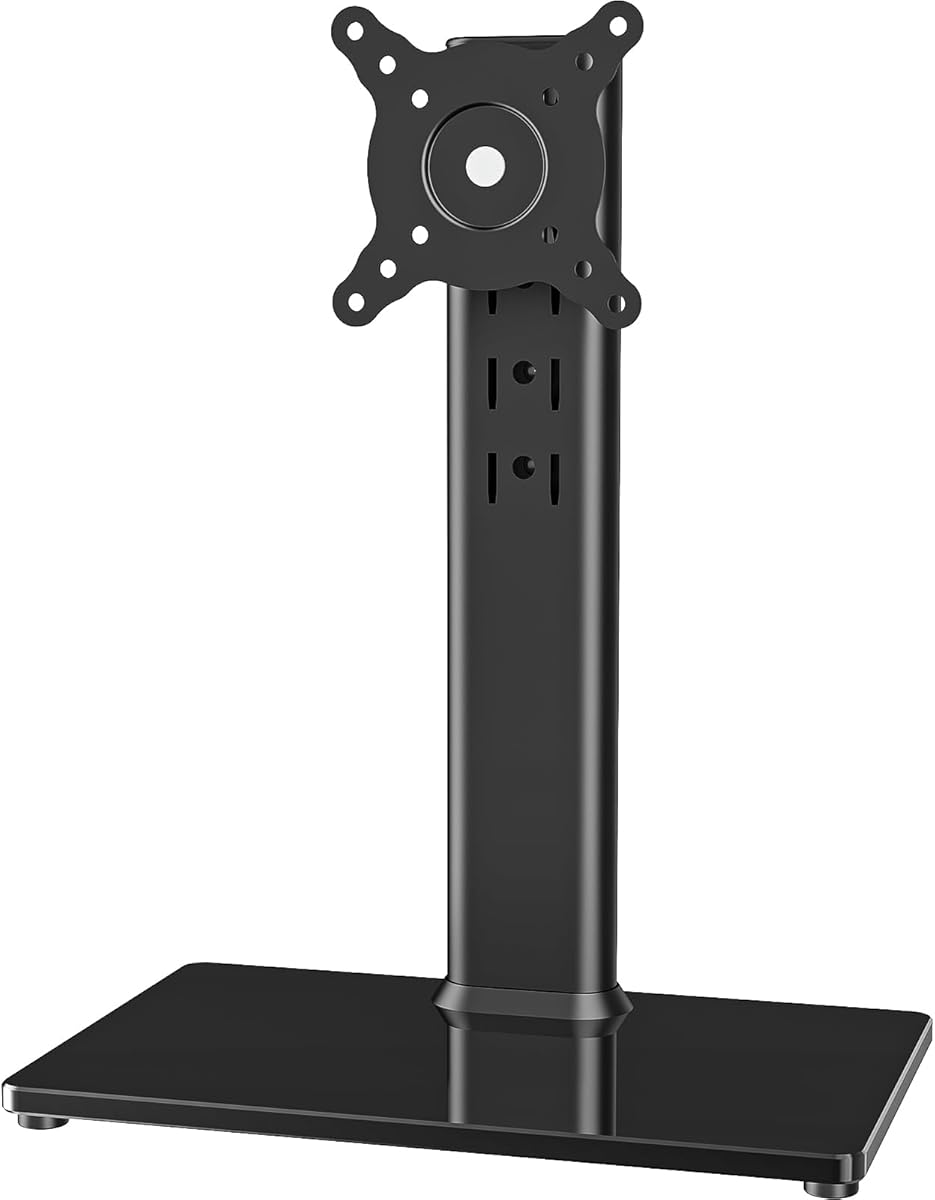
HUANUO 13 to 34-Inch Monitor Stand
4.4Editor score
Supports up to 44 pounds
Five adjustable height options
360-degree screen rotation
Explore the best non VESA monitor stands, comparing compatibility, adjustment, stability, capacity, installation, and ergonomics to help you choose the right
Non VESA monitor stands can make an older display more useful by adding height, tilt, swivel, rotation, and better positioning to a workspace. The right model must match the monitor’s size, weight, rear layout, and mounting pattern while fitting the available desk space and providing a stable base.
This guide compares ten stands and mounting solutions using the supplied specifications, including supported screen sizes, weight limits, VESA patterns, adjustment ranges, installation methods, cable-management features, and compatibility with displays that lack standard mounting holes.
Each pick reveals a different route to a more adaptable workstation: freestanding risers, clamp-mounted arms, and adapters for non VESA displays. Ratings and product details can change, and current prices fluctuate, so verify current listings and monitor dimensions before buying.
4.4Editor score
4.6Editor score

4.4Editor score
The following comparison highlights monitor-size support, capacity, mounting style, and key adjustments. Because adapter-only products require a separate VESA stand or arm, while complete stands include their own support, buyers should compare the entire mounting system rather than screen size alone.



This single-screen freestanding monitor stand is the strongest all-around choice in the group, combining a broad stated compatibility range with one of the highest weight limits. Its 4.6 rating reflects a generally positive reception, while the tempered-glass base and central column create a substantial freestanding platform that does not require a clamp or a drilled grommet.
We may earn a commission when you buy through this link, at no additional cost to you.
Adjustment is the standout feature. The bracket supports negative 15-degree to positive 10-degree tilt, negative 50-degree to positive 50-degree swivel, 360-degree rotation, and four height levels. Portrait and landscape positioning are both possible, and the included cable-management system helps prevent cords from collecting behind the elevated display. The stated mounting-hole coverage includes 50x50mm, 75x75mm, and 100x100mm patterns, which is broader than many complete stands in this comparison.
There are important trade-offs. It holds only one display, and its installation description refers to an open-top-slot VESA plate, so buyers should interpret it as a freestanding VESA-compatible stand rather than assume that every monitor rear will attach. The claimed 77-pound limit should also be treated as a product specification rather than a guarantee for every size, shape, and mounting configuration. Screen balance, base footprint, and desk space still affect real-world stability.
This is the most versatile recommendation for someone who wants elevation and frequent screen repositioning without attaching hardware to the desk. It is especially useful for a compatible 13- to 32-inch display that needs more than a fixed riser. Confirm the monitor’s rear pattern, weight, and available desk area before ordering, and choose this option when a complete stand with generous articulation is more useful than a compact adapter.
The combination of swivel, tilt, rotation, and four height settings makes the stand practical for switching among spreadsheets, video calls, and portrait-oriented content. These controls make it easier to place the display near eye level and reduce the need to lean or twist during extended sessions.
The heavy tempered-glass base and central post create a self-supporting structure, making this a practical choice where clamping or grommet installation is inconvenient. Buyers should still confirm that the base fits comfortably behind the display without crowding the keyboard, speakers, or other accessories.
We may earn a commission when you buy through this link, at no additional cost to you.
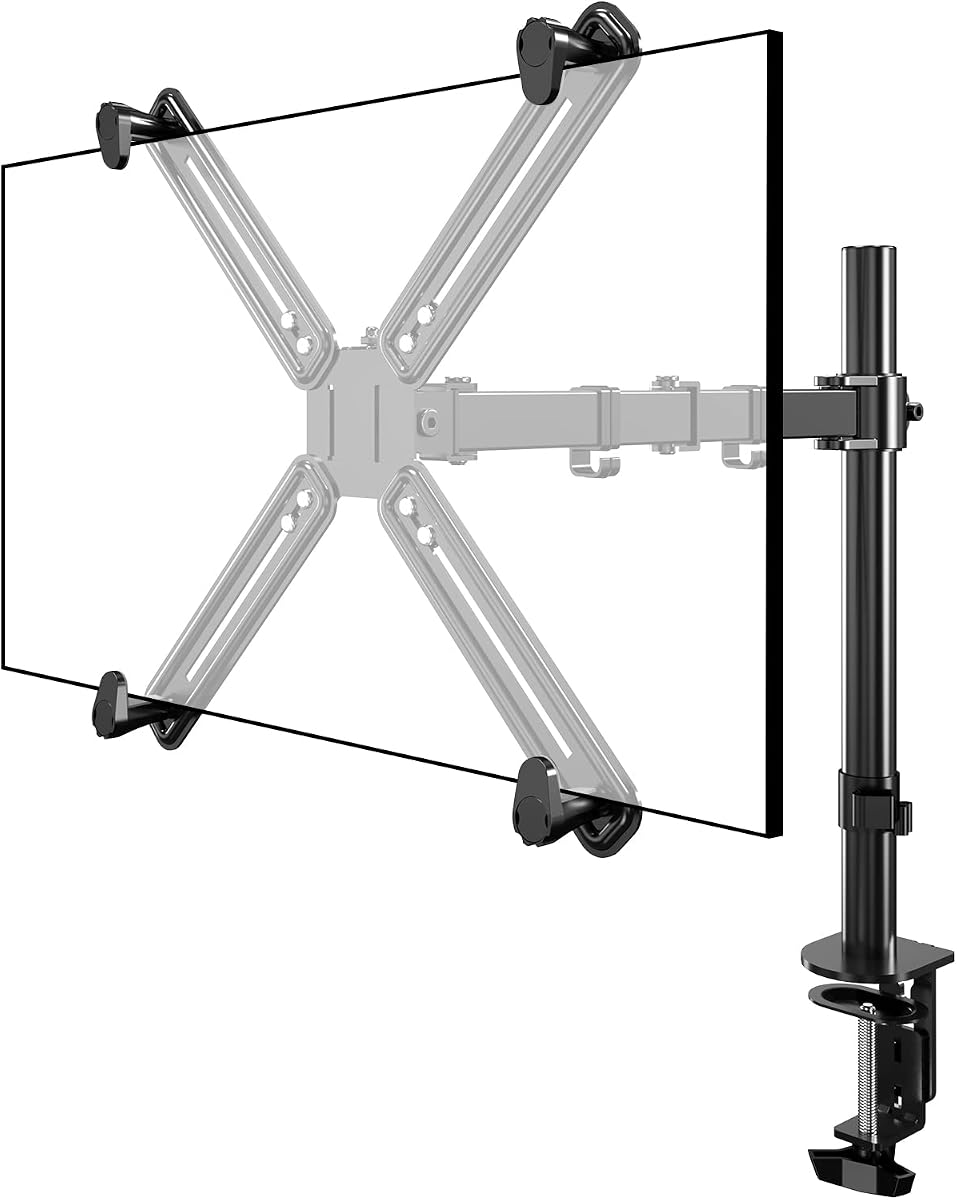
This HUANUO kit is a practical adapter for turning a compatible non-VESA monitor into a display that can use a 75x75mm VESA stand or arm. Its 4.2 rating places it among the better-reviewed products in the list, and its defining advantage is specificity: rather than asking the buyer to rely on a stand’s universal claims, it is designed to bridge a display without standard mounting holes.
We may earn a commission when you buy through this link, at no additional cost to you.
The adjustable steel bars expand to accommodate different monitor shapes and sizes. The stated range covers 17- to 27-inch LCD, LED, and OLED flat panels with thickness from 1.18 to 2.95 inches. Installation hardware, screws, and a manual are included, while the powder-coated steel construction is intended to provide rigidity and durability once the adapter is properly spaced and fastened.
This is an adapter, not a complete monitor-support system. Buyers need a separate VESA mount with a compatible 75x75mm plate, and they must confirm that the monitor’s rear has enough smooth, flat space to attach the bars. The supplied data does not state a maximum load, so weight verification is especially important. Its 4.2 rating is also lower than several complete stands, which may reflect installation or compatibility variables rather than a lack of useful adjustment.
Choose this kit when an existing monitor lacks standard VESA holes but you already own, or plan to buy, a 75x75mm arm or stand. It is a cost-conscious way to preserve a capable older display and avoid replacing it solely because of its rear housing. Measure the display, inspect the available flat area, and compare the adapter’s dimensions with the hardware it must connect to before purchasing.
The adapter preserves the investment already made in a capable display while adding compatibility with common 75x75mm mounting hardware. This makes it a sensible solution for offices, studios, and home setups where replacing a non-VESA monitor would be unnecessary.
Extendable bars make it possible to align mounting points with a broader range of rear shapes than a fixed plate would accommodate. Correct spacing is still essential, and the supplied dimensions should be checked against the actual monitor rather than relying on screen size alone.
We may earn a commission when you buy through this link, at no additional cost to you.
This desk-mounted monitor arm is among the few products here that explicitly combines non-VESA mounting support with a complete arm and base. Its 3.7 rating is the lowest in the group, so prospective buyers should interpret the specifications carefully and confirm all dimensions before purchase. Even so, it addresses an important gap: displays without standard mounting holes can be supported without buying an adapter separately.
We may earn a commission when you buy through this link, at no additional cost to you.
The arm is stated to fit 13- to 27-inch flat or curved screens weighing up to 22 pounds. Buyers can choose between a C-clamp and a grommet base, providing flexibility across different desk constructions. Height, depth, and angle can be adjusted, the screen can switch between landscape and portrait, and integrated cable guides support a cleaner desk. Protective pads are intended to reduce damage to the desktop.
The main drawback is that the relatively modest 3.7 rating gives less confidence than the higher-rated options. A complete clamp-based arm has several stress points, including the clamp, post, joint, and rear bracket, and real stability depends on desk thickness, edge clearance, and correct tightening. Curved-screen compatibility does not mean every curved model is suitable, so dimensions and mounting access should be checked first.
This product makes the most sense for a user who specifically wants a non-VESA display on a movable desk arm, particularly when a grommet hole is available or the desk edge can accept a properly sized clamp. It offers useful articulation and cable routing in a complete package. For a lighter or less involved setup, a higher-rated freestanding model may provide more confidence.
Offering both C-clamp and grommet mounting makes the arm useful across a wider variety of desks. The correct method depends on desktop thickness, edge construction, and whether drilling is acceptable in the workspace.
The stated curved-screen compatibility broadens the potential uses of the arm, particularly for users who want a more immersive display position. Size, weight, rear curvature, and bracket clearance remain essential compatibility checks.
We may earn a commission when you buy through this link, at no additional cost to you.
The HUANUO freestanding stand is a strong choice for larger displays, combining a 13- to 34-inch range with a stated capacity of 44 pounds. Its 4.4 rating reflects solid user reception, while the tall steel column and tempered-glass base are designed to provide stability without requiring holes in the desktop. Five height options add useful placement flexibility.
We may earn a commission when you buy through this link, at no additional cost to you.
The adjustment range is one of the stand’s most attractive features. It supports negative 50-degree to positive 50-degree swivel, negative 15-degree to positive 10-degree tilt, and 360-degree rotation. The five height settings range from 9.27 to 15.26 inches, helping position a compatible display closer to eye level. Two cable clips are included for routing cords along the rear pillar, and anti-slip pads are designed to improve grip while protecting the desk surface.
The product is clearly intended for 75x75mm or 100x100mm VESA-mounted screens rather than every unusual non-VESA rear. Users should verify size, weight, and pattern before buying. The manufacturer also notes that off-center VESA patterns can affect vertical orientation, so the ability to rotate into portrait does not guarantee perfect alignment for every monitor. As with any freestanding platform, the base needs enough room and the display must remain reasonably balanced.
This is a strong recommendation for a larger, heavier monitor that needs substantial elevation but whose rear has a standard VESA pattern. It is also useful for anyone avoiding desk modifications. If the display has no mounting holes, choose an explicitly non-VESA adapter or arm instead. Within the compatible VESA-equipped category, this stand offers a compelling combination of capacity, height settings, and clean freestanding design.
The 9.27- to 15.26-inch height range offers more positioning choices than a simple fixed riser. This makes the stand adaptable to different chairs, desk heights, and viewing preferences while reducing the likelihood of working with the display positioned too low.
A steel column, tempered-glass base, and anti-slip pads create a substantial freestanding platform. The lack of drilling is valuable in temporary setups or on desks where a clamp or grommet would be inconvenient, provided the base has sufficient space and the display remains balanced.
We may earn a commission when you buy through this link, at no additional cost to you.
This adhesive-mounted adapter offers a straightforward way to convert a compatible non-VESA display for use with a 75x75mm VESA arm or stand. It earns a 4.4 rating and is positioned as a simpler, less visually bulky alternative to exposed metal brackets. The product is intended for 13- to 27-inch monitors with a 6.6-by-5.8-inch flat area on the rear.
We may earn a commission when you buy through this link, at no additional cost to you.
Installation is refreshingly simple. The protective film is removed, the adapter is pressed onto the rear of the display, and the user waits 24 hours before attaching it to a mount or stand. The adhesive approach removes the need to drill or screw directly into the display housing. A stated maximum load of 24 pounds gives the adapter a meaningful capacity range for many common office and productivity screens.
The adhesive method is the central compromise. The rear area must be flat and clean, and the full curing period should be observed before the display is mounted or moved. A curved back, textured plastic, recessed area, or poorly prepared surface may reduce adhesion. This is also an adapter only, so a compatible 75x75mm stand or arm must be purchased separately, and weight is only one part of safe attachment.
Choose this product for a lightweight or medium-weight display with a smooth, flat rear when the goal is a quick retrofit rather than a complex installation. It is particularly helpful for reviving an otherwise capable monitor that cannot attach to a standard arm. Before applying it, measure the available flat area and inspect the surface carefully. For heavier screens or less forgiving housings, a screwed adapter offers more mechanical security.
The adhesive plate keeps the rear of the display comparatively uncluttered and avoids permanent modification of the monitor housing. This is helpful when the display may later be moved, sold, or used with a different stand.
A clean, flat rear surface is required, and the specified 24-hour waiting period gives the adhesive time to establish a stable bond. Users should avoid loading the adapter before curing and should not apply it across a seam, curved section, or textured panel.
We may earn a commission when you buy through this link, at no additional cost to you.
The MOUNT PRO adapter is a mechanically oriented retrofit for non-VESA monitors that need to connect to common VESA hardware. Its 4.3 rating indicates generally positive reception, and the design supports both 75x75mm and 100x100mm patterns. That flexibility gives it broader mounting potential than adapters limited to a single standard.
We may earn a commission when you buy through this link, at no additional cost to you.
Compatibility is stated for 19- to 32-inch screens weighing up to 17.6 pounds, with thickness from 0.79 to 2.76 inches and bezel height from 10.39 to 17.32 inches. Adjustable glue columns allow the bracket to match different screen thicknesses, while the triangular steel structure and rust-proof coating are intended to improve rigidity and durability. An anti-slip pad adds contact security, and the package includes screws, hardware, and a manual.
The most important limitation is explicit: the adapter does not allow portrait orientation. That makes it less appropriate for coding, long-document work, or any workflow requiring a vertical display. It also does not include a VESA plate or monitor mount, so buyers must acquire compatible hardware separately. Because the listed dimensions and load are finite, screen size alone does not determine fit; thickness, bezel geometry, and weight all matter.
This is a good option for a wider, heavier non-VESA display in a fixed landscape workstation. It suits users who want a more substantial screwed construction than an adhesive plate and need the ability to work with either of two common VESA patterns. Verify every stated dimension, check the available rear area, and confirm that the separate mount can accommodate the adapter’s shape. If portrait use is important, select a different design.
Supporting both 75x75mm and 100x100mm patterns makes the adapter useful with a wider assortment of arms and stands. The separate plate or mount must still support the combined weight of the display and adapter and provide a secure connection.
The triangular steel layout, protective coating, and anti-slip pad create a more conventional mechanical structure than adhesive-only solutions. Proper spacing and tightening are essential for the bracket to carry a display without stressing the rear housing.
We may earn a commission when you buy through this link, at no additional cost to you.
The ErGear arm is a premium-feeling standard VESA mount with a 4.4 rating and a broad range of motion. It supports 13- to 34-inch flat or curved monitors up to 19.8 pounds when they have 75x75mm or 100x100mm mounting holes. Its larger VESA head and tighter-fitting plate are designed to improve stability and keep a compatible display firmly positioned.
We may earn a commission when you buy through this link, at no additional cost to you.
The movement is extensive: height adjustment reaches 17.5 inches, reach extends to 18.1 inches, tilt ranges from positive 80 degrees to negative 50 degrees, swivel reaches plus or minus 90 degrees, and rotation is 360 degrees. That makes it particularly useful for users who frequently change between landscape and portrait layouts. The included cable clips open without tools, while the VESA plate also supports a tool-free setup process.
This model is not a non-VESA conversion solution; it requires a compatible display with standard mounting holes. Desk compatibility also depends on thickness. The C-clamp accommodates desktops from 0.39 to 2.56 inches, while the grommet base covers 0.39 to 2.95 inches. The stated 20,000-cycle core test is a useful durability indicator, though it does not replace checking every desk dimension or the combined weight of attached accessories.
Choose the ErGear arm for a standard VESA-equipped monitor that should float over the desk and follow frequent position changes. It is particularly compelling for creative work, coding, and multi-application setups where portrait mode and long reach are valuable. Buyers with a non-VESA display should first use a suitable adapter or select one of the dedicated adapter products. For everyone else, this is a polished, highly adjustable desktop solution.
Long reach, generous height adjustment, broad tilt, swivel, and rotation allow the display to move into many working positions. This flexibility is useful for aligning a large screen precisely, sharing information across a desk, or changing to portrait for narrow content.
The tool-free VESA plate simplifies attachment, and the opening cable clips make routine cable routing easier. Two base options provide flexibility, though the desktop thickness and edge structure must satisfy the stated limits before installation.
We may earn a commission when you buy through this link, at no additional cost to you.
The MOUNTUP freestanding stand is a straightforward home-office upgrade for a standard VESA-equipped screen. Its 4.5 rating is among the strongest in the comparison, and it combines a 13- to 32-inch compatibility range with a substantial stated height adjustment of up to 17.49 inches. A freestanding format means it can be placed behind a monitor without modifying the desk.
We may earn a commission when you buy through this link, at no additional cost to you.
The mounting bracket supports positive and negative 45-degree tilt, positive and negative 25-degree swivel, and positive and negative 180-degree rotation. Both portrait and landscape orientations are available, and the wide steel base is designed to remain stable while the display is repositioned. A built-in cable clip and a tool-storage slot add practical organization features for a workspace where wires and small tools tend to gather behind the screen.
The main constraint is the stated 17.6-pound load limit, which is lower than several alternatives. It is suitable for many ordinary office displays, but heavier productivity monitors or large gaming screens should be checked carefully. The stand also supports 75x75mm and 100x100mm VESA patterns, meaning a display without standard holes will require an adapter. Adjustable movement can shift the center of gravity, so adjustments should be made deliberately.
This model is a good fit for a home office, study area, or shared workspace where one display needs to sit higher and move more freely than it would on its original stand. It offers a balanced package of adjustment, stability, and cable organization without a clamp. If the goal is a non-VESA retrofit, select a dedicated adapter instead; otherwise, this is a well-rounded stand for compatible displays.
The 17.49-inch height range and broad tilt and swivel make it easier to adapt the display to different users and tasks. Rotation in either direction supports portrait and landscape layouts, which is particularly useful for documents and reference material.
A freestanding base avoids clamps and grommet holes, while the cable clip and tool slot help keep frequently used items within reach. Users should leave enough desk depth for the base and ensure the screen does not overhang the pedestal.
We may earn a commission when you buy through this link, at no additional cost to you.
This specialized VESA stand is intended for 24- to 27-inch monitors within a narrow 7.7- to 11-pound weight range. Its 4.0 rating is moderate but understandable given the specific compatibility envelope. Rather than trying to accommodate every display, it focuses on providing a spring-assisted height mechanism for lighter screens that fit its stated limits.
We may earn a commission when you buy through this link, at no additional cost to you.
The spring design allows the stand to move smoothly from 300mm to 410mm and remain freely suspended at the chosen height. The base supports 45-degree left-and-right swivel, the head offers positive 10-degree and negative 20-degree tilt, and the screen can rotate between portrait and landscape. Compatibility extends to both 75x75mm and 100x100mm mounting patterns, making it flexible among properly equipped displays.
The narrow weight range is the primary concern. The manufacturer specifically notes that the height-adjustment function only works for monitors from 7.7 to 11 pounds, so a heavier display should not be assumed to work even if its size and VESA pattern fit. This is also not a solution for a monitor without standard holes. The user should measure the display, confirm its weight, and verify that its rear hardware and stand clearance are suitable before ordering.
Choose this stand when a lightweight 24- to 27-inch display needs easy, frequent height changes and spring movement is preferred over manual adjustment. It is less versatile than the broader freestanding and arm-mounted options, but that specialization can be an advantage. It suits a tidy home office or workstation where a compact pedestal and quick repositioning are the priorities, rather than broad screen or load compatibility.
The free-suspension spring mechanism makes small daily height changes smooth and quick. It is particularly useful when several people share a workstation or when the user alternates between seated viewing and a more upright posture.
The stated size and weight limits are narrower than those of the general-purpose stands in this guide. Checking all three factors—screen dimensions, actual weight, and VESA pattern—helps prevent a mismatch that could compromise adjustment or stability.
We may earn a commission when you buy through this link, at no additional cost to you.
The HUANUO FlowLift is the best option here for a two-screen workstation, with a 4.6 rating and specifications tailored to 13- to 32-inch displays. Each arm supports a monitor from 4.4 to 19.8 pounds, provided that the screen has a 75x75mm or 100x100mm VESA pattern. The dual design can reduce desk clutter while supporting more demanding multitasking setups.
We may earn a commission when you buy through this link, at no additional cost to you.
Motion is extensive: positive 85-degree to negative 50-degree tilt, plus or minus 90-degree swivel, 360-degree rotation, and up to 15.75 inches of height adjustment. A larger platform and dual C-clamp structure are designed to resist wobble, while a grommet base provides an alternative. Cable-management guides run along the arms, allowing the screens to be raised while leaving room for a keyboard, notebook, docking station, or other accessories.
Compatibility with the desk is a significant factor. Wooden desks are recommended, while plastic and glass desks are not supported under the stated instructions. Desktop thickness must fall between 0.59 and 3.54 inches, and the underside cannot have cross beams or panels that interfere with the clamp. Each screen must also meet the size, weight, and VESA requirements simultaneously. This is a standard VESA system rather than an adapter for non-VESA displays.
Buy the FlowLift when two screens are central to work, gaming, streaming, or multitasking and both have standard mounting holes. Its range of motion is especially valuable when sharing content, switching a display to portrait, or changing viewing angles. Ensure the desk meets the material and thickness requirements, inspect the underside for interference, and check that two larger monitors will not make the setup unstable or crowded.
Two independently adjustable arms create a more productive canvas for documents, communication tools, media, and creative applications. Raising the displays also frees usable space underneath for peripherals while supporting a more natural line of sight.
The stated wooden-desk recommendation and thickness limits are important because the clamp carries the full load of both arms and screens. Checking the underside, edge depth, material, and thickness before installation helps avoid an unsafe or unstable arrangement.
We may earn a commission when you buy through this link, at no additional cost to you.
Choosing a non VESA monitor stand requires separating the display, mounting adapter, support arm, and desk base. The best choice is the combination that safely matches the monitor’s rear design, size, and weight while providing the position changes and installation style your workspace needs.
A non-VESA monitor lacks the standardized square of mounting holes normally found on the rear of a display. Some products in this category are complete stands with standard VESA plates, while others are adapters specifically designed to bridge unusual rear housings. A complete VESA stand will not automatically attach to a display without suitable holes. Examine the back of the monitor and determine whether there are 75x75mm or 100x100mm mounting patterns, a flat area suitable for an adapter, or neither.
Screen size provides only a rough indication of compatibility. A 27-inch monitor can be lightweight or heavy, while some larger displays exceed the load limits of otherwise capable arms. Compare the display’s stated weight with the stand’s maximum capacity and leave some margin when adapters or other accessories are involved. Also consider screen dimensions, rear bulge, bezel clearance, and whether the display can be centered securely over the mounting hardware.
Height adjustment helps place a screen near eye level, while swivel, tilt, and rotation make it easier to share a display, read at an angle, or switch to portrait mode. Compare the available ranges rather than assuming every stand offers the same movement. A broad range is useful in multi-user rooms, but simple fixed positioning can be adequate for a dedicated workstation. Check whether rotation changes the balance of a freestanding pedestal or whether a clamp and arm better supports the display.
Freestanding stands need only enough clear desk space for their base. C-clamps save desk area but require a compatible edge, suitable thickness, and adequate clearance below the desktop. Grommet bases provide stable attachment but require a properly located hole. Adhesive adapters can avoid drilling the desk, although they still need a separate VESA arm and a suitable flat surface on the monitor. Select the method that matches the desk, its underside, and the user’s willingness to modify the workspace.
A stated weight limit is only one element of stability. Base width, column strength, joint construction, clamp design, and the screen’s center of gravity also matter. A wide pedestal may handle large displays well, while a long articulated arm needs a rigid clamp and sufficient reach. Inspect whether the mount includes protective pads, how tightly the joints can be secured, and whether the product is intended for one or two screens. Heavy displays benefit from conservative placement close to the support column.
A freestanding base occupies surface area behind the monitor and may interfere with a keyboard tray, speakers, or a docking station. A clamped arm generally clears more of the desktop but projects outward. Measure both the base or clamp footprint and the arm’s full range of motion. Users who frequently change desks or travel may prefer an adapter paired with a portable VESA mount, while permanent installations can make a more substantial pedestal or dual-arm system worthwhile.
Raising a display can leave power, video, and network cables hanging awkwardly behind it. Clips, guides, and routes along a column or arm help keep cords organized and can make it easier to disconnect a display when switching setups. Look for accessible cable management rather than a closed channel that is difficult to use. Some models also include tool storage or protective desk pads, which add convenience but should not replace a secure mounting design.
Adapter-only products generally do not include the monitor stand, VESA plate, arm, or base. A complete stand generally includes its own mounting plate and hardware, but may still require a separate adapter for a non-VESA display. Read the component list carefully to avoid discovering after purchase that the essential support is missing. Confirm whether screws, washers, clamp pieces, grommet hardware, and basic tools are included. This check is particularly important for products described as kits.
Begin by measuring the monitor, checking its weight, and identifying the rear mounting arrangement. For a standard VESA display, compare the hole pattern with the stand’s plate and center the screen before tightening the hardware. For a non-VESA display, confirm that the rear has the required flat area or bracket dimensions, and use an adapter specifically matched to the display. Assemble the base or clamp first, attach the arm or bracket, and then place the monitor with support until every fastener is secure.
Set the monitor at a comfortable height before tightening the final joints. The top edge of the screen should sit near or slightly below eye level at a comfortable viewing distance, with the center of the display roughly in front of the user. Use swivel and tilt for off-axis viewing, but avoid pushing a freestanding stand into a position where the display significantly overhangs the base. For adhesive adapters, observe the full curing period and do not attach the monitor arm beforehand.
For routine care, wipe the base, column, and brackets with a soft dry or lightly damp cloth, and avoid abrasive cleaners around coatings or tempered glass. Check clamp tightness, adapter screws, and cable connections periodically, particularly after moving the display. Keep ventilation openings clear and avoid placing heavy objects on moving joints. If a stand begins to sag, wobble, or creak, stop adjusting it, unload the display, and inspect the hardware rather than compensating with extra tension.
A non VESA monitor stand is designed to support a display that does not have the standard 75x75mm or 100x100mm mounting-hole pattern. It may be a complete pedestal or arm with non-VESA brackets, or an adapter that connects an unusual display rear to a separate standard VESA mount. Compatibility therefore depends on the monitor’s dimensions, weight, and rear layout.
Yes, if the rear has a sufficiently flat and smooth area for a suitable adapter. The adapter may use screws, glue columns, or adhesive to create a 75x75mm or 100x100mm mounting interface. Heavy displays generally benefit from a screwed bracket, while adhesive solutions are best for lighter screens and clean, flat housings. A separate VESA stand or arm is usually still required.
No. A monitor with compatible 75x75mm or 100x100mm holes can usually attach directly to a matching VESA plate. An adapter is unnecessary and may add unnecessary bulk. Confirm the pattern and weight before installation, because visually similar mounts can have different hole spacing or load ratings.
A freestanding stand rests on the desk and needs no clamp, grommet, or drilling. A monitor arm attaches to the desk with a clamp or grommet base and generally offers more reach, height movement, and desk clearance. Freestanding models can be easier to reposition between desks, while arms usually integrate more smoothly into a permanent workstation.
Check the monitor’s diagonal size, actual weight, rear mounting pattern, and available mounting area. Then compare each value with the stand’s stated limits, including desk thickness for clamp systems. For a freestanding model, also check that the base fits behind the screen and that the monitor will remain centered without creating excessive leverage.
Only a product designed for two displays should be used for that purpose. The HUANUO FlowLift in this guide supports two 13- to 32-inch screens, with each arm rated from 4.4 to 19.8 pounds. Both screens must meet the size, weight, and VESA requirements, and the desk must satisfy the stated material and thickness conditions.
It depends on the adapter and mount. The MOUNT PRO adapter specifically states that portrait orientation is not allowed, while other designs may permit rotation when the mounting pattern, bracket geometry, and support arm are compatible. Check both the adapter and the stand because either component can restrict rotation or leave the display poorly balanced.
The stand should exceed the monitor’s listed weight, and it must also accommodate any attached adapter, hub, or other accessory where applicable. Avoid operating a stand beyond its stated limit. If the display is close to the maximum rating, a wide base or clamp-mounted arm can offer more practical stability than a narrow pedestal.
The Single LCD Freestanding Monitor Stand leads the guide because it combines a broad size range, a high stated load limit, four height levels, and extensive swivel, tilt, and rotation in a drill-free format. The HUANUO 13- to 34-Inch Stand stands out for larger compatible screens and a substantial 44-pound capacity, while the Universal Non-VESA Mounting Adapter offers a simple retrofit for lighter displays.
The right choice depends on the display’s rear and the desired installation. Use a dedicated adapter for a non-VESA monitor, a complete freestanding stand for a standard VESA screen that needs elevation, and a clamp-mounted arm when desk clearance and frequent repositioning matter most. Verify size, weight, rear pattern, and desk dimensions before selecting a model.
Ratings, specifications, availability, and prices can change over time, so check the current product listing and manufacturer instructions before purchasing. Comparing the current monitor dimensions with the stand’s limits is the most important final safeguard, particularly for an unusual display or a non-standard desk surface.
